The Grief No One Talks About: Miscarriage, Pregnancy Loss & Breaking the Silence
Listen now by clicking your favorite podcast app below:
Have you ever wondered why miscarriage and pregnancy loss can feel so isolating, even though so many women experience them?
In this episode of The Inner Script, Stephanie Baubie, NP sits down with Saloni Misra, Founder of Butterflies, for an honest conversation about miscarriage, fertility, grief, and healing.
After experiencing the loss of her baby boy during the second trimester, Saloni found herself navigating both the emotional weight of grief and the physical experience of relearning her body. She shares why well-intentioned comments like “You’re young” or “It will happen” can feel so painful, and what grieving women may actually need from the people around them.
Stephanie and Saloni also explore why pregnancy loss is still so rarely discussed, how guilt and shame can deepen isolation, and why supporting someone through grief often means holding space rather than offering advice or trying to fix the situation.
Drawing on more than a decade of experience in Human Resources and Learning & Development, Saloni explains how her personal experience inspired her to create Butterflies, a workplace support platform for employees navigating fertility challenges, miscarriage, pregnancy loss, postpartum recovery, grief, and healing.
From supporting a grieving friend to communicating with a partner and creating more compassionate workplaces, this conversation is a reminder that healing begins when people feel seen, heard, and supported.
Content Note
This episode includes an open and honest conversation about miscarriage, pregnancy loss, fertility challenges, and grief. If these topics feel especially tender for you right now, please take care of yourself and listen only if and when you feel ready.
This episode is for you if…
You’ve experienced miscarriage, pregnancy loss, or fertility challenges and want to feel less alone.
You want to better support someone who is grieving but aren’t sure what to say or do.
You’re interested in creating more compassionate conversations and workplace support around pregnancy loss.
Episode Timestamps
00:17 Saloni’s Miscarriage Story
03:51 Why Butterflies Was Born
05:18 Why This Grief Feels Different
09:16 Losing Pregnancy’s Innocence
12:35 What Grieving Women Need
18:54 Holding Space, Not Fixing
22:56 Why Women Suffer Silently
27:43 Building Butterflies
35:25 Changing Workplace Support
37:35 Grieving as Partners
Resources & Mentions
Genetic counseling
Curious about a supplement Steph has mentioned in the episode?
If you’re looking for products Steph personally recommends in practice, you can browse her dispensary here: Stephanie’s Fullscript dispensary
Please consult your healthcare provider before starting any new supplement. Food, lifestyle, and nervous system support always come first.
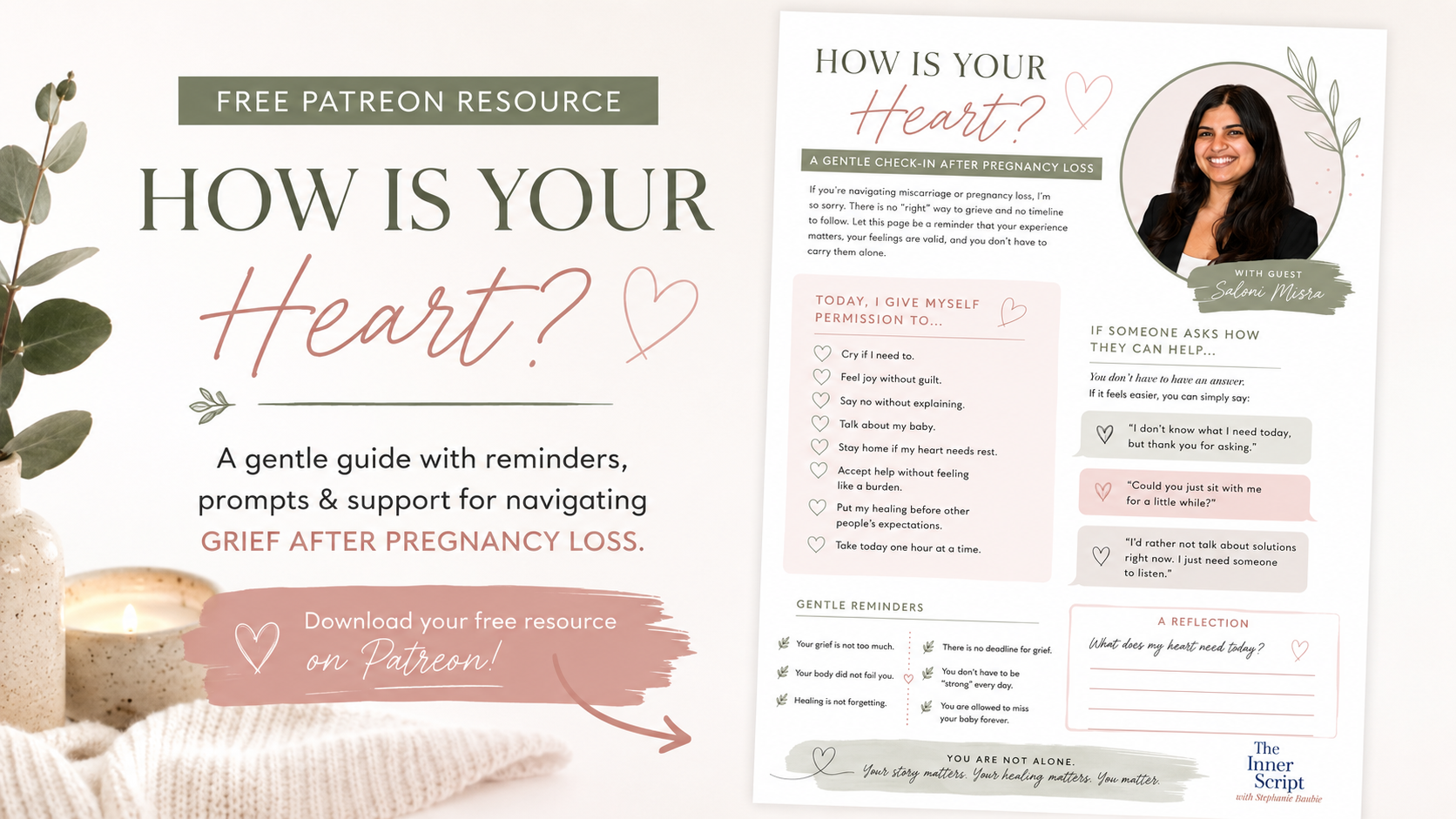
How Is Your Heart?
A gentle one-page reflection guide designed to support you after pregnancy loss. Inside you'll find gentle reminders when grief feels overwhelming, permission slips for difficult days, and more. Download it here: Patreon companion resource
You can also join Steph’s free Patreon community here:
The Inner Script Patreon

Meet Saloni Misra
Saloni Misra is the Founder of Butterflies, a workplace support platform helping organizations better support employees navigating fertility challenges, miscarriage, pregnancy loss, postpartum recovery, grief, and healing. With more than a decade of experience in Human Resources and Learning & Development, Saloni combines professional expertise with lived experience to advocate for more compassionate workplace policies, education, and support. Through Butterflies, she is working to ensure that no woman has to navigate pregnancy loss or fertility challenges alone.
Connect with Saloni: Butterflies Website, Levitalent Website, and LinkedIn.

Meet Your Host
Stephanie Baubie, NP is an integrative nurse practitioner and the host of The Inner Script Podcast, where she explores the deeper stories behind health, healing, identity, and transformation. Through a blend of functional medicine, nervous system awareness, emotional insight, and honest conversation, Stephanie helps women better understand their bodies while questioning the narratives they’ve inherited about wellness, worth, and what it means to truly feel well.
On The Inner Script, Stephanie sits down with physicians, founders, thought leaders, and experts in women’s health, while also sharing solo reflections on the transitions and inner shifts that shape our lives.
Follow Steph on Instagram.
FAQs
How is miscarriage grief different from other types of grief?
Miscarriage and pregnancy loss often involve both emotional and physical grief. In this episode, Saloni Misra shares how losing a pregnancy can leave women grieving not only the loss of their baby, but also the future they imagined and the physical changes happening in their bodies. Stephanie and Saloni discuss why this type of grief can feel uniquely isolating and why every person's healing journey looks different.
What should you say to someone who has experienced a miscarriage?
One of the biggest takeaways from this conversation is that people don't always need advice—they need someone willing to simply be present. Saloni explains why comments like "You're young" or "It'll happen" can feel dismissive, even when well-intentioned. Instead, Stephanie and Saloni encourage asking thoughtful questions, holding space, and acknowledging the loss without trying to fix it.
Why do so many women feel alone after pregnancy loss?
Despite how common miscarriage is, many women still experience it in silence. Saloni shares how little pregnancy loss was discussed throughout her career in Human Resources and how that lack of conversation can leave women feeling isolated, misunderstood, or even ashamed. This episode explores why creating community and open conversations can be such an important part of healing.
How can workplaces better support employees after miscarriage or pregnancy loss?
Saloni believes support should extend far beyond bereavement or leave policies. In this episode, she explains why managers need education, why returning to work doesn't mean someone has finished grieving, and how organizations can create more compassionate workplaces through better resources, communication, and ongoing support.
How can couples support each other through pregnancy loss?
Stephanie and Saloni discuss how partners often grieve in very different ways. While one person may need to talk openly about the loss, the other may process it privately through work or routine. Rather than expecting each other to grieve the same way, they explain why honest communication, patience, and creating space for individual healing can strengthen a relationship during one of life's most difficult experiences.
-
Everything shared here is for educational purposes and personal reflection only. Not medical advice. Always work with your own healthcare provider for individual care.
Stephanie Baubie: Hi, everyone. Welcome back to The Inner Script. I first wanna give a trigger warning. We are going to be talking about miscarriage and pregnancy loss. So if this is something that feels too heavy for you, feel free to skip this week's episode, and I'll see you next week. Today, I'm joined by Saloni Misra, an HR professional with more than a decade of experience across human resources and learning and development.
Through both her professional expertise and her own personal experiences, Saloni recognized a gap in how workplaces support women through some of life's most challenging seasons. She is the founder of Butterfliz, a workplace support platform dedicated to helping women navigating fertility challenges, miscarriage, pregnancy loss, grief, and recovery.
Through education, community, practitioner support, and workplace advocacy, Butterfliz is helping organizations create environments where employees no longer have to suffer in silence. Thank you so much for coming on, Saloni
Saloni Misra: Oh my God, no. Thank you so much for having me. I am so excited to be here
Stephanie Baubie: So let's kind of first talk about your inspiration behind Butterflies. I know it was a personal experience, so I would love for you to share your experience, whatever you're comfortable sharing, just for us to get a little bit, you know, more about you
Saloni Misra: I've, I mean, as you so lovingly introduced, I've been in the HR industry for a really long time, and I love it. Like, I love the HR space. I think if I was to use my really boring business degree, it had to be on the people side of the business. And so that's where I guess I just naturally fell. And I guess two years ago, I started doing my own thing, so my own fractional HR consultancy.
And it's really interesting because when people ask me, "How did you start your business?" I think last year my response was very much, "Oh, look, it's just always something that I've wanted to do." I think this year, when I'm a little bit more at peace, a bit more comfortable with my sh- uh, story, I think I've accepted my story quite a lot more.
The honest truth and the honest answer is I had a miscarriage. I was gonna have a baby boy. It was under 20 weeks. It was really unexpected. Everything seemed to be, quotations, "fine" . And at that point, I realized I cannot go back to corporate. I love my corporate career. I was in really startup, messy, chaos environments, and they were great.
Like, I loved them, but I just realized that I couldn't go back. So I actually decided to take a year off. I took two months. I was bored out of my mind. I think a really big part of being on that journey is honestly keeping busy and finding a purpose, whatever that is. I did the whole, let me, you know, become a cook.
Let me become a Pilates expert, and I just, I couldn't. I was like, "No, none of this is me." So that's how I started my own business, just in that fractional HR space. And then end of last year, I had this really weird epiphany. I was like, hang on. I'm navigating a journey of grief, recovery, dealing with that miscarriage, understanding what that means for me and my future, and I'm running a fractional HR consultancy.
And then there's wellbeing, which is part of HR. So it was almost like a formula that was just cracking in my head where, why would I not do this? It's a huge gap. It's massive in terms of what organizations do and what they don't. I guess how the journey over the last two years came about, and that's how Butterflies came to life.
I went really back and forth on the names quite a bit
Stephanie Baubie: Tell us about that. I was... Like, you just read my mind. I was about to ask you, like, how did you come up with the name Butterflies?
Saloni Misra: actually really embarrassing. So first it was called Soft Landings, and I just-- Oh my God, you know, when you just type into ChatGPT, like, "I've got this incredible idea. I know exactly how to execute it. I just don't know what to call it." And then it's a bit embarrassing, but you know what? I'm gonna own it.
I am a massive fan of Martin Garrix, and he's got a song, Butterflies, and it's so beautiful in terms of-- I think it just ignited transformation in my mind, and that, to me, is the journey. And once you're dealing with a miscarriage or even fertility, you are transforming who you are. Your body's being transformed.
You're figuring out so much, and I think that is the journey of a butterfly. So again, was just driving, listening to Butterflies by Martin Garrix, and I was like, "That's it. That's it. That's it." So changed my whole marketing, changed my whole-- I'd already gone out and pitched to some people, and yeah, it was a part of the journey.
I was like, "You know what? I'm gonna own it." I love it. I've reconnected with this name, and it's stuck since, and people have loved it, so that makes me really happy
Stephanie Baubie: I love that name and the reasoning behind it. That's not embarrassing at all. I love it. I got chills as you were, like, talking about it even. It's also, butterflies are so beautiful, and they, as you mentioned, go through this big transformation. And it's really turning a terrible experience and making it into something beautiful, which, you know, that's not easy to do.
And you really created something on the other side of it. I wanna talk a little bit more about kind of your grief with pregnancy loss and miscarriage. How is this type of grief, would you say, different than other types of grief? It's something I talk a lot about on my podcast because I think grief can be so profound and really cause physical symptoms.
And what were some of the things you did to help, you know, adapt?
Saloni Misra: what makes, I guess, a miscarriage journey and that grief different, I think especially for a woman, is the fact that it is so physically related to your body. Grief, as you say, absolutely profound. Like, when you lose a loved one, yes, it again has a physical impact in terms of your heart aching, anxiety, sadness, loss.
But I think what makes it so different is, the most obvious way for me to explain it, is you're losing something from your body. You are physically losing a part of someone, something that was growing inside of you, and I think that's what makes it so, I guess, you know, different. I'm not gonna say it's more difficult.
I think every journey of grief is so difficult in its own way. But I think for a woman especially, you feel this automatic emptiness, and sometimes you just don't know what to do with that. It's almost like your life flips within the second that, you know, your miscarriage is, you know, over, and it's really hard to understand what the new normal is.
And that was a really big part of, I think, my journey as well, which physically I had complete- completely changed. You know, my breasts, my body, even just symptoms that were there in the pregnancy, and it was like a snap of a finger. They were completely gone post the miscarriage. So I think I still am, but I spent last year relearning my body.
I think that was the most important thing I had to do because I was actually struggling to understand. My menstrual cycle had changed and, you know, touch wood, but growing up it was very consistent. It had a pattern. I knew what that pattern was, and it flipped. You know? The cycle changed. The length of it changed.
It was quite shocking. I was like, "I don't know what's happening." And on top of that, you're doing kinda the six-week, three-month, you know, you're still going to your appointments, but you're no longer going to your OB or gyno because you're pregnant. You're going because you're checking your body, and, you know, you're doing all sorts of tests.
A HyCoSy in terms of, you know, checking your fallopian tubes, and there's just so much that you're doing, doing, doing. And I think a really big part of it, in reflection, was actually just educating myself. I think the first six months I did spend doing, and I was like, "You know what? I just... I don't wanna think about this.
I'm just gonna do it. It's the right thing." And in hindsight, I think in the latter six months out of that year, I actually spent time understanding exactly what I'm doing and why I'm doing it, and that was really helpful to me in terms of taking those actions and building that education versus being in this world where, you know, you're fast-paced.
Like, the biggest thing I learned in the medical system, especially in Australian, I'm not sure if this is kinda a global approach, but there's a triage when it comes to going to emergency or the doctor, and it's a bit of a tick box. And I get it, you know? There's gotta be structure in place, but I needed to know what that meant for me.
I needed to know exactly what was happening, which is quite the opposite of what I was during my pregnancy. I was really laid back, really chill. "Don't tell me." You know, "Let's just go with the flow. I don't wanna overthink." Even when there were kinda instances that we did have to go to emergency during a pregnancy, whether it was spotting or anything else, I was really chill.
I was like, "That's okay." Like, "I- don't overflow me with information. I'm not gonna read a thesis on this. I don't want to." But that's what I've become now.
Stephanie Baubie: So it was really, it sounds like kind of the education piece was almost healing in a way to really get through this
Saloni Misra: Understanding the unknown of what was happening to you, you know? They don't sit you down, nobody does, and I get why, but I also don't get why you're not told during a pregnancy what it can lead to. Like, I've had so many conflicting thoughts about it, but the reality is, every pregnancy you don't know the end journey.
I, I never wanna sound cynical saying that, but I saw a really wonderful podcast the other day and it was saying when you go through a miscarriage, you almost lose the innocence of the journey. And you do, because, you know, you're nervous about those two lines. You're excited about it, but that innocence is gone of this is gonna be the best journey.
This is what we're gonna end with. It's, "Okay, we're pregnant. What's gonna happen, and what does this mean?" And it's a bit more of a practical lens versus that pure innocence of, "Hey, I'm pregnant and I'm gonna have a baby."
Stephanie Baubie: Yeah. Oh my gosh, that's something I've never really thought of before. So how do you think a conversation like that could be different when, you know, you're finding out you're pregnant and you're going to your gynecologist? You know, you still wanna stay excited and optimistic, but how do you think a conversation like that should be approached after you went through this?
Saloni Misra: It's interesting because for every person it would be really different. I actually think it just depends what stage mentally, physically, emotionally a woman and a dad, a male, is at. When I've chatted to some friends who've gone through something similar, they were very methodical. In fact, when they became pregnant, they didn't actually even experience a huge amount of joy.
It was practical, "Okay, this is what's gonna happen for this to work." I think myself being a bit more of an empath, you know, I'm still trying to romanticize the whole journey, 'cause I do wanna be excited about it. And I think also now that it's been more than a year, I am at a point where I think that excitement will hit.
I do feel quite removed from the miscarriage because, you know, cliche, time does heal everything. So now I'm a bit more on, I guess, the fertility journey. As they say, grief, every month you're mourning the loss that it didn't happen. So it's a different form. But I guess the conversation should really just be emotionally led first.
Doctors, and again I really understand, but I think there is this, "Okay, cool. You're pregnant. This is what needs to be done." Whereas, you know, I think the conversation needs to be based on that history, based on that, "How you feeling? What can we do to make this journey a bit better?" And a little bit more personalized, you know?
Yeah, you're gonna have 1,000 patients who are going through the same thing, but every single one of those patients are gonna feel and experience something different. So just asking before you go into the whole, "Hey, this is what we're gonna do at eight weeks. This is what we're gonna do at 12, 16," map it out, versus mapping it out, let's just have a one-minute, like, all right, silence.
Like, how are we feeling about this, and what can we do to make this feel a bit better?
Stephanie Baubie: Yeah. And it's like, okay, what are, like, fears, if there are any? Like, let's talk about the unknown right now, and let's maybe talk about the things that we are sure about 'cause that alone, that is such a good reframe to have during pregnancy because we don't know what's going to happen. And, you know, there's so many women out there where it might not j- be pregnancy loss or miscarriage, but they get diagnosed with, you know, gestational diabetes, and they're like, "Wait, what?"
So I think those conversations would be so helpful, such a good reframe. So when you were going through the grieving process, you know, obviously your partner was hurting as well, and I'm sure friends and family wanted to be there for you. What were some things that maybe people could have done better in a way?
Just because you never know how to handle something unless you go through it. You know, you become an expert in situations only when you go through it. What are some things, you know, you can say things they did really well, but things you kind of wish maybe there was a better worldview
Saloni Misra: I think the reason I'm laughing is because the old me would've just wanted to probably chop everyone's head off. And the new me is, you know, a bit more understanding that not everyone's gone on that journey. A bit of context, I guess more our friendship group and circle were one of the first. So I think that in itself does reveal a lot about, I think the conversations that would've happened purely because no one's in that situation.
And I have a friend who is giving birth in August, and she was so incredible, but during this year of her pregnancy journey, she actually said to me, she's like, "It's made me realize no one understands what any pregnant woman," obviously dads go on their own journey, I'm not dismissing that, "but any pregnant woman is going on.
Whether it's going well or whether it's not, no one will understand until you're in that situation." So I think we had an incredible support system. We really did. But I think sometimes in hindsight, I do think back to whether what my husband and I needed was to just get away, and we didn't. I think we were almost encouraged, and again, I get why.
You know, you don't wanna just wallow in your own grief, but I think maybe we should've just gone away for two weeks and just been with ourselves. A lot of kinda the post-miscarriage journey was a D&C two weeks later, so there was just a lot happening. But I think the conversations with friends, I think there are some things that probably shouldn't be said.
I think time and again, I've been told I'm very young, it'll happen. And again, I get that, but the reality is my age has nothing to do with the miscarriage and the loss. They're two completely separate things. You know, I'm not sitting here worrying that I'm not getting pregnant because I'm over 30. I'm on this journey that links directly to that miscarriage, and now trying to get pregnant and going on that journey, and that's its own form of grief.
Like, you know, like I said, a fertility is a form of grief. And it's funny because I never saw it as a form of grief, again, until I'm in that situation. And you talk to other people who are on that journey and say, "It's okay to mourn," you know? Put aside that day that you get your period and mourn, and then pick yourself up and move forward and do what you need to on that journey because the reality is you can't just stop.
You have to keep going. But yeah, I think there were a lot of conversations that didn't maybe fully understand that there was a loss. There was a physical loss. I, trimester two, had to give birth. I had to hold this baby, and it was devastating. Like, it was weirdly the happiest and saddest moment. Like, that's how my husband and I describe it because happy in that whoever he came out to be, he was beautiful, and that was his journey and, and we've accepted that.
But sad in terms of I'm never gonna get to see you grow up. And so there were just a lot about, "It'll happen," you know? "Go on a holiday." And on- more on the fertility journey, "It'll happen." And I just kinda sat there and I was like, "But the future is not what I really wanna talk about right now. What I do wanna talk about is my son that I lost."
It was hard. Like, I couldn't really feel that connect with some friends. I think for a lot of people, they think, "Okay, if three months passes, if six months passes, that person is completely okay." I'm also someone who, honestly, I don't like to cry and break down in public, so I do feel like for the first few months I was kind of forced to put on a face, went out socially, and it was hard.
Like, I came back from a lot of social events exhausted. Like, absolutely exhausted in a way that nothing had really happened, but my social battery was minus 100 because I was carrying so much, and I don't think anyone could see how long I was carrying that for. I had some incredible friends who were amazing.
My family, incredible in their own way. I think my sister particularly, she's got two children now, and I think, again, having people who've been on that journey or had their own journey, whether it was fertility, miscarriage, or, you know, children. I automatically, I think, connected a lot more with mothers just because they understood.
But yeah, it was hard. It was hard sometimes not to go out and smack people in the face. And again, it's nice that I can laugh about it now, but I do remember, like, in the moment it was heavy. It was a whole lot of heaviness, and there were moments I did pick myself, and I'm really proud of that, but there were moments where you just have to be almost the bigger person while you're going through this journey to be like, "Look, they're not gonna get it."
And you don't have the energy to fight with the world, set the world straight in terms of what people are saying. That's also not me. I don't wanna make people feel uncomfortable while they're trying to say the nice thing. But yeah, if you're listening to this, my advice would be don't reference the future.
Don't reference, "It will happen." Just ask them how they're feeling, and talk about the loss. Talk about the actual experience in the hospital. Talk about when they're crying, how they're crying, what they're doing to feel better. And it's uncomfortable, but the best friends will ask you those questions, and I've been lucky to have those friends, a year on, ask those questions.
The best question I ever got asked, which I- it was actually the first time I broke down in front of two of my closest girlfriends, was, " How is your heart?" I was four months in. We were on a Disney cruise. My friend had got these free tickets. It was so impactful because it almost connected with how my heart was feeling at that moment, and it felt quite broken in that time.
That's a really good question you can ask someone. If you don't wanna ask specifics, just ask them how their heart is, and trust me, they will tell you.
Stephanie Baubie: Yeah. And it almost allows you to grieve in that moment, you know? And I think as a society, we can be so focused on trying to problem solve when somebody is going through something, and it's like we're just... That's not what we need at times. It's just, sometimes it's just the validation piece, and the just acknowledgement of how difficult.
So it's interesting, 'cause I've noticed that in other aspects of grief. People just automatically wanna try to give advice. That's the last thing anyone's kind of focused on right now. So I think it's trying to switch this into, okay, like how do, how can we just hold space for somebody, and maybe ask a tough question
Saloni Misra: love that. You articulate it so beautifully. Everything you were saying, I, I felt that the first few months, people trying to tell me how my life is gonna turn out, and it, they're telling me it's gonna turn out great, and I'm like, "I don't, I don't care about the future." All I needed was that space, and I would talk about it if I wanted to, and I would brush over it if I didn't want to.
But just even somebody who could give me two minutes to be like, "Are you okay?" And those questions would trigger me back then, you know? Now I'm in a really good space, but those first few months, I think I was almost craving to just constantly talk about it because that is a part of processing the grief.
Talking about it is processing it, and I did with my husband, I did with my family, and it was incredible. But, you know, socially, you see your friends a lot, and I think, yeah, i- if advice to give people is just hold space. Even sit in silence if you have to. Go sit, watch the sunset in silence. It's healing in its own way, but find that space for what that person needs.
It's such a beautiful way to say it, Stephanie.
Stephanie Baubie: You know, things I've read about too when people are kind of going through grief is, I'm curious what you think about this. Instead of asking the person going through it, like, "Let me know what I can do for you," instead of just bring them the coffee un- unannounced. Like, not putting anything else on them.
Would you agree with that?
Saloni Misra: I 100% do. I think there was this really interesting article I read the other day, and it was talking about how people can cry out for help, but somebody can't see it. And so the example was a friend was going through a really, really tough time, and the other friend was like, "Why didn't you just tell me?"
And she was like, "I did." And the message was, "Hey, how are you?" And the guy was like, "That's not telling me that you need help." And she was like, " That's my way of telling you I need help, me reaching out to you." And so when you flip that the other way, absolutely, like, sometimes taking control of the situation when someone has completely lost that control is the best thing you can do for someone.
It's the gesture. It's that I came to you, and I just wanna sit with you. Like you say, brought a coffee, or someone brought a bag of chips or chocolates. Love it. That's it. Like, people who could just show up physically and either sit with me or just be like, "Hey, I know you love this. Here you go." And it just adds a little warmth back during a time when you're really struggling, I guess, to find that.
But I love it. I love it. 'Cause when you ask... I got asked 1,000 times, "How are you?" You know, you don't wanna be a burden, and that's a lot of people. They don't wanna ask for help. It is really hard to ask for help, and I think that is something that society does ingrain. Like, you know, go on your own journey, figure it out, move forward, be strong.
It's okay. Like, you don't have to actually do that. But it is really hard to ask for help. I struggled with it. The reality is everyone's going through their own issues. I think that's something that I've definitely grown up maturing and realizing, and that's why it's really hard to ask for help. Because when you sit there, and you think about what everybody else is going through, it's like, it's really hard to ask for that space.
So again, if somebody can give that to you, it makes all the difference in the world. And you don't have to do it 50 times.
Stephanie Baubie: Why do you think, you know, because grief in general can be incredibly isolating, but also, I mean, I imagine miscarriage, pregnancy loss can feel incredibly isolating as well, and you mentioned, you know, you don't wanna feel like a burden. Why do you think so many women feel that way? Do you think it's, like, conditioning that we're just, like, scared to ask for help or we feel like we just have to have our shit together 24/7?
Saloni Misra: it's such a good question. My God, I feel like if that question was asked to thousands of women in the room, we would just really understand how society's working. God, it's such a powerful question. I think there's two parts to it, or at least for myself. What I've realized is I, I absolutely agree with the latter half of what you said.
I do think women constantly in this state, even when they're mothers, to do everything. You know? They wanna be that successful CEO, they wanna be that incredible mom who shows up to every assembly, and the reality is you can have it all, but you also sometimes can't. Something will always be slightly giving, but women are put in these positions and almost, I think, forced to prove themselves, and I think that's a very societal thing that's come, and obviously gender equality is something of this century, which is incredible.
But I also do think to some extent, and look, I'd be really happy for women to challenge me on this, I think there can be a little bit of guilt or shame When you go through that process, it doesn't make sense, that feeling. It's absolutely inaccurate. But you do, you do feel a sense of, "Why couldn't my body do it?"
Especially when there are hundreds of people around you whose bodies could do it. So in a weird way, it feels a bit personal, the whole situation, and it feels a bit spiraling sometimes of, "What went wrong?" Like, "Was it me? What happened?" The guilt stems from, "Should I have done this differently?" My biggest guilt was, "Should I not have traveled?"
I went to Europe when I was 12 weeks pregnant. I traveled for five weeks, and do I regret it? Absolutely not. It was the best journey. It was the best holiday my husband and I have had, even though I didn't get to try a sip of Italian wine. But it lingers. Like, sometimes, you know, when you've got that angel and that devil, that devil grows a bit more in terms of that voice in your head of, "What went wrong?"
But I also think the biggest part of it, and hence why I'm trying to link something to my professional career, is education. Nobody is talking about this. Nobody. I have been in the HR industry over 10 years, and in my corporate career, which was eight of it, not a single woman came to me talking about a miscarriage or a loss or any form of grief related to that journey.
And if you statistically look at it, one in three, other statistics say four, women suffer from a miscarriage. I was part of organizations with thousands of people, and so it's wild to me because even if they didn't come to me directly, I was a part of a HR team where, you know, confidentially you discuss how to look out for someone, what's happening, and not once in those eight years did I come across this.
And I think that led to my naivety when I was on my journey, because you don't see it. You don't talk about it. When I had my miscarriage, suddenly all these aunties around me, people who have seen me since birth, were talking about their eight months loss, their stillbirths, their four miscarriages back to back.
And I just sat there and I was like, "This is crazy to me," that, A, I know your generation, and it makes me a bit sad, but I think that generation dealt with it very differently. I'm really proud that our generation talks about it more. I've had beautiful women come up to me and say, "Yeah, like, I went through a miscarriage.
I'm just struggling a bit at the moment." And, you know, again, prior to me experiencing, I would've been a bit awkward and a bit like, "Oh my God," like- What does this mean? I don't know how to handle this conversation. And I think that's sad. I think it's sad that we don't talk about it enough for it to be something that is normal.
I think that, yeah, leads a lot to it. There's multiple parts. So many women, again, will experience so many different things, but I think that's something I've thought about a lot for the year, especially as I build out Butterfliez, and yeah, it's getting rid of any form of shame or guilt that lingers, and a big part of that is just talking about it, you know?
So it's so normal, so you don't actually feel any of that shame or guilt
Stephanie Baubie: And it's almost, in a way, like giving people community so that they feel kind of a sense of belonging in a way because you're feeling isolated because you're going through this, no one's talking about it, and people are telling you, "You're young, it's gonna happen," which makes you feel even worse. And then you have to put on a show for everybody.
Speaker 3: It helps more let's kinda talk about your platform a little bit. I guess, was there, like, a specific moment where you were like, "Okay, I have to do this. Like, this is crazy. This doesn't exist. Let's get it done"?
Saloni Misra: actually, I think when I reached, like, that one-year mark of business, I was really happy where I was, but I was at this point where I realized I needed to add something to my HR toolkit, so to say. And, you know, I follow incredible HR leaders in that space kinda doing their own fractional thing. I spent a lot of January kind of redefining, okay, what is business gonna be for me in 2026?
So as much as I'd love to say it was completely personally driven, I do think my first year of that miscarriage and business concurrently was focusing on something that I was so proud of, which I had built from essentially a grief journey. So I'm incredibly proud of my business. I think it is a lot of who I am, who I've become.
I'm a completely different person in the business world than I was in corporate, and I just think when I was, yeah, defining what I wanted it to be for this year, I wanted something a bit more purposeful. And then that's when I had that realization because at the same time I was trying to, I guess, define what I wanted 2026 to be for my fertility journey.
And again, I think it's weird because now when I reflect on it, at the same time, almost every moment, I'm having a business lens running in parallel to whatever that pregnancy, miscarriage, fertility, how that journey has evolved, the both are being side by side, and I've never really looked at it. And December was the first time it collided.
It collided when I was defining 2026, and I was like, "Hang on." And I almost kicked myself. I was like, "Why have I not done this earlier? I should have done this earlier." But again, I'm being really kind to myself. I realize that was a part of the journey. The journey was finding a purpose in something else and feeling really good about it and building it from the ground up while navigating that grief.
I think it also made me realize I'm at a point where I'm so comfortable with this journey now. That's kind of how it stemmed
Stephanie Baubie: Yeah, and you kind of... It sounds like you had to be a little bit in, in a better head space in order to want something like this to kind of, you know, I don't think you heal from grief. It's, you just adapt to it. So tell us a little bit about Butterflies. How are you kind of supporting women during this time?
Saloni Misra: So I think a lot of it I did reflect on my journey. I think that's the best thing about building something that, yes, I can have that professional lens in terms of wellbeing, employee value proposition, et cetera, et cetera, but also having that personal lens. So I thought a lot about just my year. I actually just sat there and was like, "What was my journey?"
And in the moment, my God, it was blurred. As it was happening, I didn't even know what was happening. But in reflection, I realized it was discovering myself, just holistically. So what I really wanted this platform to have is, as you perfectly said before, I want it to have a community component. But I was very intentional in how I wanted it.
I don't want it to be just another Facebook group, which they're all incredible and I think, you know, I was a part of a few, and you share your journey and it's great, but I actually wanted it to even be linked by stage. So we've broken it down of trimester one, two, three, stillbirth, fertility. Recently, and this is what I love about this journey, we actually added postpartum, and the reason we added it is because that is a form of this pregnancy journey that can actually have a lot of grief associated in terms of actually not being pregnant anymore, that kind of postpartum depression that a lot of people don't talk about, and really just figuring out your body, how it's completely changing, and then somehow showing up for work and, you know, family and being the best kind of parent you wanna be.
So we recently evolved it into postpartum and then, of course, dad support. I mean, I thought about it a lot. I was like, "I don't know if this is controversial," because I don't wanna break cycles or try to show that one stage is harder than the other. But the reality is each stage is so different. It's not easier or harder, different, and sometimes connecting with that exact person is what you need.
And I was really lucky to get that, and that's where this, I guess, building out of the community came from. I chatted to three or four trimester two loss individuals all around the 17 to 20 marks, literally sitting exactly within the realm of my world, and the connection I felt with these people, and I did not have relationships with them, was everything in that moment.
So we've been really intentional about the community, and then we've been really intentional about the holistic support because I went through every stage. You know when they talk about the stages of grief? I'm like, "Absolutely does not exist" in terms of a linear pattern. That they do exist, but y- you don't go through sadness and then anger and this.
You go through everything and anything at any point, and a lot of those emotions drive your actions. So when I was feeling angry, I was so fitness-oriented because I had to burn that energy. When I was feeling sad, it was more the therapy counseling path. When I was feeling heavy or that I needed to let the load off, it was talking to people.
So I feel like I went through every stage, and then there's so much more I'm sure I'm missing, but that's a part of this journey, is getting it out there, doing a holistic support for women so that it's not just leave based. Every organization I've looked at, and there are some incredible ones, if you ever wanna go online, look at Eucalyptus.
It's an incredible organization that advertises different companies and their leave policies related to miscarriage. But that's what I've realized the world does. It's leave. And somebody can go away. You can mimic maternity leave policies, you can give somebody three months off, but you cannot assume when they come back on that three-month day that they are fixed.
There's no such thing, and that's what I want this platform to be. I want it to be a safe space. I want it to be a journey for women. I want it to be a part of that gender pay gap conversation, 'cause if we talk about gender pay gap, it is not just salary, it is physiologically how are men and women different?
Biologically, what are the differences and how does that affect how people show up at work? So my mind was buzzing end of December, early January, and then I've spent basically the last seven to eight months building it out, chatting to people, posting in forums. Honestly, I've realized the best thing is having conversations.
There's a lot of support that I didn't even realize was there in terms of genetic counseling, and that's something that we're offering. It's huge, yeah, and that's it, right? Like, I'm talking to someone and they're like, "Hang on," like, "Have you thought about this?" Amazing, and I'm enjoying how it's being built by talking to women.
So at the end of the day, when I talk about it, I don't even feel like it's mine. I feel like exactly what you said, it's ours. E- every time I talk to someone, I'm like, every woman who has inspired me in some way or the other is a part of Butterflies, and hopefully will help and support other women
Stephanie Baubie: Are you talking to some of the women who have joined Butterflies and everything? Like you've, you were able to speak to them and kind of get their stories?
Saloni Misra: So at the moment we've kept it very company-based. The reason we wanted to do that is, A, we think corporates should be funding it. B, the education piece is not gonna happen unless we target corporates. So I thought about it a lot. I was like, do I make this a charity and really push that education?
And I think there are incredible organizations that already do that, that lobby in parliament for changes, et cetera. But what's missing is that corporate space. So what we actually offer is internal and external resources. Internally, because I've got that L&D space, I will train managers. I will have conversations with them about grief.
I'm also training myself in that space, but also I work with partners to help build out that material, return to work plans, everything that I can fit under the HR lens. And then externally obviously is the platform which women can join. At the moment we are keeping it as high level as we can in terms of we will get surveys, we will get feedback.
We are framing it as very much a pilot partner for whoever wants to come on and be a part of that initial journey because we recognize we are not perfect right now. And I love that so many women are like, "Yeah, I'll, I'll jump on and give feedback." This is amazing because this is for you, and if you're giving feedback, then it's just becoming better and better.
I'm trying to respect, I think, that boundary of if they're joining through a corporate, I'm not gonna reach out to them directly. But in terms of what we wanna do is host even events. You know, whether it's monthly sessions where you're in a room with women who've gone on a similar journey and that breathwork session is navigated for that journey.
Or like I said, genetic counseling or a fertility specialist and do a webinar, and I think that's where, as people show up physically, is where, yeah, I would love to connect with them on an individual basis. I think right now who I'm talking to directly are probably more friends and I'm like, "Hey, like, what do you think about this?"
Because we're still quite new. Yeah, I do imagine it being a platform eventually where hopefully we can do sessions where we actually have almost a board of women to be like, "This is working. This is not working. We need to do this better."
Stephanie Baubie: And it sounds like there's so much longevity to what butterflies can be. I really love how you separate the trimesters and then added postpartum. And you mentioned adding, like, the paternal support. But I think we forget about, you know, the other partner in the situation. So in your experience, I mean, I'm kind of curious a little bit switching gears, how were you and your, you know, partner supporting each other in those moments?
Because that can often be really difficult 'cause you guys are both grieving
Saloni Misra: I think the way we grew together in that year is probably more than any of the years before that. It was hard. I think we both navigate grief quite differently. I also am very blessed to have quite a sheltered life in that, I mean, you know, losing grandparents and stuff is hard, but again, circle of life, and you can almost try to find meaning to it in terms of old age, you know, natural cycle.
I think this one definitely affected me quite a lot more because I have felt quite sheltered in life, and I think it really shook me in terms of how life can be unfair, and that's sometimes all you feel in that moment. This was unfair. When he goes on that journey, I think my husband is very, like, focused.
Like, he, he also runs his own business, digital marketing agency, and I think he just buries himself in his work. And I think we had to figure out, because that was also the first time I had quit my job and I was working from home. So now we are two people, minus COVID, but we were both, you know, working.
One person is not working. One person is running a business and, you know, he's been running it for seven years. You know, touch wood, he's doing really well, but he's busy, and I think he enjoyed kind of using that as a force to get through. Whereas for me, I was suddenly, "Oh my God, I've got all this time.
I'm not working. I'm grieving. Who do I talk to?" And he was incredible. You know, we would talk almost every night, but the reality is, I was in a different world. Uh, maybe it would've been a bit different if I was working, but the reality is I couldn't. I couldn't go back. I was almost just a little bit embarrassed that I would just go into work and cry every day.
So I was like, "I'm, I'm not doing that." And that's it, right? Like, I think the call that I made for myself, which I'm really proud of, is I can't put on a face right now. I can't even see myself in the near future putting on that face, so I quit. I just quit. So I think that's why, honestly, I started my own business.
Like, I- Had some interesting leads of conversations I had been chatting to that year, and I just think I needed to be busy because I was just honestly walking around being like, "What do I do?" And I can't sit there 24 hours a day and just expect, you know, him or my family or friends to just sit with me those 24 hours a day that I have nothing to do.
So I think we, we did exactly what we've talked about. We created space for each other. We would do our day. I started finding ways to kind of process it on my own, which I think I really needed to do, and that meant walking. That meant doing the Bay Walk almost every day. That meant, like, going out with my dog and kind of rebuilding, like, routine.
So it was routine that I think we both started with. First two or three weeks, obviously, we were a mess. We're like, "Whatever, doesn't matter. Let's just mourn in grief and do what we need to do." But it was hard. Like, I think finding that rhythm back together took months. It took months, you know? We had conversations where I was like, you know, like, "Have you processed it?"
And he's like, "No, that's not how it works." I haven't processed it because in my eyes I think he has processed it, and in his eyes he's, like, seeing me be busy and, you know, there were so many moments where we just had to reconnect. We had to reconnect emotionally, and we had to find ourselves again. Like I said, like, it was hard.
It took months, but I think because we feel really blessed to have chosen one another, we want to keep choosing one another. You have to choose to go on that journey with that person that you feel safe with. So I don't ever feel like that safety wasn't there. It's not that or, you know, we completely disconnected.
I think it was just we were on two really different journeys, and we had to keep recognizing that. We had to actually talk about it, why it was different, why he was doing something, why I was doing something, and we actually had to educate each other. I remember having some conversations being like, "Yeah," like- I feel really empty in my body.
And I think, you know, he kinda would then, yeah, have that perspective of, "Shit, yeah, thank you for telling me. Like, that helps me understand." And that's what we realized. You know, I think sometimes in a relationship you want the other person to know, and it- that's just not how it works. You know, we're not in a movie.
We have to tell each other. And those, I think, are the kinda subtle rules we built for each other. We had to build a few rules, which was, your cry for help has to be obvious, you know? This is our safe space. You have to tell me if you're not coping. Yes, we were really aware of each other's emotional cues as well.
I think he was getting really good with even just mine. But I think what we decided was, if we need help, we're gonna look at each other in the eye and be like, "I'm not okay." And it worked really well. And that's it. You just have to find your own rhythm. There's no right or wrong. Like, in a couple it could be, "Hey, I need time apart to figure this out."
Or it could be, like I said, you pick up your bags and you go away because both of you need to process this together. Some do couples therapy, right? Like, so many different things. You just have to find out what works, and it's not gonna happen immediately. You have to be kind, you have to be patient, and those are things that we learnt.
And luckily we were able to adapt. But kindness and patience.
Stephanie Baubie: Kindness and patience. I really like how you said you guys were kind of in it together, but also on your separate journeys, and that takes a lot of self-awareness and a strong relationship too. So such a beautiful answer. It's a good thing for people to hear if they are going through any type of grief.
Like, we are all on our own journeys. We handle things differently. We process things alone
Saloni Misra: You know, whether it's culturally or whether it's what the society that you're a part of shows, if you don't feel like you need to do it together in that moment, the biggest thing in grief is finding yourself, and you can't rely on someone else to find you. And I learnt that the hard way, you know? I thought we'll be holding hands, you know, for the next year, and we will never let go, and he will help my grief, and that's not it.
I had to process my grief, and my grief was different to his grief, and it's so okay. There is no right or wrong. Like, that is the biggest advice I would want anyone, because I've, you know, seen it. I, again, culturally in a society, I know there can be certain pressures of doing things a certain way. Ignore the noise.
Ignore anything else. Just do what feels right for you and just communicate. That's it, and it's okay to do it alone for some bits. So I love what you said.
Stephanie Baubie: Thank you so much for coming on, Saloni. And if people are curious about this, like where can they kind of find Butterfliz and more information if they kind of wanted to learn
Saloni Misra: Yeah, I love that. So at the moment, our marketing has been very subtle. That's just who I am. So we're on LinkedIn, literally Butterflies, it's all there. That's where we post most of our updates and resources. It's slow, but it's growing. I think social media, in terms of TikTok and Instagram, we will target later.
But yeah, look, the reality is, if you follow me, you'll follow the journey, and I'm trying to be really kind of authentic and natural about it. So it will be slow in terms of kinda that outreach, but we're on LinkedIn if anyone wants to follow our very new journey that we're obviously very excited about
Stephanie Baubie: Well, thank you guys so much for listening. If you have any questions, feel free to send me a DM on the innerscriptpod on Instagram. Again, Soloni, thank you so much for coming on. Such a good conversation
Saloni Misra: No, thank you so much. I'm truly honored, and I love your podcast, and- Thank you for having me
Stephanie Baubie: Until next time. All right, guys, I will see you and talk to you next week
Speaker 2: If you wanna connect with like-minded women and dive deeper into these conversations, join my Patreon community. There's a free option and it's where we can talk about each episode together. The link is in the show notes and I can't wait to see you there.
Disclaimer
Everything shared in this episode is for educational purposes and personal reflection only. It is not medical advice. Always work with your own healthcare provider for individual care.
We sometimes include links to products and services we find interesting. These may or may not be affiliate links. Thanks for your support.
Podcast production by Jamie Brooke.
