Who Are You Without Your Career? Why Your Purpose Has Nothing to Do With Your Job
Listen now by clicking your favorite podcast app below:
Who are you when you can no longer define yourself by what you do for work?
For so many of us, our careers become deeply intertwined with our identity. We measure ourselves by our productivity, accomplishments, income, and ability to keep moving forward. But what happens when the job title disappears and you're left asking who you are without it?
In this deeply personal solo episode of The Inner Script, Stephanie Baubie, NP reflects on the last two years of profound change and shares six lessons that have transformed the way she sees herself, relationships, healing, work, and uncertainty. From developing deeper self-awareness and letting go of control to setting healthier boundaries and understanding the difference between compassion and forgiveness, Stephanie explores what this season has taught her about becoming more resilient and trusting herself through change.
Most importantly, Stephanie reflects on what happens when we stop tying our worth to productivity. As she prepares to leave her healthcare job, travel overseas, and step into a chapter without knowing exactly what comes next, she's learning that purpose isn't necessarily found in a profession. Sometimes, discovering who you are means looking beyond what you accomplish and reconnecting with the values, relationships, and qualities that remain when the job title is gone.
This episode is for you if…
You're navigating a major life transition and struggling to trust what's next.
You feel stuck in people pleasing, perfectionism, or trying to control every outcome.
You're ready to build deeper self-trust and redefine your identity beyond what you achieve.
Episode Timestamps
00:00 A New Chapter Begins
03:48 Lesson 1: Self-Awareness
07:27 Lesson 2: Control & Fear
13:27 Lesson 3: Healthy Boundaries
16:58 Lesson 4: Building Resilience
19:44 Lesson 5: Compassion vs Forgiveness
23:02 Lesson 6: Beyond Productivity
25:13 What's Next
Resources & Mentions
Curious about a supplement Steph has mentioned in the episode?
If you’re looking for products Steph personally recommends in practice, you can browse her dispensary here: Stephanie’s Fullscript dispensary
Please consult your healthcare provider before starting any new supplement. Food, lifestyle, and nervous system support always come first.
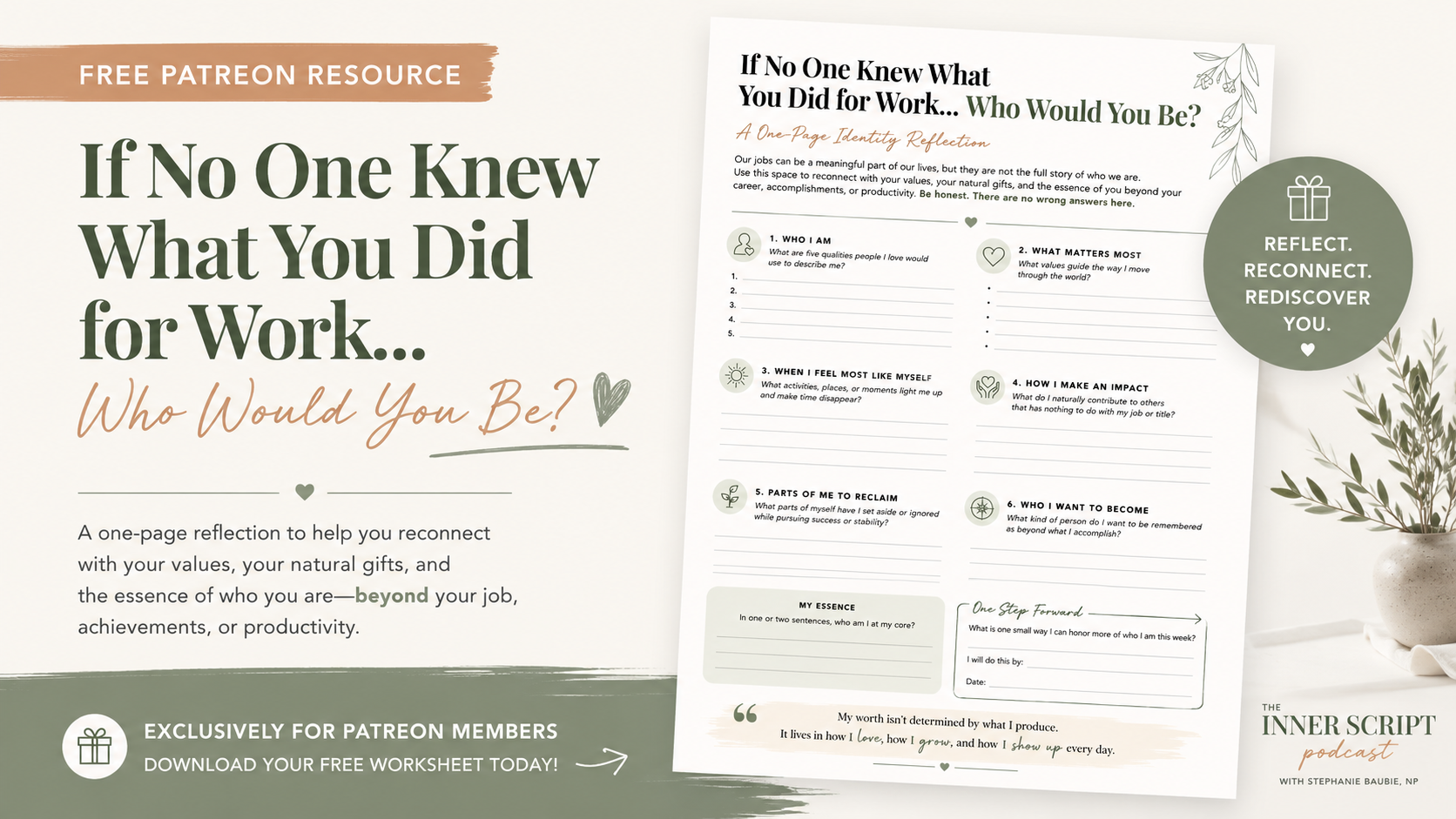
If no one knew what you did for work… who would you be?
Download this free one-page identity reflection to reconnect with your values, your natural gifts, and the essence of who you are beyond your career, accomplishments, or productivity. Download it here: Patreon companion resource
You can also join Steph’s free Patreon community here:
The Inner Script Patreon

Meet Your Host
Stephanie Baubie, NP is an integrative nurse practitioner and the host of The Inner Script Podcast, where she explores the deeper stories behind health, healing, identity, and transformation. Through a blend of functional medicine, nervous system awareness, emotional insight, and honest conversation, Stephanie helps women better understand their bodies while questioning the narratives they’ve inherited about wellness, worth, and what it means to truly feel well.
On The Inner Script, Stephanie sits down with physicians, founders, thought leaders, and experts in women’s health, while also sharing solo reflections on the transitions and inner shifts that shape our lives.
Follow Steph on Instagram.
FAQs
What does Stephanie mean when she says control is rooted in fear?
Stephanie explains that trying to control every outcome is often a coping mechanism for uncertainty. Learning to tolerate the unknown allows us to become more resilient rather than relying on control to feel safe.
What's the difference between expectations and standards?
Standards are the healthy ways you expect to be treated in relationships. Expectations, on the other hand, often involve trying to control how situations or people should behave, which can lead to disappointment.
Why is self-awareness so important for healing?
Stephanie believes that understanding your emotions, behaviours, and patterns creates the foundation for meaningful healing because you can't effectively care for a body or mind you don't truly understand.
Do you have to forgive someone in order to heal?
Not necessarily. Stephanie discusses how compassion and forgiveness are different, and that releasing resentment may be more important than forcing forgiveness before you're ready.
How can I stop attaching my worth to productivity?
Stephanie encourages separating your identity from your career and accomplishments by focusing instead on your values, integrity, resilience, and the way you show up in the world.
Why are boundaries an act of self-respect?
Healthy boundaries protect your energy and wellbeing. Stephanie shares how learning to tolerate other people's discomfort around your boundaries is an important part of respecting yourself.
What does resilience look like during life transitions?
Rather than waiting until you feel completely certain, resilience is trusting that you'll be able to adapt and recover regardless of how things unfold.
-
Everything shared here is for educational purposes and personal reflection only. Not medical advice. Always work with your own healthcare provider for individual care.
Hi, everyone. Welcome back to The Inner Script. My background looks a little different. I am currently in Chicago. I was here for my friend's baby shower, and then tomorrow I am heading overseas. Yeah, we're going with it. My background is gonna continue to look different, but here we are. The last few solo episodes have been what my journal looks like, kind of a bit of a diary, and I've been sharing where I am professionally Personally, kind of all of the uncertainty that comes with being in the middle of a major life transition.
Because right now I'm really closing one chapter of my life and stepping into another, which is like really what this podcast was intended to be about from the start. The company I've been working for is shutting down, which means I'll be unemployed in a few weeks. A situation like that has never happened to me, like working in healthcare, which is a privilege.
If you looked at my life from the outside, it might seem like everything is falling apart for me, but strangely, it kinda feels the opposite to me. That just has to do a lot with perspective and how I've really changed in the last two years, because I really used to be somebody who was just trying to control every little thing.
I didn't have a good relationship with the unknown. I just felt like if I wasn't in production mode, I wasn't worthy of living a fulfilled life. All of that has really kind of started to change for me because my perspective has changed, and I've really grown as a person. Overall, this huge life shift in terms of losing my job because the company is closing, it really has felt like my life is redirecting me.
Instead of rushing into another job, I'm really taking a step back. I'm taking a break from healthcare, traveling for a while, and giving myself space to figure out what I actually want my next chapter to look like. At the end of the day, when one chapter ends, it's hard not to reflect on the one that's ending.
The last two years have really changed me more than any other period of my life, and they really weren't easy, to be fully transparent. I left a relationship that didn't feel emotionally safe. I started over in a new city without a friend group, really without a support system, and I dealt with health issues that forced me to look at my body differently.
And somewhere in the middle of all that, I became a completely different person. Looking back now, I don't actually wish any of it hadn't happened. As painful as those experiences were, I generally believed they happened for me. They forced me to ask harder questions, develop more self-awareness, and really become someone I don't think I would've become otherwise, and that's really a beautiful thing.
This episode isn't about regrets because... To be fully transparent, I really don't have any. It's about that shift in perspective that I've had. These are the lessons that fundamentally changed how I see myself, my relationships, my career, and what I really want in my life. If I could go back and tell the version of myself from two years ago anything, this is what I'd say, and I'm gonna go through kind of six lessons I learned and what kind of made me came to these realizations and how I came to them.
The first one is really self-awareness is everything. You are responsible for your actions, your reactions, and emotional state. Regulation isn't someone else's job. It's really up to you to regulate yourself. And, and there are times where people may be going through having emotional roller coasters or having breakdowns.
Yes, like, you need help in that instance, but it's really on you to go find that help. It's the importance of leaning into discomfort and friction because that's something I've seen more so professionally in my career, is a lot of my patients have a lot of difficulty leaning into that discomfort, feeling uncomfortable, feeling friction.
It has a lot to do with so many of us are used to instant gratification. We order something on Amazon, we get it the next day. We order our groceries and get them delivered. Because we have such less friction in our lives, it kind of doesn't allow resiliency to come into place. Resiliency is one of the most attractive qualities to have in yourself, and because of this, because of gaining self-awareness, you really need to build this relationship with yourself and a sense of connection.
It also goes into how you heal. I don't think you can fully heal from a chronic condition, a chronic illness, unless you have that relationship with yourself, unless you are connected with yourself, unless you have self-awareness. To put it in simple terms, you can't heal a body you don't understand. So if you don't understand yourself, how can you expect yourself to heal?
How can you expect Anyone else to understand you. Going into this, in the last two years, I really started to take accountability for the decisions I made. I've seen this just observationally in other people where we can be so quick to blame other people for situations, problems, what have you. But you have to take accountability in every decision or life event, because there is some type of way you showed up that could have been contributing to something, and maybe it was so minor, but just having that awareness alone really shifts perspective and takes the blame off of somebody else, and just kind of redirects it and allows you to self-reflect and grow from it.
And that alone I think is so transformative. This also goes into having triggers in relationships, family, romantic partnerships, friendships. I see so many of us projecting our shit we haven't worked through onto other people. I've been the person projecting my shit onto somebody else, and I've had someone projecting their shit onto me, and it's really not fair.
We've all been through things, and no matter what, we're always going to get triggered in any type of relationship we're in, but it's up to you not to project that onto somebody else. And I think it's a different situation where you have the ability to communicate, like, "Oh, wow, that made me feel some type of way," without putting blame on that other person, because they're not responsible for a wound that you may have not integrated yet.
It's a different story where we can recognize triggers and have patience for somebody when they're kinda going through it, but I don't think it's okay to ever blame somebody or put your own core wound onto somebody else, because they're not responsible for that, you are. This all kind of takes into account owning your part in your own reactions, and that allows for growth, and growth is asking yourself how you could have showed up differently.
Because even when someone did you so wrong, there is always a way for us to change our perspective. That whole lesson of self-awareness, taking accountability for the decisions we make, led me to another realization, that control is really fear described as productivity. What I mean by that is there are so many aspects of our lives we are trying to control.
Healing, expectations, outcomes, our emotional state, and not everything is meant to be controlled because it just- can't. The only thing you have control over are your own reactions and actions. And control, in my opinion, can be a form of dysregulation. It's really a coping mechanism to try and feel more comfortable with the unknown.
That's been my experience with control. Whenever I find myself trying to control an outcome, that's me in a dysregulated state. That's me needing to kinda come back to myself and to figure out what's going on. Even touching on having expectations, I think this is another form of control. It's counterproductive.
That saying that comparison is the thief of joy, which I do agree with, but I also think expectations can be more of a thief of joy. Here's what I mean. Expectations are not the same as having standards. Standards in a partner or a friendship or family member. Like, standards on how you're treated day to day, that's different than having expectations.
When I talk about expectations, I'm saying it's expecting a trip, a night out, a conversation to go a certain way, and it's in this rigid framework of, "I really hope it's gonna go this way." So it's having impossible expectations of friends or a partner to do things in a way that can feel transactional.
Like, you're expecting somebody to always be doing something for you or behaving in a way that you would behave. Those can be, like, really impossible to meet because nobody is you. Nobody is going to behave or act in a way that you would. It's kind of releasing these expectations and being more trustworthy with the people in your life, and knowing they're coming from a good intention state.
And again, that's not the same as standards. Standards are completely different than expectations. I also found having really difficult expectations in the healing space. When you're going through a chronic condition or illness and having expectations that this one supplement or healing modality is finally going to fix you, I promise you, placing these expectations, you will feel disappointed.
With expectations, it's a form of control that's rooted in fear, that's rooted in some form of unmet needs or some feeling you may be overriding. If you're noticing yourself having these expectations of how a thing is supposed to go, it's asking yourself, "What is, like, underneath all of that? What need is maybe not being met in my life, or what am I overriding?"
And this is why having a better relationship with yourself is so important, why I talked about self-awareness as the first thing, first lesson. Because the more connected you are to yourself, the less you really expect from others. Expectations are also kind of a future way of thinking. It's not really living in the present, and...
It's having that poor relationship with the unknown and just very future-oriented thinking, which is necessary at times, but I feel like so many of us are just not living in the present enough. Then there's wellness becoming another form of control, which I've talked about in the last few episodes.
Wearables tracking all of these metrics, optimization, checking hundreds of biomarkers, taking 20 supplements to aim for a specific lab value. Discipline is the form of working out when you're exhausted and didn't sleep well, but you feel like you have to get the workout in, restricting calories and food.
I just feel like all of these things have become very maladaptive. The more restrictive we are, the worse we feel, and the less we are enjoying our lives. All of this is really rooted in fear. So many of us are just gripping way too hard to specific outcomes in our lives, and it really puts you in a low vibrational, energetic state which, when you're in a state like that, where you're just trying to control every little aspect of your life, you're not flowing.
You're so rigid in your life that you can't attract the things you want. Control is rooted in fear. It repels opportunities. If someone's ever tried to control you, your first instinct was probably to run away. So that's, like, a good perspective to have. When you feel like you're trying to control some specific outcome in your life, think about it that way.
It's trying To release that grip and not white-knuckle your way through life, 'cause that just isn't gonna get you anywhere.
Another way to think about it is everything operates in energetics. Think about when you meet someone and they're in a negative head space or they're bitter. You can feel that. Or you walk into a room after two people just had a fight.
You can feel that negative energy. There's so much talk out there about raising your vibrational state or being in a more positive energetic state, but no one really explains how to do it. For me, it was really doing the inner work, hate to say it, because that allowed me to just be way more in flow with myself, connect with myself, and release outcomes or expectations.
I stopped trying to control everything. I stopped making decisions from fear. That naturally just allows you to flow in your life better and stay present. It was also changing my environment, whether that was doing a new workout class, taking a day trip with friends somewhere, go on vacation, take some type of class, and surrounding myself with like-minded people.
Those are all really good ways to kind of raise that vibrational state. Again, it's just accepting the unknown, trying to go have fun, find joy, and live. That really shifted perspective for me. The third lesson was boundaries are really self-respect. And listen, as a chronic people pleaser for most of my life, my biggest issue with boundaries wasn't actually stating them, it was the guilt for making someone else feel uncomfortable by the boundary I placed.
And the best reframe I had was if someone felt discomfort by a boundary I placed, that says so much more about them, and it's really not my problem if they feel uncomfortable. And that really helped me to not feel guilty anymore. People pleasing is also one of the biggest ways you can disrespect yourself, so it all goes back to having this relationship with yourself.
More self-awareness, because when you people please, it feels so bad in your body to do it. It's one of the biggest ways to disrespect yourself. And the biggest area of friction people pleasing showed up for me was really in my career as a nurse practitioner, feeling like I had to solve all of my patients' problems and making them happy and accommodate them no matter what, even at my own expense.
And I finally realized, as a nurse practitioner, it's my job to Educate, guide, and diagnose, but not to solve all of their problems. And I'm not saying health problems, like life problems. Because at the end of the day, I cannot control their actions. I can stay present in the room with them, give them all the information possible to make informed decisions, and provide evidence-based recommendations, but at the end of the day, it's not me who is enforcing the change, it's them.
The shift where there's accountability and responsibility go both ways. The patient-clinician relationship is 50/50. It's a two-way street, and I will die on that hill. For example, I would have patients who would say to me, more or less just kinda summarizing this, "It's just really difficult for me to find the time to cook my own meals and eat healthy."
So I'd give them recommendations like, "Can you meal prep? Can you have five to eight meals you cook on rotation so you get really good at making them and it takes, like, maybe 15 minutes? Having meal delivery service, looking up recipes for 15 to 20-minute meals." And I would be met with resistance at times of like, "Oh, I can't do that."
And I realized, I was like, "This is not my responsibility to figure out how this works in their life, how they can find a way to eat healthy." It's really on them to figure out what to do with the information I'm giving, with some of the recommendations I'm giving, and see what works for them, trial and error.
And I used to take all of that on of like, "Okay, well, what can we do?" I took that aspect on, and that's not what I was there for, and that was a really helpful shift for me in my career. It was also acknowledging that not everyone is meant to like you. And this was always really hard for me to grasp because I wanted to be well-liked.
I wanted every patient to like me. You know, there's patient satisfaction scores. I wanted to get a good score. But if you are well-liked by everyone, then you wouldn't be authentic, and that was, like, a really amazing shift in perspective for me. Another one, number four, you don't need certainty, you need resilience.
There have been so many instances in my life where I was so scared to make the wrong decision. I thought I had to be certain about things before deciding something, whether it was getting into a relationship, a career change, taking a vacation, where I'm going, whatever. It didn't matter. I just thought I had to have everything figured out and feel 100% sure.
And the truth is, we are never going to be 100% certain with any decision we make. The only way to get certainty is to actually lean in, experience it, and trust that you can bounce back if things don't go the way you wanted. And this goes back to control as well. Trying to find certainty in my experience was me trying to control the outcome.
It's feeling like you have to brace- for disappointments, wait for the other shoe to drop because of past experiences we've been through. I mean, I could do a whole other episode on that, but it's this aspect of we don't wanna get too comfortable because if we're comfortable and everything's going well, then it's only a matter of time before something bad happens.
And that is a form of dysregulation. That is fear. That is some type of dysregulation still living in your body, and that's really information. And asking yourself, "Where is that coming from? What does this mean?" Because we are never gonna achieve 100% certainty in anything in our lives. And again, I know I've said this two times already, but we can only be 100% certain in ourselves.
And the only way to do this, to feel certain in ourselves, is to have self-trust and a sense of connection with ourselves. And I truly feel like you cannot live freely until you understand yourself and stop seeking external validation. And that's what really builds resiliency in yourself and your body, which is why I think resiliency is the most attractive quality to have.
Well, one of them, but it's- Top up there. And it's also knowing how resilient our bodies actually are because they are so adaptive, and they're always on our sides. Disease and illness can really happen when we are overriding our internal signals. The more we get frustrated with our body for behaving a certain way...
And look, I get it. Like, I have been there so many times. I've seen that with my patients where they're just so frustrated with their symptoms. But having that subtle shift in perspective of, like, "My body's actually adapting to something," that alone can really help because it's starting to kinda release that fear in your body a little bit because we do store emotions in our bodies that then can create a lot of chronic conditions.
And it's not that every emotion is the culprit of a disease, but there's a lot of instances where it can be or there's a lot of moving parts, and that is always something we wanna look into. Number five, compassion isn't the same as forgiveness. One of the biggest shifts I had in my perspective was after my last relationship.
It was for the first time in my life I stopped taking someone else's behavior personally. I don't know how I was able to do that. Something just clicked and snapped in me, I can't explain it, where I was just like, "This is not on me. This actually has absolutely nothing to do with me." It was the sense of instead of asking, "What's wrong with me?"
I started asking, "What happened to this person who gave them the capacity to behave this way?" And that shift changed everything. It didn't excuse what happened. It certainly didn't make it okay, but it helped me stop carrying it, and it stopped me taking on somebody else's problems. I think that's really where compassion lives, is just understanding that healthy people don't intentionally try to hurt other people.
Just being able to have empathy for someone who is capable of doing really not great things to you, it's such a reflection of what the heck happened to them in their life where they're capable of doing something like that. Being able to have empathy for somebody who really hurt you is another form of resilience.
Back to resilience Here's something else that also changed my perspective is we hear so much about forgiveness, almost like forgiveness is the final step of healing. But I remember hearing Dr. Ramani, and she's, like, all over social media, on Instagram. She talks a lot about kind of being in bad relationship dynamics or unhealthy relationship dynamics.
She's, like, a wealth of knowledge. But she basically said something that completely shifted how I thought about forgiveness. And she said that not everyone may deserve your forgiveness. Sometimes people intentionally try to diminish your confidence, distort your reality, manipulate you, or make themselves feel powerful at your expense.
And in those situations, maybe forgiveness isn't the goal Maybe indifferences. Maybe it's simply refusing to carry their behavior anymore. Maybe that is good enough. I don't think healing requires forcing yourself to forgive someone who intentionally tried to maybe harm or hurt you in some way, but I do think it requires releasing the resentment so it stops hurting you.
I do think you can release resentment and not necessarily forgive. I don't know, maybe. But it's just accepting that you cannot fully forgive someone for what they did to you, and maybe that's okay. Because there can be almost a lot of guilt as a result of not being able to forgive someone, too. So that was just, like, a really interesting perspective shift, because we hear all the time about forgiveness and how important it is, but some people live their lives not being able to forgive certain people, and I think that's okay.
If they find more peace in not being able to forgive, then I don't think we should push it. Finally, number six, your identity is not what you produce. For most of my life, I thought my worth came from what I produce, what I achieved, what I gave. All of that was tied into how worthy I felt, and that came in the form of my career, accomplishments, being needed, being productive.
But losing the job I thought I was building has forced me to ask a different question. Honestly, in the last two years just talking about productivity and identity and feeling burnt out, it was kind of separating my career from my identity, 'cause those are two completely different things. I had to kind of sit on this thought of if I couldn't tell someone what I did for work, then who was I?
That's actually a better question, because we are so tied to what we do for work that many of us don't really know what our actual identity is. It's not your job. Your job could be a part of your identity, but your identity forms before you get a job, I would think. It's also not your chronic illness, and it isn't what happened to you.
For me, identity is my values. It's the way I show up. It's my integrity and my sense of resiliency. I continue to see so many people attach their identity to the things that have happened to them, but I really believe thinking that way keeps you stuck. Like, I've seen it time and time again. I'm not saying it's easy to let go of the things that have happened to you, but I think it can keep you stuck.
It kinda can keep you in this state of anger, bitterness, or resentment. We'd just feel so much better if we found a way to release that, and it's not easy at all. Easier said than done. Your identity is the growth you experienced overcoming the hard things. That was the biggest shift in perspective for me because it's not what you produce, it's not what you achieve, it's just, like, really who you are as a person.
It's like, are you a good, kind person? That, for me, is enough. So we are taking a break from healthcare, and we are not assigning my identity to my career anymore . And I am gonna go travel for a bit, continue podcasting, and just see what's next in store. Figure out what lights me up. I'm gonna come back to healthcare in some capacity.
I do know that. I just think it's gonna look different, and I'm really excited. So that's all I have to say for today. Rate, review, subscribe, all the things. It helps a lot. And any questions, feel free to DM me on the innerscriptpod on Instagram. I will see you guys next week.
If you wanna connect with like-minded women and dive deeper into these conversations, join my Patreon community. There's a free option and it's where we can talk about each episode together. The link is in the show notes and I can't wait to see you there.
Disclaimer
Everything shared in this episode is for educational purposes and personal reflection only. It is not medical advice. Always work with your own healthcare provider for individual care.
We sometimes include links to products and services we find interesting. These may or may not be affiliate links. Thanks for your support.
Podcast production by Jamie Brooke.
