Listen now by clicking your favorite podcast app below:
You go out for dinner with friends. You have a couple of drinks, eat a great meal, laugh, stay out later than usual, and have exactly the kind of night you needed.
Then you wake up the next morning and your stomach looks completely different. You’re bloated. Your jeans feel tight. Maybe your face and fingers are puffy too. And immediately, the investigation begins.
Was it the wine?
The margarita?
The pasta?
The dessert?
Did you eat too much?
In this solo episode of The Inner Script, Stephanie Baubie, NP wants you to consider another possibility: It might not be one thing. It might be the pile-up.
Bloating after a night out can involve what you ate and drank, carbonation, alcohol, eating later than usual, how quickly you ate, nervous system stimulation, poor sleep, your menstrual cycle, and how sensitive your gut was that particular day.
Steph begins by making an important distinction between bloating and visible abdominal distension.
Bloating describes the sensation of fullness, pressure, tightness, or swelling. Distension is a measurable increase in the size of the abdomen. You can experience one, the other, or both.
And surprisingly, feeling extremely bloated doesn't necessarily mean your digestive system is filled with an unusually large amount of gas.
For some people, gut sensitivity and the way the diaphragm and abdominal muscles respond may also contribute to the experience of bloating and visible distension.
Then there are the more obvious contributors.
Alcohol can affect the digestive tract and contribute to dehydration. Carbonated drinks introduce bubbles. Certain mixers contain fructose or sugar alcohols. Restaurant meals may be larger, richer, saltier, and contain more fermentable ingredients than what you typically eat at home.
Eating later and lying down soon afterward adds another variable.
But that still doesn't explain why you can eat almost the exact same meal on two different nights and feel completely different afterward.
That’s where the nervous system enters the conversation.
Your gut and brain are constantly communicating through the gut-brain axis.
Think about what happens during a night out. You're talking, laughing, listening, reading social cues, navigating a loud restaurant or crowded bar, and possibly meeting people you don't know particularly well.
Even when you're having fun, your nervous system is processing stimulation.
Steph explains why that matters for digestion, particularly for people who are highly sensitive to their environment or internal bodily sensations.
Stress and stimulation can affect how quickly the gut moves and how strongly you perceive sensations from it. You may also eat faster, swallow more air while talking, or breathe differently when you're socially stimulated.
And this leads to one of the most important messages in the episode:
Your nervous system affecting your gut does not mean your symptoms are “all in your head.”
Quite the opposite.
The gut is physically connected to the body's stress response.
Steph shares how her own bloating has often changed depending on her emotional state and even who she is around. When she feels comfortable and emotionally well, she notices that she often tolerates nights out differently than when she's already anxious, stressed, or socially depleted.
That realization also changed the way she approaches going out.
Instead of scanning her body, anticipating tomorrow's symptoms, checking every metric, and trying to control the experience, she began practicing something surprisingly difficult:
Letting herself have fun.
Because staying home and avoiding dinner, drinks, laughter, and connection because you're afraid of how your stomach might look tomorrow isn't necessarily wellness.
Sometimes it's fear dressed up as wellness.
The episode also explores two other pieces of the pile-up: sleep and the menstrual cycle.
Alcohol can disrupt sleep later in the night, leaving you under-rested and potentially more sensitive to discomfort the following day.
And where you are in your menstrual cycle may change the equation too. Steph explains that in the days before menstruation, changes in progesterone can slow the gut, potentially contributing to constipation and bloating. That means the exact same night out may feel very different depending on where you are in your cycle.
So what can you actually do?
Steph breaks it into three phases.
Before you go out, don't arrive starving. Eat adequately earlier in the day, give yourself enough time to get ready without rushing, and consider taking a couple of minutes for slower breathing before you arrive.
While you're out, slow down when you eat, drink water between alcoholic drinks, pay attention to how different beverages affect you, and let yourself enjoy the experience instead of trying to perfectly manage it.
Afterward, a gentle walk can help. Hydrate and prioritize sleep.
And the next morning?
Eat.
Hydrate.
Move gently.
And don't punish yourself.
Steph specifically advises against fasting, restricting, detoxing, or doing an intense workout to compensate for the night before. Your body doesn't need punishment. It needs time and support.
At the same time, not all bloating should simply be dismissed.
Steph explains when persistent or worsening bloating deserves medical evaluation, particularly when it is new, occurs most days, lasts for weeks, or accompanies symptoms such as unintentional weight loss, blood in the stool, persistent abdominal or pelvic pain, early satiety, repeated vomiting, or changes in bowel habits.
Ultimately, the morning-after belly is rarely just the wine.
It's the pile-up.
And pile-ups are much easier to work with than mysteries.
This episode is for you if…
You frequently wake up bloated after dinner or drinks
You experience visible abdominal distension or uncomfortable fullness
You immediately blame yourself or a specific food when you're bloated
You notice your digestion changes when you're stressed or anxious
You’re highly sensitive or easily overstimulated in social environments
Your bloating seems worse at certain points in your menstrual cycle
You avoid certain foods, drinks, or social experiences because you're afraid of digestive symptoms
You want practical ways to support digestion without restriction, detoxes, or punishment
Episode Timestamps
(00:00) The morning-after bloat
(01:30) What bloating actually is
(03:00) Alcohol, mixers and food
(06:00) Your gut-brain connection
(09:00) A sensitive gut
(11:30) Letting go of control
(13:30) Sleep and bloating
(14:30) Your menstrual cycle
(15:30) Are sensitive women different?
(17:00) What to do before
(18:30) During your night out
(19:30) The morning after
(21:30) When to see a clinician
Curious about a supplement Steph has mentioned in the episode?
If you’re looking for products Steph personally recommends in practice, you can browse her dispensary here: Stephanie’s Fullscript dispensary
Please consult your healthcare provider before starting any new supplement. Food, lifestyle, and nervous system support always come first.
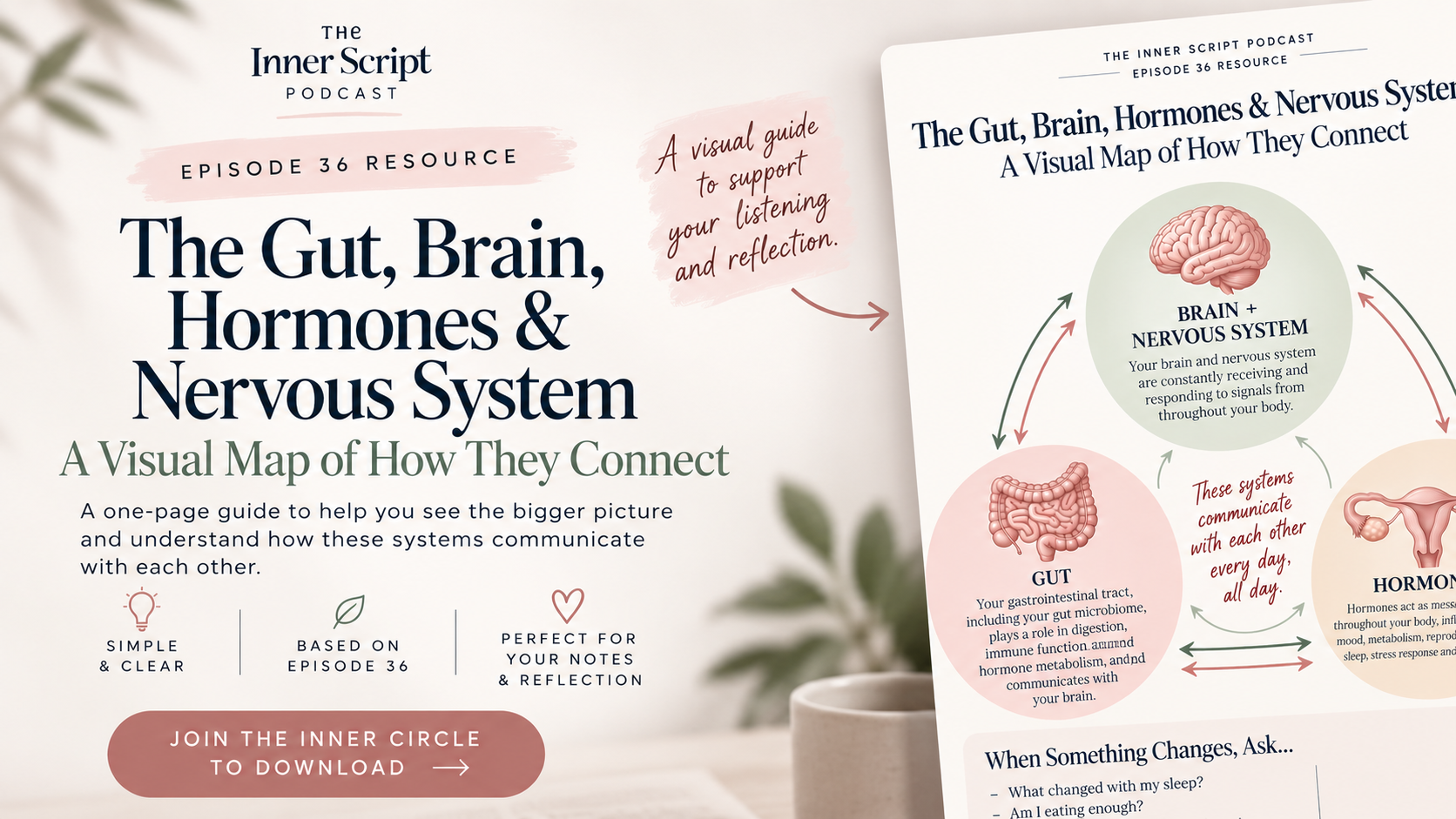
What is your gut actually trying to tell you?
Trying to understand how all of these systems interact can get complicated quickly, so Steph created a free one-page visual companion to Episode 36. The guide maps the connections between the gut, brain and nervous system, and hormones, giving visual learners a simple way to see the bigger picture discussed throughout the episode. Patreon companion resource
You can also join Steph’s free Patreon community here:
The Inner Script Patreon

Meet Your Host
Stephanie Baubie, NP is an integrative nurse practitioner and the host of The Inner Script Podcast, where she explores the deeper stories behind health, healing, identity, and transformation. Through a blend of functional medicine, nervous system awareness, emotional insight, and honest conversation, Stephanie helps women better understand their bodies while questioning the narratives they’ve inherited about wellness, worth, and what it means to truly feel well.
On The Inner Script, Stephanie sits down with physicians, founders, thought leaders, and experts in women’s health, while also sharing solo reflections on the transitions and inner shifts that shape our lives.
Follow Steph on Instagram.
FAQs
Why am I so bloated after drinking alcohol?
Bloating after drinking may not be caused by alcohol alone. Steph explains that alcohol, carbonation, richer or saltier foods, eating later than usual, nervous system stimulation, poor sleep, and hormonal changes can create a “pile-up” that leaves you feeling bloated or puffy the next morning.
Can stress and anxiety cause bloating?
Stress can affect gut motility and how sensitive you are to sensations coming from the digestive system. Steph explains that eating while stressed, excited, socially stimulated, or anxious may affect digestion differently than eating the same meal in a calmer environment.
Why does my stomach look bigger even if I don’t have a lot of gas?
Bloating and visible abdominal distension are not always caused by excessive gas. Steph discusses how gut sensitivity, fluid retention, breathing patterns, and coordination between the diaphragm and abdominal wall may also play a role.
Can my menstrual cycle make bloating worse?
Yes. Steph explains that digestive symptoms can change throughout the menstrual cycle. In the days before a period, hormonal changes may contribute to slower gut motility, constipation, and bloating, which can change how you feel after the same dinner or night out.
Does carbonation make bloating worse?
For some people, it can. Beer, sparkling wine, seltzers, and other carbonated beverages introduce bubbles, while some mixers may contain ingredients such as fructose or sugar alcohols that can contribute to digestive symptoms in sensitive people.
What should I do the morning after drinking if I’m bloated?
Steph recommends gentle movement, hydration, eating normally, and giving your body time to recover. She specifically cautions against fasting, restricting food, detoxing, or punishing yourself for the night before.
When should I be concerned about persistent bloating?
Steph recommends seeking medical evaluation when bloating is new and persistent, occurs most days, or is accompanied by symptoms such as unintentional weight loss, blood in the stool, ongoing abdominal or pelvic pain, feeling full very quickly, repeated vomiting, or changes in bowel habits.
-
Everything shared here is for educational purposes and personal reflection only. Not medical advice. Always work with your own healthcare provider for individual care.
Stephanie Baubie: Hello, welcome back to The Inner Script. We are starting today with a little scenario. Let's set the tone here. You had a great night, dinner with friends, a couple of drinks, maybe more than that, but who's counting? Real laughter. The kind of evening you actually needed after a very stressful week. And then you wake up the next morning looking about five months pregnant.
Your stomach feels like a drum, and a quiet voice in your head that says, "What is wrong with me? What did I do?" And here's my first piece of unvarnished feedback for you. Stop interrogating the one cocktail because the answer is almost never one thing. It's a pile-up There's food, alcohol, a revved up nervous system, poor sleep, and where you're at in your cycle all hitting your gut at the same time, and they all matter.
And today, I'm gonna walk you through the pile-up and what you can do about it without punishing yourself and without being rooted in fear. And as someone who is bloated pretty much daily for 20-plus years, I am your girl on this topic, and I get it. This is my expertise. One of them, I'll say. Let's get into it.
What does bloated actually mean? First, a distinction that clears up a lot of confusion. Bloating is really two experiences that get lumped together. It's that feeling of bloating, the fullness, pressure, tightness, a sense that your stomach is swollen, and then there's the visible distension. Your stomach measurably gets bigger.
Your jeans don't close, or even the thought of putting jeans on makes you wanna die. And you can have one without the other, or you can have both. And I have to say, I had both for 20-plus years. And here's something that also surprises people. Studies of people with bloating don't always find a big increase in the amount of gas.
For a lot of people, what's going on isn't too much gas. It's more about how sensitive the gut is to normal amounts of gas and fluid and how the muscles of the abdomen and diaphragm are behaving, and that's really important information. The muscles of the abdomen and diaphragm. Can't emphasize that enough.
We're gonna get back to that. But a piece of that is that's where the nervous system comes in. That's the role, is navigating the muscles. There's a third thing too which isn't gas at all. Water retention and puffiness, and that's the face and fingers, rings feel tight version. Again, it has different drivers.
Mostly salt, alcohol, and hormones. I say this 'cause it's really worth knowing which one you're dealing with. Let's talk about the usual suspects. Let's give the obvious stuff its due because it's real. Alcohol itself. Yes, alcohol irritates the lining of the digestive tract, and it can change how quickly things move through.
For some people, it speeds everything up, and for others, it slows things down. Alcohol also dehydrates you, and when you're dehydrated, your body holds on to more water. Enter puffiness. That morning after puffiness can be partly due to your body clinging to the fluid, and that's why hydration is so important before going to bed or throughout the night.
Another thing that doesn't get thought of a lot is what you're mixing alcohol with and the- Can be a little bit of a sneaky one. There's beer brings carbonation and fermentable carbohydrates. Sparkling wine and seltzers bring bubbles, which means swallowed gas. Sweet cocktails often bring fructose. And if you reach for the zero-sugar mixer, it may contain sugar alcohols, which are notorious for causing gas and bloating in people who are sensitive to them.
I mean, I don't know if anybody can truly tolerate them. And examples of these are sorbitol and mannitol. The reason these can cause so many symptoms or just people can be overly sensitive to them is because they just aren't absorbed well and can cause a lot of irritation. So these are usually the powdered drink packets that you see.
Anything that says zero sugar, always approach with caution. Zero sugar marketing doesn't mean it's healthy, and it's not. Just be careful. And obviously, the next thing is the food. Yes, restaurant meals tend to be higher in sodium and fat, bigger than what you'd cook at home, and often loaded with more of those fermentable ingredients like onion, garlic, and wheat.
Fat can slow stomach emptying, so a rich dinner plus Alcohol means you're still digesting hours later. I will say, like, that's why it can be helpful to take digestive enzymes before going out to dinner. That's something I used to do a lot, and I really feel like it did help. I really like papaya digestive enzymes.
Those are great to just have and to take before a heavy meal. So there's definitely some tips and tricks we're gonna get into, but that's kinda more of a side note. And then there's the timing. Eating late and then lying down to sleep gives your gut less help from gravity and less time to clear the meal.
Now, if you stopped here, you'd get the standard advice, drink less, skip the soda, eat earlier, which is all true, but it leaves out the part of the story that explains why two people can eat and drink the exact same things and have completely different mornings, and why you can have the same dinner at home on a Tuesday and feel completely fine.
That difference is where things get interesting, and we're gonna explore it. Your gut and your brain are in constant conversation. I've mentioned this a lot on previous episodes, but this is called the gut-brain axis, and it's not just this wellness buzzword out there. It is a well-studied two-way communication system involving nerves, hormones, and immune signaling.
Now, think about what a night out does to your nervous system. You're socializing, you're reading faces, managing conversation, maybe navigating group dynamics. There's a loud restaurant, a crowded bar. If you're a sensitive person like me, your system is taking in a lot. at once. Even when it's fun, it's stimulating, and fun is still arousal.
And here's what also that does when you're eating. You're eating while you are possibly stimulated. Digestion works best when your body is in a calmer rest and digest mode. And when you're keyed up, whether it's excitement, stress, you're on a first or second date and you don't know the person well, social effort, digestion is not the priority there.
Stress can change how fast the gut moves and how sensitive it is. The same meal gets processed differently when you eat it mid-conversation, half listening, in a loud room, versus slowly at your kitchen table with less stimuli. Also, when you're out to eat with people at a restaurant, you may be eating faster, and then you swallow more air.
This is because you're talking and laughing in between bites. You're gonna swallow air. Same with drinking through straws and sipping bubbly drinks. The air has to go somewhere. You can also start to breathe differently. Many people hold their breath or breathe high in the chest when they're socially vigilant or stimulated.
There's some interesting research out there suggesting that in some people with bloating, the diaphragm and abdominal wall coordinate in a way that pushes the belly outward instead of the usual pattern And I don't wanna oversell it, but it's a fascinating reminder that bloating isn't only about what's inside the gut.
It's kind of what I was saying about earlier in this episode. It's also about posture, breathing, and muscle tension. This is why diaphragmatic breathing is so important, and that's why I've talked about it so much, and that's why breathwork is a practice out there for nervous system regulation. Many of us breathe from the chest, which is very shallow, but in order to breathe from the belly, you sometimes have to think about it and get into more of a regulated state, and that's gonna help alter that muscle tension.
Your gut might just be more sensitive. People carry sensitivities differently in their body. Instead of that being fear-mongering, I think it's just useful information. Knowing that alone, at least for me, really helped my digestion issues because I took it as information instead of viewing my body as, "Oh my God," like, "What are we gonna do?"
It's kind of this level of acceptance in a way, but what's interesting is that acceptance helped the digestion issues. And there's conditions like irritable bowel syndrome. One of the central ideas is this, is this visceral hypersensitivity. That's pretty much the gut sensing normal stretch and gas as uncomfortable or painful, and stress and anxiety can turn that sensitivity up, and that 1,000% happens for me.
So you're not alone in that. When I say your nervous system is part of your bloating, I don't mean it's all in your head. It's actually quite the opposite. It's very much in your body, and your gut is wired to your stress response. Again, I'll say for me, bloating is very much tied to my emotional state. I notice that I am way less likely to have hangovers, even bloating or even water retention when I am in a good emotional state.
However, if I'm going through a more anxious time, a tougher time, then yeah, I definitely feel it more. And I think that's just a really important distinction to make because we are never gonna feel the same every day, and it just allows you to give your body some grace, cut it a little slack, because sometimes it's just doing the best that it can.
The other thing I've noticed is it matters who I'm around. When I'm around people where I can feel 100% myself, I feel comfortable, I can tolerate alcohol more. Unfortunately, if I'm around energy vampires or just don't feel 100% comfortable or feel like my social battery isn't where it normally is because of a stressful week, then I feel it more the next morning.
All of this goes to show that I truly can't emphasize how much your emotional state is tied to your threshold for developing physical symptoms. I just want everybody to really take that in because very important, just allows you, again, to give your body a little bit more TLC when it's needed. And also, there's a part in this where when you are going out to dinner, drinks, whatever, you have to give up control.
You have to loosen that grasp. Things like if you wear a sleep tracking device, maybe don't wear it. We don't always need the data every night. It's like if you know you're gonna have a late night, maybe just skip the sleep data that night. I also think a portion of this is leaning into the fun of the night instead of scanning your body and thinking about the repercussions of it.
That really was a game changer for me. It was this avenue where I just kinda gave up control. I just accepted that I was gonna have a fun night, not worry about it, and surprisingly, my symptoms were a lot better the next morning. I say this because sometimes the best thing you can do after a long week, or it doesn't even have to be a long week, is to go have a few drinks with your friends, to go laugh, like have a fun meal.
Experience joy and pleasure, happiness, instead of staying at home, cooking your dinner and skipping out on the night out with your friends 'cause you're scared of how you're gonna feel the next morning. That's not wellness, that's fear.
Stephanie Baubie: Another thing I've been doing more frequently is I've been drinking tequila more.
I find that tequila doesn't affect me as emotionally and physically the day after. However, I have been feeling more anxious than my baseline, so even though I'm drinking a skinny margarita, I do feel the effects of the alcohol a bit more than I normally do. So just a side note, but it also takes just knowing what works for you.
Like, I refuse to drink champagne. Gives me a headache, don't tolerate it well, and gives me the worst hangovers. Tequila has kind of been a good spot for me. There are two more pieces of the pile-up Sleep. Alcohol may help you fall asleep, but it tends to fragment sleep later in the night, and you definitely aren't going in and out of your sleep cycles as well, and especially you're not getting a lot of REM sleep either, and that's kind of the restorative sleep.
So you can wake up in the early hours, sleep more lightly, and feel un-refreshed. Poor sleep affects stress hormones, appetite, how sensitive you feel to discomfort in general. So after a late night, your gut is working with a system that's under-rested and a little more reactive. That alone can make a normal amount of gas or bloat or whatever feel like a lot, 'cause you're just way more in tune to it, and again, your threshold for tolerating physical symptoms is probably lower as well.
All right, your cycle. If you still menstruate and you're a woman, where you are in your cycle matters. In the days before a period, progesterone rises, and it can slow the gut, so you can get a little bit more constipated, a little bit more bloating in general. The same night out can feel very different depending on whether you're in the follicular phase, which is just after menstruation, which is when energy is pretty good, or the week before your period, which is your luteal phase.
So if you keep a cycle tracker, look back at the nights you felt terrible and see if there's a pattern. It's a really useful bit of detective work, and it can spare you from blaming the wrong thing and just, again, give your body a little bit more grace and more TLC. What this question brings me, and something I've asked myself, is, are sensitive women or people more affected than the general population?
I've said this show is for highly sensitive, empathic individuals, so let me address the question you're probably asking. Is this worse for me because I'm sensitive? And my honest answer as someone who is highly sensitive and has really had to embody it instead of run away from it, it's plausible, but I also want to be careful at the same time.
Sensitive people often tune in more closely to internal signals, which researchers call interoception. That's why highly sensitive people in general tend to be more intuitive or are really good at pattern recognition or are told that they're overthinkers because they're picking up on things a lot of people are missing.
That can mean you notice a subtle gut sensation that someone else would just filter out and not even give it a time of day. A nervous system that's more reactive to stimulation may take longer to settle after a big social night. But I'd be overstating if I said research has proven that sensitive women have more bloating or that the trait causes it.
That's more of a hypothesis, and it f- It's what I see clinically. So what I'd say is don't take this as my body is broken. Absolutely not. Take it as my system is picking up a lot, and it needs support, and just integrate it. That's sometimes the best thing you can do. So what to actually do? Let's try to make this practical and divide this into three phases because these are what I try to do before going out.
I really make sure I don't show up starving, so I actually like to have a really big lunch before I go out, one that has lots of protein, good source of carb, fiber, fat. If that doesn't hold me over, I will have a snack with protein and fiber before going out. Because arriving hungry means you're gonna eat fast and larger quantities.
That's okay, but sometimes it's better to not do that if you are more prone to bloating, which, hello, that is me. Another thing, try not to rush getting out the door. Give yourself plenty of time to get ready, and I know this sounds like, does this actually matter? But it does. It does 'cause when you're rushing and then you're stressed, you're late, you're calling the Uber, you're running out the door, you're just in this, like, dysregulated state, and that's not gonna help.
Because then if you are highly sensitive like me, then you show up to the dinner, and you're just already overstimulated and dysregulated, and it can be hard to come back from that. So just give yourself plenty of time, and try not to rush. Take your time. Another portion of this too that can be helpful is just taking two minutes to arrive in your body.
Slow exhales on the way there, longer out breath than in breath. This is really helpful, especially if you're going to be around a ton of people. I do this in the Uber on the way there. I just take two minutes to take a deep breath in and out. I do that before meeting people if it's a large group or people I don't really know, or especially if I've, like, gone on a date with somebody, first or second date, I do that as well, just to do a little nervous system reset.
During the night out, just slow down. Put your fork down between bites. Sometimes if you're feeling called to it, chew. Yes, it sounds like your grandmother, but it also works. Water between drinks, and consider whether you actually want the bubbly option. It kind of takes a minute to see what works for certain people when it comes to alcohol, what causes the least amount of reactivity.
And have fun and do your best to not try and manage everything. Give up control, loosen the grip, lean into the fun, and just trust in your body's resilience. That is key.
After the meal, if it's feasible and safe wherever you are, I recommend going on a walk. Like, a gentle walk after dinner helps many, many people.
For me, if I'm going to a bar after with my friends, I always suggest walking if it's close enough, just because it helps to digest the meal better, it helps with lymphatic flow, and all that makes a big difference. The next morning, light movement helps more than lying in bed and feeling puffy and swollen.
For me, my favorite thing to do is to go on a walk and grab a coffee, drink it while I'm sitting outside. That's enough movement. It doesn't have to be, like, crazy. You don't need to go to Barry's Bootcamp in order to feel better. I actually probably would advise against that if you're hungover. Anyways, hydrate, obviously.
Water. I always drink electrolytes after drinking the night when I get home, packet of electrolytes before bed, and then I do it in the morning as well with my lemon water, too. Eat a normal breakfast. I wanna say this clearly. Do not fast, restrict, or detox to make up for it. Skipping meals the next day tends to make the whole cycle worse and teaches your brain to treat a social night as something you owe punishment for, and you absolutely do not Eat normally.
Your body knows how to recover. Listen to what it wants. If it wants a breakfast sandwich, get a breakfast sandwich, or make your own. It can still be healthy. It doesn't mean it's bad for you. Just eat what you want. And then if you're really trying to be, quote-unquote, "healthy," you can always make it at home to make it better for you.
And stop looking at your stomach in the mirror. I say this as someone who used to do that all the time. Just don't do it. You're not gonna like what you see. Even then, it's probably so much more subtle because we are our own worst critics. So just don't. It's going to pass within a day or so. The more you worry, the worse it will be.
Again, it's not bad, it's just retaining a bit more water than normal. The more you hydrate, do the electrolytes, get some movement in, you're gonna be back to normal t- the next day. One more thing, because I am a nurse practitioner, and I'd be negligent to skip it, occasional bloating after a big meal and drinks is obviously common.
That's what this whole episode is about. But persistent or worsening bloating is not something to explain away. See a clinician if your bloating is new and lasting more than a couple of weeks, happens most days, or comes with things like unintentional weight loss, blood in your stool, ongoing abdominal or pelvic pain, feeling full very quickly when you eat, repeated vomiting, or changes in your bowel habits.
In women especially, bloating that is persistent and new deserves to be taken seriously and evaluated, not dismissed as stress or diet. You are not being dramatic, you're being appropriately cautious. Just would be remiss if I didn't mention that. The morning after belly. Rare- rarely just the wine. It's a pile-up, what you ate and drank, how fast, in what state, on how little you sleep , at what point you are in your cycle.
The good news is that pile-ups are easier to work with than mysteries. If this was helpful, send it to a friend who has apologized to her stomach. And I will see you guys in the next episode.
Stephanie Baubie: If you wanna connect with like-minded women and dive deeper into these conversations, join my Patreon community. There's a free option and it's where we can talk about each episode together. The link is in the show notes and I can't wait to see you there.
Disclaimer
Everything shared in this episode is for educational purposes and personal reflection only. It is not medical advice. Always work with your own healthcare provider for individual care.
We sometimes include links to products and services we find interesting. These may or may not be affiliate links. Thanks for your support.
Podcast production by Jamie Brooke.
