Listen now by clicking your favorite podcast app below:
You wake up feeling good. You slept well. Your body feels fine.
Then you check your Oura Ring.
Your HRV is down. Your readiness score is terrible. Suddenly, you’re wondering whether you actually feel as good as you thought you did.
If you’ve ever let a wearable change how you feel about your body, your workout, or your entire day, this episode is for you.
Stephanie Baubie, NP sits down with performance scientist, author, and heart rate variability expert Don Moxley to unpack what HRV actually measures and how we can use wearable data without handing it control over our lives.
Don has spent more than 30 years studying human performance, stress, and recovery. He began his career at Polar Electro and later became The Ohio State University’s first paid Sport Scientist, helping move HRV out of the research lab and into real-world performance decisions.
At its simplest, Don describes HRV as a window into the autonomic nervous system, the part of your nervous system responsible for many of the processes happening automatically in your body.
But one of his most useful analogies is even simpler:
HRV is a thermometer, not a thermostat.
A thermometer gives you information. It doesn’t decide what happens next.
And neither should your Oura Ring.
Stephanie and Don explore what can influence HRV, including sleep, exercise, stress, relationships, environment, recovery, and even the constant stimulation of our phones and social media.
They also dig into a question that comes up frequently for anyone using wearable technology: What happens when the data doesn’t match how you feel?
Don’s answer is not to ignore the data. It’s to put it in context.
Rather than waking up, seeing a low number, and allowing an app to determine whether you should exercise, rest, worry, or feel healthy that day, Don encourages looking at trends and using the information in service of a larger goal.
The conversation also gets into exercise and overtraining. Don shares how HRV helped him recognize when an Ohio State athlete was maladapting to his training. By adjusting the athlete’s workload based on what his body was ready to handle, rather than simply pushing harder, the athlete’s HRV improved substantially and he went on to become an All-American.
For women, Stephanie and Don also discuss the added complexity of hormonal cycles, changing physiology, exercise, and recovery. Don emphasizes that wearable information can be useful, but the individual still has to interpret what the data means for her body rather than blindly following an app’s recommendation.
And sometimes, the wearable itself becomes the stressor.
When Stephanie asks whether there are people who should stop tracking HRV because they’re getting too caught up in their numbers, Don’s answer is yes. If the device is creating stress on its own, taking it off may be appropriate.
Because ultimately, the goal isn’t a perfect readiness score.
It’s learning how to use the information available to you while staying connected to your own body.
This episode is for you if…
You check your HRV or readiness score every morning
You own an Oura Ring, WHOOP, Apple Watch, or another wearable
A “bad” score can make you question how you feel
You’ve wondered what low HRV actually means
You’re trying to improve your stress and recovery
You exercise frequently and wonder whether you’re doing too much
You struggle with balancing training and recovery
You want to use health data without becoming obsessed with it
Episode Timestamps
(00:00) What HRV actually measures
(05:44) High vs. low HRV
(09:00) Sleep, breath and recovery
(11:59) Waking up at 3 AM
(15:21) Relationships and stress
(19:28) When your wearable says otherwise
(24:28) Exercise, hormones and HRV
(28:19) Are you overtraining?
(35:37) When to stop tracking
(38:32) Fear, love and resilience
Resources & Mentions
Heart rate variability (HRV)
Zone 2 and Zone 3 training
Curious about a supplement Steph has mentioned in the episode?
If you’re looking for products Steph personally recommends in practice, you can browse her dispensary here: Stephanie’s Fullscript dispensary
Please consult your healthcare provider before starting any new supplement. Food, lifestyle, and nervous system support always come first.
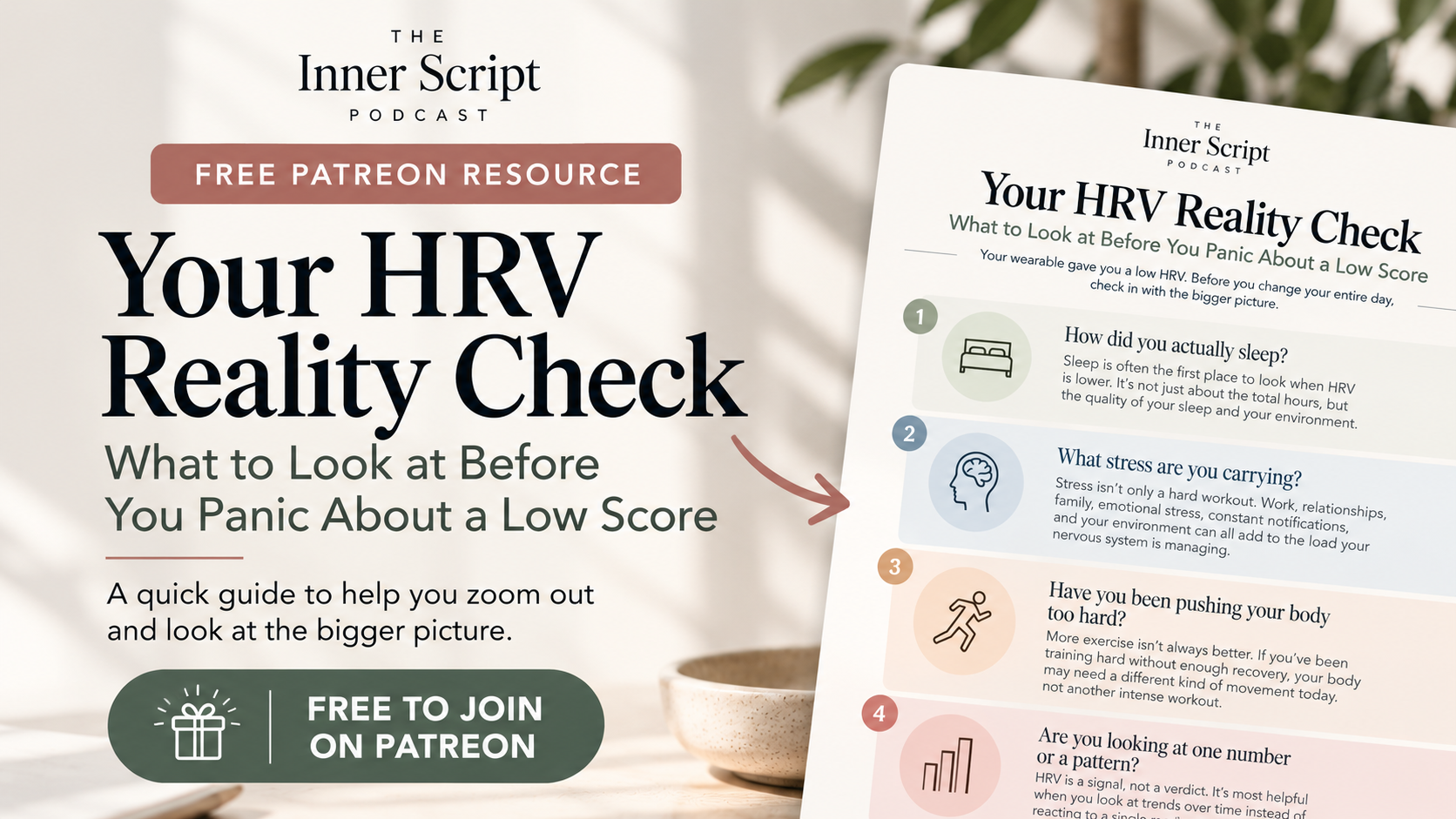
Is a low HRV score stressing you out?
To accompany this episode, Steph created Your HRV Reality Check: What to Look at Before You Panic About a Low Score, a one-page guide to help you zoom out and look at sleep, stress, exercise, recovery, your environment, and how you actually feel before letting one number dictate your day. Download it here: Patreon companion resource
You can also join Steph’s free Patreon community here:
The Inner Script Patreon

Meet Don Moxley
Don Moxley is a performance scientist, author, and innovator with more than 30 years of experience pioneering biomarker-driven approaches to human performance. He began his career at Polar Electro and later became The Ohio State University’s first paid Sport Scientist, bringing heart rate variability out of the lab and into everyday training and readiness decisions.
Don is Chief Science Officer and part of the ownership group at Mode+Method, where he leads the science behind HRV+. He is the author of The HRV Book and The Complete Athlete, hosts the 90% Healthy podcast, and runs the athletic education platform Train Recover Win.
Connect with Don:
Train Recover Win: https://www.trainrecoverwin.com
Mode+Method: https://www.modemethod.com
The HRV Book: https://www.thehrvbook.com
Instagram: https://www.instagram.com/donmoxley/
Mode+Method Instagram: https://www.instagram.com/mode.method/

Meet Your Host
Stephanie Baubie, NP is an integrative nurse practitioner and the host of The Inner Script Podcast, where she explores the deeper stories behind health, healing, identity, and transformation. Through a blend of functional medicine, nervous system awareness, emotional insight, and honest conversation, Stephanie helps women better understand their bodies while questioning the narratives they’ve inherited about wellness, worth, and what it means to truly feel well.
On The Inner Script, Stephanie sits down with physicians, founders, thought leaders, and experts in women’s health, while also sharing solo reflections on the transitions and inner shifts that shape our lives.
Follow Steph on Instagram.
FAQs
What is HRV and what does it tell you?
Heart rate variability measures variation in the timing between heartbeats. Don explains that it can provide information about the autonomic nervous system and how your body is responding to stress and recovery.
Is a higher HRV always better?
Don generally describes moving HRV upward as desirable, but emphasizes individual context rather than comparing your number with someone else’s. He discusses unusually high HRV in elite athletes as a more specialized situation that most people will not encounter.
Why is my HRV low even when I feel fine?
HRV can respond to many sources of physiological and psychological stress, including sleep, training, work, relationships, environment, and recovery. Don recommends treating the number as information rather than allowing a single reading to determine how you think you feel.
Can lack of sleep lower HRV?
Don considers sleep the first place to look when working on HRV. He emphasizes both getting adequate sleep and creating an environment that supports it.
Can overtraining affect HRV?
Yes. Don discusses using HRV to identify athletes who may not be adequately adapting to their training load and to help guide changes in intensity and recovery.
Should women interpret HRV differently throughout their menstrual cycle?
Don discusses the importance of considering ovarian cycles when interpreting wearable recommendations and emphasizes that changing physiology should be part of the context used to understand the data.
Can an Oura Ring or wearable make health anxiety worse?
It can. Don says that a device can become a stressor itself. If tracking is causing someone to become overly focused or anxious about the numbers, he says taking the wearable off can be appropriate.
-
Everything shared here is for educational purposes and personal reflection only. Not medical advice. Always work with your own healthcare provider for individual care.
Stephanie Baubie: Hi, everyone. Welcome back to The Inner Script. Today, I am joined by Don Moxley, a performance scientist, author, and expert in heart rate variability, who has spent more than 30 years studying human performance, stress, and recovery. Don began his career at Polar Electro and later became the Ohio State University's first paid sport scientist, helping take HRV from the research lab into the real world.
He's the author of The HRV Book and The Complete Athlete. Today, we're talking about what HRV can actually tell us about our bodies, how stress and recovery show up in our data, and, which I think is most important, how to use wearables as a tool without letting the numbers run our lives. Don, welcome to The Inner Script
Don Moxley: Stephanie, I really appreciate your time and excited about this
Stephanie Baubie: I think this is such a good conversation because I released an episode recently about how I had the healthiest week of my life, but, like, on paper, it probably would've looked really unhealthy and showed my heart rate variability plummeting. So I think it's such a good conversation to have an expert in heart rate variability and give us a little bit of a background in really how to use these wearables as tools instead of having them control our lives and become a part of fear-mongering in the wellness industry which is getting out of control.
Let's kind of start off, for someone who sees HRV on their wearable every morning but has no idea what it actually means, what is HRV?
Don Moxley: HRV is a measurement of what we call your autonomic nervous system. And your autonomic nervous system, I call it your automatic nervous system. It's the part of your nervous system that runs by itself. Your nervous system has two sides. There's the motor side that says, "Move my arm, move my lip, do whatever these things are do- you know, these voluntary movements."
But then you have the autonomic side. You don't have to think about breathing. You don't have to think about your heart beating. Your autonomic system handles this. And HRV, heart rate variability, this was first discovered in the Soviet cosmonaut program, that there was a cosmonaut that was struggling, and they diagnosed the problem by looking at heart rate variability changes while he was in space, and he actually had an appendicitis.
This comes down, and the Russians have done a great job of developing this science. It was picked up by the Finns, the Finnish experts. Finland is kinda like Silicon Valley of Europe, lots of great technology, and I was lucky enough to be working with a company called Polar Electro. You've probably seen their heart rate monitors in their watches and things like that.
The Finns have picked up this technology, and what we know is that our autonomic nervous system has two sides to it. There's what we call the sympathetic side, or fight or flight, and then there's this, what we call the parasympathetic side, rest and digest. And these are two evolutionarily preserved stress management states that help us survive Back when we lived in the bush and we're out walking looking for food, when there is a rustle in the weeds, the sympathetic side of your body says, "That's probably something that can eat you.
Move away." Whether you know what's there or not, it could be a bunny rabbit, it could be a lion, but your sympathetic says, "Let's not take a chance on this. Let's get away." If it is a lion, it says that you're really in trouble. It tells your stress system to dump all of the hormones and all the things you need to do to escape the lion.
That's sympathetic. Parasympathetic control, when you escape the lion, you then have to get into a state of recovery. You find a tree, you climb up in it so you're not a threat anymore, and you take a nap. This is your body saying, "We just dumped all these hormones. We just did all this work to ke- get you away from the lion.
Let's go ahead and help you grow. Let's help you get stronger." And we see the body dumping hormones that help with growth, whether it's testosterone or growth hormone or all those things, and that is recovery. Our challenge today is that, as a good friend of mine, and I write about this in the book, Dr.
Raouf Garbo, Ron Garbo, was a teammate of mine, and he said that we don't have lions today, we have paper lions. You're at work and your boss calls and say, "I need to talk to you for a little bit," or you have to do your taxes, or you have a relationship, or X, X, X, X, X, or you have that damn device in your hand that's always buzzing, which is the complexity of dopamine versus the stress response that comes with it.
But we live in a state of constant lions now. They're just paper lions. And so HRV is the tool. In the book, I equate it to a thermometer, Stephanie. We wake up, we feel cold. That's our feeling is cold. Well, we confirm that by looking at a thermometer. The thermometer says it's cold in here. Then we have to make a decision.
Do I throw a log on the fire? Now, most of us have thermostats that automatically adjust things for us. We don't have to think about it. Well, HRV is not a thermostat, it's a thermometer. We still have to take the effort to respond to the signal, and this is what most people miss with wearable tech, that it's simply a thermometer.
Now, what the question is, what do you do to deal with the feeling? And that feeling could be fear, that feeling could be angst, that feeling could be love, that feeling could be across the board, but HRV is that physiological measurement that gives us a tool to understand what we're feeling
Stephanie Baubie: I really like that analogy you made, SEEN. It's a really helpful way to kind of, okay, it's a dial. It's helping us to kind of get an internal view of what's going on. So can you tell us a little bit more about when you have low HRV, high HRV, what do you want a reading to be? Is it possible to have too high of an HRV?
Don Moxley: No, but I will qualify that statement. In some of the athletes I work with, we deal with a concept called parasympathetic lock. I have athletes that will have HRVs greater than 150 milliseconds. They're between 150 and 200 milliseconds, and I'm all right with that as long as there's a corresponding response in heart rate.
What I find a lot of times is I'll get a super high HRV, I'll have a super low heart rate in the 30s, and I have to watch that athlete, and I usually have to come through with some type of a stress response that's not a work-based stress response. 'Cause the body gets so good for... In some of these elite athletes, it gets so good at adapting to stress, it's like your body's saying, "Okay, bring it on.
What's next?" And it gets used to the common stressors that you put against it. When I see this in an athlete, I'll use a non-work stress like cold plunge or things like that to get a shock in there to try and get that cycle working again. That's the tangent that w- I don't think most people have to deal with.
Most people, you can't get your HRV too high. You're always striving to move it up, and what I equate this to is that my Olympians that I work with all have HRVs greater than 100 milliseconds. Most of them are 150 and up. We know that your HRV goes to zero right before you die, so we're in between those two, dead and Olympian, and you've always gotta...
You have to work towards moving away from dead, that if you don't, there will be a natural decline there that comes in, and it will accelerate your aging. And I write about this in the book. There's a great paper that a friend of mine, JP Errico, wrote looking at autonomic regulation and its relationship to, uh, longevity, that if we're not doing the things...
And when I say doing the things, the thermometer says it's cold, you throw a log on the fire. When HRV says it's low, what are the behaviors you're going to engage in to go ahead and start to move this back up? That's what's so important about this. You always wanna be moving away from zero, always.
Something that I see sometimes, you know, I have clients that will have HRVs in the teens. I've never had a single-digit client yet, but I have had teens. I do deal with teens, someone who's 15 to 19. That doesn't mean that you're close to death. It just means that you've got a lot of stress in your life that is not being balanced with a parasympathetic signal.
Physicians, orthopedic surgeons, and Stephanie, one of the funny things I find is when I run into these people a lot of times is they will have used a device, a Oura Ring or a WHOOP band or something like that, and it doesn't give them confirmation bias. I've come to believe that the human animal has three drives: to reproduce, to find food, and to get...
confirm our beliefs. Those are the three big things, and when the device doesn't do it, they throw the device away rather than looking at the behavior. And it's the same as looking at the thermometer saying it's 32 degrees. You're at freezing and not heating something. That's the challenge that comes into play here.
So you always wanna move it up, but you may not be able to get to Olympic level
Stephanie Baubie: What are some behaviors you kind of talk through with your clients or your athletes? Where do you start?
Don Moxley: Listen, for any human, the first place you look is sleep. And I don't need to tell you this, and I'm sure you've talked about this to your clientele, that we live in a society for the longest time minimized the value of sleep. "I'll sleep when I'm dead," is the quote. And I'm like, "Nope, that's wrong. If you don't sleep, you will be dead."
It's going to accelerate. So you can't fix HRV without fixing sleep, period. That's where it starts. This is one of the seven levers I put in the book, and that's the first one, and it's there for a reason. I think I need to write another book just on HRV and sleep. I think that's how deep this subject can get.
The second thing is free. It's something that you have, and it's your breath. Your autonomic system largely operates on its own, but there is a time where you can take control of it, and that's when you control your breathing. Data is very clear that when you go to a 10-second breath cycle, five seconds in, five seconds out, six breaths per minute, that's the mean of maximally stimulating autonomic response.
So I can wire you up with a device. I can take you through a breathing exercise. We can do that for a minute to five minutes. The time is not critical. And I can demonstrate a change in your HRV status. It's very clear. Now, the question is, how sustainable is it? Will one breath session move you from 15 to 100?
Not even close. But a sustained practice, continuing to put logs on the fire, will raise the temperature, and the thermometer will eventually change. Now, is six breaths per minute for everybody? Maybe not. It's a great place to start. So those are two places that I begin with immediately. Let's fix your sleep.
And Stephanie, I've talked about on my podcast before, there's a thing that we call sleep divorce. I've been married for 37 years. My wife and I have been through it. Lots of counseling, lots of work, but you know what? We're 37 years in. We're doing okay. Well, along the way, we had to do a little sleep divorce, and what that means is that I slept in the extra bedroom.
There was stress going on. She didn't need me waking up at 6:00 in the morning and starting to bug her because I wanted to mess around. She needed that sleep time. I needed to respect that, so I slept in a different room. When I turned over, she didn't need me pulling the blankets off her. She needed to have great sleep time, and so did I.
Now, we do a thing, I forget what it's called. It's called the Swedish method or something like that. We live in an RV now, and we travel the country full-time. We've been doing this for about four years, and we have a king-size Sleep Number bed in our bedroom. We put a full-size fitted sheet on it. It's got a king-size sheet. But then it has two sets of sheets, two sets of blankets, so that when we get in bed together, when I turn over, when I move, it doesn't bother her. That's how we manage sleep divorce in an RV situation. But getting on top of it, programming your bedroom for sleep is critical. Temperature, darkness, all these issues that go with this.
So those are two of the things that I start with.
Stephanie Baubie: That's perfect 'cause I think sleep is so important, and I think we all logically know it, but sometimes we, like, refuse to accept the impact it has. What about, like, the person who is like, "I've tried everything to sleep, but I wake up at 3:00 AM and can't fall back asleep"? Is that more of stress response?
I mean, are you working with clinicians at that point as well? What would be your recommendation?
Don Moxley: I think the data's pretty clear that you're getting a cortisol dump at 3:00 in the morning, which is starting the waking pattern. Now, there's lots of things that can cause that, and this is when I typically bring in a pro to work with a client. I'm a huge fan of a thing called ketone esters. If you do a diet and you're losing fat, you create ketone bodies.
There's ketone, there's keto diets that you can do that create these ketones. It's a very valuable process. Well, ketones, I'll take ketones a lot of times. Listen, I have stress, too. I'm in this game like everybody else is. I'll take ketones right before I go to bed, which a lot of times helps me get through that 3:00 in the morning bump I've also created a supplement that I call HRV+.
It's at a s- website called Mode Method. It's a combination of cannabis extracts, hemp extracts, with specialized pro-resolving mediators, omega-3s, and this supplement has helped a lot of people sleep. So normalizing the endocannabinoid system in your nervous system helps a lot. This is why cannabis is such a great product when used correctly.
Lowering inflammation is one of the biggest stress r- things you can do, and by boosting your omega-3 levels so that they're present for to be converted to СПMs. But now we live in a time when we can get СПMs directly, and we actually put that into a product. So yeah, there's lots of tools that you can use for this.
Like I said, ketone bodies, СПMs, HRV+. If someone's listening, you can go to my website, Train Recover Win. I've got a recommended product page. You can click and find any of those things there. To answer your question, yes, it's a stress response. That three o'clock wake-up is a stress response. I want to dig into this just a little bit more.
Part of what we're doing is we're living in a dysregulated environment. We evolved to go to sleep when the sun went down and to wake up when the sun comes up. We now live in a dysregulated light environment. I give a talk on longevity, and we come to the end, and I talk about my five rocks in the jar of longevity and performance.
And so my first rock in the jar is exercise. My second rock in the jar is movement, nutrient-dense food, sleep. You hack movement with exercise. You hack nutrient density with supplements. You can't hack sleep, but you can hack the sleep environment. The fourth rock is light, toxic light versus nutritive light.
And then the fifth rock is community. Okay, those are my five rocks, but these go into the jar of purpose. You have to have a purpose. You have to have something that you wake up for in the morning that drives you because in the absence of purpose, you move less, you eat shittier food, you sleep worse, you get way too much toxic light, and your community sucks.
But you've got to have that purpose. You've got to have that reason to wake up and say, "I'm going to get my exercise in. I'm going to make a conscious decision on my food consumption. I'm going to value sleep. I'm going to really program the light in my life so my circadian rhythm works the way it's supposed to work, and then I'm gonna have community so I feel safer."
If you have those five rocks, it lowers the fear, it lowers the stress, and all of a sudden sleep can then correct itself.
Stephanie Baubie: Such an important piece about the community aspect because when I've been practicing as a nurse practitioner and a lot of my patients come in and they're so stressed out, we're kind of getting to the bottom of their stress and a lot of the times it's their job or their relationship. How do you see that showing up maybe more on the relationship aspect?
If they're in a relationship and they're really going through it, what's a way to kind of help regulate their stress response when they're just constantly
exposed?
Don Moxley: As I said, my wife and I have been married for 37 years. We have had a counselor in our life nearly our entire marriage. When you decide to get into a relationship, you better be in love because it's hard work. It takes work. It's not like it's presented to us. We're very different. I've read a ton on this.
I think it's critical. So counselors are gold. Now, I say that and I tell you, if you go to a counselor personally and this person isn't feeding you, fire them and move on. I've done this many times. When you find that counselor that understands what you're dealing with, then you can start to, okay, understand what's going on in this relationship.
My wife and I grew up very different from each other. I grew up on a big farm in Eastern Ohio raising beef cattle. She grew up in a household with a very professional household, physician as a father. It was completely different. How we fall in love and all of a sudden we move in together, we're building this relationship together, and all of a sudden my farm boy understanding of life is not consistent with her understanding of life.
It took a lot of work for me to understand her and what drives her fears and have the empathy to say, "Okay, there's something here I need to pay attention to." And she did the same for me. This is love. This is what love does. You're willing to sacrifice, and ultimately I think that's what love comes down to, is a willingness to sacrifice.
Is- that's part of where that goes to in the relationship, that it takes work, but at the end of the day, it should feed you. And if it's not feeding you, I'm not saying you leave the relationship, I'm taking, you take a step back to understand. One of my favorite books I've ever read on this, I don't know if you ever read Harville Hendrix, Getting the Love You Deserve, and what's called Imago therapy.
Outstanding book. I recommend it. I've been teaching for 27 years at a college level, so a lot of my kids are moving in and through relationships, and I've had more than one of them sitting in my office saying, "What do I do about this?" And I'm like, "Let's start by understanding Imago, that you may have been attracted to something that they're magnifying, and you guys need to deal with this."
It's part of the challenge. It's part of figuring things out.
Stephanie Baubie: And I think it's just kind of having that awareness alone can help to maybe calm it down a
little bit
Don Moxley: We're living in an interesting time right now, Stephanie. I don't know if you feel this, but I am feeling a distinct movement away from my smartphone. I'm old enough... Listen, I started with rotary dials. We thought it was a big deal when we got a radio phone that we didn't have to stick to the cord. Then we go through bag phones for cell phones, and I've had a chance to work my way through this.
And honestly, I could pull open my desk drawer and I'll show you my favorite phone ever. It is a Motorola Razr. If I could make that work today, that would be my phone. And so I don't have to carry around the smartphone that creates the artificial distraction. So now I'm having to take a step back to manage my distractions, to manage my life, to manage this, to realize I don't need some joker in Facebook telling me some opinion.
I don't care what you think. Stephanie, I care what you think. We have a relationship. We have a conversation about this. I know where you're coming from. But these faceless, nameless stressors that come through social media and so forth, I think we're finally moving away from it, and I think we're better off for it
Stephanie Baubie: I kinda think we are too. And it's also kind of, I think it's just having so much access to information, and then it's like this compare/despair
Don Moxley: And what is information and what is absolute bullshit? And you, the user, is about taking the information. And this applies to your Oura Ring. It goes back to, "Okay, what does this number mean? What do I need to do? What's the behavior?" And moving through that
Stephanie Baubie: Let's actually kind of talk about that because this has happened to me many times where I go to bed, I feel like I had like a really good sleep. I check my sleep score, my readiness score, my HRV looks like shit, and my sleep scores and readiness score is terrible. How do we integrate that information without letting it ruin our
day?
Don Moxley: Don't let it be the driver. So something that I talk about, and I think this is really important, I talked about it in the book in chapter 22, that we are goal-oriented animals. We're always working towards something. As an athlete, you're working towards a particular sports goal. As a human, as a parent, we have objectives there.
As a grandparent, we have objectives there. In the absence of purpose, again, I'm gonna go back to purpose. In the absence of purpose, taking a minute to take a step and say, "Who, who am I? What am I do- why do I wake up in the morning? Why do I do this?" And this changes over time. I talk in the book about what I call first third, second third, third third of your life.
Your first third you spend learning, and then your second third you spend earning and service to others. We have jobs. I have family. Our daughter moved out of our home four years ago, January 2nd, going on five years ago now. She had gone to Ohio State. She played lacrosse there. COVID ended her senior year.
She moved back in with us during COVID, went to grad school, but then she got a job coaching up at Northwestern, lacrosse And she moved out on January 2nd, and I looked at my wife and I go, "We're done. She's not coming home." My wife and I started our third third of life, which is our third. Yes, I talk to my daughter practically every day.
I'm constantly concerned about what's going on, but you know what? She's running her life now. We sold our house and bought an RV and started traveling. That was a big change that we made, but my point is, what is your purpose? Stephanie, my purpose is to be that crazy 90-year-old that can still walk into a wrestling room and teach.
I had a really significant event. About five years ago, I had my seventh and eighth knee surgeries. Tore my knees up wrestling, never backed off, kept skiing, blow another ACL skiing. But I had a knee surgery now six years ago that I got a MRSA infection from, and I was in bed for close to 60 days. I had a PICC line in, IV antibiotics.
I didn't realize how close I was to seeing the end, but I never manifest that. I'm like, "Okay, I'll get through this like I do everything else." Finally got through it, but I've got- I've had this real problematic knee for the last five years. Kept working on it, kept working on it. Well, my daughter, we were out in Lake Tahoe, Nevada, and my daughter flew in for the holidays, and she and I went skiing.
So I did well enough that I've got my knee back to where I could ski again. I would have never been able to ski with my mom and dad. They were too beat up. My purpose is to teach my grandkids to ski or teach my grandkids to wrestle or do this. This is my long term. I want to be that crazy 90-year-old, and I accept it, and that's what drives me.
Purpose, this is where it starts. You can't get purpose from the thermometer. You can't get purpose from the Oura Ring. You've got to define that, and then once you figure out what your purpose is, you start to create a series of what I call trainable life events. Nobody takes a picture of the scale and hangs it on the wall.
But most people, if you ask them, "Why do you go to the gym?" They'll tell you, "To lose weight." Worst goal in the world. What you want to do is constantly be in a position where you are working towards that purpose. Trainable life events is how you measure that. It's the pictures you put on the wall that defines you, and you've got to make that part of what you do.
Now, the HRV signal gives you feedback on, am I moving towards my goal? Am I moving towards my purpose? Am I doing the things that I need to do? Listen, if you're in your third third of life, you've got to manage stress because it's debilitating. If you are in the second third, trying to service your family, trying to service your work, trying to be the best you can, you've got to learn to recognize the call from the boss that says, "Hey, I need to see you in my office for a little bit."
You don't have to look at that as a threat. Perception is critical. Now, as you improve perception, as you improve the behaviors, you'll see the number move, but it takes time. And the idea that you wake up in the morning, look at the number, and decide what you're gonna do that day, huge mistake. You've got to get something on the horizon.
You've got to get something out there that I'm working towards. Then HRV becomes incredibly valuable. Okay? It's like, okay, I'm moving up. For what it's worth, we're back in Ohio right now because of a string of events, and you know what? I'm starting a new company. We're doing some new stuff. I've got a lot of unusual stress in my life, so my numbers are down.
I'm down in the 30s right now. When I'm in Lake Tahoe, I hit in the 90s. When I'm in a place where I'm at peace, where I'm exercising well, where I'm breathing well, where I'm taking it all in. What I've learned is that your environment is critical, and you may have to do things to resolve the toxic environment, the same way you resolve the toxic light, the same way you resolve the toxic food.
These are all things that you can engage in that will eventually move that number
Stephanie Baubie: How about exercise? Over-exercising can become maybe toxic at times too, especially with, for women, for childbearing age, we do not feel the same week to week. Do you think the wearables are doing a pretty good job with stress physiology for women just because of the cycles that we go
through?
Don Moxley: I do think they're additive. Now the next step is managing the recommendation that comes from the numbers and integrating your ovarian cycle into that. And I'm seeing lots of good information. I'm seeing a lot of this. It can create challenges from the standpoint that if I'm working with the coach of a women's team, I've heard this, "Are you telling me I have to change my practice because my team's all of a sudden on their period?"
My answer's no, you don't have-- But you may have to understand the expectations and understand what's going on. The temperature may have dropped. The room is colder I need to then take a look back, say, "Do I need more wood on the fire or do I need to close the window?" Me, the coach of myself, has to interpret the data correctly.
To answer your question, there's not a bigger behavioral driver of sustained HRV improvement than exercise. But exercise is not-- It doesn't require you to do HYROX. It doesn't require you to finish your day laying in a puddle of sweat. There are great tools, and if you're new to exercise, first of all, all exercise works.
So this idea of what's better, this or that, get over that, okay? What's best is what you'll do, number one. Number two is that I believe one of the most valuable tools you can add to what your routine is a heart rate monitor. You don't have to go to where you feel it. So m-- for so long I would go out on a run and I would run until I felt it.
So what we're feeling is cortisol. We're feeling anaerobic response. We're getting a cortisol dump and, oh, we're getting some dopamine there too. Again, we've got that fight or flight working for us because our body thinks something's chasing us. I'm an old wrestler. If your face isn't on fire when you're training, you're wasting your time.
That's what we thought. All of a sudden we then learn about zone two, zone three and the value of doing zone three work. Certainly zone two is valuable for most of us and we're seeing the emergence of that. But Stephanie, the only way you can tell if you're in zone two or zone three is with a heart rate monitor.
I'll tell you, I'm not a huge fan of the heart rate monitors like on a Oura Ring. WHOOP has a pretty good heart rate monitor. I'm not the biggest fan of the data that comes out on their HRV, but it's good. They're publishing great research. They're doing a good job. But if you have an Oura Ring, I think it's good to have a heart rate monitor as well that we use and it feeds, it feeds the information channel.
That when I exercise with my Polar heart rate monitor, and I use a strap and my phone app, that immediately communicates to my Oura Ring. It's given me feedback on this. Listen, there's a reason why movement is the biggest rock in my jar. It's the first rock in my jar and exercise is the hack for it. So figuring that out.
And you know Stephanie, genetically while we're all humans, there's an incredible amount of diversity. Depending on the paleontologist you talk to, the DNA that you and I share is between a hundred thousand years or a million years old, depending on the paleontologist. There's no evolution unless there's extinction.
We've not had an extinction event for a really, really long time. All we have is diversity. You may respond to zone two and I may respond to zone five. You may be a vegan and I may be carnivore. This all fits in the human design and the human experience. And again, HRV goes back to when we make a decision, when I go keto or I go vegan or when I do these things, do I see the numbers move over time?
That number on that ring or on that watch or on your phone, a lot of time is more like the odometer on your car, not the speedometer. Am I making progress? Your heart rate tells you the speedometer part, but that's how that starts to come together.
Stephanie Baubie: I'm also kind of curious to pick your brain about this because I was working at a longevity clinic for about six months, and unfortunately had to shut down 'cause it wasn't making enough money. But it was a really cool experience. But we had a lot of athletes, active individuals, and most of them were over-exercising and under-fueling on top of it.
So I would have this conversation daily, multiple times, and it was really hard for people to change that behavior, to kind of dial back on the exercise. So I'm curious how you do that with your clients and kind of get people to, like, fully grasp that we gotta do less sometimes.
Don Moxley: Well, language is critical, particularly with these people. And to tell an athlete to rest or to do less, you are running up against a brick wall. Language is very important. The other thing that athletes like is data. They like to see results. They want to understand that. Otherwise, we're running on cortisol and dopamine.
Now, what I do is I use evidence. We do cardiovascular work. First of all, I'm not a fan of VO2, and we can talk about what that is later. I'm a huge fan of what I call output at threshold. I put people on a device that measures wattage. We train them at a heart rate. We see the wattage, and here's what I know.
When I'm doing good zone three work, I see the heart rate drop at each wattage. When the heart rate drops enough, I raise them both. And when you show that to people, they are like, "Okay." You get buy-in. So evidence is so important. Number two, language is critical. They need to know that you understand what they're going through.
I literally just had coffee with a coach who was a four-time All-American himself in lacrosse. This guy is just an absolute alpha. And we were talking about the belief systems that athletes have, the need to develop the right mindsets, the challenges that we have with parents' involvement, and parents just complete separation from reality when it comes to expectations, when it comes to this.
To go back and deal with this, at the end of the day, it's a scientific cell that you have to bring evidence to the table, otherwise it's going to fall back to ego. And anytime you have someone locked in this ego-driven paradigm, they're gonna burn up and break, and unfortunately, I can't prevent that. I can simply show you a pathway.
Here's what's exciting about this. In an HRV program in a college athletic program, 10 years ago, if you wanted to start something like this, it took between a nine and $40,000 investment in hardware. You had to hire a staff person, you had to train them, you had to come up with data policies about who has data, who has access, things like that.
Stephanie, right now, half of teams' athletes are walking in wearing a WHOOP band or an Oura Ring, and these are excellent tools. These are tools that I would recommend that a program invest in. Well, the kids are already doing it. They're already coming in wearing them. Now it's a process of teaching.
Here's what I've learned, is that there's a lot of these college kids out there, they finish up a college practice and their WHOOP says, "Oh, you don't have enough strain for the day." And they go out and do a run on their own, and they can't understand why the HRV's not moving the appropriate direction, okay?
It's this management, and I'm literally writing a book right now called HRV for the Athlete, where we're beginning to coach them, "Okay, how do we interpret this number? And do you take what the device app says as gospel?" Well, you don't. And this is the challenge in understanding the science. I'll give you a funny story.
I really did a deep dive on this back in 2015. The wrestling coach at Ohio State came to me. At the time, I'm one of those guys that has a lab in his house, and I do a lot of exercise testing. I did VO2 and lactate and all these other testing protocols. And he has had an athlete that's struggling, and he brings this kid over at 9:00 on a Sunday morning, having wrestled a dual meet at 7:00 on a Friday night.
This kid's got a good solid 48 hours, certainly 41 hours of recovery. I wire him up before we get ready to do testing. First thing I do is measure HRV. We're standing there, getting ready to get on the bike ergometer. His resting HRV was 12 milliseconds. And I'm like, "Interesting." So I don't say anything to anybody 'cause no one in the room knows what's going on.
I have this kid go lay down on a bench in my facility. Over a period of five minutes, his HRV climbs to 100 milliseconds. As soon as he stands back up, boom, back down to 15. What do we know from this? Well, what we know is the act of standing up, that kid's autonomic nervous system perceived as a threat, a threat so much that it threw him into full sympathetic state.
We put him on the bike, we do the test. Everything comes out exactly like I would have guessed. He does about half the work he should be able to do. I looked at the coach, I said, "Listen, here's what's going on with this kid. He is maladapting to his training." This is at Ohio State University. At the time, we had an athlete who had won three national championships coming back to win his fourth.
We had three freshmen that were all eventually four-time All-Americans. The coaching staff knows how to coach excellent athletes. The challenge was this kid was maladapting. For some reason, his system was out of sync. It was so far out of sync that it was creating problems. And I said to the coach, I go, "You gotta stop training him like you think you should train him, and you need to train him for what he's ready to do."
The coach believed me. He had my trust. We wired him up. Basically, I changed nine workouts on this kid. I threw a training ceiling on him. We started doing zone three work instead of everything being zone four, zone five. Where his morning resting HRV went from 15, 18 milliseconds, we sent him to Big Tens with a morning resting of 50 milliseconds.
We got him through Big Tens, and then we sent him to Nationals with a morning resting HRV of 72 milliseconds, and he made All-American. So we take a kid who's struggling, we basically use the thermometer to make the decisions about what do we do, and the system eventually rolls through. And I'm an alumnus of Ohio State University.
My name is on the wall. Everybody knows who I am. I had coaches looking at me like I had three eyes, like, "What are you doing?" And I'm just like, "Guys, I know you think this is crazy, but you need to trust me." He makes All-American, we win a national title. He comes back, and all of a sudden, those same coaches that were looking at me, they're like, Okay, tell me about this voodoo you have.
How do we integrate this?" So we spend the next three years integrating and building a program on this. It was an incredible opportunity, but it's an opportunity that I see every day. I live in this little town just south of a town called Granville, where Denison University's at, and Denison University is a good Division III school.
I was up there on campus helping with some stuff, and the number of kids I see walking around wearing WHOOP bands and Oura Rings, I'm shocked by. I'm like, "Okay, this is legit." People want to learn this. Challenge is the device is designed not for that student, but it's designed for that student's parents, okay?
When it really comes down to it, they're looking for that demographic, and that's what the software works towards. And our challenge is, is understanding that the software that I'm working with may not be for me. You might like a 50-degree room, and I like a 70-degree room, or it may be opposite. We need to figure this out.
Menopause changes the game too about how we do this. But the HRV signal is always there to provide us guidance, long-term guidance against what we're doing, our behaviors, and are we moving the needle? Are we minimizing sympathetic? Are we be maximizing parasympathetic. It's gonna result in an improvement in number, sometimes durable, but there's-- the practice is always necessary
Stephanie Baubie: Do you ever recommend or advise somebody not to be tracking their HRV if, if they're getting, like, just too in their head about the numbers?
Don Moxley: Yes The device can cause stress when it's on its own. If that's the case, yeah, take it off. I believe in another decade you're going to walk into your doctor's office and the first question the nurse asks you going through the door is, "Where is your HRV data? Where is your CGM data?" Right now, I walk into my doctor's office, they put me on a scale.
There's no value in that number. Then they'll measure my blood pressure, which is valuable for maybe 10% of the population. It's a screen. It is not a number that you're necessarily managing, and it's a trigger for writing a script for a beta blocker. Now, both of those numbers will be impacted by HRV and CGM data.
I believe we're living in a time where we're going through a transition right now. I believe HRV data will become the 10,000-foot indicator what's going on. Again, we're seeing some great research. Again, that paper on longevity and autonomic balance, I believe will become a landmark paper on this. At an elite athletic level, at the very top of whatever program you're at, everyone's strong now.
Everyone has good skills. Everyone is doing a lot of things right. The thing that determines your ability to perform at the highest level is readiness, resources, and resilience. All of those are measured in HRV. We've learned this. The data's clear. We see it in elite warriors. We see it in athletics. Again, we're spending more time talking about...
The challenge is, is that a lot of times college coaches or coaches are afraid of this. They're afraid that some geek managing the data is gonna tell him he's gotta change his practice. That's what coaches are afraid of. I'll tell you, to date, I've only made the recommendation to lower the intensity of practice one time. Interestingly, we had sent the team home for holiday break. Wrestling crosses two semesters. It's a unique sport. So we have a competitive season October, November, December. I call it weight cutting season. Usually, the matches are not critical. We're usually cutting weight, getting to where we need to be.
But then when we come back in January, we start our conference season. In the Big Ten, that's the season, and you've gotta be on. But our guys come back at the very end of December. It was right before New Year's. We've got a seven-day training block set aside 'cause this is the last training block I can really bury these guys.
I can really put a big stress in, and I do an HRV study when they get back. I measured the worst HRV scores I measured for the entire year, and what I learned, family stress is the toughest stress of all. You asked about relationships and families. Yes, it's complex. I went to the coach, I said, "We can't do the workout we had planned.
We need to drill. We need to do basics. Let's get this a night's sleep in their bed." They came back the next day, boom, my number's where I wanted them. Then I buried them. Instead of burying them for seven days, I buried them for six. Drove the numbers down, gave them the recovery, boom, we came back and rolled through the season.
This is where it's valuable. You have to have the trust. You have to have the trust of the athlete, you have to have the trust of the coach, you have to have the trust of the medical professional. They have to believe in you. They don't need to fear you. And again, I talk about love and fear. Fear is largely a sympathetic re- Response. Love is largely a parasympathetic response. Doing things that build love is a really good tool. Helping to understand fear, this is really hard, particularly with trauma. I know that we talked about your audience a little bit ago. We are traumatizing females in our society at record levels, and it's bullshit.
It's absolute bullshit what we do. Can I change it? I can't change it. All I can do is when I work with someone, help understand the impact. This is where endocannabinoid system comes into play. It's very, very dominant in this place. We've talked about what we call the runner's high. From exercise, and we get this high.
Well, that comes from a ligand called anandamide. This is an endocannabinoid that your body produces when you exercise. We didn't know about this until we started studying cannabis. And oh, by the way, anandamide lands on the same receptors that cannabinoids do. How does cannabis work in this place? Well, there's an entire science that goes with this that we can use to normalize or at least support what's going on.
But when I was studying in this space, what I learned is that in the amygdala of your brain, there's a drop of anandamide. Now, this is done in animal studies. You can't do this study in humans 'cause we have to harvest the amygdala. People don't do well after that surgery. If you fear condition an animal, a dog or a mouse or something like that, there's a drop of anandamide in the amygdala, which leads to hypervigilance.
If you're born in a rattlesnake pit, the only way you survive is through hypervigilance. That's what's going on in the amygdala. Well, if you grow up in trauma, regardless how, whether it's poverty or sexual abuse or physical abuse or whatever it is, there's an adjustment there that you've got to take into consideration.
I see it in my athletes. I see athletes with dads that need their asses kicked because of the damage they're doing to their sons and daughters because they don't understand the fear response. The end of the day, I want my daughter to come to a loving space. I want her to know that regardless of what she does in school or on the field, that there will always be a loving environment there for her.
I want to be able to create that environment. That's critical. I want my wife to know that. I want to come back to a loving environment. We're always working towards that. But too many times we create fearful, traumatic environments, and we've got to recognize that.
Stephanie Baubie: I think that is such a good reframe, and I love how you said finding things that kind of bring love in. That's the best thing you can do for your health in
general
Don Moxley: Do you think we need to teach some people what love is?
Stephanie Baubie: Yes. I think it's like love, it's joy, it's finding authenticity, it's knowing who you actually are. 'Cause I don't think you can find love unless you know who you
are
Don Moxley: And you can't find purpose until you can't work on that. I've done lectures in the past, I talk about pleasure, enjoyment, and happiness. Pleasure is two nerves connecting. When I put a spoonful of butter pecan ice cream on my tongue, I get nerves that connect and say, "Ooh, that's good." Enjoyment is flow, the psychological flow state.
I can be standing on the side of a mountain trying to climb. If I make the wrong step, I fall to my death, but I'm so locked into the event, I'm s- so locked into flow, it's an enjoyable environment. And then happiness is kind of a calibration to what your expectations of reality are. Sometimes you have to start with that conversation.
Is this enjoyment? Is this excitement? Or is this happiness? They're three different things. And love, the only way I can show love to my wife and to my daughter is in my willingness to sacrifice for them, and I have to demonstrate that. And if I do that enough, it will be demonstrated back to me. And some empathy along the way.
When someone's struggling, it's understanding they may be dealing with some shit. Let's give them some bandwidth. Let's give them some room. Not everything has to be solved right off the bat, but having a little bit of empathy really helps you manage that state
Stephanie Baubie: Totally agree. I think that is such a perfect place to end today. Couldn't have ended it better myself. So please tell everyone where they can find you, where they can find your podcast, your books, all the
things
Don Moxley: The easiest way to find me is to go to trainrecoverwin.com, just as it sounds. The front page has a link to Mode Method. The front page has a link to my podcast, Ninety Percent Healthy. I have recommended resources. And I'll tell you right now, it is not a pro website. I do it. I am not a programmer. I get it up there, and it works.
So don't expect to go find something Hollywood-produced. It is backyard-produced. But it's got all the information there. You can go to thehrvbook.com. That'll take you to a page on that. You can click and buy the book there. It's an e-book. You can buy that there. We're going to do some promotions. If you buy the e-book, you're probably gonna get a $20 coupon to try HRV Plus if you want it.
So whatever you spend on the e-book, you're gonna get back in a coupon there. But if you want to get ahold of me, you can contact me there, so that's how that works
Stephanie Baubie: Perfect. Thank you so much for coming on, Dawn. This was such a good conversation
Don Moxley: Stephanie, I can't wait to see you in person sometime
Stephanie Baubie: Absolutely. All right, guys. Well, that's all we have today on The Inner Script. I will talk to you guys next week
Stephanie Baubie: If you wanna connect with like-minded women and dive deeper into these conversations, join my Patreon community. There's a free option and it's where we can talk about each episode together. The link is in the show notes and I can't wait to see you there.
Disclaimer
Everything shared in this episode is for educational purposes and personal reflection only. It is not medical advice. Always work with your own healthcare provider for individual care.
We sometimes include links to products and services we find interesting. These may or may not be affiliate links. Thanks for your support.
Podcast production by Jamie Brooke.
