How to Navigate Major Life Transitions Without Losing Yourself
Listen now by clicking your favorite podcast app below:
Life transitions have a way of shaking everything we thought we knew about ourselves.
Whether you're navigating a breakup, grieving someone you love, changing careers, moving to a new city, or simply realizing the life you've built no longer feels aligned, these moments can leave you questioning your identity, your direction, and your ability to trust yourself.
In this deeply personal episode, Steph shares the foundational truths she wishes she understood before experiencing some of the biggest transitions of her own life. Through stories from both her clinical practice and personal journey, she explores why honoring your emotions, listening to your body's signals, and strengthening your relationship with yourself are the foundation for moving through change with greater resilience.
Rather than offering quick fixes or toxic positivity, this conversation is an invitation to slow down, build self-trust, and approach life's hardest seasons with more compassion, curiosity, and grace. If you've been feeling stuck between who you were and who you're becoming, this episode offers a roadmap back to yourself.
This episode is for you if…
You're navigating a major life transition such as a breakup, career change, move, or loss.
You struggle to trust your intuition or constantly question your decisions.
You tend to dismiss your emotions or tell yourself you "shouldn't" feel a certain way.
You're working on healing people-pleasing patterns or self-abandonment.
You're learning how to set healthier boundaries without guilt.
You want practical ways to build emotional resilience and self-trust.
You're ready to create a life that feels more aligned with who you truly are.
Episode Timestamps
00:00 Introduction and why life transitions can feel overwhelming
04:30 The patient story that perfectly illustrates emotional self-abandonment
11:45 Why your relationship with yourself is your most important relationship
18:20 The four-step emotional framework: Name it. Feel it. Express it. Release it.
25:40 Choosing compassion without abandoning yourself
33:15 Why joy comes before gratitude
41:50 Daily practices that rebuild nervous system resilience and self-trust
52:30 Expanding through discomfort and embracing the unknown
59:10 Grieving the life you thought you'd have—and why that's part of healing
Resources & Mentions
Journaling for emotional awareness
Nervous system regulation practices
Sleep meditations
Walking and daily movement
Massage and restorative self-care
Oura Ring (personal tracking experience)
Curious about a supplement Steph has mentioned in the episode?
If you’re looking for products Steph personally recommends in practice, you can browse her dispensary here: Stephanie’s Fullscript dispensary
Please consult your healthcare provider before starting any new supplement. Food, lifestyle, and nervous system support always come first.
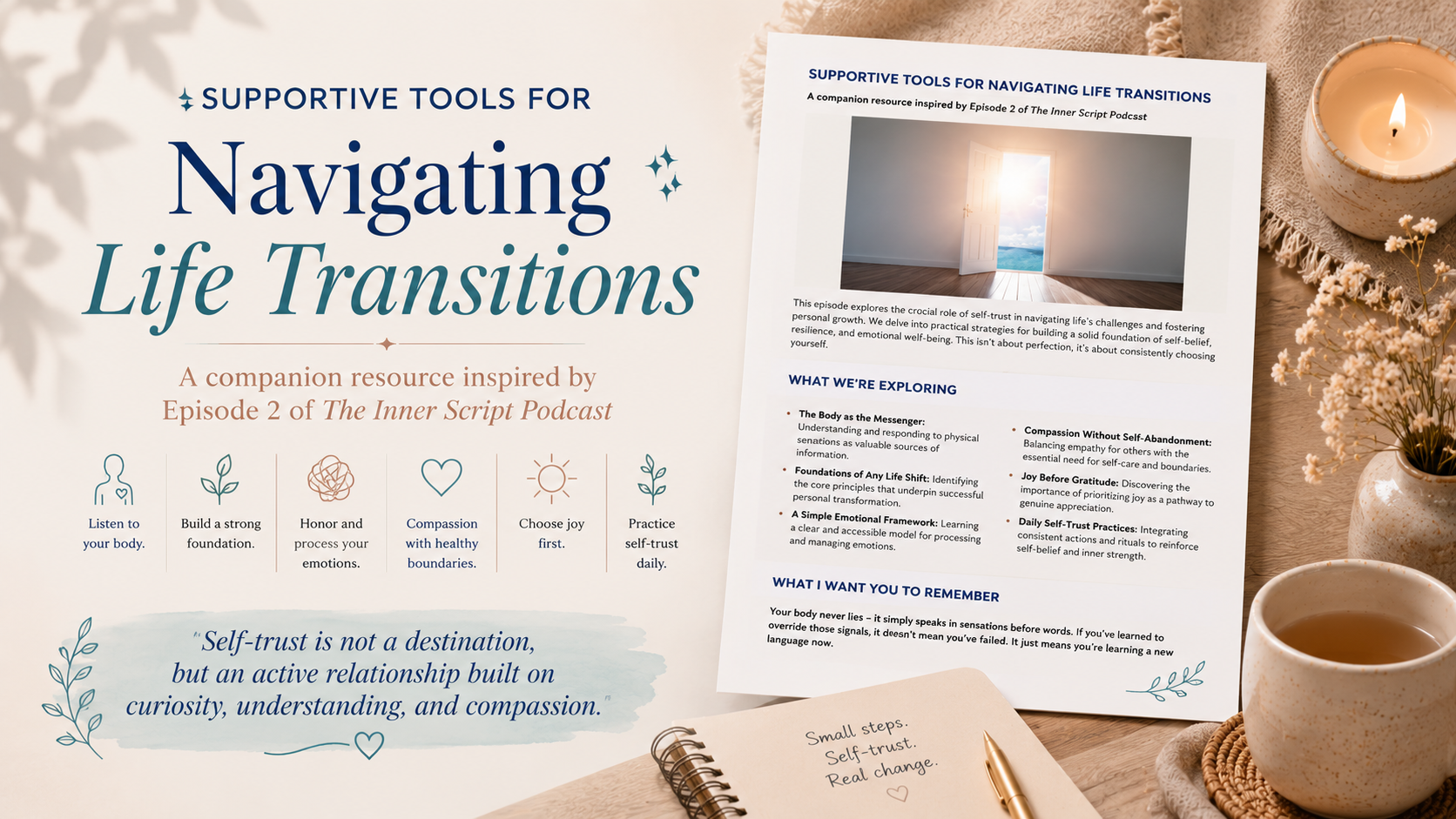
Supportive Tools for Navigating Life Transitions
If today's episode resonated with you, I've created a companion guide to help you put these ideas into practice. Download it here: Patreon companion resource
You can also join Steph’s free Patreon community here:
The Inner Script Patreon

Meet Your Host: Stephanie Baubie, NP
Stephanie Baubie is an integrative nurse practitioner and the host of The Inner Script Podcast, where she explores the deeper stories behind health, healing, identity, and transformation. Through a blend of functional medicine, nervous system awareness, emotional insight, and honest conversation, Stephanie helps women better understand their bodies while questioning the narratives they’ve inherited about wellness, worth, and what it means to truly feel well.
On The Inner Script, Stephanie sits down with physicians, founders, thought leaders, and experts in women’s health, while also sharing solo reflections on the transitions and inner shifts that shape our lives.
Follow Steph on Instagram.
FAQs
What are the biggest life transitions discussed in this episode?
This episode focuses on experiences like breakups, grief, moving to a new city, changing careers, friendship shifts, and periods of personal misalignment. While every transition looks different, the underlying principles of self-trust and emotional awareness apply across many life changes.
How can I learn to trust myself again?
Steph explains that self-trust isn't built by forcing confidence. It develops through understanding yourself, honoring your emotions, listening to your body's signals, and consistently making choices that align with your values rather than abandoning your own needs.
What is the emotional framework Steph shares?
Steph introduces a simple four-step process:
Name the emotion.
Feel it.
Express it.
Release it.
The goal isn't to suppress difficult emotions but to allow them to move through you so they don't remain stored in your body.
What does "compassion without self-abandonment" mean?
It means extending empathy toward others while still maintaining healthy boundaries. You can understand someone's behavior without excusing it or sacrificing your own emotional well-being.
Why does Steph say joy comes before gratitude?
Steph believes genuine gratitude is easier to access after your nervous system has experienced moments of joy, safety, and connection. Instead of forcing gratitude during difficult seasons, she encourages creating small moments of joy first.
How do I regulate my nervous system during stressful life transitions?
Steph recommends finding daily practices that activate your body's rest-and-digest response, such as journaling, walking, meditation, massage, baths, creative hobbies, quality sleep, and meaningful connection with others.
What is the most important message from this episode?
Your body never lies. It often communicates through sensations long before your mind can put words to what you're experiencing. Learning to listen to those signals is one of the most powerful ways to build self-trust.
-
Everything shared here is for educational purposes and personal reflection only. Not medical advice. Always work with your own healthcare provider for individual care.
Hello everyone welcome back to the Inner Script. So happy to be back here with you guys this week and for this week's episode. I'm really excited to dive into this and we're gonna talk about Foundational truths about moving through major life shifts. Kind of the things I wish I knew before going through many of mine because a lot of mine happened all at the same time, so it was very intense, but.
I explain a good amount of that about those specific transitions I went through in my previous episode, the first episode, if you ever wanna go back and listen to the first episode, there's. Some more detail on that, but we're really gonna be talking about some of the things I wish I knew before going through these things.
A lot of this encompasses self-trust emotional permission, owning your feelings, allowing yourself to feel and really alignment over self abandonment. I'm going to start with a patient story and I saw this patient of mine like a few weeks ago and it just. Was so perfect of what we're going to talk about today.
Like I actually couldn't believe that this happened. It was, I don't know, the universe works in crazy ways. She came in. Just continuing to feel off for probably like the past year or so, and she felt really fatigued, low energy, even though she was getting great sleep and her prior labs looked really good.
And obviously laps alone. Can't tell us the whole story, but. I asked her all of the standard questions, what's been going on, any changes in your diet, digestion, exercise, have you been traveling more? Any medications? You know, I asked about her mood.
Many of other symptoms because, feeling fatigued and off, that's very vague. So you really gotta get a full history to kind of know what's going on. and then eventually when I asked her about stress, she immediately. Teared up. And that's something number one I wanna point out is, and I think everyone has probably experienced this at some point, when somebody asks you a question and you feel this like rush of emotion and you feel like you have to start crying, that right there is emotions In your body that need to get released. That is something there that you have to navigate. And I think every single one of us has experienced that. When somebody is asking you what's wrong and you're just, you have no control and you just start crying. So. That happens a lot in my patient visits and it's so telling that there's something there that we have to explore.
so she immediately teared up and I'm like, what's going on? And she was explaining to me she was having more pressure at work, but not because of chaos, but She's in this job that, again, it's not like terrible, it's just not what she sees herself doing.
And I asked her to rate her stress on a scale of one to 10. Which I do all the time. And she said, you know, like not that bad, like six outta 10.
so then I asked, I was like, would you be okay with living with a six outta 10 pain level every day? And she paused and she was like sometimes I do, but I do it to myself. It's pretty much all my fault. I get so anxious for no reason. I create all of this tension in my body, I know I shouldn't feel this way.
Certain things just shouldn't make me anxious. And when she said that, my heart sank.
before she could continue going on this and like, kinda tearing herself apart, I intervened. I stopped her gently and I was like, look, I'm gonna be very blunt and I'm always very transparent. And she laughed. She loved that. And so I continued. I was like, I really don't like how you're talking to yourself.
You're not being fair. These are your feelings. Your feelings are non-negotiable. Nobody can tell you how to feel, especially yourself. Feelings are always there for a reason, and it's an opportunity for us to explore and figure out what's really going on underneath everything. You don't need permission to feel them not from anyone, and especially not from yourself.
And I know that sounds counterintuitive, but it's really the truth every feeling you have is valid. So please don't dismiss them. I kind of watched a light bulb go off in her head like, oh my God. first of all, feeling validated in how you feel is critical. It's so important because a lot of us are going around with what I say, the shoulds and the shouldn't.
Like, I should do this. I shouldn't do that. I shouldn't feel this. I should feel that. We have to honor ourselves. So then I asked her, I was like, where is this coming from? Why don't you honor your feelings?
And she said, I don't know. Maybe it's low self-esteem, but I don't really know where that stems from. My relationships are great. I have a great relationship with my husband, with my family, my friends. She didn't know where this was coming from, so I was like
I think what I would recommend doing is sitting on this and kind of journal about this, and I know this sounds kind of crazy. You know that A PCP or primary care provider is telling their patient to journal, but I want you to figure out where this low self-esteem is coming from, why you don't honor your feelings, why you dismiss them, and just kind of write about it.
And it's kind of an emotional dumping thing and allows you to really connect with yourself and you will be shocked what comes up and before anyone is coming at me here, I ordered the labs. Okay. We did a comprehensive lab panel for the fatigue, obviously. And, we did the screening questionnaires and we were gonna follow up in a few weeks to go over everything.
But my point in this is, this is a perfect example of how I blend this physical and emotional health, because it all is so layered.
You can't treat one thing without treating the other.
And this kind of transitions into the foundation of any life shift, and it's really the number one thing that I think is so important for us to emphasize when going through a huge change is.
The relationship you have with yourself is the most important relationship you will ever have. I think we need to imprint that like on our foreheads and remember that at all times, before anything else changes in your life, you have to be in a relationship with yourself. And what I mean by that, it's you have to trust your own inner voice.
And trust only comes. With understanding yourself. So a lot of the times I hear people wanting to connect with their intuition or trust themselves. How do they do that? But we're missing a step. You have to understand yourself first. You know, I can't speak to every life transition, but I can speak the ones that I've lived and that's been, grieving a parent, grieving relationships, going through breakup.
Friendship transitions, moving cities, career transitions, job changes, feeling misalignment in all areas of my life. What we're gonna talk about today really applies to most transitions, first thing I feel like you really need to give yourself is grace, and that means grace to feel.
Grace to sit in discomfort and grace to stop judging your emotional responses and the ability to say, this is really hard and that's okay, and it's not I shouldn't feel this way. Why am I still not over this, that's just not helpful. Like you have to give yourself grace.
You are feeling something for a reason,
So instead, I find it really helpful to ask, what is this feeling trying to show me? And that's a better way to approach it because.
It's not attaching so much pressure on you, it's about the feeling. And when you address it that way you can really figure out what this underlying reason is and why this is bothering you so much so what I recommend when any emotion coming up, 'cause it's always a signal, you name it.
You feel it, express it, release it. I'm gonna say it again. Name it, feel it, express it, release it. A little bit of my personal story, especially with my most recent breakup. this kind of came up a lot for me. People would always with good intentions, would ask. Aren't you angry after everything you did for him, and this is how it turned out?
Or don't you regret moving to San Francisco or moving across the country for him? Aren't you just so pissed and angry and sad and regret everything and all of these questions focused on him. The truth in the matter is I needed to take accountability for the fact that I chose someone who wasn't aligned with me.
And again, this is not blaming myself and I think people get so caught up when I say this is, well, it's not your fault. I'm like, that's not what I'm doing. I'm not blaming myself. I'm actually doing the opposite. I'm giving myself grace by understanding myself and understanding my pattern. The grace is the responsibility with responsibility comes identifying patterns so that we can break them. That is the best thing you can ever do for yourself is asking these deeper questions. Here's the hard truth that I had to sit with and another reason why. I think I almost felt triggered with these questions is because it was so focused on him making mistakes, which of course he did, but takes two people to tango always, and there's always, a way for us to grow in a situation.
So here's the hard truth I had to sit with. I saw the red flags early on, but I chose to ignore them. I ignored my own intuition. I didn't want to see them. So when you're dealing with anyone who isn't aligned with you, lack for a better word the real question isn't, why did they do this? The question is that I asked myself was, why didn't this behavior turn me off?
I'm gonna say it again. Why didn't this behavior turn me off? Because at the end of the day. Chaos felt familiar to me, and that's what I knew. To be brutally honest, I wasn't surprised by the ending. that definitely leveled out the herd of it. I will say I wasn't surprised. I was actually very relieved and I felt very validated in the way it ended.
But , was there hurt there? Yes. Disturbed, yes. Surprised not at all.
And that's another thing, people would be like, oh my God, were you blindsided? No, I wasn't. And you know what? I had to take accountability for that. That whole reflection alone it really led me into inner child work, and it finally allowed me to understand my attachments and my patterns a lot better.
And once you see it, you can't really unsee it. here's what really shifted everything for me in this situation. I was obviously really scared to start over at 32 years old, in a new city, didn't really have an established friend group and all of that, so I was very anxious. I was freaking out, to be quite honest.
But. I refused to become bitter. There is nothing worse than a bitter, angry person out there, in my opinion. I really refused to let anger get away of my own happiness. So instead of resentment. I was trying to figure out what could I do to prevent feeling resentful? What makes sense?
And so what I did was I chose compassion for myself and for him. And I know you're gonna be like what you compassion for him? And yes, I chose compassion look, it's not compassion that excuses behavior, but it's compassion that understands it and you can understand behavior.
Feel compassionate, but you still stay away. only makes you better. Resentment, anger makes you worse. obviously there is a time and a place to be angry, pissed off, frustrated, resentful. Absolutely. But the problem I think, is when we hold onto that for like months and months. So I found this to be very helpful because it really activated my empathic side, my sensitive side, and.
It allowed me to really release emotions and anger, and it allowed me to move on. Again, compassion doesn't excuse behavior, but it understands it. the more someone is capable of hurting you, the more it reflects their unhealed experiences, not your worth.
Compassion doesn't mean access, doesn't mean tolerance, and it certainly doesn't mean self abandonment. You can still lead with compassion by having boundaries as strong as steel, and I think that's. The flip side and the thing to understand is compassion doesn't mean you're weak. It means you're strong and you're continuing to have self preservation by having strong boundaries.
Hey friend, it would mean so much if you left a quick rating or review on Apple Podcasts or Spotify. It helps more women find these conversations and it truly energizes me and keeps this podcast going.
In looping back to that patient, she and I were dealing with the same patterns, but in different contexts. We weren't honoring our feelings. We weren't listening to ourselves and we weren't trusting our own inner script. So that right there, those few instances, that is really the start of navigating any life shift for me.
the next thing I really tried to focus on going through all of this is finding gratitude. And that's not me telling you to start a gratitude journal. I actually hate. The thought of a gratitude journal, and I actually think gratitude journals are bullshit when you're in the thick of your feelings, and I think it can feel very invalidating when you're in the thick of it, really going through a hard time and somebody says.
To start a gratitude journal again, so invalidating and it kind of insinuates like, oh, if you were just more grateful, you wouldn't be struggling. And that's bullshit, and that's not even true. yes, gratitude is important, but we are missing a crucial step. And for me, you can't access gratitude.
Until you find joy your nervous system needs to feel that goodness first before you can actually feel grateful. I know joy sounds really corny and about to dive deeper into this corny territory, but just bear with me.
It makes sense. joy isn't a feeling, it's really a state of being. Just keep going with me. Come along. Joy is really the door to access gratitude
and. Once you access gratitude and joy, you find authenticity, you're really able to find the things that light you up. And once you're living in this authenticity where you're just being yourself, doing the things that light you up, you find alignment, growth, and freedom, and you really become magnetic and you start to see things in a different light.
Opportunities and. Experiences start to come towards you because you're really living this authentic magnetic self and you're just in such a good positive energy that things really begin to shift and it's pretty amazing. also when you're in this state of being, you notice patterns break.
You stop betraying yourself. You recognize your worth, and anything that violates your worth really becomes non-negotiable. it's such a powerful feeling because you just have this amazing relationship with yourself. So , for me. Joy during this period really looked like, you know, I had friends come to visit me, and then I would travel to go see friends I started building a community in San Francisco and really saying yes to connection, I was prioritizing my needs in a way that I had never done before.
I was getting, quote unquote selfish, but it was really just, prioritizing me. I was being in a relationship with myself, it was honoring my independence when I needed alone time, things that really used to make me feel bad, but I need that time to decompress. Like you don't wanna be around me if I'm not decompressed.
The people who are closest to me would would agree. Like if I am not. In a good emotional state and haven't had my decompression transition time. Look, you don't wanna be around me, and that's fine. I get it. But yeah. During a transition, I think community matters so much. I cannot emphasize that enough.
I obviously was just saying how important alone time is and, independence, but you cannot heal in isolation. You can reflect alone. Decompress alone, but you can't rebuild alone. And that community creates a sense of safety, connection and joy and friendships are so important. And that was huge for me.
And the next piece of advice , it's really to always prioritize yourself. For me growing up, prioritizing myself felt selfish, which I think a lot of us are now realizing with, all of this information with like nervous system regulation and, and our work, I self prioritization is crucial and I think it's becoming something that's way more widely accepted, which is great,
but. When it comes to prioritizing yourself, it's your emotional, mental, and physical health. So all of those together, 'cause each one affects the other. And this meant for me, like saying no to things I didn't have capacity for and really not feeling guilty about it. that really meant stopping people pleasing, which is something I struggled with forever.
I don't remember a time when I wasn't people pleasing And look, I still catch myself from time to time, but I've begun to say no so much more without overexplaining myself and I don't feel bad about it. Also, it was really doing things that felt good in my body. for me, that was regular movement.
Walking to and from work, which is very grounding for me, , helps me decompress listening to funny podcasts in the morning before work, it's good to start your day laughing with lightness.
Especially if you're working with people also it was trying to cook close to 90% of my meals at home. Feeling really nourished, energized, and it's satisfying to cook most of your meals at home. And also cooking, creates presence. Prevents you from scrolling on your phone.
So I really found it was a creative outlet in a sense for me, and I looked forward to doing it when I got home from work. It really created this kind of stillness and allowed me to unplug a little bit from the day. Also skincare, just something about it just feels really good. You're kind of activating your feminine energy when you're doing your skincare.
And look, I don't have like a 10 step skincare routine. It's maybe like three, like not big, but it's something that I just really started to look forward to and enjoy doing and really focused on my sleep saying no to things at work. I would have. patients or colleagues ask me to do something.
And if I had the capacity then I would, if I didn't, I said no. And that honestly felt really good or really, really good 'cause I always would say yes. And then lastly, quality time with friends. You can't beat that.
Another thing that's so helpful is trying to do one relaxation practice a day. It's things that pulled my body in the parasympathetic nervous system, which is the rest digest phase. Because so often I ask people, I'm like, what do you do for stress relief? And they tell me Exercise and exercise is great.
It's great for endorphins, you know, stimulates lymphatic flow. It's good for energy, muscle mass, all the things. But I with true stress reduction, we need relaxation. And so that, again, is putting our body in that rest digest phase where we are just in total relaxation mode.
So for me, that was taking baths or try to get massages a few times a month. I started journaling every night and then doing a sleep meditation. Crucial. I can't even emphasize that enough. You have to figure out something that works for you. I, I talk about this with my patients all the time and they're like, well, what should I do?
And I'm like, I mean, I'll tell you what I'll do, but like, that's different for what's gonna activate. Your rest digest phase, so you kind of have to play around with it and figure out what works. But yeah, so it was baths, massage, journaling, sleep meditations, and long walks were really good for me. And doing all of that, I really saw how much my sleep improved.
I wear an aura ring and my heart rate variability improved significantly, and also my resilience to stress just. Completely improved. So, Another thing too is what I tell my patients. You know, finding something relaxing can also look like finding creativity. And I know that sounds, again, really corny, but creativity requires presence and that forces stillness and it's really hard to get stillness and presence with technology.
We have, notifications on our phones, we have TVs, podcasts, all the things, but. , We really need to get into that stillness mode, which I think is so crucial for nervous system regulation. So again, creativity can look like cooking, baking, writing, or a spiritual practice.
It doesn't have to be necessarily artistic, which I think was hard for me to grapple with. 'cause when I thought of creativity, I thought of like. Being artistic, which unfortunately I wish I was, but I can't paint or draw. That's just not a skill set I have. And honestly, once I decided to start this podcast, my nervous system never felt better because it required a lot of creating, like I was getting into my creative mode.
I was writing these episodes and figuring out out what guests I wanted to have on. I obviously felt so aligned and excited to start it, but I also was activating this creative side in me and I also started to view myself like, oh wow, I actually am pretty creative. Like, I'm kind of impressed. That all just really helped with nervous system regulation the next thing that really helped was.
Trying to feel expansion and a lot of the times in order for us to expand, you're gonna feel discomfort first. But I think that's beautiful about growth is it builds resiliency when you're feeling discomfort and you truly realize what you're capable of. So, a few things I did that were very transformative as I went to the ranch in Malibu.
It is, I would say a retreat, but it's pretty like hefty. You hike 10 to 13 miles a day on top of exercising, stretching, restorative yoga, and you eat really healthy meals you're around a group of people that kind of have a shared passion for. Wanting to feel good wanting to unplug and into movement and wellness.
So it was really fun to meet people kind of in the same boat. And it also activates that connection part that I think is so crucial, but. also it gave me a week of connection with my brother. He has gone to the ranch. I think he goes twice a year. He loves it because he leaves never feeling better.
So when I was going through my things, he was like, well, why don't you go to the ranch? And I was like, eh, it's a little bit of a hefty price for me, Robbie. He was like, so sweet. He paid for half of my trip and it was very, very nice of him because he was like, wellness and mental health is everything.
So I think let's go. And I'll pay for half of you. I was so grateful he did that. It was like one of the nicest things someone's done for me. but also it was really fun to experience that with my brother. And we were there for a week together and we were talking and we were like, when's the last time we spent like a full week?
One another because in your adult life, life gets busy. PTO is real. It's hard to get a week off for the holidays to spend time at home. So it was a really great experience and I was so happy we explored that together. I was also so impressed I've always had this woo woo side of me and I told this to my brother, I was like, you have a Wooo side, and I don't think you knew, or maybe you did.
And now you realize after coming to the ranch that yeah, he has a little bit of a woo woo side. He's into a lot of the things I'm into. And that experience really gave me a different lens on our relationship,
so I think taking a trip with a sibling or really close friend and doing something that isn't revolving around, drinking or. I don't know, just like a traditional vacation doing something that you guys both enjoy. it's really fun. I would put that on the bucket list. And then my other one was my solo trip to Myorca I never thought I would ever take a solo trip to a foreign country If you would've told me I was going to do that even two months prior to me leaving, I literally would've told you to shut up. Like absolutely not. But it really allowed me to push myself and allowed me to expand myself and showed me what I was truly capable of. And I was proud of myself for doing that.
and when you are proud of yourself and you accomplish things that really builds that self-trust. The last piece of information I have, which is probably the most difficult thing to do, and humbling, I would say, is grieve the life you thought you would have.
I say this because transitions are hard on its own because it, activates so many things, so many things come up. But it requires us to release this picture in our heads of what we thought our life would be like. And it's really okay to be sad about that.
This is probably the number one reason that keeps us through going through decisions is trying to release this image we had of what our life was going to be like. And for me, I'm 33 right now. I thought I would be married with a child by now, and that's clearly not the case for me. and I do want that for myself.
Absolutely. I know that is meant for me. I just know it's not a right now thing, and that's okay. And I truly trust that wasn't supposed to happen by now. I trust I'm going to have it. But right now the universe has a better plan and I feel really good about that. I think a lot of this has to do with having a better relationship with the unknown, which is very scary, but it's also unbelievable at the same time because.
You just don't know where your life is going to go, in the last like six months, I will say I can't believe some of the things that have happened. Again, going on that solo trip starting a podcast, like none of that was even remotely on my radar. And it's really cool to see. What unfolds when you have this better relationship with the unknown and you truly believe you cannot miss out on what's meant for you.
The last part and the best part of a transition, if you had to ask me, it's the moments that create the most discomfort. And then the realization that they truly become your biggest blessings, so you actually feel grateful for them happening. And to me, that's really when you get to a strong spot it's that realization.
That if you had never gone through that transition or that really tough time in your life, you wouldn't be who you are today. And I would've never started a podcast if, well, maybe I would've, but it wouldn't be the way it is right now. I wouldn't be called the inner script. It wouldn't be focusing on the inner work.
It might be. A different format, but it wouldn't be so authentically me. But if I had never met him and moved across the country and gone through that breakup and moving out and all the things, I wouldn't be where I am today. So I am truly so grateful for that whole. Ordeal, that whole situation, that whole relationship, meeting him, all of that.
And it really has become one of my biggest blessings. it's allowed me to heal in a way that has been transformative to step into my self-worth and to never question myself again. Those things have been so critical for me, if you're in your own life transition, remember this misalignment is never failure.
I know how uncomfortable misalignment feels, but it's not a failure. It's self-awareness and owning your inner script. And if you remember nothing else, remember this, your body never lies. It just speaks in sensations before words. Thank you guys so much for tuning in. That's all I have to say for now about life transitions.
It's been such a pleasure to release these episodes, record these. It's been so much fun. If you want to, reach out to me on Instagram. Please do let me know where you're at in your healing journey. If you want some more clarification on something or if you're a beginner or two.
Health and wellness or doing the inner work, or maybe you have a little bit more experience or you're advanced. I wanna know where everyone's at so we can, talk about things that resonate thank you guys so much for tuning in. I hope you guys have a wonderful rest of your day and we'll chat next week.
If you wanna connect with like-minded women and dive deeper into these conversations, join my Patreon community. There's a free option and it's where we can talk about each episode together. The link is in the show notes and I can't wait to see you there.
Disclaimer
Everything shared in this episode is for educational purposes and personal reflection only. It is not medical advice. Always work with your own healthcare provider for individual care.
We sometimes include links to products and services we find interesting. These may or may not be affiliate links. Thanks for your support.
Podcast production by Jamie Brooke.
