Why You Feel “Off” Even When Labs Are Normal | 6 Pillars of Integrative Health from a Nurse Practitioner
Listen now by clicking your favorite podcast app below:
Have you ever felt like you're doing everything "right" for your health but still don't feel like yourself?
If you've been chasing answers through supplements, lab work, restrictive diets, or the latest wellness trend, this episode offers a refreshing reminder that true healing often begins somewhere much simpler.
In this episode of The Inner Script Podcast, Stephanie Baubie, NP, shares the six foundational pillars she uses with every patient before recommending advanced testing or complicated treatment plans. Drawing from both her clinical experience in functional and integrative medicine and her own healing journey, Stephanie explains why lasting wellness depends on creating stability within the body first.
From nutrition and digestion to movement, sleep, stress regulation, and detoxification, you'll learn how these interconnected systems work together to support homeostasis, resilience, and long-term health. Whether you're navigating chronic symptoms or simply looking for a more grounded approach to wellness, this episode will help you reconnect with the basics that allow your body to heal the way it was designed to.
This episode is for you if…
You feel overwhelmed by conflicting health advice and want a simpler, more sustainable approach to healing.
You've tried supplements, restrictive diets, or expensive testing but still don't feel your best.
You want to understand how nutrition, sleep, stress, digestion, movement, and detoxification work together to support whole-body health.
Episode Timestamps
00:00 Welcome Back
01:05 Why Foundations Matter
02:20 Understanding Homeostasis
05:12 Six Pillars Overview
07:08 Diet & Food Freedom
12:42 Gut Health Basics
16:08 Rethinking Movement
20:38 Sleep & Recovery
25:47 Stress Regulation
33:20 Detoxification Explained
40:52 Small Changes Matter
Resources & Mentions
Magnesium Glycinate (Pure Encapsulations)
L-Theanine (Pure Encapsulations)
Magnesium Oxide Powder (NOW Foods)
Dandelion Tea
Curious about a supplement Steph has mentioned in the episode?
If you’re looking for products Steph personally recommends in practice, you can browse her dispensary here: Stephanie’s Fullscript dispensary
Please consult your healthcare provider before starting any new supplement. Food, lifestyle, and nervous system support always come first.
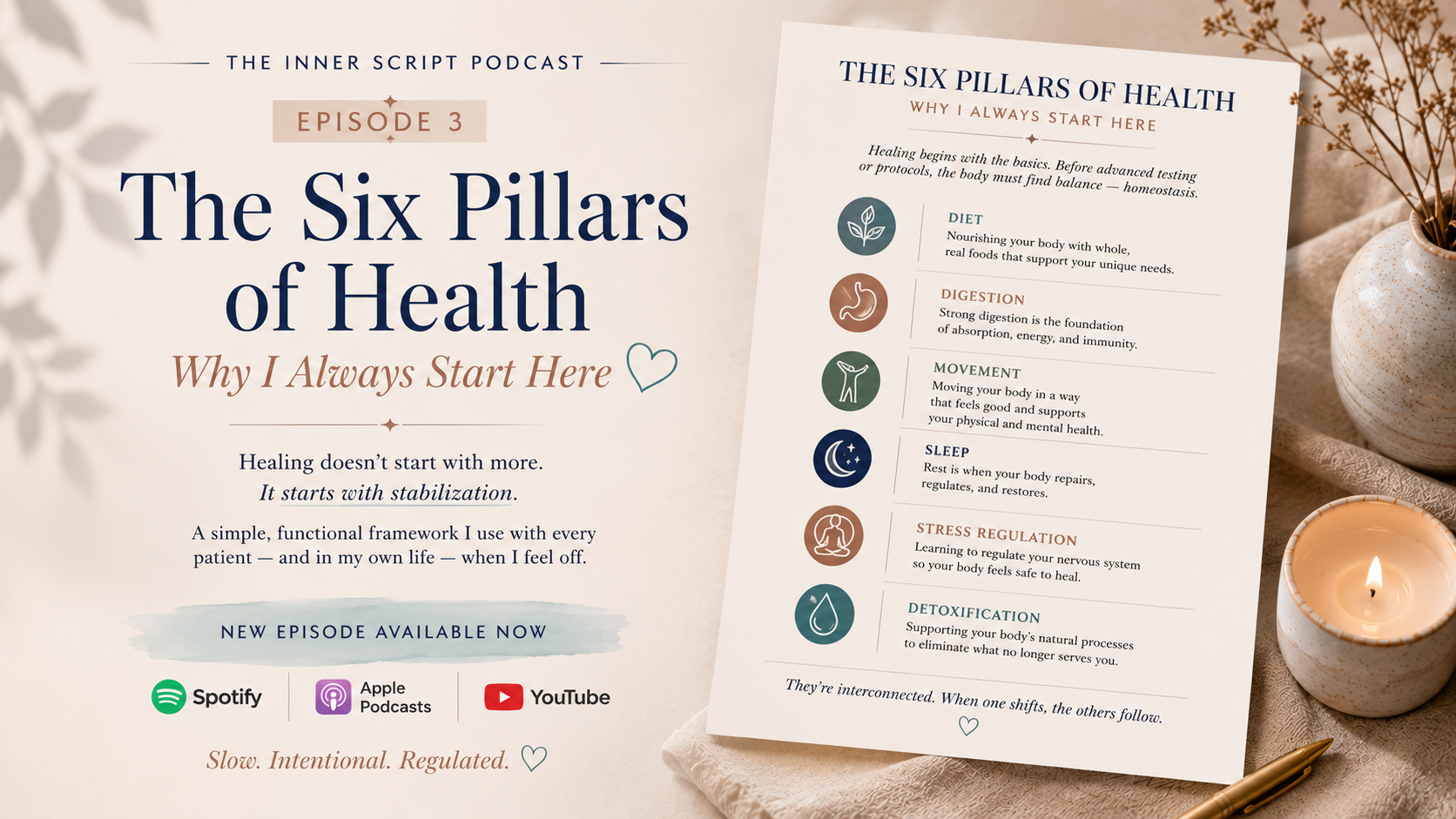
Download: The Six Pillars of Health Guide
This beautifully designed companion guide walks you through Stephanie's Six Pillars of Health framework, giving you a simple reference you can return to whenever you want to rebuild your health from a strong foundation. Download it here: Patreon companion resource
You can also join Steph’s free Patreon community here:
The Inner Script Patreon

Meet Your Host: Stephanie Baubie, NP
Stephanie Baubie is an integrative nurse practitioner and the host of The Inner Script Podcast, where she explores the deeper stories behind health, healing, identity, and transformation. Through a blend of functional medicine, nervous system awareness, emotional insight, and honest conversation, Stephanie helps women better understand their bodies while questioning the narratives they’ve inherited about wellness, worth, and what it means to truly feel well.
On The Inner Script, Stephanie sits down with physicians, founders, thought leaders, and experts in women’s health, while also sharing solo reflections on the transitions and inner shifts that shape our lives.
Follow Steph on Instagram.
FAQs
What are the six pillars of health?
The Six Pillars of Health are Stephanie Baubie's foundational framework for creating long-term wellness. They include diet, digestion, movement, sleep, stress management, and detoxification. Rather than treating symptoms in isolation, these six pillars work together to help your body maintain homeostasis and support healing from the inside out.
What is homeostasis and why is it important?
Homeostasis is your body's ability to maintain a stable internal environment despite outside stressors. When your body is in balance, it can regulate hormones, support digestion, strengthen immunity, repair tissues, and adapt to everyday challenges more effectively. Stephanie explains why protecting homeostasis is often more valuable than chasing the newest health trend.
Why do I still feel unhealthy even if my lab work is normal?
Normal lab results don't always tell the whole story. Stephanie believes many people experience symptoms because foundational lifestyle factors—like sleep, nutrition, movement, stress, and digestion—are out of balance. Supporting these areas can often create meaningful improvements, even when traditional lab work appears normal.
Why doesn't Stephanie recommend complicated health protocols first?
Stephanie's approach to functional and integrative medicine is to build a strong foundation before considering advanced testing or expensive protocols. Addressing the basics first often improves resilience, helps the body heal more effectively, and provides better long-term results than jumping straight into complex interventions.
Is intermittent fasting right for women?
In this episode, Stephanie explains why extended intermittent fasting isn't the best fit for many women. She discusses how long fasting windows may increase cortisol, disrupt hormones, and leave some women feeling more depleted. Instead, she encourages listening to your body's signals and prioritizing consistent nourishment.
How can I start improving my health without feeling overwhelmed?
Stephanie recommends choosing just one small area to improve first. Whether it's getting better sleep, adding more whole foods, taking a daily walk, or supporting digestion, consistent small changes build momentum over time. Healing doesn't require perfection—it begins with a solid foundation.
-
Everything shared here is for educational purposes and personal reflection only. Not medical advice. Always work with your own healthcare provider for individual care.
Hello everyone welcome back to the Inter Script. I am recording this on Sunday, January 4th, so right after the holidays and it's 2026, which I'm really excited about. I hope everyone had wonderful holiday celebrations doing whatever it is that you do. I hope you guys got some downtime.
I sure did. I had almost like two weeks off of work, so the scaries are definitely real going into tomorrow. So what I wanted to. Talk about this episode is how I practice medicine the way I do.
When I approach integrative medicine particularly, it's bringing things back. To the basics. There is so much health information out there and it's so overwhelming, and oftentimes there's a way to simplify it. And things, ideas, systems can be made a lot more simple than the things that are out there.
So I'm going to dive in and explain some of the ways I treat my patients and if there's one. Truth I've learned personally and professionally through working with thousands of patients, I would say, and even myself, is this, before we chase the fancy labs, while very tempting or all of the trendy protocols we have to build a foundation when it comes to health and wellness in our bodies.
So the basics are really what keep our body in homeostasis, which I'm going to explain a little bit about what that means. I practice. Using what I developed and what I call are the six pillars of health, and these are what transformed my own health, reshaped the way I practice medicine, and honestly saved me during one of the hardest seasons of my life when it came to my health.
So today I'm gonna share them with you in a little. Story into my why for this. You know, before I get into the six pillars, I wanna take you back to college because that is really when this moment shaped my entire approach to chronic illness, even though I didn't know it at the time when I was in this class.
Basically in my sophomore year of nursing school, I was taking pathophysiology, which was hands down my favorite class I've ever taken Nerd alert. Our first lesson in this. Pathophysiology class was on a concept called homeostasis, and it's the body's ability to maintain a stable internal environment.
So it's really built on resilience in your body, which is just amazing. We learned this at this cellular level. That's how detailed this can get. How complex our body is and how much of a system our body is that we oftentimes overlook. When the body is. Homeostasis. Everything is working in harmony.
Chaos can't get through, but when the balance is disrupted, disease takes hold, and that can look many different things. So I basically became fascinated with the idea that if we could preserve this balance, we could prevent chronic illness before it ever developed. Fast forward to my work. In functional and integrative medicine in Chicago where everyone wanted thousands of dollars worth of labs.
Microbiome testing, hormones, neurotransmitters, you name it. And these are very expensive tests, not covered by insurance, but I noticed something if we didn't address the foundation, nothing moved. So you cannot heal on a shaky foundation. And there's also. A line from a show I recently watched, and it's called Brilliant Minds and.
It stopped me in my tracks. The doctor said something along the lines of, we don't treat the person as the disease. We treat the disease within the person. And that's exactly how I practice. A diagnosis is never the whole story. The symptoms even are never the whole story. It's a chapter, not the full identity.
So we have to look at the whole person.
My whole idea of the six pillars of health were born. And I named them diet, digestion, movement, sleep, stress management, and detoxification. once I brought patients back to these six basics, I saw momentum, I saw clarity, and I finally saw healing. So some of the most common things.
I have treated our chronic fatigue, gut issues, thyroid disorders, autoimmune disorders, chronic pain, weight gain, menstrual irregularities, or hormone imbalances, and patients would come to me wanting every panel imaginable, but before labs, I always. Asked questions. This is where it starts. You have to get a good history.
I would ask things like, what does your diet look like? How much caffeine do you drink? Alcohol? How's your sleep? How's your digestion? How often are you moving your body? How do you feel after you move your body? Very key. How do you feel emotionally? Do you feel supported, connected with yourself, friends, family, partner, and do you like your job?
So every single time, I found that at least two or three of the pillars were completely out of balance. And fixing those alone created massive shifts. And Know this, when the basics crumble, internal resilience disappears. Your body cannot maintain homeostasis. That concept we talked about in the beginning, it can't adapt, it can't repair, and it can't thrive.
So let's break down each pillar and I'll share how my own experiences shaped them. So the first one, diet. I don't prescribe rigid diets because the body often tells you exactly what it needs. Obviously, if there's an underlying issue, celiac disease for instance, or a known allergy, sure,
There's a time and a place for it. It's just, it's not everyone gets a gluten-free diet, I guess is basically what I'm trying to say. all we have to do when it comes to diet is we have to learn how to listen. So I focus on whole foods with lots of color, fiber, and balanced plate.
So basically what I tell patients at each meal, really try to aim for a protein source, one to two servings of healthy fats, fruits or vegetables, and then a complex carbohydrate. Right now I've noticed we're in a huge protein craze, and yes, protein is crucial, absolutely. But what I've noticed is most women specifically are undereating carbs.
There's a lot of food fear out there and it takes a long time to reverse that mindset. Many women are undereating carbs. And they literally break down into glucose, which is your body's primary fuel.
So especially there's so many women out there exercising, every day, not eating enough carbs. Your muscles, your cells need carbs. Carbs, stabilize cortisol support hormones. And give your nervous system the energy it needs. Here's the truth with all of this. You have to eat enough chronic calorie and carb deficits, rock your hormones.
. I really don't ever help people to eat certain types of macros or calories. I mean, I do make sure people are eating enough. If they tell me they track their calories and they're eating, way too little, I will tell them and try to. Get them to increase their caloric intake.
I'll have them see a dietician just so that they can spend a little bit more time on that. I don't really like prescribe like a calorie, whatever. 'cause everyone's needs are different. And then another thing with. Cravings, which I hear a lot about. Cravings are clues, not problems. So that's another reframe we all have to make.
a lot of the times I notice if people are craving fat, then you probably need more calories craving sugar. You likely are under fueling with complex carbs. I am not kidding. Once you start increasing your. Carbohydrate intake, whether it's through potatoes, rice, you will have less sweet cravings. I promise.
It's kind of rare for me to crave a sweet, once I started adding more carbs , into my diet, I obviously still crave them, but it's not like it used to be, another one with like craving red meat. You might need like iron or protein. So those are just a few like tips if you guys wanna take that away.
And then one thing for me, I used to avoid eggs and limit fat because I was afraid they'd upset my stomach due to my chronic digestion issues. And once I really started to listen to my body and. Tune in and figure out what it needed. And part of this was aligning my eating with my menstrual cycle, which is, your follicular phase, ovulation luteal, and then your menstrual phase.
Everything changed. And not only that, I was listening to my body. My digestion issues changed too, because I was giving my body what it needed, so my anxiety around food dropped. As I said, my digestion improved and I finally felt nourished. it can take a minute to kind of reframe this it's hard, but it's possible.
Okay. I wanna touch on intermittent fasting, hot take. I do not recommend intermittent fasting longer than 12 to 14 hours for women. So say like I eat dinner at seven. Pm I am eating breakfast at 7:00 AM I don't really even think about a fasting window.
I just go to bed and make sure that I eat a well balanced dinner, and then I wake up and I try to get food in within like an hour of waking up. Yeah. The thing is, I think men can get away with intermittent fasting more than women, and that's okay. We are wired differently. Our physiology is completely different, and our hormones are way less resilient than men's when it comes to intermittent fasting.
long, fast, increase cortisol cravings, disrupt your hormones, and make most women feel worse. One thing, please don't drink coffee on an empty stomach. Listen, I've been there, but it just wrecks your hormones. It wrecks your digestion. It's very acidic, not ideal. For me, what Another thing that really helped when it came to diet overall was really cooking close to 90% of my meals at home and.
You might think, well, wow, that sounds very restrictive. Listen, I always cooked mostly like I would say 70 to 80% of my meals at home. But I'm at this point in my life where I actually look forward to it. I want to cook my meals. I enjoy it. It's a creative outlet for me honestly, now that my food anxiety has kind of gone away, it makes me more excited to cook at home. Like I'm just cooking a lot more fun things. Think your intention behind everything is really important, and for me, cooking close to 90% of my meals at home, it's not a way for me to restrict myself.
It's, I'm actually enjoying it. I prefer to do it, obviously. I love to go out to dinner with friends or go to brunch, but I really enjoy this part of my life. Now, that's another thing that really shifted for me and mindset is everything. Pillar number two is digestion.
digestion is one of my favorite topics because I've lived through. All of it. All of it. You name it, I've had it. So your digestion is really a window into your internal world, and I really always knew that growing up, or even as an adult, but it's different to truly believe it. I'm gonna have a whole episode dedicated to digestion and my story behind it and what I did. And what worked, what didn't. So that will be a whole other episode. So I'm just gonna touch on a few things here. But usually if you're feeling bloated, or have reflux or indigestion, that's often a sign of low stomach acid or low bile.
Again, we're gonna get all into this, but just kind of test in the waters here. And then if you're having like loose bowel movements or diarrhea, that's typically possible intestinal permeability. And then if you're having like lower bowel movements, constipation, most common stress, it can be a sign of low stomach acid, low fiber, or dehydration.
So those are the most common things I see. But this is the piece. I want you to remember, if you don't digest your emotions, you can't digest your food. Simply put, stress and unprocessed emotions live in the gut. Our gut is our second brain. 70% of our neurotransmitters are in our gut.
So when you're doing nervous system regulation, stress reduction, guess what? Your digestion will improve, I promise. Again, as I said, we're gonna go deeper in a future episode, but for now, no. For many people, especially people who are highly sensitive, and I imagine that is you, since you are listening to me, know that your gut mirrors your emotional landscape.
Okay. Pillar three movement. My relationship with exercise has changed dramatically over the past 15 years, I used to think movement. Meant run sweat, push, burn, calories look a certain way. And now I focus on movement, not exercise. This pillar used to be called exercise in the last, I would say year, year and a half.
I switched this to movement because that's how I view. Exercise now, movement to me is intentional. It's flexible, it's intuitive, and exercise is simply one part of it. So my current routine, it changes every week. Like I don't have like a structured thing, but I typically give her take.
We'll do two days of Pilates. I aim for three days of strength training. Sometimes it's two if I'm too tired or if I'm not feeling it, and then daily walking, not for steps just to move, get sunlight, support, lymphatic flow, and clear my head. It's a huge nervous system. Regulation tool for me, I feel my best when I'm just outside walking I have been through every phase of this.
The over training, hot yoga, daily HIIT workout, six days a week, 90 minutes in the gym. I look back at photos from my like mid to late twenties, and I was the most inflamed during the time I was doing the most. Most inflamed when I was doing the most in terms of exercise. If you overdo it with exercise, your body will get inflamed.
I promise. And then mobility matters so much it does not get talked about enough. Like mobility is literally everything. And I will say Pilates transformed my flexibility and even. It has helped my patients eliminate, like chronic back pain. Pilates is amazing for lengthening muscle fibers, so it indirectly helps improve your flexibility.
I am not naturally flexible, but my flexibility has improved significantly. With Pilates. And then one thing for women is honor your cycle when it comes to exercise and movement, crucial during my luteal phase, which is after ovulation, until you have your period, that's your lute phase.
It's usually when your body needs the most nourishment, the most rest, downtime. So during my luteal phase, I move less. I choose more Pilates. More walking, stretching, movement should always match your energy, not punish it. So if you wake up feeling depleted, guess what? Just skip your workout. Your body is telling you to slow the F down.
And then lastly, I want to touch on the importance of movement and muscle mass. Muscle mass is really crucial for overall longevity. I love Pilates, as I mentioned, but I also love strength training. We need strength training to build muscle, and one thing I will say that I give a lot of credit to when it comes to strength training and movement and exercise is my mom, she is 68 years old and she's always been very active and she has always emphasized the importance of strength training and lifting weights.
I will tell you, she is still extremely active she's 68 and still goes to Orange Theory I see her and her arms are jacked as a 68-year-old woman and she looks great.
I really think it's because she has always been very active and she did strength training from an early age well into her sixties, and she will continue. She also rides horses at 68.
I do not see her stopping anytime soon. So my point is, muscle mass is key for longevity and yeah, I owe that a lot to my mom.
Okay. Pillar four is. Sleep. Sleep is literally Everything, nothing improves without sleep. And I will say after I went through a really hard time, my sleep. Completely tanked.
My aura ring showed me how deeply my stress was affecting my recovery, if you wear an aura ring, you can tell how well your body is recovering from stress based on your HRV or your heart rate variability. It basically reflects your nervous system and my. HRV was like tanked I was 32 at the time.
That's really not ideal, especially like already living a healthy lifestyle. It didn't fit, what was going on. Another thing with the aura ring of what it showed me, and I love data and this was very helpful in figuring out what was going on with my sleep. So it also showed me alcohol absolutely destroys my sleep.
Quality screens late night, destroy REM and deep sleep, and then morning caffeine without food was spiking my stress response. Yeah, I used to drink coffee at an empty stomach because I was on the go trying to get to work at 8:00 AM Didn't have time to eat my breakfast, so I would do it at work, and then I was drinking coffee.
That no longer happens anymore, so my sleep changed the most when I took. Magnesium glycinate after dinner added L-theanine before bed, which is an amino acid. It's very calming and it helps really promote deep sleep in rem. And then I reduced my nighttime screen time. I was really good about this.
At one point I was sleeping with my phone, charging in my kitchen, and then. I kept it outta my bedroom and I was really good about that. I haven't been good about that lately. I need to go back to doing that. I'm gonna hold myself accountable, so. That was game changer. I would read before bed and I also lowered my caffeine.
I really supported my adrenals. Your adrenal glands is what produces cortisol. Getting my body in that relaxation state of my nervous system and I was really learning how to regulate stress and that all. Occurs with changing your perception to something that is happening to you that you perceive as stressful.
So there's a portion of that. And then actually honoring my bedtime. I can't tell you how many times I've seen. This similar profile of a patient where they come in exhausted, inflamed, anxious, losing hair, sick all the time. Sleep is . Almost.
I wanna say always, but I'll say almost because I can't be certain right now 'cause I've seen this like a hundred times. Sleep is almost always part of the root cause. Sleep deprivation, dysregulate, literally everything. And yes, the solution can be simple, but simple doesn't always mean easy.
Okay. Okay, pillar five, stress management. Stress and sleep are inseparable. They really do go together. You really can't sleep well until your stress is under control. when I ask people how they manage stress outside of exercise, most of them literally look at me like I have five heads. They don't know how to answer.
And I'm not saying not to exercise. Exercise movement is crucial, but we need to get our body in that rest digest phase of our nervous system. Exercise is great, movement is great, but it does increase your heart rate, your blood pressure and spikes your cortisol, which in a short period of time is fine, but we.
Need to balance that out with the rest digest phase of our nervous system. None of us were taught how to actually regulate our nervous systems. None of us were taught. How to reduce stress, how to relax, and there really isn't a cookie cutter approach. You have to figure out how you are wired in order to reduce your stress.
And I have this conversation with patients all the time. They ask me like, well, what can I do to reduce my stress? And I'll give them some ideas, but I'm like, you need to tune in. You need to figure out how you are wired. That's a question better suited for you.
That's something you need to kind of figure out. Like you can try. This is what works for me, and I give them my spiel, but it might not work for them. So you have to figure out how you are wired in order to. Get your body in that rest digest phase. Stress management. What works for me is walking without headphones, journaling.
Cooking meditation, but nothing longer than like 10 to 15 minutes. Otherwise, I'm not sitting there doing meditation for longer than that. I get restless, you know, breath work. And again, that's not me sitting there doing a 20 minute breath work. It's literally like. Taking three deep breaths in between patients, especially if I, deal with a very stressful situation at work.
I will go outside, I put my arms like over my head stretch, and I take like five deep breaths in and out to reset my nervous system. That's really all it takes. You don't need to be doing that for 20 minutes. So yeah, , breath work, creative hobbies, like honestly.
I will say once I decided to start a podcast and started creating content and writing episodes, my HRV and sleep improved. My resilience to stress improved because I was doing something that really lit me up. I cannot emphasize that enough. And then yoga and massages love those. The other thing when it comes to stress management is.
In order to reduce your stress, you have to find presence in your mindset and in your body in order to activate that rest digest phase. What I mean by presence is you're not getting totally distracted by external stimulus or stimuli Presence only works if your perception of stress changes.
Things like that for me, I am naturally an anxious and nervous person my nervous system is very sensitive. It's very easy for me to get off the rails, like very easy. So I have to keep myself in check when I'm feeling really overwhelmed and stressed out.
I have to ask myself, does this need to be handled right now? Can this weight, does this sensation, emotions, do these even belong to me and is this mine to carry? That really helped shift this perception to incoming stressors another thing is boundaries.
Boundaries changed everything. For me, especially in patient care, I am a naturally a people pleaser. I want to make everybody feel good. I naturally tend to take people's emotions on and, try to manage everything at once, that doesn't work for me at all. No one should be doing that, but it really came to understanding my perception too, just because I say no to someone. That doesn't mean I am selfish. That doesn't mean I am a bad provider or a bad nurse practitioner. I had to literally change my mindset of if this is going to disrupt my inner peace, I'm not gonna do it.
And I think that's a helpful. Thing to ask yourself if, say somebody's trying to get you to take on a project at work, or, a friend is asking you to go to dinner with somebody you don't like, I don't know. If you ask yourself, is this going to disrupt my inner peace? Then you don't do it.
And I think that was a really helpful transition. And obviously we have to do things we don't want to do. That's not what I'm saying, but it's more of that inner peace sensation where it literally causes your body to contract and react than it's a no. This isn't selfish, it's self preservation.
I think understanding that and flipping that script a little bit is a. Very helpful improving sleep, regulating my eating, honoring my cycle, shifting from exercise to movement. All of this really reduced my stress. . Last pillar six. Detoxification detox is very nuanced, so I'm going to try and simplify this as much as possible.
But detoxification only works when the gallbladder, liver and microbiome are working together. I teach the three Ps of detox with my patients. Pee poop perspire. So basically the way this works, the body moves toxins through three phases. Phase one is also called activation phase, so that's when liver enzymes make.
Toxins, water soluble. Things have to become water soluble so that they can eventually get bound and taken out of the body. But the thing is that you have to know is when these toxins become water soluble, they're still reactive. Meaning if you're not actively eliminating them, they can cause detox reactions.
So phase two. Is neutralization. That's when toxins that are now water soluble get bound. In other words, conjugated. So get bound so that you can get it out of your body. And then phase three is elimination. That's when the toxins that have been transformed into water soluble compounds and are bound.
They are now ready to get excreted through stool, urine, or sweat. And the thing is about this that, people can make mistakes in is you have to start with phase three. So you go backwards. You don't start with phase one because if you are going to make toxins, water soluble, but still reactive, you will get detox reactions.
That's why, if you are constipated, you have to fix the constipation first before you address the other forms of. Detox. How I support detox sweating through exercise.
Sauna Epsom salt baths. One of my favorite things to do, high fiber diet, leaner breakfast and what I mean is like things that aren't super high in fat because high fat in the morning just doesn't work for my body.
It really slows things down. So, Oatmeal with protein powder and a scoop of like coconut yogurt or something. Like, I still do get fat in the morning, but I can't do like a really high fat breakfast. Otherwise, it really messes with my digestion. And then coffee only with food.
I never drink coffee on an empty stomach anymore. Managing stress and then. Aiming for two to three bowel movements per day. Yes. Yes. 2, 2, 3. One. Bowel movement is good, two is great. Three is excellent. We really should be going to the bathroom two to three times a day, because guess what? You're eating three times a day.
If you're not actively pooping things out, toxins can build up and then. Magnesium oxide when needed can be really helpful. Magnesium oxide powder it really stimulates water into the colon so that you can have like a good bowel movement. That's key. I find that can work better than magnesium citrate.
I find magnesium citrate can cause a lot of cramping and urgency. Magnesium oxide really doesn't do that. I'm sure it can in certain people, but I haven't had that complaint yet. And then dandelion tea before bed is great. And then just really trying to get optimal sleep. When you're sleeping, that's when your body detoxes the most.
So again, detox is very nuanced. I can do a whole episode on it. If you guys are interested, Kind of to close this out, you know, these pillars overlap and that's the point. Our body is a system at the end of the day. Like I think, especially in school, we were taught to look at the body as like separate organs, but that just couldn't be more false.
when you adjust one of these pillars or you bring something in for your health, another area of the pillar starts to shift, and it doesn't have to be overwhelming, and I know it can feel bad. I a thousand percent know, but you pick one thing and maybe it's morning hydration and you will feel subtle, but meaningful changes and that's everything.
So these six pillars have like seriously changed my life in the way I look at my health, and they've really changed my patient's lives too. Just trying to get them to think of things in more simpler terms. It's bringing things back to the basics and building a strong foundation. . I hope that these brought some clarity to your health journey as well.
I'm gonna talk all about digestion in the next episode. If you want me to go deeper into some of the other ones, let me know. I'm happy to do it. Thank you so much for tuning in. If you have any questions or want to share where you are in your wellness journey or if you just.
Want more of a specific topic or anything, questions, comments, concerns, whatever. Send me a DM on Instagram at the inters script pod. I would truly love to hear from you. Love to know what's resonating, maybe what's not. I hope you have a wonderful rest of your day and I will see you guys next week.
All right. Take care.
If you wanna connect with like-minded women and dive deeper into these conversations, join my Patreon community. There's a free option and it's where we can talk about each episode together. The link is in the show notes and I can't wait to see you there.
Disclaimer
Everything shared in this episode is for educational purposes and personal reflection only. It is not medical advice. Always work with your own healthcare provider for individual care.
We sometimes include links to products and services we find interesting. These may or may not be affiliate links. Thanks for your support.
Podcast production by Jamie Brooke.
