Can Breathwork Heal Your Nervous System? What You Need to Know Before You Try It
Listen now by clicking your favorite podcast app below:
Have you ever felt like you understand why you’re stressed, anxious, or triggered, but your body still reacts the same way?
In this episode of The Inner Script, Stephanie Baubie, NP sits down with Megan Ashton, founder of Unity Breathwork and an advocate for raising safety standards in the breathwork industry, to explore conscious connected breathwork, trauma, nervous system regulation, and why healing may require more than simply understanding what happened to you.
After spending more than 15 years trying different approaches to heal from bulimia, alcohol dependence, grief, and trauma, Megan discovered conscious connected breathwork. She explains how this activating form of breathwork differs from everyday calming breathing exercises and how intentionally working with the body may help people access emotions, memories, and physical responses that aren't always reached through the conscious mind.
Stephanie and Megan also discuss the limitations of approaching healing entirely through the mind, why someone can understand their triggers and still feel them physically, and the potential value of combining top-down approaches like talk therapy with bottom-up, somatic practices.
But not all breathwork is created equal. Megan shares why conscious connected breathwork requires proper preparation, trauma-informed facilitation, grounding, and integration, and why the growing popularity of short facilitator trainings concerns her.
They also explore the pressure to constantly chase the next wellness practice, the importance of choosing practices that actually feel right for you, and why something as simple as five minutes of intentional breathing or stillness can be more valuable than continually checking new wellness practices off a list.
This episode is for you if…
You understand your triggers but still feel them physically
You feel chronically stressed, reactive, anxious, or emotionally shut down
You’re curious about somatic healing and nervous system regulation
You’ve tried talk therapy or other healing modalities and feel like something is still missing
You’re curious about conscious connected breathwork but don’t know how it works
You want to understand how to choose a safe, trauma-informed breathwork facilitator
You feel overwhelmed by all the wellness practices you’re “supposed” to be doing
Episode Timestamps
00:00 What Is Conscious Connected Breathwork?
05:51 Inside a Breathwork Session
09:32 Megan’s Healing Journey
13:24 How the Body Releases Emotion
18:42 How Trauma Shows Up in Breathwork
25:48 Breathwork vs. Plant Medicine
29:24 When Talk Therapy Isn’t Enough
31:35 Why Breathwork Safety Matters
36:30 Your Nervous System’s Stress Bucket
40:36 Stop Chasing Every Wellness Tool
43:36 Inside Megan’s Breathwork Retreats
46:57 The Power of Your Breath
Resources & Mentions
Trauma-informed breathwork
Nervous system regulation
Somatic healing
EMDR
Coherence breathing
Box breathing
Curious about a supplement Steph has mentioned in the episode?
If you’re looking for products Steph personally recommends in practice, you can browse her dispensary here: Stephanie’s Fullscript dispensary
Please consult your healthcare provider before starting any new supplement. Food, lifestyle, and nervous system support always come first.
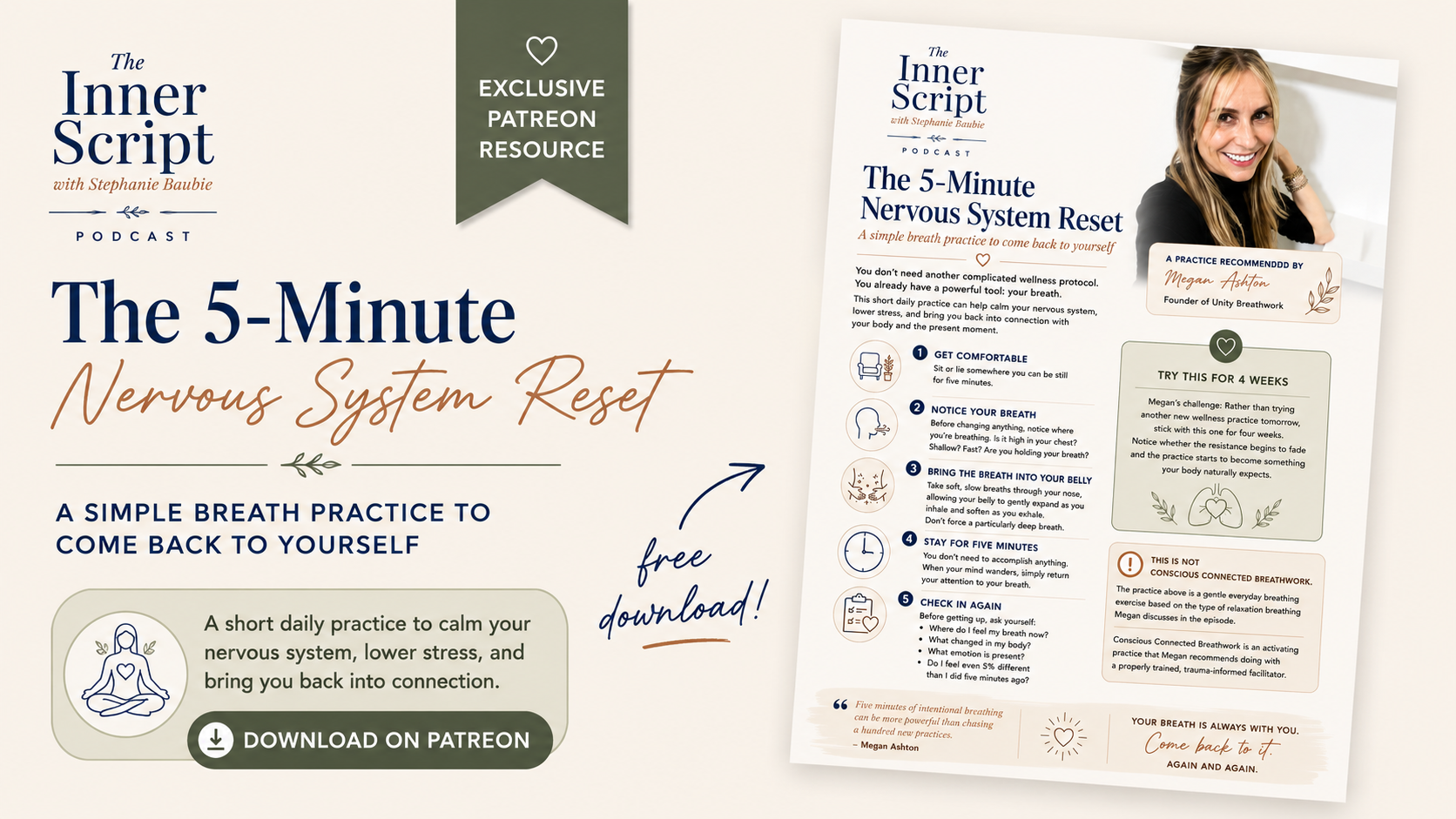
What if supporting your nervous system didn’t require another complicated wellness routine?
To accompany this episode, Steph created The 5-Minute Nervous System Reset, a free printable guide inspired by Megan’s recommendation to start with a simple, consistent daily breathing practice. Download it here: Patreon companion resource
You can also join Steph’s free Patreon community here:
The Inner Script Patreon

Meet Megan Ashton
Megan Ashton is the founder of Unity Breathwork and a leading advocate for raising safety standards in the breathwork industry. Her own healing journey through trauma, bulimia, and alcohol dependence brought her to Conscious Connected Breathwork and showed her firsthand its transformative power for trauma and grief processing, addiction recovery, and deep nervous system healing. After years of collaborating with international breathwork schools and witnessing the gaps in facilitator training and safety culture, Megan became a vocal advocate for trauma-informed practice, facilitator competency, and public education around the real risks of altered states work, so people can make informed decisions about who they choose to work with. Today, she leads healing-focused retreats in Mexico and directs Unity Breathwork's GPBA-certified facilitator training, one of the most comprehensive trauma-informed breathwork certification programs available.
Connect with Megan:
Instagram: https://www.instagram.com/unitybreathwork/
Breathwork Facilitator Training: https://unitybreathwork.com/breathwork-facilitator-training/
Website: https://unitybreathwork.com/

Meet Your Host
Stephanie Baubie, NP is an integrative nurse practitioner and the host of The Inner Script Podcast, where she explores the deeper stories behind health, healing, identity, and transformation. Through a blend of functional medicine, nervous system awareness, emotional insight, and honest conversation, Stephanie helps women better understand their bodies while questioning the narratives they’ve inherited about wellness, worth, and what it means to truly feel well.
On The Inner Script, Stephanie sits down with physicians, founders, thought leaders, and experts in women’s health, while also sharing solo reflections on the transitions and inner shifts that shape our lives.
Follow Steph on Instagram.
FAQs
What is conscious connected breathwork?
Conscious connected breathwork, sometimes shortened to CCB, is an activating breathwork practice in which there is no pause between the inhale and exhale. Megan describes sessions as extended breathing experiences that can lead to non-ordinary states of consciousness and emotional, physical, or somatic responses.
How is conscious connected breathwork different from calming breathing exercises?
Calming practices such as slow belly breathing are generally used to support relaxation and activate the parasympathetic nervous system. Conscious connected breathwork is intentionally activating and works with the sympathetic nervous system before allowing the body time to ground and integrate afterward.
Can breathwork help release trauma without remembering what happened?
Megan believes people can have somatic experiences during breathwork without consciously revisiting a specific traumatic memory. She describes shaking, trembling, crying, movement, stillness, and other responses that may occur during a session.
Why might talk therapy not completely change a physical stress response?
Stephanie and Megan discuss the difference between top-down approaches that work primarily with thoughts and awareness and bottom-up approaches that involve the body. Someone may intellectually understand why they are triggered while their body continues to react automatically.
How do you know if you’re living in chronic fight or flight?
Megan describes frequent reactivity, impatience, anger, fear, rapid or shallow breathing, upper-chest breathing, and feeling unable to handle small stressors as possible signs that someone is spending significant time in an activated stress state.
Is conscious connected breathwork safe for everyone?
Megan emphasizes that conscious connected breathwork is an activating practice and may have contraindications. She recommends working with a properly trained, trauma-informed facilitator who screens participants, explains what to expect, preserves participant agency, and allows sufficient time for grounding and integration.
How can you find a qualified breathwork facilitator?
Megan recommends looking for a trauma-informed facilitator with substantial training and specifically mentions certification through the Global Professional Breathwork Alliance (GPBA) as a credential to consider.
-
Everything shared here is for educational purposes and personal reflection only. Not medical advice. Always work with your own healthcare provider for individual care.
Stephanie Baubie: Hi, everyone. Welcome back to The Inner Script. Today's guest is Megan Ashton, founder of Unity Breathwork and a leading advocate for raising safety standards in the breathwork industry. After navigating her own healing journey through trauma, bulimia, and alcohol dependence, Megan discovered conscious connected breathwork and experienced its profound impact on trauma, grief, addiction recovery, and nervous system healing.
Today, she leads trauma-informed retreats, trains breathwork facilitators through Unity Breathwork, and is passionate about helping people understand not only the power of breathwork, but the importance of choosing safe, well-trained practitioners. Megan, I'm so excited to have you on The Inner Script. How are you?
Megan Ashton: Thank you, Stephanie. I'm really excited to be here with you and with everyone listening, and yeah, I'm doing well
Stephanie Baubie: We're gonna dive right into it 'cause I have so many questions. I've never even heard of conscious connected breathwork, so I'm really excited to learn more about it, and I'm sure the listeners are too. But can you explain a little bit about conscious connected breathwork and how this differs from other forms of breathwork and why this form appealed to you?
Megan Ashton: I love the question 'cause the word breathwork can mean so many dramatically different things nowadays, and so it causes so much confusion. And I'm just wondering if before I even get into answering the questions, if you'd be okay if we just take a few grounding breaths
Stephanie Baubie: Love it. Absolutely
Megan Ashton: Okay, so I'm gonna blink my eyes closed.
I invite you to as well. And just taking in some soft, slow breaths through the nose, deep down into the belly. Connect you to your body, to the moment
Maybe even placing a hand on your heart if that feels nice
And just taking in three more soft grounding breaths, and whenever you're complete, gently blinking your eyes open
Thank you for that
Stephanie Baubie: Yeah, that felt really good. It's crazy what that does.
Megan Ashton: I know, just a few breaths, right.
Stephanie Baubie: Into the belly, not into the chest.
Megan Ashton: Exactly. Yes, I've listened to a lot of your, your talks on that, and it is, it's such a direct pathway. The upper chest breathing equals stress and anxiety. So to answer your question, though, so conscious connected breathwork is actually quite different from what we just did. What we just did, I often just call it a parasympathetic breathing practice 'cause it activates the rest and digest parasympathetic branch of our nervous system.
Those are everyday practices. You can use them anytime, and they're great in the moment when you're feeling stressed, if you can't fall asleep, if you have anxiety. You do some of these breaths, and it feels good, but you're not really getting to any root cause of why your nervous system is stuck in fight, flight, or freeze.
So with conscious connected breathwork, it's connected because there's no pause between the inhale and the exhale, and we keep it connected for an extended duration. I personally like to do at least 50 minutes of this lying down with your eyes closed. It sounds like a long time to breathe , but the interesting thing is the first 10 or so minutes, most people get a lot of resistance, and the ego tries to talk us out of it 'cause it's scared of change, and it senses something might shift But after that, anyone who follows the technique can't even believe it was a whole hour, 'cause you go into this naturally induced non-ordinary state of consciousness, and then from there it's timeless.
And so by the end, a lot of my breathers are like, "We don't wanna come back, Megan. Let us stay out here." You just have to get through that initial resistance. One thing that separates conscious connected breathwork, which sometimes is called CCB for short, connected breathwork for short. If you ever heard of holotropic or rebirthing or DMT breathing or nine deep breathwork, it's all united in using this no pause between the inhale and exhale, deep belly breaths to create these non-ordinary states.
So in this type of breath practice, it's activating. We're working with the sympathetic nervous system, which is our fight or flight branch, in an intentional way. And this is the part that I love, is any adverse experience, trauma, emotionally charged experience we've had, we've been put into sympathetic without our choice.
We feel overwhelmed very often, and we don't breathe. We lose our breath. And a lot of times these things get trapped in our bodies and in our nervous systems. So when we can go into a similar physiological state but do it in a safe, empowered way, then we actually start to get access to these things that are stuck in our bodies, in our nervous systems, maybe in our subconscious minds, and we can start to breathe with them, feel them, process them, and release them.
So you're actually creating some real lasting change fairly quickly with connected breathwork. I consider it a root cause that we're addressing with connected breathwork, whatever it is you're carrying. And we're working with non-ordinary states, so that's something else that's different from the everyday breathing practices.
You don't really wanna work with non-ordinary states daily, intentionally for long durations of time. It would be too much. You need time to integrate afterwards. Those are the main differences of connected breathwork versus an everyday breathing practice. Or even most of pranayama practices are more about relaxation, trying to quiet the mind, trying to focus, whereas this is like, no, let's activate.
And then once you do, you don't even have to try anymore 'cause you just get to these really, really deep meditative altered states without trying. And that's what I love is that it's a practice for everybody. Everybody gets something if they follow the technique
Stephanie Baubie: How do you guide people into like a CCB? Because I've done breathwork. You count, inhale, and then hold, exhale. How do you guide people through
it?
Megan Ashton: There's like a whole thing around it. Like in fact, my training is a whole year, which you would think for breathing, why? But it's because the structure matters. First, you need to prepare people. You need people to know this is an activating practice. You need to check for contraindications 'cause you are working with the sympathetic state.
So once you've done all of that, everybody shows up, and a well-trained facilitator will give a long introduction. Not only this is the technique, but this is like everything you can expect physically, mentally, and emotionally so that people aren't scared. A lot of people have anxiety and panic these days, and if you don't prepare them for the sensations that can feel similar, it could be too much for them.
So we empower our breathers with information, and then this is how you can use the accelerator and the brake so that people feel really in control the whole time. And because they know that they're in control, that is what allows them to soften and to move through these activated states in a really safe way without going into overwhelm.
And so after you do all of that, I always like to have everyone share a name and intention. I like to create a community feel. I really believe with trauma, we feel isolated, and so connection is a big part of that healing. And so if I can infuse that into the container, better. So after all of that, everyone lies down, and you're lying on your back the whole time doing disconnected breathwork.
There's music, and music plays a really big role, sometimes even instruments. And the music will start slow so that it's not jolting to the nervous system, and then it's gonna build. And yeah, you don't want to just start with like serious shamanic drums and a bass and everything like, "Go!" No. We start slow, get used to this way of breathing, and then it builds in pace and tempo to a halfway through point.
In my longer sessions, it's usually about half an hour in. That's the peak. As music builds, I'll invite everyone to continue with the connected breathing but breathe a little faster, even deeper. It's actually done through the mouth, so maybe even opening their mouth even wider. 'Cause if you think about the physiological shifts that can happen through a wide-open mouth versus two tiny nostrils, you're gonna go a lot faster and a lot deeper in with the mouth.
So all of this brings them to the peak, and then the music becomes like emotionally evocative, spacious, and that's usually when the biggest releases start to happen. Sometimes they happen right away. Like sometimes just giving someone the space to sit and lie and feel, within minutes they're crying. But most of the big emotional, energetic, physical releases are the second half when the music becomes, like, really evocative and emotional.
People start crying. Sometimes the body just naturally wants to move around. Trembling happens. Shaking, which is so good for our nervous system, happens. Vocal releases happen. Everybody is so different, and so every session is so different. And so that's what the session looks like. And then at the end, a lot of time to come back, and I think this is something that a lot of facilitators skip, and that's not safe for me.
We're bringing people to these non-ordinary states. They need time to ground. So I give several songs of just lying down and grounding and then an opportunity to journal about the experience. And then I always finish with a sharing circle at the end and some grounding breaths. And so there's a big chunk after the breathing segment where people are just grounding back into their bodies, connecting and integrating before they walk out the door back into the world.
Stephanie Baubie: No, and I think that's so important to do that, and just allowing people to kind of share and connect with each other on kind of what they just experienced, because everyone's altered state is different in a way
Megan Ashton: Uh, saying it's the community thing again, right? So often the sharing circles can be just as healing for the breathers as these big things that happen in the breathwork session. And so it's something I would never skip. I would rather have a shorter breathwork session to make time for the sharing circle
Stephanie Baubie: That's so important. I'm so glad you do that. If you know me, I'm like all about that. I'm like, "No, we need to make sure everyone feels good and safe afterwards."
Megan Ashton: Exactly. It's so important. It's intentional
Stephanie Baubie: When you were on your own healing journey, I don't want to put words in your mouth, but you were looking for breathwork and maybe went through different practices.
So why did CCB appeal to you? And I'm also kind of curious what the safety standards were looking like when you were kind of going through this. So if you could share your story a little bit.
Megan Ashton: Yeah, I would love to. You know, I was on a healing quest for probably more than 15 years trying everything to get over my bulimia, my alcohol dependency, and my numbing through travel. And I got so many certifications hoping to heal myself in the process. I became a clinical hypnotherapist because I really believe in the power of the subconscious, but I wasn't suggestible, so then I felt inauthentic offering it to others 'cause it didn't give me the healing I was looking for.
I became a, a yoga teacher, and I love yoga, but again, I still was dealing with all these things, and they weren't getting any better as a result of it. I became a holistic nutritionist, and that's great too, but didn't get to my root problems. And then I had tried a whole bunch of ayahuasca. I had done a week-long ayahuasca trip to Colombia It was actually, I would almost say, re-traumatizing for me.
The shaman just pushed me way past my boundaries, was giving me hyper big doses without my consent. And when I told him I wanted to opt out after the first session, he was like, " Well, how has your life been so far?" I'm like, "Well, it's been really hard." He's like, "Well, if you don't continue, it's always gonna be this way."
And he kinda just, like, used what I'd shared with him to, like, force me into staying. And it felt... I'd gotten a clear message from ayahuasca in my first session, "Don't do this again. This isn't your medicine." And he encouraged me not to honor my own body's wisdom. And I already had chronic fatigue, and so after that, I was just sick for a year, like infection after infection, really run down, and I was just disheartened.
I'm like, "I've been trying for more than 15 years, and if plant medicine doesn't work for me, nothing's gonna work for me." And then a friend was just like, "You have to try this breathwork practice while you're in Bali." And I was like, "I don't know." If I'm honest, in my yoga teacher training, my pranayama part was, like, really a struggle for me.
It wasn't something I looked forward to 'cause I was so in the monkey mind. I'm just like, "I can't focus on this." I kind of went to this connected breathwork session as a skeptic, and within 15 minutes, I was deep in this non-ordinary state, but in a way that felt safe and empowering, and I released so much that day.
I didn't even realize, like, all of my numbing and escapism was tied to my childhood. Like, I wasn't even thinking about the obvious that we all think about now. This was 10 years ago. It wasn't as much in the vernacular. And I just processed, like, a lifetime of grief, and I went back to my little inner childhood.
I was just crying out and convulsing with tears, and I would never usually do that in a group container, but it didn't matter in this state. Your CEO shuts down so you can just feel these things finally. And I felt reborn, and so that's why I'm so passionate about it. That's why this is the medicine I wanna bring to the world because it worked for me, so it feels authentic.
And I just love the underlying, I've said it a few times already today, em- empowerment element of it because it's our own medicine. We all have breath, and when we do the connected breathing, the facilitator isn't healing you. Facilitators are not healers. I'm, like, very much against that kind of concept. I think we are our own best healers.
And in this practice, people get access to their inner healers, and they get exactly what they need, guided by their own inner wisdom. And with thousands of breathers, I've never seen someone follow the technique and walk away not having gotten something from the practice. And so I believe it works for everyone 'cause it is our own medicine.
And so that's why it's something that I'm so passionate about bringing to the world. And I knew after day one, this is what I wanna do for the rest of my life. I wanna bring this to the world. I want people to know about it as much as they know about yoga. I want it to be as popular and accessible as yoga.
And then now, more recently in the last few years, the safety piece has come in where I'm like, "I want also more safety around this," 'cause it actually has gotten quite popular in the last four or five years, and people don't really know that they need to take responsibility in choosing a facilitator wisely, and facilitators don't know that they need to take a proper training that's trauma-informed 'cause we're working with trauma.
So now I'm an advocate for that and speaking out against safety in breathwork.
Stephanie Baubie: So when you're talking about this kind of release, the shaking, the trembling, maybe crying, laughing, or whatever it is, what is happening? Is it the body releasing emotions? Is it recognizing the trauma and releasing it? Like, what's going on?
Megan Ashton: I mean, that's the s- like the hundred dollar question. But I know that what's happening is beneficial and people feel so much better after. So I would say the trembling, the natural trembling. Have you heard of tension and trauma release exercises? So there's a whole modality around this, and it's so good for the nervous system.
If you watch animals in the wild or even a dog, they shake everything off. And humans, we suppress this, except for if we're really angry or stressed, we might notice our hands shake a little bit, at least mine do. And so we suppress this response, but that's actually the nervous system discharging the energy of what's happened to us.
And when we don't do it, it just stays stuck in our body. So in about ten percent of breathers, the body will just naturally start to shake and tremble, and I believe it's processing that stuck survival energy that's gonna help to get the nervous system out of stuck in fight or flight or freeze, so that it can move back and forth the way it's meant to be able to.
But then sometimes there's just natural body movements. Mostly emotional release is big. Some people get psychedelic, colorful visions. Some people go to their inner child or their inner elder. A lot of people feel like they're connected to something larger than themselves or to a deceased loved one. The spectrum of experiences is so wide, and I'm such a big believer that each person's inner wisdom is giving them exactly what they need, and we don't even need to exactly know why.
Like, some people will be like, "I felt a weird kink in just my right neck. Why is that?" I'm like, "I actually don't know, but your body had a reason for that, and just trust in that."
Stephanie Baubie: It's almost like we need to stop asking questions and trying to understand what's happening and just be like, "Okay, you know what? It worked. I feel a lot better now. My body's doing its thing."
Megan Ashton: And I think that's the thing that I love is that this is a inherently somatic practice. We're working with the body, so we don't need to have the answers in our head. Sometimes we do. Like, some people have a session where they just get so many downloads of insight and clarity that they're writing novels afterwards so they don't forget.
But other people just have purely somatic experiences, and I really believe we can process trauma without revisiting it and remembering it, and that can happen in breathwork. So sometimes when, like, a lot of tension is getting dialed up or there's just a lot of, like, shaking or movement, I think the body is processing that survival energy without your conscious mind having to go back to relive it
Stephanie Baubie: When you started doing CCV, what were some of the things you noticed? Maybe it kind of fed off each other, but in terms mentally, physically, emotionally, spiritually, like what was the biggest shift you noticed?
Megan Ashton: I think all of it. I left that first session feeling reborn. I was very tired for about 20 hours 'cause I had such a big physical and emotional release. Slept, and the next day I was like, "I feel more confident. I kinda don't care as much what people think about me." And suddenly, I was able to feel emotions without alcohol, without having to numb through food.
And I think that we can't pick and choose our feelings, so because I was spending my adult life numbing, I couldn't feel happiness, joy, connection, peace. I was just in this numb state. But when I was allowed to access the grief, the sadness, the pain in the breathwork, then it also allowed me to have much more access to these higher emotions on a regular basis.
Naturally, I mean, I went into a training almost immediately, and so then I was doing biweekly sessions. And after even the first session, I already felt, like, the grips of bulimia starting to loosen. It didn't seem like I needed to go there, but I would still have, like, a couple relapses every few weeks.
And then by, like, month four, it literally just didn't resonate, and I was just like, "I don't want to." It just was not even a thought. And I was able to finally root down in a single place. I didn't have to keep running away through travel every time s- my emotions start to bubble up, where am I gonna move next?
It has to be the town's problem. And physically, I would say that for me, not for everyone, but for me, that was the least dramatic change. My physicality was still basically the same, but I do have breathers that will come with chronic neck or back pain or injuries, and they often feel it, it dials up in the sessions, and afterwards they feel like, wow.
Like, I've had people say, "I have had this neck for a year, two years, three years, and suddenly it's gone. The pain is gone." So the physical stuff can happen. For me, it was more emotional, energetic, spiritual, just feeling this connection to something larger. And intuition too. I think when we go on these deep inner journeys time after time, we start to really trust our body's wisdom and our felt sense and connect to our intuition and just realize how connected we all are and that we're not alone.
Stephanie Baubie: I mean, connecting to your intuition is just so crucial, and I think doing these practices, which is kinda regulating your nervous system, do you feel like that is really what is allowing you to connect to your intuition afterwards? Or do you think it's kind of helping that inner child piece, like kinda coming back to yourself?
Like, what are your thoughts on
Megan Ashton: That's such a good question, and I honestly have not thought about it. I never even thought about the nervous system piece for intuition. I just think that so much of how we're living is so high-paced and running from our feelings and our inner worlds and ignoring our body signals. So I think it's just that giving myself the time to go inward so many times and process all of these things just gave me that deeper connection to what was already there.
It became louder instead of so soft of a whisper. And I think that these types of journeys just increase our confidence in ourselves so that we can trust the messages that we're already getting. And then I think the more trust you give it, the louder and more palpable it gets
Stephanie Baubie: If someone has gone through traumatic events, whether it's big T, little T, doesn't necessarily matter, how does that show up during a
breathwork session? 'Cause you said sometimes you don't always have to go revisit the memory, is what I remember you saying. But how does that kinda show up in a session?
Megan Ashton: Firstly, I'm a big believer that we all have trauma. Nobody escapes this modern world without trauma. Often just our birth itself is traumatizing
Stephanie Baubie: And then there's generational trauma that we're inheriting
Megan Ashton: A thousand percent. And so I just kind of hold the space knowing that everyone in my group has some sort of trauma. And because everybody's life history is so different, and their ancestry, and their bodies, it's gonna come out in such dramatically different ways. For some people, they become really still when they're processing something, almost like they're barely breathing, and they say they don't even remember what happened over the last hour.
And for other people, it's really visually dramatic, and you just see the wailing, the crying, the moving around, sometimes, like, back and forth. And so really I could never look at a breather and say, "Okay, they're processing little T versus big T," or, "This is unprocessed trauma versus trauma they've already worked through several times."
And that's something that I just love, again, is just that their body wisdom is doing it, so I don't need to try to guess what they're moving through. I just need to empower them so that they feel safe to move through however their body wants to process it
Stephanie Baubie: Is part of it kind of releasing control in order to get into that state and allowing yourself to release it?
Megan Ashton: Yes and no. So yes, in a sense that we as a facilitator need to create a really safe, empowering state so that people don't feel like they have to control and push back. Like, "Okay, I feel held here, and I feel like I'm empowered, and I have the agency." So actually, they have some element of control 'cause they have the breath as their medicine, so they have the accelerator and the brake.
And also, in the first 15 minutes that, like I said, with the prefrontal cortex, so for anyone who doesn't know, that's the CEO of our brain. It's in charge of all these executive functionings, but it's also a lot where the ego maintains the control. And when we do the connected breathing, the prefrontal cortex is still in its normal kind of activity, and so that's when the ego really gets loud and tries to talk us out of this.
But this is again why I love breathwork because if you just continue past that initial resistance, the prefrontal cortex actually gets less blood. There's an oxygen redistribution in the brain in this practice. And so that starts to soften, and so the control actually starts to just subside. And then when the prefrontal cortex isn't as active, the amygdala, which is responsible for our emotions and our fear response, becomes more active, and so does our hippocampus, which stores all of our memories.
And so because of these changes, even if you come in as, like, someone who likes to control everything, if you follow the technique, you will get to a state where this non-ordinary state has taken over now, and you're not in control, but you still are. Like, you still get to maintain that element of the breath, but you get to finally release control over your emotions.
'Cause I think that a lot of us have... There's a whole therapy called parts therapy, and there's always a part protecting us from our emotions. But when we're in this state, doesn't matter anymore. And I think that's also why I was able to have such a big cry in the group setting. Usually, I would control myself.
I'd be like, "No, Megan, not around others." But without the prefrontal cortex controlling my behaviors, I was able to just be my authentic self. I think what you actually need for healing can come out in these sessions. And so often I'll have people say, particularly men, because of, unfortunately, the way our culture is, will say, "I haven't cried since I was three years old.
How did you just make me cry?" And I'm like, "I didn't do that. You did that with the breath." And so they've been controlling their emotions their whole life, and suddenly they're in this state where they actually get to feel it, and it feels so good afterwards to finally feel it.
Stephanie Baubie: And say somebody were to come in as maybe like a non-believer or a critic in some way, it sounds like that part of them can get overridden by breath, where in other practices it can't
Megan Ashton: Exactly. This is something else that I love about breathwork that I haven't spoken to. I absolutely love it when somebody brings a loved one who is very skeptical and is like, "I don't believe in any of this stuff, and I don't meditate, and I don't wanna heal, and this is woo-woo garbage." They're my favorite because I will show up, I'll tell them a little bit about the science behind it, and then I'll just like, "You know what?
Just keep it connected." And as long as I can get them to follow the technique, they're the ones that have the biggest breakthroughs 'cause they need this the most. They haven't had a chance to do this. And so they end up becoming my biggest believers and my biggest advocates in bringing all kinds of people to me.
So that's what I love, and that's why I wasn't able to continue down the path of hypnotherapy, even though I believe in it. Because it didn't work for me and because it doesn't work for everybody, it felt out of alignment. Whereas I literally-- anyone who has followed the technique in my sessions has always gotten something out of it, and so that's even if you are not a believer.
And also speaking sort of the same topic, people that come that don't believe in anything more than themselves, they don't believe in anything higher than us, sometimes they'll, in the session, suddenly, like, have a deceased loved one there, or they'll feel, like, connected to some kind of divine force or something just almost miraculous happens in a session, and then they're like, "Now I have to question everything."
And I'm like, "Yay! The seeds have been planted." Because you don't need spiritual beliefs to get the benefit from this. It's a medicine for everyone, which I love. But it can open you up to greater possibilities, which is really beautiful
too.
Stephanie Baubie: No, I love that. I don't know if you're able to speak on this, but out of curiosity, why do you think some people are kind of more resistant to quote-unquote the "woo-woo" stuff versus others? It's something I've always tried to kind of assess the pattern. I'm like, why are some people more resistant to it? Is it just kind of like personality or fear?
Megan Ashton: I actually don't have an answer for that. I would say though that it's literally just their own life experiences. Something happened that put them off it. Probably their parents were highly against it. Maybe it could've been as simple as one comment before they were eight years old, 'cause ev- like, our subconscious is still getting programmed up to the age of eight.
So one little comment that stuck where someone was like, "Oh, that woo-woo stuff." And then they're like, "Oh yeah, that woo-woo stuff," and they just took it on, and then it just got perpetuated. I really think a lot of it is parental experiences, your peers, what were your peers like in school, and I think if you end up becoming friends with someone who's very open-minded when you're a student or even a teenager, that could open you up to it.
But yeah, I don't have an actual, like, this is the reason why.
Stephanie Baubie: Yeah, I'm just curious 'cause it's something I ask myself all the time. I'm like, "What's going on?" But I think people truly find it when they're meant
to
Megan Ashton: The breath is like a really good gateway drug to the woo-woo, 'cause it's not that out there. It's something we're doing from birth to death. And when people can start to experience that, or even just everyday breathing practices, somebody who doesn't do anything woo-woo, there's enough science around it now with like, "Okay, it does actually reduce my stress.
It helps me calm down before a big meeting." From that, it's like baby steps. And then like, oh, maybe I'll go to a connected breathwork session or Wim Hof. Wim Hof brings a lot of people to my sessions. They start for like athletic reasons 'cause Wim Hof is very focused on athleticism and immune system building and performance.
They start to see the power of the breath, so then they come to a connected breathwork, and then they're like, "Okay." And then little by little they become a little more woo-woo. I have breathers that have been coming for years, and some, they came without that part of themselves, and now they're sharing about their like spiritual experiences in the sessions.
Stephanie Baubie: I kinda wanna backtrack to when you were talking about plant medicine and ayahuasca because that gives you an altered s- I've never done it, but I've heard stories about, I guess you're in some type of altered state. How is that altered state different than a breathwork altered state, and why do you think some people, maybe it's not their cup of
tea? I think the biggest difference is the plant medicine. It's something outside of you, and so you need actually a lot of preparation for that. For ayahuasca, for instance, you're supposed to be on a dieta for a few weeks, a special cleansing diet to receive this medicine. And then you need to, need to choose the right shaman and the right setting.
Megan Ashton: You need to be in the right space. You need to feel super safe. And then you're also giving away your control 'cause the shaman is choosing how much medicine they're giving you. So with breathwork, we go to very similar non-ordinary states. And for myself and for so many of my breathers who have done plant medicine or even just psilocybin on their own, not even in a plant medicine therapy sort of container, they will say that they got so much more out of the breath.
And I think that little element of empowerment, of control, of getting to choose, I think with plant medicine, it could become overwhelming very easily, and that's what happened to me. In all of my sessions, I felt overwhelmed. I felt like all of my senses were just swirling around me. I'm like, "I really wanna get out of this," and I couldn't.
I was stuck in it for like 16 hours day after day, and it was just like my own personal hell. But I think even people that have a lot of anxiety and panic, because they know at any time in the breathwork they can just return to a normal breath, and within two minutes they're back in their bodies. And because of the fact that it's their inner wisdom guiding it and not some outside medicine just allows that sense of safety that so much of us are lacking, and we need that safety to truly open and let go.
And so I think it takes a lot less preparation. People can just come from a busy day at work, no preparation at all, show up, breathe, and the breath meets you where you're at and takes you where you need to go. Whereas I would say plant medicines, you need to be at the right space to be able to handle that medicine, and then it might be a good experience, but it could also go wrong if you're not properly prepared.
Stephanie Baubie: and that's a big reason why I don't think I'll ever do it, just because I have this feeling that I'm sensitive about everything so I feel like my body would just not be able to handle it well. I'm so glad we're having this conversation because as a society, we are constantly looking outside of ourselves for the next tool.
We've gotta do plant medicine, but you can actually get to an altered state just with breathwork
Megan Ashton: And that's what a lot of people say in their shares 'cause they had no idea. They've been using pet medicine or even just weed or other psychedelic substances to escape the reality for so long, and then they're just like, "Wait, I can get to these non-ordinary states with just my breath? And I actually got like something beneficial out of it afterwards instead of feeling maybe tired, hungry, drained, whatever, chaotic?"
It's all within us, and actually, one of my other missions is to get this more normalized into therapy, in mainstream therapy. I have therapists that have trained with me, and they're saying, "I've worked with clients that were-- had clinically resistant depression, for instance, for several years, and then they came to two or three of my group sessions, and suddenly it's just lifted, and like the light's turned back on in them."
Or they've had clients that they've been seeing for years, and they never shared the actual vulnerable truth of what's going on inside of them, and suddenly they're open and sharing it with them and having these real shifts. And so I just think everyone needs to know about this medicine. It's, it's within us.
We just need to give ourselves the time and space to connect with it
Speaker 3: It helps more
Stephanie Baubie: I'm so glad you said that too because I think talk therapy is amazing. It's such a good foundation to have, especially when you maybe don't know yourself very well and you're kind of-- I think saying things out loud can be really helpful, but sometimes I think there can be a missing piece to it where there isn't that like somatic release because we can keep talking about the same thing, but until we release the thing that is making us anxious or depressed or whatever emotion it is, we're gonna continue feeling it.
I hope one day psychologists can bring this somatic practice into their schooling
Megan Ashton: I think we're moving in that direction. But yeah, like into the actual schooling would be the ultimate. 'Cause we've seen now that a lot of therapists are incorporating EMDR, which is really great. That's a bottom-up therapy, just like breathwork is bottom-up. Talk therapy is t-top-down, where we're just working with the mind.
And what some of my therapist students have said is they would notice their clients that, like you said, they gain the awareness and the understanding, and they're like, "Oh, I know why I'm triggered, but my body's still reacting." And so they'd actually start to get, like, shame around it. 'Cause they'd be like, "I've been in therapy for three years, and I'm still perpetuating these same cycles even though I know better," because they haven't worked with the body.
The marriage of the both top-down as well as bottom-up is really the ultimate pathway for true and lasting change. And I think it can happen so, so much faster when you bring breathwork in. Because you could talk for years and years, and like you said, if you haven't worked with the body and the nervous system yet, there can almost become a cognitive dissonance.
And so if you give yourself a chance to feel it somatically and work through it from the body, then you can actually start to create that lasting change, and pretty quickly. Therapists might find that they're losing clients because they were just getting better so fast. So my vision is that every therapist will either be working with a breathworker that they refer their clients to, and I do have some therapists that refer their clients to me.
Or if they're really interested in it, they just train themselves. And what a lot of my former students will do is they'll work with their clients in the regular capacity one-on-one talk therapy, and then every couple weeks they do a small group session with some of their clients, and they bring the group together so they can have that community connection as well.
And then they can talk about it and integrate it again at their next one-on-one session, and this combination is really creating some profound change in their clients
Stephanie Baubie: When you talked about seeing this shaman and it sounds like there wasn't a lot of safety-informed care there. Were you seeing this as well with breathwork facilitators and how did you address that
gap?
Megan Ashton: I haven't addressed it. I'm just right now starting to talk about it because I've seen it so much over the last ten years. I worked alongside a lot of different breathwork training schools before I started my own training, and just having seen what happens at those schools, plus just the people that come to my sessions who have been to other sessions, I hear these horror stories where it's like they're just not being properly prepared.
And I think a lot of people who are interested in breathwork, they're coming from a good place. They're like, "You know, I want to bring this to the world, so why not just take a fifty-hour training? Why would I choose a four hundred and fifty one?" And they're thinking, "Well, it's just the breath. How dangerous can it be?"
'Cause maybe they didn't have really big trauma releases in their sessions. They had these beautiful, more light sessions, so they don't realize that this is a really big responsibility. And when conscious-connected breathwork, it's working with the sympathetic nervous system, so it's activating. It's working with non-ordinary states.
It's working with the subconscious program, and we have access to people's subconscious in these sessions. We have to be careful with how we speak. And then of course, it's just naturally working with trauma. Trauma release comes up in almost every session, so it's not something you can learn to do in fifty hours, and there's so many schools out there that are doing like weekend trainings, and then they're like, "Okay, go deal with people's deepest, darkest traumas and their grief.
You've got this." And it just blows my mind. And they're not giving a proper introduction to how to control things if it becomes overwhelming to titrate the experience. They're not teaching people about the importance of grounding and integration afterwards. Also, a lot of facilitators, they don't realize it, but they're getting caught up in their ego, and they're chasing catharsis.
Catharsis will happen in these sessions. Like, my first two sessions were very cathartic, and that was beautiful 'cause it happened on its own. I was ready for it. But it's becomes very dangerous 'cause a lot of facilitators are chasing catharsis. Their ego wants to see the screams, the cries, the big releases.
And instead of giving people suggestions, like I frame everything in a session as a suggestion, they're demanding it. They're like, "Breathe more. You've got to do this. Don't stop or else." And it's like almost threatening, and some people's tender nervous systems are like, "Okay." And part of our trauma responses can be just following things without questioning it, and so people are just getting too activated.
You know, there's this thing called the window of tolerance, which is what our nervous system can handle. Either hyperarousal or hypoarousal is outside of the window of tolerance, and so we want to keep people on their edges of their window of tolerance. We don't want them to go outside of it. And when a session isn't trauma-informed and there isn't enough agency and empowerment and preparation and grounding, people can potentially leave re-traumatized.
And there's also just a lot of health conditions we need to be aware of because the heart rate can get elevated, the blood pressure can get elevated in these sessions. And so facilitators aren't necessarily learning about all of the contraindications. They learn maybe five of them, if any, and there's at least thirty, and they're just bringing people into these sessions kind of blindly.
And to me, it's just very dangerous.
Stephanie Baubie: That sounds really unfortunate that people are looking for healing and then they go in and getting re-traumatized. What are ways to help kind of integrate and ground yourself after a session?
Megan Ashton: Just giving yourself the time to come back in the first place. So you don't want to just stop the connected breathwork and stand up. First of all, you might be really dizzy and lightheaded if you do that. But you need to lie there for a good amount of time and just bathe in what happened. Just some stillness.
And then everybody processes differently, so how one person's gonna integrate is different than others. Some people find writing really helpful, so I always give the opportunity to write. But some people don't integrate through words. They integrate somatically, and so just some grounding practices, maybe tapping on the body or some slow conscious belly breaths.
Some people integrate by being in nature. And I think one of the most important things is just time, not going, just chasing experiences and going to a session after a session after a session without giving yourself space and time for integration. This is outside of a retreat container, 'cause obviously a retreat container is designed to give you the whole day to integrate.
But in your everyday life, if you're busy, you're gonna get more out of a session every week or two than you will going to three sessions a week, going right back to your workday and not spending any time grounding, reflecting. Some people integrate by talking to a loved one. The sharing circle that we have is a big part of the integration.
A lot of integration happens there. There's no magic book for how to integrate. Everyone is different. But I think time and grounding are a really important part of it
Stephanie Baubie: And it's not forcing somebody like, "Okay, you gotta go journal now." It's understanding that their way is their way
Megan Ashton: Yeah. And actually, one of the modalities, holotropic breathwork, which is used as the same technique, they use mandala drawing, and that is great for some people, but not everybody is a drawer. Not everyone thinks in images. And so we really need to respect that everyone learns and integrates differently, and each person's gonna know best for themselves.
So sometimes I'll give pencil crayons and a pen so they can write or draw, and they can choose. And sometimes they don't need to do either 'cause it was purely somatic, and they didn't have any insights to integrate. It was just the stuff in their body
Stephanie Baubie: The goal of breathwork, it sounds like, is the emotional release aspect, but it's also integration and regulation. Is that-- Would you say that?
Megan Ashton: Yeah. I would say we get to regulation by doing several sessions. So in the session itself, it's activating, but by the end of the session, people usually feel really relaxed, almost like they've just gotten out of a vacation, a really rejuvenating vacation, because the body does dial up tension to process and release things.
And so in these sessions, when we're working with activation, with tension in the body, you just feel better after, and especially the next day, a lot of people just feel like they have a greater patience, greater flow, a greater capacity to handle everyday stressors. And then when we keep doing it, I always use the analogy of a stress bucket.
So everything that happens to us in our lives is like another drop in the bucket unless we do these deep bottom-up therapies to help to kind of poke holes in the bottom and release some of it. If we're not releasing it, it's just building to the top, and then the tiniest drop makes us very dysregulated.
We might fly off the handle because somebody cut us off, and it, like, ruins our whole day. But when we can, like, poke these little holes in the bottom with the bottom-up therapy and with breathwork, you're actually letting a lot of that stress that's been pent up and living in your body for so long be released.
Then it takes so much more to make you dysregulated. Your nervous system just naturally becomes much more regulated over time. And so people who have been living in chronic stress modes or disassociation, like frozen and shut down, can finally have the restoration and the rebalancing of their nervous system.
And it's not like one side is good or bad. We need-- Fight and flight is actually, like, our motivation to do things, to get out of bed, to chase our goals and our dreams. But the ideal is, as I'm sure you know, to be able to fluidly flow from one to the other appropriately, as opposed to just automatically being in stress or shut down.
And that's what happens when we do connected breathwork regularly, is we start to restore the nervous system's ability to respond appropriately and not to be overwhelmed and stuck in fight, flight, or freeze and shut down.
Stephanie Baubie: I think that's so funny you mention that 'cause I released an episode last week maybe just about the stress bucket. And I'm a nurse practitioner, so I tell my patients, I always ask them about their stress, and they're like, "Well, I'm not stressed right now." And I'm like, "But you have to think about this bucket.
You don't even know the level of stress you're probably in because it becomes normalized. And then once it overflows, that's when you can't ignore things anymore
Megan Ashton: that's when there's burnout or just explosions
Stephanie Baubie: Emotional outburst. That's what that is. So I'm just so glad you said that
Megan Ashton: Yeah, and I like that you spoke to that everyone doesn't even realize it. It's the same as trauma. Like a lot of people are like, "Oh, I have no trauma. My childhood was normal." And then you start hearing stories, you're like, "That's not necessarily normal. That sounds pretty traumatic." People just don't identify it, and I think just the world we're living in is so stressful that we're all subjected to it.
It's an ongoing thing to keep our buckets low because even when you have regulated, more drops are gonna come in, just waking up to an alarm and rushing to get to work
Stephanie Baubie: What would you say are some signs of people living in that chronic fight or
flight?
Megan Ashton: Yeah. So fight and flight specifically, I would say just like highly reactive and impatient and can't handle anything. Like even a small thing is gonna put them over the edge. I think if you feel like you have to walk on eggshells around someone, very often that's a sign that their nervous system is stuck in that stress fight or flight response.
They're very edgy. Sometimes you hear it in their breath. They start to like when they're talking. They start to gasp 'cause they're just so activated. So you can even just watch the breath. That's actually something we teach our students is breath awareness. Being aware of how you're breathing, but actually watching the people around you, not only your participants, but how's your family breathing when you're having a conversation?
Watching, are they just breathing in the upper chest? There's probably some level of chronic stress. I listened to an episode about-- you speaking about that as well. Are they ever breathing into the belly? Is it really short, rapid breaths? That's usually a sign of anxiety. There's lots of subtle cues, and I think just if someone is constantly going into anger or fear, it-- those are big signs, too.
Their body's just not regulated enough. They're not feeling safe, and it's coming out in these emotional outbursts
Stephanie Baubie: No, for sure. And I'll say, like, at my most stressed out state, I could not get my breath into my belly. I couldn't do it. It was like this weird block. And eventually, once I did somatic release, I was able to do it. And it's funny, the things that regulated me the most were free. It was journaling and meditating.
I don't even want to say it was like meditating. I would just sit for five minutes in my bed in just stillness and feel the breath go into my stomach, rather my chest. There's so much information out there in the wellness space that I think is making things so complicated
Megan Ashton: Yes. It's a rabbit hole and people don't know where to start, and they're spending money and they're looking for someone else to heal them when it's already within them. The breath is within us. Stillness is within us
Stephanie Baubie: I just see it so much in my patients where they're doing these things to check a box throughout their day. I think the intention behind bringing these practices in is just as important as doing them. How can we shift that mindset? 'Cause the mindset is so powerful as well. Like, how do we shift that mindset of, okay, I need to stop viewing this as a thing to, like, check off the box.
Like, how do we shift it?
Megan Ashton: Well, I think there's just like a chasing of experiences behind it without the patience to stick to one thing. I think we benefit so much more from sticking to one thing and knowing that there's gonna be resistance in integrating any kind of wellness practice, at least for the first few weeks.
That's how we build a habit. So seeing it through. I would just recommend starting... If you're looking to really improve your stress buckets in the most successful way, start with a daily five-minute rest and relaxation breath practice. So coherence breathing or box breathing, or exactly what you were doing, just being still and breathing into your belly.
For five minutes a day, do that. For the first few weeks, there will be resistance. By week four, for most people, it becomes, "Okay, I'm gonna do it. It's almost like brushing my teeth." But if you continue for eight or 12 weeks, we have our students do it for the whole training, and then they reflect at the end.
By the end, it's like, "Well, I can't even imagine my life without it. On the occasional day where I miss it, I feel so different, and I would never wanna go back to not doing it." So I think instead of just chasing the next thing, sticking with one thing, making that a habit. I think there's almost like spiritual bypassing too.
People are doing these big experiences. They go to a 10-day Vipassana, and then they go to a big nervous system retreat, and then they go to this and to that, and they're never integrating any of it. Like, choose a tool and stick with it. Maybe you like guided visualizations, and so you listen to a visualization on YouTube every day, the same one for several days.
Or like you said, free writing can be therapeutic. Sometimes for me, I'm so fortunate, most of the year I live on a beautiful beach town with like lovely sunsets. So for me, mine is watching the sunset every night and walking on the beach barefoot. And then I also carve five minutes of intentional doing nothing time on the beach, 'cause very often I'm still doing things on the beach.
I'll just lie down on the beach, and I'll look at the trees, look at the sky. That can be really therapeutic. You'll get so much more out of sticking to one thing than trying all the things and checking all the boxes, and I think you know what's best for you. Don't just listen 'cause someone says this is a new trending thing for wellness, you need to do that.
If it doesn't sit right in your body, don't do it.
Stephanie Baubie: The healing industry is just, it's becoming like another identity. It's tough. I feel like it's really tough out there right now, so we need more people like you to like step forward and just be like, "We can make this pretty simple," but... So you do host retreats, right? Can you tell us about your retreats?
Megan Ashton: Yeah, I just love them because I live in a very transient town in Mexico, and so I often see people one time, and then they're gone, and I never get to see what happens after. Sometimes they will come back a year later and be like, "Well, like after that session, I had so much more self-love and patience for my children, and then my children became happier," and I get to hear the butterfly effect, and that's so gratifying.
But at the retreats, I get to be with people for eight days, and we do six full-length breathwork journeys in those eight days. So we have a break day on like day three and day six to give just kind of rest, and we'll do things like a sound bath or yin yoga class on those break days, so more gentle integration things.
So I've intentionally structured it to not be overly jam-packed with things. I think a lot of retreats, they're just forcing so many things into it that you leave more tired than before you went. So instead, it's like every morning you have to yourself. We meet around one o'clock in the afternoon. We do a workshop, and then we go into a full-length breathwork.
We do a sharing circle, and at some point in the day, we'll do like a check-in with everybody. And then we do our breakfast and dinners together. But you get so much time to just go hang out on the beach, watch the sunset, lounge in the pool, talk to your peers, talk to everyone else at the retreat. And by the end of it, people are just so changed.
And you hear, even in the sharing circles, day one, some people are vulnerable, other people are still a little bit masked, and they don't wanna go too deep, and they're like, "Yeah, I felt sensations." And then by day three, they're talking about the death of their loved one and being visited by their dog, all the things.
And then by day four, people are just dropping in in like one second. There's no resistance. They're just in it. And you just get to see this amazing transformation. And everyone always leaves really connected, too, and remains friends afterwards and kind of support buddies. And I just think like one connected breathwork can be life-changing for some people, like it was for me.
So when you put six in a week in a really supportive container that has a lot of rest time and grounding time into it, it's just really, really special.
Stephanie Baubie: You're also with like-minded people. Three weeks ago, I got back from a fitness retreat. There's something about just meeting like-minded people where you just feel so good
Megan Ashton: It's the connection piece again and the community that most of us are just missing in this life. We're all on our screens
Stephanie Baubie: It's so good. Just put your phone away. I wasn't even on my phone. You just don't even think about it. I encourage everyone, book a retreat in some capacity. The retreats you host, it's not so healing focused. It's just let's all be together and figure it out
Megan Ashton: I mean, it's both. Like, we don't force the healing. It just happens. Like
Stephanie Baubie: That's my point. It just happens. Like, you're there, you show up, which I think is so important 'cause I think some retreats can be a
lot
Megan Ashton: It's almost too heady. It's like, let's work with all of these things that we know is gonna heal you, versus like, let's just pause, breathe, listen to music, and share, and what's gonna happen is meant to happen for each of you. And then I think just the connection to nature element. It's always in this magical beach town called Sayulita, where I live most of the year.
Just a special, charming little town with the most beautiful sunsets. The ocean is warm, the weather is ideal, so you just get that extra element of nature to ground you and to just be off your phone and disconnect a little bit so that you can connect to actual humans versus the electronics
Stephanie Baubie: I love that. Well, I think this is a perfect time to close, but I want to ask you one more thing. If you could leave the listeners with one thing about breathwork, the nervous system, what would it be?
Megan Ashton: I think just if you are the type of person that has been trying everything and it's not working, and you're frustrated, or you're thinking there's something wrong with you, there isn't. Your nervous system is the way it is because it had to be to survive. And when you can give yourself the time to feel and move through that and process what your body's holding onto, things can start to shift.
And I really believe the breath is the most powerful medicine 'cause it's our medicine. We're born with it for a reason. Cultures and religions have been using it since the dawn of time in different capacities. And I think we almost lost it, and now we're finally kind of remembering it. So I encourage you to try the breath, but if you're gonna do a conscious connected breathwork session, it's just really important that you choose a trauma-informed facilitator that's certified by, it's called the GPBA, or Global Professional Breathwork Alliance.
It's the closest thing we have to, like, the Yoga Alliance, which regulates practitioners, and it ensures that they've gone through a proper training to hold you well. And you'll be surprised. There is a lot of facilitators, and if you can't find one near you, go online. I offer them online. Look me up on Unity Breathwork or go on the GPBA website and find someone there.
And just know that there's nothing wrong with you. Your nervous system is doing what it was meant to do. Our nervous systems aren't really prepared to be living in this modern society. In the past, a lion might come once every six months, and then we're regulated again. But now there's threats all day, every day, every time your phone bings, bing.
So just give yourself the time and space to breathe, to feel, and know that you can feel better. You can get
Stephanie Baubie: So where can people find you if they wanna work with you, like your retreats, all of
it?
Megan Ashton: My website is Unity Breathwork, and I'm a researcher and writer by nature, so I have like 100 articles on there about everything breathwork and trauma-related. I do the breathwork retreats about three times a year. So I have one coming this November, and then next February and next April, so lots of opportunities for that.
I do offer online sessions. Sometimes I even do couples sessions, which is really beautiful, or mother-daughter sessions, and people feel so connected after breathing together. It's really beautiful. And finally, I also have Unity Breathwork on Instagram. And if you're listening and you're a wellness practitioner, I teach a trauma-informed breathwork training, which is such a passion of mine, and so you can find more information about that on my site too
Stephanie Baubie: I love that. Thank you so much for coming on. We'll put all of your information in the show notes. I mean, I wanna come to your
retreat.
Megan Ashton: Yeah, I would love to have you
Stephanie Baubie: That'd be so fun. I've, like, heard about Sylida so many times
Megan Ashton: Oh, it's such a special place. Like, it has my heart
Stephanie Baubie: Well, thank you so much for coming on. Thank you guys for listening. If you have any questions, feel free to send me a DM on the Innerscript Pod on Instagram, and I will see you guys next week
Stephanie Baubie: If you wanna connect with like-minded women and dive deeper into these conversations, join my Patreon community. There's a free option and it's where we can talk about each episode together. The link is in the show notes and I can't wait to see you there
Disclaimer
Everything shared in this episode is for educational purposes and personal reflection only. It is not medical advice. Always work with your own healthcare provider for individual care.
We sometimes include links to products and services we find interesting. These may or may not be affiliate links. Thanks for your support.
Podcast production by Jamie Brooke.
