The Lindsay Clancy Trial & the Failure of Women’s Healthcare: What We’re Missing About Postpartum Psychosis
Listen now by clicking your favorite podcast app below:
Content Note: This episode discusses the deaths of children, suicide, postpartum psychosis, and severe mental illness. This conversation is for educational purposes and personal reflection only and is not medical advice. Stephanie does not offer an opinion on Lindsay Clancy's guilt or innocence.
The Lindsay Clancy trial has become one of the most closely watched cases in the country, raising difficult questions about postpartum psychosis, maternal mental health, psychiatric care, and criminal responsibility.
But beyond the question being decided in the courtroom, Stephanie believes there is another question worth asking: What happened in the months before January 24, 2023, and where did our healthcare system fall short?
In this solo episode of The Inner Script, Stephanie Baubie, NP examines the Lindsay Clancy case through her perspective as a healthcare provider, while making clear that she is not weighing in on Clancy's guilt or innocence. Instead, she looks at what the case may reveal about much larger gaps in women's healthcare.
Stephanie discusses the limited research historically conducted on women, the complicated relationship between hormones and mental health, and why postpartum psychiatric illness can be extraordinarily difficult to identify. She also explores testimony surrounding the numerous psychiatric medications prescribed to Clancy in the months before the deaths of her three children, and why fragmented care can make it difficult for any one provider to see the complete picture.
The conversation also extends beyond postpartum mental health. From PMDD to perimenopause and menopause, Stephanie argues that medicine has too often separated psychological symptoms from the hormonal and physiological changes occurring in women's bodies.
Most importantly, she challenges one assumption that extends far beyond this case: being high-functioning does not necessarily mean someone is well.
This episode is for you if…
You've been following the Lindsay Clancy trial and want to understand the broader conversation around postpartum mental health
You want to learn more about postpartum psychosis and why it can be difficult to recognize
You've wondered how hormones can affect women's mental health
You've ever felt that women's symptoms were minimized or treated in isolation
You're the person who continues functioning even when you're struggling internally
You believe healthcare needs to treat the whole person, not just a diagnostic checklist
Episode Timestamps
00:00 Disclaimer
00:17 Life from the Amalfi Coast
04:49 The Lindsay Clancy Trial
06:20 Did Healthcare Fail Her?
07:36 The Women’s Health Research Gap
08:37 What Happened With HRT
11:18 Understanding Postpartum Psychosis
14:31 Hormones and Mental Health
15:17 The Diagnostic Checklist Problem
19:15 When Competence Hides Suffering
21:17 What Needs to Change
22:20 Compassion and Accountability
23:21 Listen Before It Gets Worse
Resources & Mentions
Lindsay Clancy trial
Postpartum psychosis
Postpartum depression
Maternal mental health
PMDD
Perimenopause
Menopause
Hormone replacement therapy (HRT)
Women’s Health Initiative
Hormonal health
Curious about a supplement Steph has mentioned in the episode?
If you’re looking for products Steph personally recommends in practice, you can browse her dispensary here: Stephanie’s Fullscript dispensary
Please consult your healthcare provider before starting any new supplement. Food, lifestyle, and nervous system support always come first.
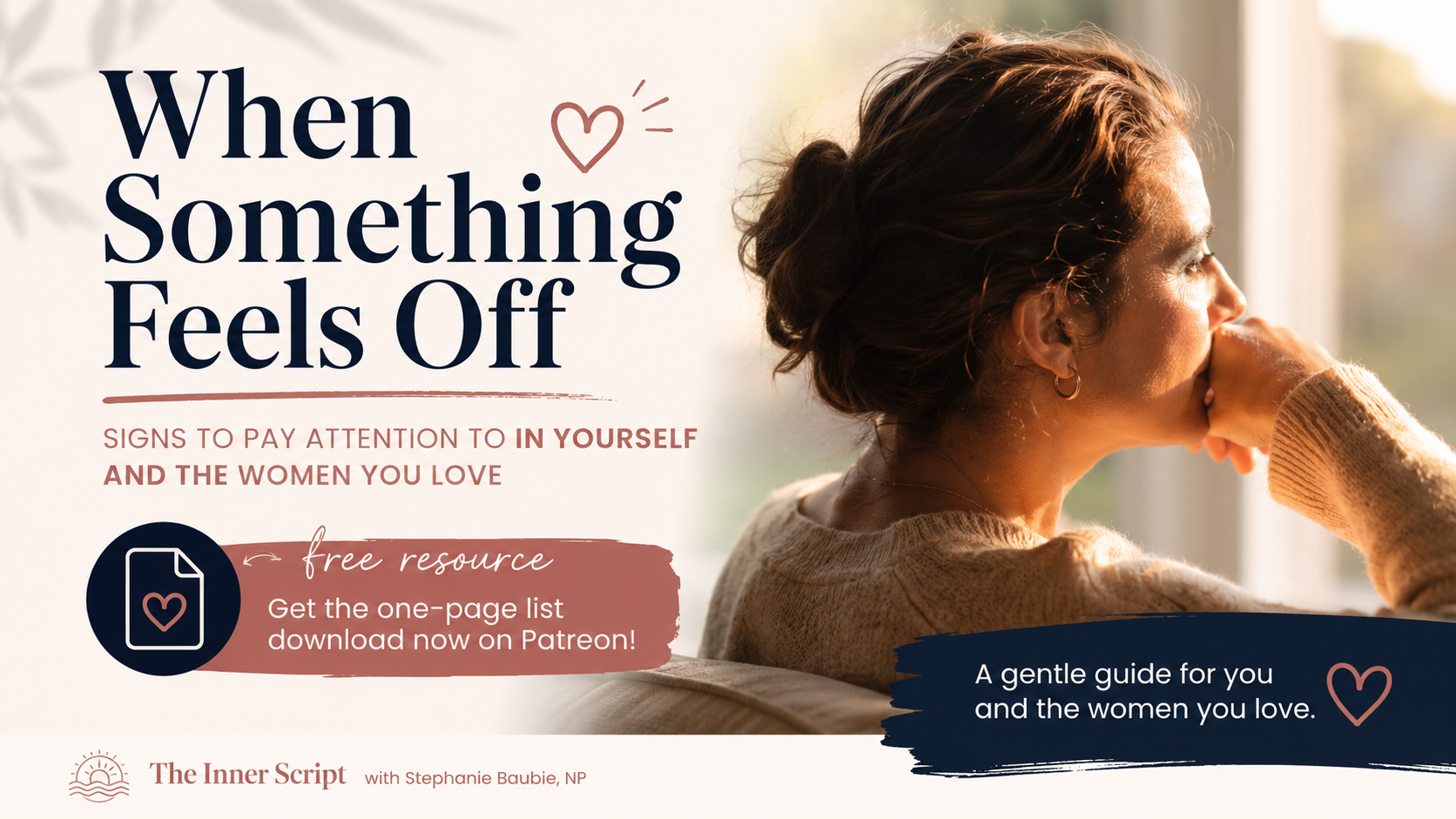
What if you or a woman you love knows something feels different, but it doesn’t yet look like an emergency?
To accompany this episode, Steph created When Something Feels Off: 10 Signs to Pay Attention to in Yourself and the Women You Love, a free one-page guide designed to help you notice meaningful changes that may deserve more attention. Patreon companion resource
You can also join Steph’s free Patreon community here:
The Inner Script Patreon
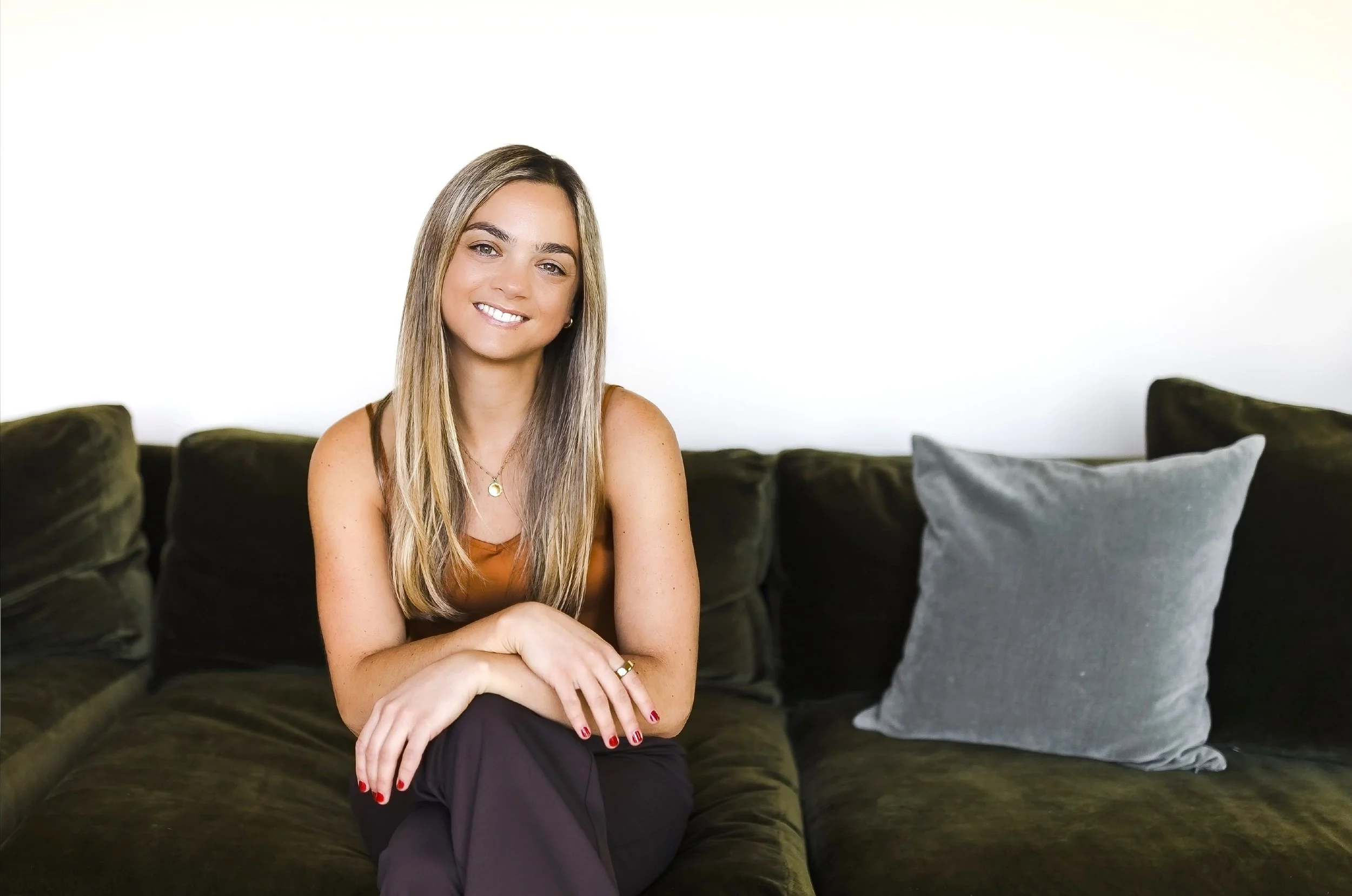
Meet Your Host
Stephanie Baubie, NP is an integrative nurse practitioner and the host of The Inner Script Podcast, where she explores the deeper stories behind health, healing, identity, and transformation. Through a blend of functional medicine, nervous system awareness, emotional insight, and honest conversation, Stephanie helps women better understand their bodies while questioning the narratives they’ve inherited about wellness, worth, and what it means to truly feel well.
On The Inner Script, Stephanie sits down with physicians, founders, thought leaders, and experts in women’s health, while also sharing solo reflections on the transitions and inner shifts that shape our lives.
Follow Steph on Instagram.
FAQs
What is postpartum psychosis?
Postpartum psychosis is a rare but severe psychiatric condition that can occur after childbirth. Stephanie discusses how quickly it can escalate, why it may occur in women without a previous psychiatric history, and why existing healthcare systems may struggle to identify it early.
What does the Lindsay Clancy trial have to do with postpartum psychosis?
Postpartum psychosis has become a central issue in the Lindsay Clancy trial and the debate over her mental state at the time of her children’s deaths. In this episode, Stephanie does not offer an opinion on Clancy’s guilt or innocence, but instead examines what the case raises about postpartum psychiatric care and the healthcare system.
How many medications was Lindsay Clancy prescribed?
Stephanie discusses reports and trial testimony concerning 13 different psychiatric medications prescribed to Clancy over approximately four to five months, using this as a starting point to examine fragmented care and the challenges of treating complex postpartum psychiatric symptoms.
Can postpartum psychosis happen without a history of mental illness?
Yes. Stephanie discusses research indicating that severe postpartum psychiatric illness can occur without a previous psychiatric diagnosis, making previous mental health history an imperfect predictor of who may be at risk.
How are hormones connected to mental health?
Hormonal fluctuations can affect both physical and psychological symptoms. Stephanie discusses postpartum changes, PMDD, perimenopause, and menopause as examples of why she believes mood and hormonal physiology should not be evaluated entirely separately.
Why can mental illness be difficult to recognize in high-functioning people?
Someone may continue working, parenting, communicating, and completing everyday responsibilities while experiencing significant internal distress. Stephanie argues that outward competence should not automatically be interpreted as evidence that someone is well.
What does the Lindsay Clancy case reveal about women’s healthcare?
Stephanie uses the case to explore broader questions about gaps in women’s health research, fragmented care, hormonal health, diagnostic criteria, continuity between providers, and how the healthcare system responds to people who are struggling but have not yet reached an acute crisis.
-
Everything shared here is for educational purposes and personal reflection only. Not medical advice. Always work with your own healthcare provider for individual care.
Stephanie Baubie: Hello, my friend. Welcome back to The Inner Script. So currently, I am recording this from the Amalfi Coast. I wish you could see my view right now. It's overlooking the sea, and it's absolutely beautiful. I've never seen water this blue in my entire life. I don't think I've ever been to a place this beautiful in my entire life.
A few updates before we get going here. I last recorded a solo episode on August 12th, the day of the solar eclipse. Completely unexpectedly and by accident, I was actually in one of the best places to get a view of it, which was Bilbao, Spain. It was such a cool experience to see the eclipse so clearly.
If you know anything about me, I am very into astrology, all the woo-woo things, but I really wasn't prepared for how profound that experience was actually going to be. I showed up without the eclipse glasses that everyone was wearing, and a man was standing near me and was kind enough to hand me an extra pair, so I was able to look at it, and it was so cool.
Finally, when the eclipse happened, I think it was maybe 15 seconds when it went dark, and you just got full body chills, and everyone around us was cheering. It was just so cool. It was just very moving to watch everyone kind of experience it together and everyone coming out to see it. Very cool experience.
Since then, I went to London and reconnected with some people from Salt Escapes. That was the group trip I went on back in June when I went to Comporta, Portugal. And there was a party on the 13th of August for Salt Escape, so that's where a lot of us kinda reconnected, and then there was a group workout on the 16th.
So I got to see a lot of familiar faces from that trip, which was awesome. I was in London from the 13th to the 17th, then headed to Ortigia, which is a very tiny island in Sicily, it's, like, two miles around, where I met two friends from San Francisco. They actually booked a last minute to Sicily, and I obviously was in Europe and could make it work and hopped on over.
One thing I have to say something about is this heat wave that's been going on in Europe. There's just not a lot of air conditioning in Europe, especially if you're staying in Airbnbs, and even some hotels don't have air conditioning. It's a real luxury back in the US. But it really has tested my mental strength.
And resilience. I have had a few near meltdowns physically and emotionally. So overall, just kind of embracing the discomfort. It could be way worse. I have to talk about Italy though, because in my last solo I mentioned feeling really unwelcome in Basque Country a few episodes back, and Italy has been the exact opposite, so that's been a really good change of pace.
So friendly, so welcoming, highly recommend. Italy has been the best. When I was in Sicily, my friends and I did a cooking class. It was led by a local chef who took us to the market to pick up ingredients, and then we went back to his restaurant to cook, so it was just a really fun experience. He had no idea what we were gonna cook.
We kinda just walked around this market outside, picked the fresh local ingredients, came up with a plan, and then went back. I will say, I had one of the best pastas of my entire life. It's funny, because it could not have been more simple to make it. It was a pistachio pesto with pistachios, oil, lemon zest, basil, salt, and pepper.
That is it. No Parmesan, no garlic. Apparently, you're not supposed to use lemon juice when you cook because it oxidizes the dish, but the zest is what actually pulls the flavor forward. And I always thought zest was a nice to have ingredient, not really essential, so I've always skipped it. That totally changed my outlook on lemon zest.
We will be using it and not skipping it when I'm cooking. Anyways, the pasta reminded me of something I keep coming back to on this podcast. We overcomplicate our lives because we think good has to mean complex, and it just doesn't. Sometimes it's just using what's already there and just letting it do its job, and food included.
We get intimidated by cooking because we think it has to be really hard and difficult, and you have to be really skilled to make a good dish. That's not the case. That was the best thing that reminded me of that whole experience. I'm like, "My gosh, this is probably the, one of the best pastas I've ever had," and it was so simple to make.
Okay, on to today's topic Like a lot of people right now, I've been following the Lindsey Clancy trial. To be honest, I'm not watching the testimony live since I'm traveling. I'm not really watching every little bit of it, to be honest. I'm following it on a lot of social media accounts and kind of getting clips here and there.
I feel like I have a good understanding of what's been going on, but I kind of wanted to talk about this today. And let me be really clear about something before I go any further. This is an incredibly sensitive case. Three children passed away, Cora, Dawson, and Callan. There is a father who lost his children, and there is a mother who is on trial for killing them who lost her kids as well.
I'm not here to tell you whether Lindsey Clancy is guilty or not guilty. That's what the trial is for, and I'm not here to minimize what happened to those children. And I'm not even here to talk about just all of the theories circulating around social media right now. I'm not even going to weigh in on that.
But what's really fascinated me on a deeper level is how much sympathy and empathy Lindsey Clancy has been getting out of this situation because I think she was clearly struggling for a long time mentally and emotionally. As a nurse practitioner who has spent years inside our healthcare system, I just can't stop thinking about everything that happened to her before January 24, 2023.
Because when you look at this story from that angle, it raises a much bigger question than the one the courtroom is asking. And I think, in my opinion, the healthcare system failed Lindsay. Watching the clinicians who treated her get questioned on the stand based on their own notes and what was prescribed, I don't even want to say that any of them were necessarily negligent or careless, but I think a lot of times we can get so lost in what a clinician does instead of asking the bigger question of how did this happen in the first place?
How is our healthcare system operating? What are the chances that there were... I think she had, like, four psychiatrists, that they all missed this. Are they all bad clinicians? I think that's a very too broad and vague of a statement to make, and the question is so much bigger. It reinforces how fucked our healthcare system is.
To me, it's a systems failure. For example, when a plane crashes, we don't just ask what the pilot did wrong. We ask about all of the safety checks in place. So I wanna ask that question here. Why were so many things missed in this woman's case? And she was on 13 different medications across four or five months.
How did that happen? And I think that number is actually a clue to something much bigger than one case, the profound lack of research into women's health, particularly anything involving hormones. Let's talk about this research gap that literally nobody ever talks about. Here's something most people don't know.
Until 1993, women of childbearing age were routinely excluded from clinical drug trials in the United States. For decades, the default research subject in medicine was a 70-kilogram man. That's 154 pounds. Women's hormonal cycles were treated as a confounding variable to be avoided, not something worth actually studying.
So huge amounts of what we think we know about how medications, dosing, and disease work in the human body were built almost entirely on male physiology and then just applied to women with fluctuating hormones, feeling differently all across the month. It is wild to me that this was the case. And then postpartum psychiatry inherited that gap.
Menopause inherited that gap, too. Let me give you the clearest example I know, because I think it explains so much about why women's hormonal health keeps getting dismissed, minimized, or badly mistimed. In 2002, a massive trial called the Women's Health Initiative released early results linking hormone replacement therapy to an increased risk of breast cancer, stroke, and blood clots.
Made headlines everywhere almost overnight, and HRT use in the US dropped by close to half, and doctors and clinicians stopped prescribing it. So an entire generation of women were told their hot flashes, insomnia, mood swings, brain fog were just something to push through because the alternative was supposedly too dangerous.
And here's what most people never heard is that study has since been picked apart by researchers, and it turns out it was deeply flawed. And I actually think there's been a lot of recognition about this, which is a really good thing. But just to kind of go a little bit deeper into this, of how this all happened, the average participant in that study was in her early 60s.
Early 60s, many more than a decade past menopause, which is a very different population than the women who actually start HRT for symptom relief in their late 40s and early 50s, or even during perimenopause, which is in, usually in early 40s. The hormone used wasn't even bioidentical It was a synthetic compound derived from pregnant mares' urine paired with a synthetic progestin.
So it wasn't even progesterone, it was progestin, a formulation that behaves very differently in the body than the estrogen a woman actually produces. And when researchers went back and reanalyzed the data by age, they found something the headlines never corrected. Women who start hormone replacement therapy before 60 or within about 10 years of their final period often see a reduction in cardiovascular risk and no meaningful increase in mortality.
And I will say, I can't tell you how many times I've prescribed HRT for women, especially estrogen therapy. I do it a lot for high cholesterol, and their cholesterol drops once we start it. Anyways, tangent, side note. So estrogen-only therapy was even associated with a lower risk of breast cancer in that group, but the damage was already done.
One imperfect study reported without context shaped medical practice and public fear for more than 20 years. 20 years women were suffering in perimenopause and menopause. Only now with perimenopause finally getting real cultural attention are we starting to undo that and we're starting to unlearn it, which is awesome.
And I bring this up because I think it's the exact same pattern playing out with postpartum mental illness, a pattern of we don't fully understand it, we don't fund the research to understand it, and then when something goes wrong, we act shocked that we didn't see it coming. Postpartum psychosis is rare.
It affects somewhere around one to two women out of every thousand who give birth. But here's the detail that I think matters most for this conversation. Roughly half of the women who experience it have no prior psychiatric history at all, no previous diagnosis, no red flag in their chart. It can be the first and only psychiatric episode of a woman's entire life, and it can escalate within days.
I think that there's a huge gap in this because we put so much emphasis on the psychology in women behind hormonal imbalances instead of recognizing it as also a biological condition. So that should just show us that postpartum depression, psychosis, you don't have to have had a psychiatric condition to increase your risk necessarily, but it's...
We are so heavily focusing on the mental aspect of it instead of viewing it as a physiological condition as well. Both can be true. We call women being hormonal when they're on their cycles. At least I grew up hearing that all the time. I would hear women say all the time like, "Ugh, I'm just really hormonal."
We attribute this to a mental health condition and/or just being super moody, but in reality, it's Simply biology. Obviously, when hormones drop and/or fluctuate, there are going to be mental symptoms. You cannot separate the two. There's mental symptoms and there's physical symptoms because your hormones are fluctuating.
We focus so much on the psychology of it and not enough recognition that it is a physiological condition, and I'll just die on this hill. To kind of go on a mini tangent here, for instance, I have had countless male patients suffer from low testosterone. They experience fatigue, inability to gain muscle, depression, sexual dysfunction.
Do we ever call them hormonal? Imagine if I called a man hormonal because he couldn't get an erection. Imagine. So no, instead, we call it male hypogonadism and recognize it as a medical condition. It's like, why isn't that happening for women? Instead, we call hormonal conditions premenstrual dysphoric disorder, PMDD, postpartum depression, and postpartum psychosis, but all of these have to do with low or fluctuating hormones.
It's like we emphasize so much about the psychological impact, but it's also physical. So yes, I agree these should be recognized as mental health conditions. I f- just feel we take away the impact of how these conditions are physiological as well. Mood and hormones can never be evaluated separately.
They're always going to influence one another. So when we ask, how did no one see this coming, part of the honest answer is, for a huge percentage of these women, there was nothing in their history to predict it. The tools we have to catch it are still catching up to how the illness actually behaves. Now layer on perimenopause and menopause.
Same story, different decade of a woman's life. Hormonal fluctuation driving very real psychiatric symptoms, anxiety, depression, rage, brain fog, even psychosis in rare cases. And for years, the default response from medicine was some version of, "This is normal. Just get through it." We are only now starting to name what a lot of women have been quietly, I hate this word, but gaslit about for their entire adult lives.
Mood is not separate from hormones. It never was. We didn't just have the research funding, the training, or honestly, the cultural respect for women's bodies to study it properly. So when I see 13 medications prescribed to a postpartum mother over four to five months, I don't just see one case going wrong.
I see a system that has never been resourced to actually understand what it's treating. And here's the part of this I think about constantly as a clinician. When we're taught to diagnose, we're taught to work from a checklist. Does the patient meet criteria A, B, and three out of five from column C? It's called out for a reason.
It creates consistency, and consistency does have value. Two providers in two different states should ideally land on the same diagnosis for the same set of symptoms. But here's the problem. A checklist is built to answer, does this person's presentation match this category? It was never built to answer, what is actually happening to this specific human being?
Those are two different questions, and healthcare has quietly let the first one stand in for the second. So we end up with clinicians trying to see if the person fits the disorder instead of looking at the whole person and asking how a disease process might be showing up uniquely in them. Because how can anyone present the same in any condition?
It just makes zero sense. We all have different biologies. We all have different medical histories, genetics, family history, social history. It's crazy. Again, like, one starts with a category and looks for confirmation. The other starts with a person and stays open and curious and doesn't just follow a checklist and see if they meet every single criteria, because not everyone will.
And postpartum psychiatric illness is one of the hardest things to fit into a checklist to begin with because it doesn't always look like the way our training says it should. It can present with anxiety instead of sadness. It can present with intrusive thoughts a mother is terrified to admit out loud because she's afraid of what will happen to her if she does, with obsessive checking behaviors that get mistaken for devotion instead of distress, with rapid mood swings that get chalked up to sleep deprivation because, well, everyone's exhausted with a newborn, right?
If a symptom doesn't map cleanly onto the checklist, it can get minimized or framed as normal new mom stuff, or treated in isolation from everything else going on. One provider manages the sleep issue, another manages the anxiety, someone else screens for suicidal ideation in a 15-minute visit, and nobody is standing far enough back to ask what's happening to this person as a whole across weeks and months, not just the 15 minutes she's sitting in front of them.
And that's the threshold problem I wanna name directly. In healthcare, we are trained to constantly ask, "Does this rise to the level that requires action? Is she suicidal? Does she have a plan? Is she in imminent danger? Does she meet criteria for hospitalization?" Those questions are necessary. We need them, but human deterioration doesn't always show up neatly enough in a checkbox.
A patient can be struggling tremendously and still answer every safety question correctly, quote, unquote. She can be oriented, articulated, and say all the right things while something underneath her is unraveling in a way the 15-minute visit was never designed to catch. That doesn't mean the clinician doesn't care.
It means the system is built to wait for suffering To become acute enough to justify the next level of care. And I've always struggled with how thin that line actually is. And this gap between I'm struggling and this is an emergency is so much smaller than we wanna believe. And to top it off, to have some empathy for these clinicians in this case, back to what I was explaining before about the lack of research in women's health and especially mental health, especially hormonal health, how are they supposed to treat this correctly if we were never taught?
If there isn't evidence-based practice for this? So I just wanna reemphasize that because clinicians get blamed for so many things, but we are literally doing our best most times. I am saying me. I can't speak for anyone else other than myself, but we are doing the best we can with the resources and education that we were provided, and there is clearly, based on what I was saying, so many gaps in education when it comes to women's health, hormonal disorders, and psychiatric conditions.
Okay, that was a tangent. Another thing, we confuse competence with safety, and I think this is especially true for people who are high-functioning, and Lindsay was a nurse. Nurses are very high-functioning. They're capable. They are empathetic. They care. They put their needs below everybody else's. They prioritize other people.
Like, definition of a high-functioning person. And healthcare workers are trained to take care of other people. We're trained to assess, stay calm, keep functioning no matter what's happening internally, and sometimes that competence becomes its own camouflage because we're taught and conditioned to hold it together no matter what Especially as a bedside nurse.
People think she's a nurse, she would know if something was seriously wrong, but knowing about illness doesn't make you immune to it necessarily, and being able to describe what's happening to you is not the same as being able to accurately judge how sick you've actually become. And Lindsay did seek help multiple times.
She checked herself into an inpatient psychiatric facility. She knew something was off and wrong, but nobody was really able to meet her there. So I think a better reframe is someone's ability to function tells us almost nothing about how much they're suffering. Because think of clinicians, it's true of mothers, and it's true of the most self-aware people you know.
You continue to override yourself until you can't anymore. It's like a boiling pot of water. You put a lid on it, eventually the water is going to overflow, but you keep putting the lid down trying to stifle it, and eventually you can't anymore. In my opinion, a person can go to work, take care of their kids, answer texts, make dinner, even laugh at the table, and still be in profound psychiatric distress.
And this whole, "But she seemed fine," has become a phrase we recognize as a myth. That's not evidence that nothing's wrong. Why do we reach for every moment the person seemed normal as proof they couldn't possibly have been that sick? But she made lunch, but she played with her kids, but she was texting normally, but she knew what day it was.
Functioning and wellness are not the same thing, and that's really worth sitting with. I ask myself, what would a better system look like? As a healthcare provider, this is where the Clancy case keeps landing for me. We need systems that connect the dots instead of evaluating isolated moments, especially postpartum and especially through perimenopause and menopause, when hormonal shifts are doing real, measurable things to the brain, and we still treat the resulting symptoms as an afterthought.
We need continuity between obstetrics, primary care, psychiatry, emergency care, instead of five providers each holding one puzzle piece. We need families to understand what severe postpartum psychiatric illness can actually look like because it often looks like the version we've been shown in movies.
And we need partners to know which changes should trigger an immediate reassessment. Not a, "Let's see how she's doing in two weeks." We have to treat the person with the disease, not the other way around, because every illness condition shows up differently in every human being. And I think that's really worth noting.
We have to stop fitting a diagnosis to meet a person's condition and really understand the person as a whole and how they're showing up in that moment. So the question I'm left with, I don't know what was happening inside Lindsey Clancy's mind on January twenty-fourth, neither does anyone listening to this.
That's why there's a trial. But I think we can hold more than one truth at the same time. Three innocent children died, and their lives matter, and the horror of that shouldn't be softened for anyone's comfort. And we can still ask whether there were points along the way where our healthcare system had the chance to recognize a mother's deterioration and didn't.
Compassion doesn't erase accountability, and asking what could have prevented a tragedy doesn't minimize it either. Because if the only question we ask is, "How could a mother possibly do this?" we miss the more useful one. What would we actually need to understand about the brain, about severe mental illness, about the systems meant to catch it, to make something like this less likely to happen again?
And maybe there's something smaller and more personal in here, too, for those of us whose lives look nothing like this case. Maybe it's noticing when someone you love keeps saying something doesn't feel right and believing them even though they're still going to work. Maybe it's checking in on the friend who looks like she has it all together.
Maybe it's remembering that competence does not mean you're okay, and it's not immunity. And maybe it's finally extending that same compassion to yourself. You don't need to wait until your life becomes unmanageable to admit something isn't working. You don't have to earn help by suffering enough. You don't have to prove you're falling apart before you're allowed to change your life.
Maybe the question isn't how bad does it have to get? Maybe it's simply, what am I noticing right now, and what would it look like to listen before it gets worse? And that's the inner script I think this case is asking all of us to examine. Thank you guys so much for being here with me. I will talk to you soon.
Rate, review, subscribe, all the things. I hope you have a wonderful rest of your day and your week. Chat later.
Disclaimer
Everything shared in this episode is for educational purposes and personal reflection only. It is not medical advice. Always work with your own healthcare provider for individual care.
We sometimes include links to products and services we find interesting. These may or may not be affiliate links. Thanks for your support.
Podcast production by Jamie Brooke.
