Chronic Fatigue, Low Energy, and Brain Fog | An Integrative Nurse Practitioner’s Step-by-Step Blueprint
Listen now by clicking your favorite podcast app below:
Why are you so tired, even when you're doing everything "right"?
In this solo episode of The Inner Script, Stephanie Baubie, NP walks you through the exact blueprint she uses in practice to evaluate chronic fatigue, low energy, and brain fog — from the history she takes in the exam room to the blood tests she orders and the treatment plan she builds from there. Instead of jumping straight to supplements or expensive testing, Stephanie breaks down a stepwise, root-cause approach that starts with sleep, cortisol, movement, diet, hormones, and stress before a single lab is ever drawn.
Fatigue is rarely caused by one thing. It's layered — sleep quality, cortisol patterns, overtraining, under-fueling, menstrual cycle irregularities, digestion, and chronic stress can all be quietly driving low energy and brain fog at the same time. Stephanie explains how she distinguishes a high-cortisol "wired but tired" pattern from a low-cortisol, constantly-drained pattern, why waking between 1 and 3 a.m. can be a clue, and why overtraining especially HIIT and heated workouts is a surprisingly common culprit in women.
From there, she walks through the foundational blood work she orders for almost every fatigued patient, the additional labs she adds based on symptoms, and why she's cautious about ordering a single morning cortisol test. She also shares practical, back-to-basics treatment principles around sleep support, caffeine and alcohol, acupuncture, and movement that patients can start using right away, while waiting on labs.
If you've ever wondered why you feel exhausted no matter how much you sleep, or you suspect your cortisol, hormones, or nervous system might be playing a role, this episode gives you the exact framework to bring back to your own healthcare provider.
This episode is for you if…
You feel tired no matter how much you sleep, or you never wake up feeling rested.
You suspect your cortisol, hormones, or nervous system may be playing a role in your fatigue.
You want a root-cause, integrative approach to chronic fatigue and brain fog — including exactly which labs to ask for.
Episode Timestamps
00:00 Understanding Chronic Fatigue and Its Nuances
02:28 The Importance of Sleep in Energy Levels
04:48 Exercise and Its Impact on Fatigue
07:24 Dietary Considerations for Energy
09:35 The Role of Hormones and Menstrual Health
11:54 Digestion and Detoxification
14:16 The Overlooked Factor: Stress Management
16:31 Lab Testing and Diagnostics
18:44 Treatment Protocols for Chronic Fatigue
21:25 Real-Life Case Studies and Patient Insights
Resources & Mentions
Magnesium Glycinate
L-Theanine
Glycine
New Mission Acupuncture - Nikki Fancher (San Francisco)
Curious about a supplement Steph has mentioned in the episode?
If you’re looking for products Steph personally recommends in practice, you can browse her dispensary here: Stephanie’s Fullscript dispensary
Please consult your healthcare provider before starting any new supplement. Food, lifestyle, and nervous system support always come first.
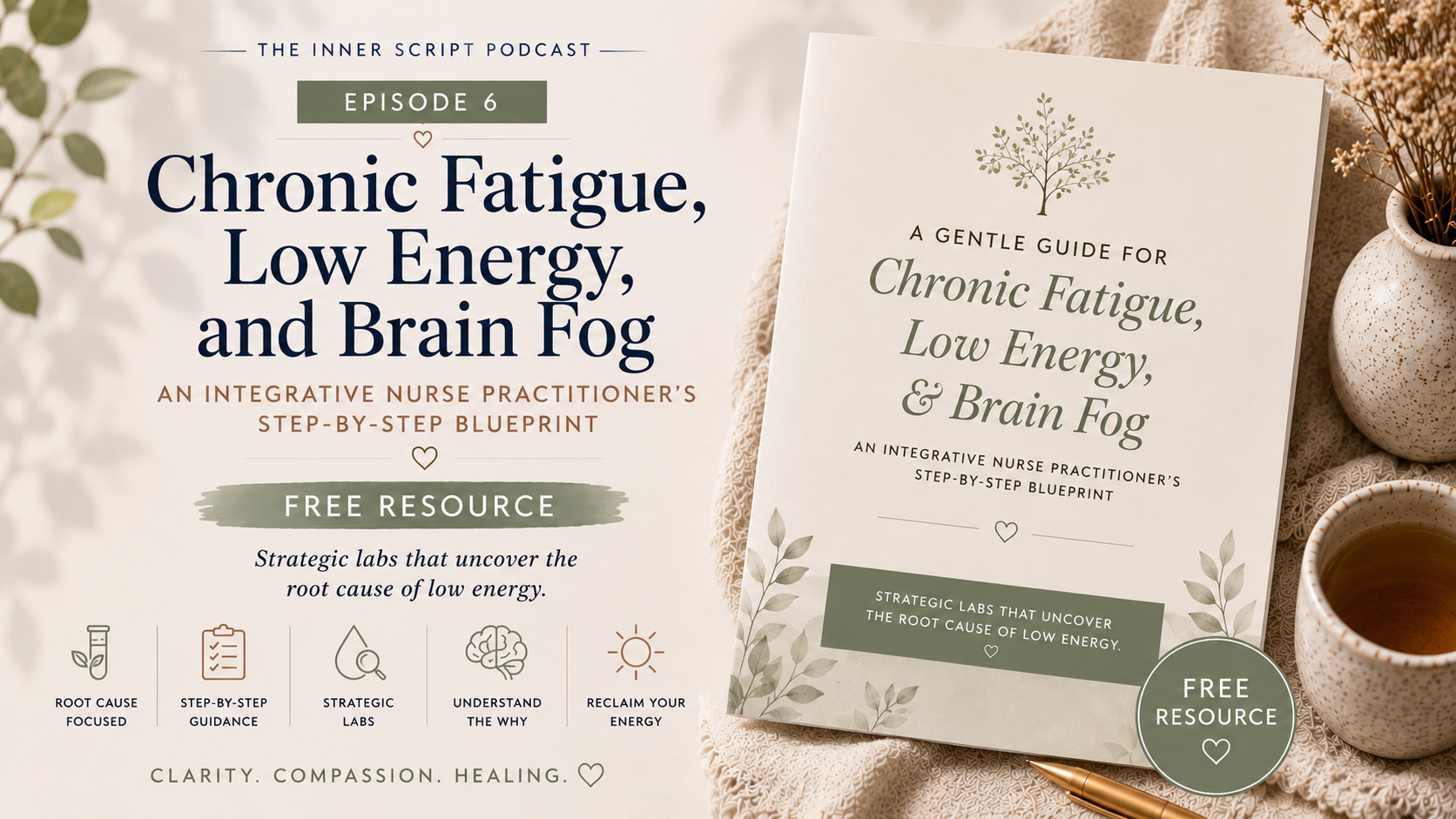
Free Guide: Strategic Blood Tests for Chronic Fatigue
This companion guide walks you through exactly which blood tests to ask for when evaluating chronic fatigue, low energy, and brain fog plus why each one matters so you can bring it straight to your own healthcare provider. Download it here: Patreon companion resource
You can also join Steph’s free Patreon community here:
The Inner Script Patreon

Meet Your Host: Stephanie Baubie, NP
Stephanie Baubie is an integrative nurse practitioner and the host of The Inner Script Podcast, where she explores the deeper stories behind health, healing, identity, and transformation. Through a blend of functional medicine, nervous system awareness, emotional insight, and honest conversation, Stephanie helps women better understand their bodies while questioning the narratives they’ve inherited about wellness, worth, and what it means to truly feel well.
On The Inner Script, Stephanie sits down with physicians, founders, thought leaders, and experts in women’s health, while also sharing solo reflections on the transitions and inner shifts that shape our lives.
Follow Steph on Instagram.
FAQs
What blood tests should I ask for if I have chronic fatigue?
In this episode of The Inner Script, Stephanie Baubie explains that she typically starts with foundational labs for almost everyone dealing with chronic fatigue: a complete blood count, comprehensive metabolic panel, full thyroid panel with antibodies, hemoglobin A1C, vitamin B12 and folate, vitamin D, and an iron panel with ferritin. She then adds labs like fasting insulin, DHEA-S, or a female hormone panel based on the person's individual symptoms.
What are the signs of high cortisol versus low cortisol?
Stephanie Baubie describes a high-cortisol, "wired but tired" pattern as trouble falling or staying asleep, often with waking consistently between 1 and 3 a.m. A low-cortisol pattern tends to look like constant tiredness even after 10 to 12 hours of sleep, with a person still never feeling rested. She explains that identifying which pattern is present helps guide the rest of the workup.
Can overtraining cause chronic fatigue in women?
Yes. On The Inner Script, Stephanie Baubie discusses how overtraining, particularly frequent high-intensity interval training or workouts done in heated rooms, can contribute to cortisol dysregulation and chronic fatigue in women. She looks for signs like feeling great during a workout but crashing one to two hours afterward as a clue that someone needs more recovery days.
Why does low ferritin cause fatigue and hair loss even when hemoglobin looks normal?
Stephanie Baubie explains that ferritin reflects the body's stored iron, while hemoglobin only reflects circulating iron, so a person can have "normal" hemoglobin with critically low iron stores. She notes this is an extremely common and often missed cause of fatigue and hair loss in women, which is why she checks a full iron panel with ferritin rather than iron levels alone.
Is a single cortisol blood test useful for diagnosing adrenal issues?
Generally, no. In this episode, Stephanie Baubie explains that a single morning serum cortisol test does not capture how cortisol rises and falls throughout the day, so it's not particularly useful for evaluating everyday cortisol dysregulation. She reserves cortisol testing and endocrinology referral for cases where a more severe adrenal disorder, like Addison's disease or Cushing's syndrome, is suspected.
How is chronic stress connected to low energy and brain fog?
Stephanie Baubie considers stress to be one of the most overlooked drivers of chronic fatigue. She explains that showing up daily to a job, relationship, or environment that feels misaligned keeps the body in a fight-or-flight state, which raises cortisol and heart rate and makes it very difficult to resolve fatigue until the underlying stress is addressed.
What at-home tests can help evaluate hormones and energy levels?
For people who want more comprehensive insight beyond standard bloodwork, Stephanie Baubie mentions the DUTCH test, which measures detailed hormone metabolites and cortisol patterns through dried urine, as well as the Mira hormone monitor and Function Health for more extensive biomarker testing over time.
-
Everything shared here is for educational purposes and personal reflection only. Not medical advice. Always work with your own healthcare provider for individual care.
Hello. Hello everyone. Welcome back to the Inner Script Podcast. We have a solo episode today and I thought it would be a good idea to cover one of the most common complaints I get from patients and it's chronic fatigue, low energy, brain fog, and I thought it could be fun. To kind of show my blueprint for how I treat patients, get the history to figure out what's going on, labs I order, and some treatment protocols.
So I thought it could be a good idea to dive deeper into one of these more common conditions that so many of us have dealt with. At some point. I feel like fatigue is. There's so nuanced, there's so many causes to it, and it really takes a careful history and a lot of the times that can be difficult to get, you know, all of the information I need in a 20 to 30 minute visit.
One thing I will start out by. Saying like, I'm gonna start with a tip for people and anyone who doesn't work in the healthcare system, this tip is for you. So if you want to come in and talk about a complaint, like. Chronic fatigue, low energy. I would focus on that visit for just one. One symptom. You are dealing with, and I'm saying this because I have so often where people come in with like five things they want to address in a 20 to 30 minute visit and.
It's really not feasible, especially if one of those issues is fatigue because it takes a lot and you're going to do yourself a favor by doing that. I want to emphasize. And so it really takes the whole visit to talk about fatigue. So that's just kind of a tip I wanna leave you guys with. If you are dealing with this, just talk about the fatigue and then you can follow up on some of the other things too, because some of the other.
Symptoms you might be dealing with could be tying back to underlying fatigue. So just kind of wanted to start off saying that, but what I will say, the number one thing I like to rule out when people come in with chronic fatigue, low energy or brain fog, is a cortisol issue. Whether it's high cortisol, low cortisol, or you can even have like a mixed cortisol state.
So again, going to dive a little bit deeper into this, but I really. Try to have as much of a stepwise approach to this as I can. Otherwise, it can feel really overwhelming. And again, this is a general guide for how I get the history. But you know, every patient is different. Every patient has a different medical history, medical background, taking different medications.
So the approach is gonna be different based on whoever is coming in. But I do start off by asking if I don't know the patient. Like prior medical history, whether they have autoimmune disorders, thyroid issues, known hormonal imbalances such as PCOS or menstrual irregularities, iron deficiency, anemia, malabsorption issues such as celiac.
And just so I can kind of get a better idea of the whole person, we need to know your medical background. So the first thing I really start off with is sleep. You know, I ask. I don't just ask. Like, how is your sleep? Because many people will say, oh, it's good. And that doesn't tell us anything. And a lot of the times their sleep is not good after I ask more questions.
So I ask if they have any issues falling or staying asleep, how many hours they get if they ever wake up feeling rested. A lot of this will kind of guide me into what else is going on, if there is an underlying cortisol issue. So I'm basically trying to see if there's any signs of a high or low cortisol, which is our stress hormone, high cortisol.
What looks. Like a high cortisol state is anybody who kind of that wired but tired feeling you're having issues falling and staying asleep. You're waking up consistently between one to 3:00 AM or even two to 4:00 AM or just some really specific window, and a lot of the times, the reason for that is because cortisol, which again is our stress hormone, should be at its lowest.
Before bed to prep us for sleep. And it should be at its highest when we wake up in the morning. So for a lot of us, if you're in a mixed cortisol state, or cortisol dysregulation in general, a lot of people's cortisol is spiking too early, and that's kind of what's causing you to jolt awake. Some people can fall back asleep, okay.
And some people can't. So that can often kind of look at the severity of the issue. And with low cortisol, it's really just this. Constantly tired, feeling like you're not having issues falling or staying asleep. You could sleep like 10 to 12 hours every night and you just never feel rested. So that definitely tells me there's a low cortisol issue with sleep.
I always ask about alcohol and caffeine, and both of these really disrupt sleep significantly. I have a lot of people coming in, like one guy told me he drank like 40 ounces of coffee a day, which. That's a lot. That could be like half of your water needs. So there's, again, it's just, it's very nuanced. So try to get as much information as possible, and even one to two alcoholic drinks can really disrupt your sleep in terms of.
REM deep sleep and heart rate variability, so I just try to get a clue into both of these things. Lastly, when it comes to sleep, I ask about other medications like sleeping pills, like Ambien, Lunesta. I'm really not a fan of those benzodiazepines like Xanax. Lorazepam and Trazodone too, which isn't a benzo, but it helps with sleep.
These really negatively impact sleep and really not meant to be taken every night. 'cause your body gets used to that. It's really hard to fall asleep on its own. You're taking these medications and another one are stimulants like Adderall or Vyvanse, and there's obviously a time and a place to take these medications, but if it starts to impact your sleep, I do recommend reducing the doses, and that obviously doesn't always come with open arms, but these stimulants can really impact cortisol levels because it's spiking your, your blood pressure, increasing your heart rate, and it's spiking cortisol.
So all of these things. Become nuanced and I need as much info as possible. The next thing I move on to is movement or exercise, and I really ask about the types of exercise they do, how many days a week, just to try to get a, an idea if they're over training, because I see in a lot of people over training can lead to chronic fatigue, low energy, they're not recovering well and their sleep needs increase way more than.
The average Jane or Joe. And then importantly I ask how they feel after their workouts. Because a lot of people, they tell me, oh, they feel great like during, but then their energy crashes one to two hours after, and that tells me they could be over training and they're probably doing too much and they need more.
Rest days. And then another part of it with the over training is I also ask specifically how much like high intensity interval training they're doing or hi. Because I do think doing HIIT training five days a week is not the. Best, and especially for females, it can really lead to a cortisol issue and also hit workouts in a heated room where I know people love like hot Pilates or yoga sculpt, where you're really getting your heart rate up and it's very cardio based.
I just have a hard time with that. To be honest, I don't see how it's great to be doing mountain climbers in a 100 degree room regularly, so I'm not a fan of those. I know people are, so if they work for you, that's great. I just, if somebody's coming in depleted and they're telling me that they're doing hip workouts in heated room five days a week, that can be very telling.
Next, we're going on to diet. So I try to figure out if they have any dietary restrictions and what type of diet they follow. A lot of it, I like to see their exercise pattern first be before I ask about their diet, because I kind of wanna see how much they're exercising. So then I can kind of gauge how much more nourishment they may need than the average Joe or James.
So obviously nourishing our bodies appropriately is very important, especially based on the level of activity we're doing. So I do see many people under eating and insignificant calorie deficits on top of over training. I've mentioned this in a previous episode, but especially with carbs, I notice a lot of people are undereating carbs.
This. Especially, they're doing a lot of cardio and strength training. We need carbs, so that helps to kind of gauge what's going on. And then intermittent fasting, I've mentioned this before, I'm not a huge fan of it, more than 12 to 14 hours max, and especially for females and especially as you're kind of getting out of your twenties and into your thirties, I really don't recommend intermittent fasting like ever, just because hormones become less resilient.
And our body needs fuel. Another thing with diet is, you know, especially asking about dietary restrictions, what they're eating, I do tell them, or ask them to kind of give me a 24 hour a day diet recall of like what they eat for breakfast, lunch, dinner, snacks, and even like water. Just so I can kind of get an idea of what an average day looks like.
I know that's hard to do, but it just gives me an idea and it will also possibly clue me into certain vitamin deficiencies like. B12 folate, iron, especially with vegan or vegetarian diets. So anyone who is vegan or vegetarian, that's immediate. I'm checking B12, folate and iron. And I ask about, as I mentioned, water intake.
People are chronically dehydrated and it continues to strike me. How many people wake up each morning and don't drink water and they go straight for the coffee? Guys, we need to stop doing this. I can't emphasize this enough. First thing in the morning, you have to drink water, coffee dehydrates you further.
It's also very acidic. It spikes your cortisol. If you're doing it on an empty stomach, it's not good for your digestion. So if you could take one thing, please drink water first thing in the morning, it will make a huge difference. You know, we need water to support our detox pathways and support lymphatic in vascular flow.
So very simple thing to incorporate. But so, so, so crucial. And then if it's a woman I am talking to, I ask about their menstrual cycle always. And I ask how long their cycles are regularity, heaviness, and if they're super painful and if they've had any, even like changes to their menstrual cycle. You know, in the last like few months, take years.
I ask about birth control history. Why they went on birth control if they went on it like oral contraceptive pills, the NuvaRing IUD, and it can kind of clue me in on if anyone is dealing with a possible estrogen dominance situation where that can show up as like PCOS or uterine fibroids endometriosis, or possibly low progesterone, which.
Can clue back into a cortisol issue, even thyroid. But no matter what their menstrual cycle is like I always check iron panel in ferritin and women to check Iron Store. So you do, you know, total iron isn't enough. You wanna check a ferritin 'cause that. Reflects your body's iron stores. So a lot of the times, you know, women come in with iron stores being in single digits and it really should be in like the fifties to sixties.
And I do see a lot of women with energy issues and even like hair loss, I see that commonly due to low ferritin. So extremely important. And then moving on to digestion and detox, definitely go together. I always ask about their digestion patterns, whether they're having daily bowel movements, because if you think about it, if you're not eliminating regularly, toxins build up, which will make you tired.
Yeah. Go figure. Yeah. People when are chronically constipated when it comes to digestion, I'll ask. Asking, are you constipated? Isn't enough? Because people will like, no. And then you ask, do you have daily bowel movements? And they'll be like, oh no. I go like every three days. Like, oh my God, no, you are constipated.
When you are chronically constipated, you just have a feeling of being just like really sluggish because it makes sense. You're not eliminating things effectively in your detox. Pathways are off and frequent or loose. Bowel movements or diarrhea can suggest intestinal permeability, which is a lot of different reasons, but that overall can lead to malabsorption.
So if you're having loose bowel movements, you're most likely not absorbing nutrients. Well, and guess what? That can lead to chronic fatigue. So you know, if we're not absorbing nutrients, if we're frequently eliminating. We are not only losing nutrients, but we're also losing electrolytes, and electrolytes are crucial for everything in the body to function well.
Again, very nuanced. Lastly, I ask about stress because I tend to lose people the most when I talk about stress and how this can affect energy and fatigue, and it's honestly the most overlooked. One of these out of everything. And I ask about their job, their relationships, their happiness. I ask if they feel happy, if they feel emotionally safe in their partnership or their career, friendships, family, whatever.
Because this is so important when you're feeling high stress or if you don't like your job or you're in a partnership that feels misaligned. Said this so many times, but misalignment is one of the most uncomfortable things to feel in my opinion, because it is really hard to show up to something that doesn't feel right in your body.
And that can be extremely draining on its own. And more often than not, when I ask people about this, a lot of them are in some, some type of situation that is out of alignment with 'em. So it's definitely something. I need to explore. It also can clue me in on, you know, with this stress and chronic fatigue, I do like them to fill out like mood questionnaires to screen for depression and anxiety.
And I'm not saying that I'll just give them an SSRI or you know, an antidepressant and have them go on with their day, but it can help them put things in perspective of like, wow, okay, this situation is really impacting. How I show up, my energy, my health, so all really helpful to get a good picture. Again, that feeling of misalignment, it goes back to it can be a cortisol issue.
So if you're showing up to something that is not making you happy on a day-to-day basis, guess what? Your cortisol levels increase, your heart rate increases, blood pressure increases, and it activates that fight or flight response. So I truly think it is impossible to treat chronic fatigue and low energy in someone who is in chronic fight or flight.
And I'm saying this as somebody who's been there preaching to the absolute choir right now. So just I'd be remiss if I didn't mention that. And I ask people to rate their stress levels on a scale of one to 10, because, you know, we've normalized chronic stress and it's, I've said this in previous episodes, but I compare to chronic stress, to chronic pain.
And like many of us would not be cool with living in five, outta 10 pain. But when it comes to stress, like we're good with it, stress is, is so. Overlooked and I could go so much further into it, but on top of stress, it's really asking about what they're doing to manage it, manage it. That isn't exercise.
And I do lose people on this and I, this is something I've mentioned in previous episodes as well, but we have to be just as important as exercise. Is activating our parasympathetic nervous system, our rest digest phase. So we have to find relaxation practices that's gonna lower our heart rate. We're gonna fully relax, get us out of fight or flight.
And it, it's a practice because it takes practice to allow your body to get into this stillness and presence mode. So that's a whole other thing we kind of dive deep into. But I will say stress is just overall. The most overlooked thing when it comes to addressing chronic fatigue. It really takes probably 20 to 30 minutes to get all of that.
And then during all of this, I kind of in my head figure out what type of labs I want to order, so it's very nuanced. I don't just order a panel for every single person. But again, I do start with kind of the basics. Which I do order with everyone is A CBC, a complete blood count with differential because it looks at all of your white blood cell counts.
There's different types of white blood cells and low levels of those, or high levels of those could suggest different etiologies of immune system dysfunction. Pretty much order that a comprehensive metabolic panel, which looks at liver, kidney function, electrolytes. I do a full thyroid panel with TSH, free T three, feed free T four.
And thyroid antibodies to look for signs of Hashimoto's or autoimmune versions of thyroid disorders. Hemoglobin A1C, which looks at your average blood sugars over a three month period. Vitamin B12 folate, vitamin D, iron panel with ferritin. So that's really like pretty much what everyone probably gets unless they're like, no, I don't want that.
But that's pretty much where I start and then I'll add other labs based on what's going on with them. A lot of the times people can have like resistant weight loss or they're like, I feel really puffy. I can't lose weight. So I'll add on a fasting insulin level. High insulin can be a big. Cause for issues losing weight, so always ruling out insulin resistance hormone panel, if I'm concerned, for a hormonal imbalance, D-H-E-A-S, it's a pretty good indicator for a possible cortisol issue.
It's basically the mother of all hormones, so it's a precursor. For cortisol production. So if there are high levels of that or low levels of that, that can clue me into cortisol and estradiol. Progesterone, F-S-H-L-H, and estradiol. And I usually check hormones on either days three through five of somebody's menstrual cycle.
Or 1920 or 21 of their menstrual cycle. The problem with hormones is they fluctuate so much, and I do tell people this. I'm like, look, we can check your hormones, get a baseline, but I need to know where you're at in your menstrual cycle. So if you have really irregular periods, it's really difficult to interpret.
So, again, I can get an idea of what's going on, but if people want really comprehensive hormone. Panel testing, I tell them to see like a naturopath to do a Dutch test, which is more extensive panel, or I tell them to purchase, which is pricey. A m tell them to purchase a Mira, which is a little pod, and you buy sticks where you pee on the stick, insert it into this mirror pod, and it shows all of your hormone levels.
F-S-H-L-H, progesterone and estradiol, because hormones fluctuate so much throughout a 30 day cycle, it'll kind of give an idea of, okay, is your estrogen spiking when it's supposed to? Or do you have low estrogen, or is your progesterone spiking when it's supposed to? In the luteal phase, is there an estrogen dominance pattern?
So the more data, the better. So if people want extensive testing. That's what I recommend doing. And then I have them do it for 30 days and then they can bring it back to me and I can kind of take a look and something that's helpful for people to understand about hormones. If you Google like hormone chart, you'll see how much your hormones fluctuate.
So when we're checking hormones through blood at one time in space, one period of time, it's really difficult to know what's going on. And when I show them that, then they kind of understand why there can be pushback with chest. Testing hormones, but again, it can give us some information, but really doesn't always diagnose a hormonal imbalance.
And then if I'm concerned for an autoimmune disorder, I will run an autoimmune panel like an a NA titer inflammatory markers. You know, I don't order inflammatory markers on every single patient because these markers are very nonspecific, they're very vague and they're a lot of times not gonna change.
What I'm going to do anyways, if people want. I will order it, but I find I really try to avoid like comprehensive lab testing and people who are a little bit of, you know, have some health anxiety because it's only going to make their health anxiety worse. And again, a lot of the approaches and recommendations are gonna lower inflammation already.
So just kind of a little, a little tidbit piece of advice. If people want more extensive labs, that's. Totally fair. I just, I tell them like, I don't know what insurance is gonna cover. I don't work with insurance. So I do recommend people to try function health if they want like a hundred plus biomarkers, because if we were gonna order those same labs through insurance, it would be like.
Thousands of dollars where function health, it's a $500 a year membership and you can get your labs done twice a year. So it's a little bit more of a deal. And one thing people ask me to check their cortisol levels and to be honest, like I know I talked about how important cortisol is, but again, going back to checking hormones, you have to look at the patterns of the cortisol.
Like what's it, what are the. Levels in the morning versus the afternoon versus nighttime. So checking a serum cortisol level in the morning, it doesn't give us any information. So if I was concerned about a really severe cortisol issue, which would be like pushings or Addison's disease, it's actually where I would send you to an endocrinologist.
Situation where you might need to take actual cortisone or prednisone or whatever, then yeah, I'll check a cortisol level. But if we're talking more about a cortisol dysregulation, it's like kind of a waste of money, I will say.
Hey friend. If there's someone in your life who you think would also love this conversation, please send them this episode. Sharing it with a friend makes you look like the exceptional friend that you are. Oh, and it helps the podcast grow too. Thank you.
So going on to treatment. So I usually wait for the labs to come back before I give a full treatment plan, but I'm gonna talk about just some like general principles I give patients in the meantime.
So, you know, I focus on sleep. I've mentioned this. In prior episodes tube, you know, magnesium glycinate is great for sleep. L-theanine and glycine, both of those are amino acids that help to promote relaxation and naturally lower cortisol levels. If you have low cortisol, I would. Only recommend magnesium that can help with the dysregulation, but we don't wanna further reduce cortisol in somebody who already is in a low cortisol state.
And I tell people to reduce caffeine to no more than a hundred to 200 milligrams per day. Obviously, I titrate people off of it. I don't just immediately say 200 milligrams only. They're drinking like 500 milligrams. It's a very slow titration. If I fear people are really sensitive with caffeine, I tell them to switch to like green tea or matcha, and some people I do recommend that for, especially just in the, in the meantime and never consume coffee or caffeine in general on an empty stomach.
I know I've said that a million times, eliminating alcohol for the time being because. It's really not gonna help your sleep much. And it's, especially if you unwind with one to two drinks a night, it's really hard to get your fatigue back on track because your sleep is not going to be optimal that way.
And then sleeping with the phone in a separate room, no screens an hour before bed, 15 to 20 minutes of relaxation per day, whatever promotes relaxation in that individual, they kind of have to play around with it and figure out what. Works for them. And it's really getting your body in that rest digest phase of the nervous system.
And another thing is acupuncture has been around for thousands of years longer than pharmaceuticals, and that typically shuts people up. But can't go wrong with acupuncture. There's a great acupuncturist in San Francisco, Nikki at New Mission Acupuncture. She is amazing. She is a magician. And I send so many patients to her and I cannot even tell you how many.
She has helped in terms of improving their immune system, hormonal imbalances. I cannot emphasize that enough. I've gone to her and she's great. And then I recommend daily movement, whether it's walking, stretching, strength training, Pilates, and just being careful not to overtrain or over exercise. And sometimes, or time being, it's reeling the exercise back.
It's maybe you're walking every day and then incorporating more strength training. So it's really. Tuning in and listening to your body, and it's exercising based on their cycle. So I talk about, you know, the different types of exercises and workouts that may feel better in your follicular face versus luteal face.
So all of that makes a difference. And I tell people to limit their HIIT workouts or cardio to meet me like twice a week. I really don't think you need more than that. So that's just a personal preference. But again, you, you know, you have to do what works for you. But. Typically two days a week. But if somebody has symptoms of low cortisol, I tell them to eliminate hit altogether until we get things back into balance a bit.
And I really try to tell people to cook 80% of their meals at home, whole foods space, diet, lots of color, getting enough protein, fiber, complex carbohydrates, healthy fats, focusing on bowel movements, one to three bowel movements a day. If they need some additional support with that, come up with a little bit of a protocol for them with like.
Lemon water, hydration, herbal teas, increasing fiber. It just kind of depends on the person coming in. And then we pretty much meet two weeks later to discuss the labs, correct. Underlying hormonal imbalances, any autoimmune issues, vitamin deficiencies, just to kind of find, tune some of the things we've already talked about, some of the, the treatment protocol we've already discussed and.
I do find that people really get stuck on the stress component and it continues to get overlooked. This really does happen more often than not, and it's not that they don't think their stress is causing their fatigue, but a lot of times they feel like they can't do anything about it. I totally hear that.
It's just, it's really hard to feel better in terms of energy. When the stress isn't getting reduced. So, you know, I, I know I mentioned this earlier and it's really depleting and draining to show up to something that is actively misaligned with you. I just can't emphasize that enough. I keep coming back to that, but I do think that is like a hidden reason for a lot of these chronic issues, and that's honestly why I started this podcast.
So it's just something I have to emphasize. You know, I've gone through it myself. So when you're in something and showing up for something that just doesn't feel in alignment with you, it can just feel really uncomfortable and create symptoms like fatigue. Another thing I'll kind of, you know, end on people can be very resistant to bringing it back to the basics.
You know, I've had people say to me like, that can't just be it. And a lot of the times it can be. And simple doesn't always mean easy. Basic doesn't always mean easy, but it makes a huge difference. I'm gonna end on this patient. I had kind of going back to people being a little resistant to. Believing that chronic fatigue can really improve when we bring it back to the basics.
But I basically, I had this patient who was dealing with chronic fatigue, low energy, getting sick often, and I, you know, found out that she had been on Ambien for 10 years and she currently sleeps five hours per night. Even when taking the Ambien had a lot of back and forth and there was a lot of disconnect, like she really couldn't accept that her chronic fatigue and immune issues.
Were due to lack of optimal sleep. 'cause not only is she getting five hours per night, but she's also taking sleep medication where you're not naturally going through your sleep cycles. And this is coming from a place of not judgment, it's just allowing her to understand the impact of what five hours of sleep every night can really do to your body.
You know, unfortunately I wasn't able to convince her, and that's okay. Sometimes all you can do is meet somebody where they're at. Again, I'm not successful every time, but I am here to be a sounding board, a mirror getting people to look at their health and conditions in a different way. And maybe at some point she'll come back and approach it with a different lens.
So again, just wanna say, I'm always trying to meet people where they're at, and I'm never trying to convince either. That's just a big, big thing of mine. If I sense that I can't get somebody. To see something in a different light, then I kind of stop and that's okay. You know, we're all meant to find this information at certain times in our lives and maybe never at all.
So, yeah, that's all I have to say about chronic fatigue. I mean, I could dive deep into so much more of this. But I know how overwhelming this can feel, and I hope this helps anybody who has been dealing with this in the past, and if they want to do a more comprehensive workup, can bring some of this information to their providers and see if they could order just some of those labs, which can really clue us in onto something that's going on.
And yeah, that's all I have for today. If you have any questions, comments, concerns, feel free to DM me on Instagram at the inter script pod.
I will talk to you guys next week.
If you wanna connect with like-minded women and dive deeper into these conversations, join my Patreon community. There's a free option and it's where we can talk about each episode together. The link is in the show notes and I can't wait to see you there.
Disclaimer
Everything shared in this episode is for educational purposes and personal reflection only. It is not medical advice. Always work with your own healthcare provider for individual care.
We sometimes include links to products and services we find interesting. These may or may not be affiliate links. Thanks for your support.
Podcast production by Jamie Brooke.
