Why Trauma Gets Stored in the Body: Jaw Tension, Nervous System Healing, and Somatic Healing with Brian Donahoe
Listen now by clicking your favorite podcast app below:
What if the tension in your jaw is actually decades of unspoken emotion asking to be released?
In this episode of The Inner Script, Stephanie Baubie, NP sits down with structural bodywork practitioner Brian Donahoe, co-founder and lead practitioner at Shen Generation, to explore how trauma, stress, and emotional suppression become physically stored in the body especially in the jaw, fascia, and nervous system. Brian shares the story that shaped his path into this work, a childhood injury that left him in a coma and taught him how profoundly the body and nervous system are connected to safety, healing, and identity.
Stephanie also opens up about her own experience receiving treatment from Brian, including an intense jaw and fascia release that brought up years of suppressed emotion she didn't know she was carrying. Together they talk about why the jaw is one of the most common places we hold clenched, unspoken stress, how breath and pelvic floor tension are linked to nervous system dysregulation, and why so many people feel disconnected from their own bodies in a world of constant stimulation.
The conversation goes beyond the physical, touching on sensitivity as a gift rather than a weakness, the difference between masculine and feminine energy, and why chasing productivity can quietly become a way of avoiding ourselves. Brian and Stephanie also get into functional testing like HTMA (Hair Tissue Mineral Analysis), the role of circadian rhythm and morning sunlight in nervous system regulation, and simple, non-overwhelming ways to start reconnecting with your body today.
If you've ever felt like your symptoms — fatigue, bloating, tension, breakouts, inflammation — don't have a clear explanation, this episode offers a different lens: one that considers the nervous system, emotional patterns, and stored tension as part of the picture, not separate from it.
This episode is for you if…
You feel disconnected from your body or stuck in chronic stress patterns you can't quite explain.
You experience symptoms like fatigue, bloating, tension, breakouts, or inflammation that conventional approaches haven't fully resolved.
You're curious about somatic healing, mind-body medicine, or how trauma and stress get physically stored and released.
Episode Timestamps
00:00 Introduction
04:10 Brian's Near-Death Experience
09:15 Reading Tension And Trauma
14:05 Why The Jaw Holds Stress
19:20 Somatic Release And Processing
25:05 Breath And Pelvic Floor
31:45 Sensitivity And Self-Rejection
39:30 Disconnected From Our Bodies
47:00 Circadian Rhythm And Sunlight
55:10 Starting Nervous System Regulation
Resources & Mentions
Shen Generation - Brian Donahoe's structural bodywork and functional medicine practice
Rhythm Restored - Brian's upcoming women's health course through Shen Generation
Blue light blocking glasses
Epsom salt baths
Morning sunlight exposure for circadian rhythm
Curious about a supplement Steph has mentioned in the episode?
If you’re looking for products Steph personally recommends in practice, you can browse her dispensary here: Stephanie’s Fullscript dispensary
Please consult your healthcare provider before starting any new supplement. Food, lifestyle, and nervous system support always come first.
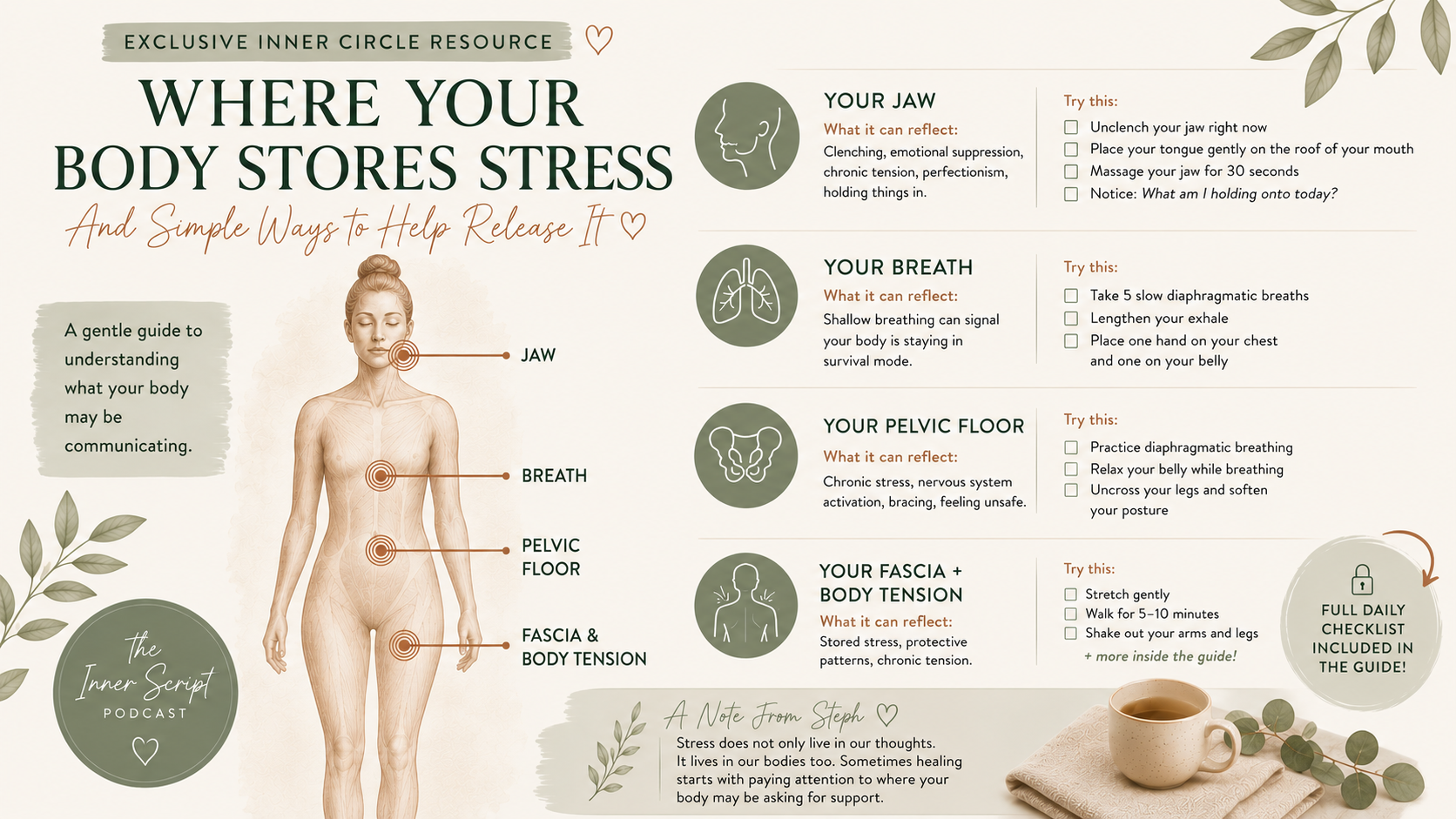
Free Guide: Where Your Body Stores Stress
This companion guide walks you through four places your body may be holding onto stress — your jaw, breath, pelvic floor, and fascia along with simple, gentle practices to help you start releasing it. Download it here: Patreon companion resource
You can also join Steph’s free Patreon community here:
The Inner Script Patreon

Meet Brian Donahoe
Brian Donahoe is the co-founder and lead practitioner of Shen Generation. He began his career as a massage therapist in New York City, where early exposure to Eastern medicine shaped his view of the body as an integrated system rather than a collection of separate parts. In 2012, he expanded into strength and conditioning, followed by advanced training in physical therapy and chiropractic-based techniques. Over time, his focus evolved toward functional medicine, weaving structural work, metabolic data, nervous system regulation, and emotional patterning into a systems-first approach to healing, one that honors physiology alongside the body's energetic and spiritual dimensions. Website: https://shengeneration.com
Instagram: https://www.instagram.com/shengeneration
Shen Generation’s Website & Instagram

Meet Your Host
Stephanie Baubie, NP is an integrative nurse practitioner and the host of The Inner Script Podcast, where she explores the deeper stories behind health, healing, identity, and transformation. Through a blend of functional medicine, nervous system awareness, emotional insight, and honest conversation, Stephanie helps women better understand their bodies while questioning the narratives they’ve inherited about wellness, worth, and what it means to truly feel well.
On The Inner Script, Stephanie sits down with physicians, founders, thought leaders, and experts in women’s health, while also sharing solo reflections on the transitions and inner shifts that shape our lives.
Follow Steph on Instagram.
FAQs
Why does the jaw hold so much stress and trauma?
In this episode of The Inner Script, structural bodywork practitioner Brian Donahoe explains that the jaw is one of the few joints in the skull we can consciously move, which makes it a place where subconscious tension — like nighttime clenching or grinding — often shows up. Because the jaw sits close to the brainstem and connects to cranial nerves tied to safety, Brian explains that releasing tension there can trigger a real autonomic nervous system response, sometimes bringing up emotion that's been held for years.
What is somatic bodywork and how does it help release stored stress?
Somatic bodywork is a hands-on approach to identifying and releasing tension held in the body's tissue, fascia, and nervous system, rather than only addressing symptoms cognitively or through talk therapy. On The Inner Script, Brian Donahoe describes how working through areas like the jaw, tongue, diaphragm, and pelvic floor can allow suppressed emotion to surface and move through the body, which he describes as a key part of fully integrating and processing stress rather than just managing it.
Can nervous system dysregulation cause bloating, inflammation, or digestive issues?
Yes. In this episode, Brian Donahoe explains that when the body doesn't feel safe, it can struggle to produce enough stomach acid and digestive enzymes, which affects how well nutrients and fats are broken down and absorbed. Stephanie Baubie shares her own experience with lifelong digestive issues and how practicing somatic healing and nervous system regulation significantly reduced how often she experienced digestive flares.
What is an HTMA (Hair Tissue Mineral Analysis) test used for?
An HTMA is a hair mineral test that looks at how the body is using and balancing minerals in relation to stress. On The Inner Script, Brian Donahoe explains that the test doesn't just show mineral levels in isolation — when interpreted correctly, it can reflect patterns of stress and how the nervous system is functioning, offering context that a standard lab panel might miss.
How does morning sunlight affect circadian rhythm and nervous system health?
Brian Donahoe explains on this episode that getting outside early in the day helps signal the body's internal clock, supporting hormone production, digestion, and nervous system regulation. He discusses how constant exposure to artificial light, especially in the morning and at night, can confuse the body's sense of timing and contribute to the overstimulation and disconnection so many people experience.
Why do people feel disconnected from their bodies?
According to Brian Donahoe on The Inner Script, chronic overstimulation from technology, artificial light, and modern pressures to constantly produce and achieve pulls people out of their bodies and into their heads. He and Stephanie discuss how tying self-worth to output and productivity can prevent people from feeling safe enough to slow down, feel their emotions, and reconnect with their own physical sensations.
What are simple ways to start nervous system regulation and somatic healing?
Brian Donahoe suggests starting with a simple inventory: noticing what feels invigorating versus depleting throughout your day, without needing to change anything right away. On this episode, he and Stephanie also point to practices like morning sunlight exposure, Epsom salt baths, blue light blocking glasses in the evening, and gentle movement as accessible ways to begin supporting the nervous system without feeling overwhelmed.
-
Everything shared here is for educational purposes and personal reflection only. Not medical advice. Always work with your own healthcare provider for individual care.
Stephanie Baubie, NP: Hello everyone and welcome back to the Inner Script Podcast. Today I'm joined by a very special guest. I have Brian Donahue here. He is the co-founder and lead practitioner at Shun Generation in Los Angeles. Brian's work blends structural body work. Nervous system regulation and functional medicine. All rooted in seeing the body is a truly integrated system.
And I also wanna share that I experienced his work personally, and it was so profound and I'm so excited that he's here so that we can kind of jump into it and really talk about how transformative his healing experiences are. So really excited to have this conversation with you guys.
Brian. How are you doing?
Brian Donahoe: Doing well. Thank you for having me. It's such an honor. Yeah. Sharing your story too. You know, when we do these things, actually talking to person on a podcast who's been through this treatment path 'cause. A little bit more context because we'll find out. I go places I'll, I'll wear multiple different hats.
I'm trying to mirror what information needs to come through to break a pattern.
Stephanie Baubie, NP: And you're also very intuitive too, like you just pick up on a lot of things. So we're obviously gonna get into it. But first I want you to kind of talk about what originally drew you into this work. I know you had a, you have a very interesting story, so why don't you share kind of your experience with what drew you into mind, body medicine and the physical body.
Brian Donahoe: I was drawn into helping people. I originally went to school to become a teacher as a history teacher, and then switched into a physical therapy program thinking that that was gonna be the path to connecting to people. But medicine and just really like, you know, even emergency medicine or really just making it.
A life-changing difference on somebody was in high school. I was being a bit of a jerk, and I at a practice indoor track, we ran around in my high school building for practice, and so at one of the stairs I decided to grab the ledge above halfway through the stairs. Jump up, grab the ledge above, swung.
Landed two stories on the back of my head, fractured my skull. Had to get emergency medical airlift. Yep. I was in a coma for three days. It was touch and go, but I made a massive recovery and I don't remember three days of my life, but after hearing all the stories, the people that were there who helped orchestrate my rescue and saved my life, one was the athletic trainer who instinctively grabbed my head and just held my neck and just holding and stabilizing right there.
He wasn't. Part of the EMS team, the emergency medical team coming through, he was just there holding the head. He had one job. And hearing that of all the different people that helped me, it was his name was Mike, he instinctively took control of a place that on my body needed to be stabilized. And it wasn't really as much about the head as it was just the instinct to stabilize.
And that in a chaotic situation, he did one thing that made all the difference. And so that. Sort of later on looked back and going that simple thing like, what was that? And so I was fascinated with medicine at that point and I was fascinated with care and the human body. And then, you know, I became a massage therapist.
I went to school to become a strength coach. I combined this weird hybrid physical therapy. It just sort of spoke to me. And, uh, all the time I didn't wanna do the conventional road. I wanted to make it a hybrid thing. So I spent the first eight years of my career just bouncing from different industries in the medical world, in the health and wellness world.
Just learning about this licensing and that. And all this time it took me years later to look back and think about like in a chaotic world that we live in, the simplest thing could be the most profound difference. And so I've always taken that lesson with me to remember that, you know, don't sweat the technique.
You know, really just be there in the moment. That's what this is about. And so I've learned to take all these different modalities, translate it and distill it down to help people be in the moment while they get that medical care.
Stephanie Baubie, NP: I mean, I love that it really can be that simple, and I do tell my patients that. But simple doesn't always mean easy, but basically, you know, you talk about the head, the skull, and the spine. You know, you experienced that. I experienced that, especially with my jaw and where we tend to hold a lot of trauma, tension emotions.
So when you are feeling the head and the skull, what exactly are you, are you feeling in that moment with people?
Brian Donahoe: So there's on a few different levels, and this is, you know, like the basis of osteopathy, osteopaths will know this work. Certain chiropractors might feel into this, but that sensitivity of, you know, this is the central computer. In terms of the brain, all the cranial nerves that are leaving the spinal cord, and regardless of the other areas you wanna access in the body, it still relies on the central computer.
And so when you're supporting the skull, for example, and the fascia around the skull and all that little tissue that supports the fluid and the, and the skull and the brain floating, I'm feeling for movement. But, you know, in this electrical tissue, I'm, I'm getting these signals. So as much as we're feeling movement, I'm also identifying flow and energy and where there's a connection, it begins, especially you walk in, you're not really sure what we do, and you get on the table and one of the first places I'll hold is just cradling the head and just getting some, a sense of who this person is.
You can get all the information on a physical level. Through just that palpation touch, you could see how they hold their tension. You could see the levels of are they dissociating outta their body or not? What factors are keeping them from feeling flow in the moment? You could just feel that from a few minutes of just cradling somebody's the base of their skull and watching that flow happen.
So that's the entry point of when we're doing our hands-on work, because that's how we can break out into other areas and prompt, you know, Hey, I'm feeling this. What's going on here? And then we go down that story of what's going on in your body or break out the rest of it.
Stephanie Baubie, NP: So I guess, you know, what type of people do you typically draw into your practice? I mean, where do people, you know, they, they get on the table, you hold their their head, I guess. What are you sensing in that environment? And then what are you doing next?
Brian Donahoe: So the people that are coming into us, I mean primarily women, you know, you're dealing about 85, 90% women just because we don't fall under that conventional model of medicine. So, you know, most people aren't looking, you know, most men aren't gonna just like, oh, that's the thing right off the bat. That level of understanding comes from.
Somebody who's more comfortable in that dynamic of, okay, things aren't so linear and straightforward, but then your follow up to that is like, where are we going? That is your body dictating, like it comes down to that simplicity. And so you're, you're going in from that simplicity to complex and back and forth.
You get the answer right away. Now, how do you convey it to somebody so that their body understands so you can make a meaningful change? So we interrupt. Okay. I feel this. This is our objective. How we get there is gonna be unique, but usually somebody will come in, they'll tell you exactly what's going on, even if they don't understand their symptoms, they'll tell you if you can listen.
And so my aim is to use that technique to begin the listening process. Because the way I pick up on information, and we will obviously get more into this, but even with you, like that intuitive side, if I just start blurting things out, it can get lost to the wind, right? And so we need to have some sort of structure.
And so the cranial bones, the multiple different, you know, cranial bones, the movement here, we can start making neurological changes. Some people might feel zen State within minutes and they'll begin. Their nervous system calms down. They're able to receive information.
Stephanie Baubie, NP: Maybe let's just kind of use me as an example of when I came to see you. You know, I was feeling very like burnt out, fatigued. I was having terrible like skin flares, acne. Like all over on the right side of my jaw. A lot of muscle tension on the right side of my body too, which is interesting 'cause it's the masculine side, so we can even, whatever, dive into that.
But my biggest issue was just feeling so inflamed, puffy, and retaining a lot of water. So I guess let's kind of use me as an example. You know, I come in, we chatted for like, I think like maybe 30 minutes or an hour, something like that.
Brian Donahoe: I leave two hours for the session usually. You came in and you know, you have your in-depth intake, so I know a little bit about you, but we have a good dialogue because it disarms certain narratives you have around your body. Diagnosis, things that you think about your body and then gets you thinking differently about it, and then you start revealing more information. It gives me context.
And we start making those aha moments happen fast. A few of those moments where we were having you think about and connecting stuff that you already knew you had context to, but now we're putting it together so you can see it in a different light.
And then getting into a state where their body's calm and we could start making adjustments happen easier, and they can integrate those changes. So then we could start to go out like, okay, I see this posturally. I see you have this complaint. We'll follow this through, but we gotta calm 'em down first.
Brian Donahue: And for your situation too, as you were getting familiar with that touch and that touch was helping you drop in, opening up, okay, that this is safe because the safety signal is key.
Intellectually there is an understanding, okay, I'm here. You know, I, I understand this person. I feel safe. But your nervous system holds a different story that you might not consciously be connecting to. And that can come from those traumas, the programs, the safety mechanisms that were in place when something at childhood wasn't met or some incident occurred, right?
And so we have to navigate that too, because you might not understand that that's what you're holding and it prevents. Us from getting to the next place. And so that's where we have to work with. It's not a challenge, it's just that's where we pick up.
Stephanie Baubie, NP: You know, we chatted and then I get on the table and you always hold the head first. Right?
Brian Donahue: If you're lying on your back, 99.8% of people, unless they come in with super active back pain, like they can't, like I'm almost carrying them onto the table, then we, you know, that's where we kind of just address that immediately. I'll always refer to this as like the vitamin or the painkiller. And when people come in and they're in that painkiller need, like, I can't just start like, oh, just calm down like they might.
Really get pushed off by that. But for most people, if we need to contact the stomach too, just a gentle hand placement for certain people, that is a place, you know, if I feel that their body is really already sort of opening up, we'll go there. If I worked on somebody a lot, I might start on the feet just contacting the feet, like, Hey, gimme the signal.
What's going on? If somebody's not really feeling grounded, I don't feel them. They're up in their head a lot. I'll always contact the feet. Just to help pull them into their body a little bit more and then work into the hips, the stomach area, and actually the head will be the last place that for certain people.
But generally speaking, it's never a wrong choice to start at the head.
Stephanie Baubie, NP: From what I remember, it was all. Very intense. Very intense. But I get on the table and you're touching my head and you start kind of working on my jaw and you're putting your fingers into like four points of my jaw. And it, I think you were saying you were like barely even touching it, but it felt like really intense.
Pain like a fire poker inside my jaw. And you were explaining to me that's where a lot of us store a lot of those emotions and trauma. So like what are you feeling on your end in that moment?
Brian Donahue: Well, you think about, first off, your session two is I actually chose to do the jaw very early on, and that's one threshold place that we get to for most people. Within one or two sessions, we have to get in that area. And why we work the jaw is because it's one of those joints, the only joint in your skull, you can consciously move the subconscious tension.
You know, you grind your teeth at night or you're in stress, you don't even realize you're clenching. It's because the brain is using that, your mandible, your jaw as also a protection. And so, you know, it's, it's connecting to all these different cranial nerves that signal safety. But when you clench that joint is right actually deep.
Parallel to the brainstem. And so releasing that tissue can actually have us release deeper structures of these deeper cranial bones that can have this like, you know, this real, this autonomic nervous system response right away. And for some people we build up to that. Most people we're building up to that.
I think for you, you know, the context too is you were coming in outta town, you were there for one session. We needed to get in there. It's a call, it's in the moment, it's a call. It's like, Hey, we can go in there, we can do this. This will open up more. Versus, you know, if we like build up to this, we got there right away and I'm, I mean the pressure is like, you know, if you're, you know, hitting an elevator button, but I'm in the back way back there and I'm holding a few different structures and there are some reflexes for these bones right here.
But what it does is the body goes freaks out. It's like, what the is going on? And we get over that hump 'cause we keep consistent depth. And pressure changes a little bit, but the depth and the intensity is like that. Seven outta 10 of hovering closer to an eight. You know, you want it to be just enough where the body's like, get outta my mouth, but I can get through this and I'm walking you through.
You can release this. So I'm always guiding somebody, hey, you know, sometimes, ah, open up more. Let go. And it's not just like physically let go of the jaw, mostly like let go mentally and that. Control that you have in that threshold of intensity. This alchemy, this magic happens where bang, the body lets go and opens up.
And when it opens up here, it opens up any other place. And it's really interesting that consistency across the board, so many different types of people is once we get to that threshold, their body becomes more tolerant of any type of treatment change. Things happen within one day of their first initial session where they're like, whoa, what was that?
It was, you know, something happened at the jaw release. And so that's really, uh, an important place. And for you, it helped open you up on a level of like something you already knew that you could do, but it got you to a place where your body can feel like, all right, anything's possible now.
Stephanie Baubie, NP: I think something I always say is when it comes to mind body connection, mind body medicine, it's such a different. Process to know something. Like for me, I knew a lot of my symptoms were emotional, but it's so much different to actually believe it 'cause your entire body is embodying it. And I think that situation really led me to fully understand how profound even the most minor negative experience can really just live in your body and how much pain we're actually carrying on a day-to-day basis just by you.
Like just pressing on that area. It was crazy. And then with the release of it, you just, I felt this huge, I had no control over my emotions when I felt that release. So what exactly is going on there? Like, you know, for me the release was crying for other people. Would that be like screaming, yelling, body shaking?
Is it different for people?
Brian Donahue: How anyone processes like it is unique. There's common things you're gonna see, but you know, the layered tranches of wrapped up experience that we have, you know, our brain is the processing center, but in the tissue holds. All the unique information or the tension and we're getting back into the fascia and how, you know, fascia's a primarily a water structure based crystalline matrix of fluid like tissue.
And what's inside that. It's not just water. What water carries memory. Dr. Emoto, and, you know, people like to poo the science on water memory, but we understand, uh, fourth phase of water that is like a supercomputer in every little droplet. The structure of water carries information. That our brain then processes and it's not an instantaneous reflex.
It sometimes takes some time. And so with the jaw, almost all stress you've ever had in your life is gonna have some sort of tie back into this area. So you think if, if somebody's clenching at night and a majority of people you know will clench. At night. A lot of that's postural related, but for the most part, you know, when you're, when you're in that, what's happening is you're having some wild releases.
Some of it has to do with the duration. I think that's the biggest thing too, is when people get jaw work, people tend to move around and say, Ooh, that was uncomfortable, but, but I'll hold the spot. I'll find where that needs to be held and that puts people through. I've seen what seems like an orgasm and I've seen laughter.
Tears are something that comes out sometimes, some slow tears and, and not just like, oh, this is like the, you know, when something's a little tense, you, your eyes, water. It's an involuntary thing, I think for you too. It felt, it was just, it just came up. And as that happens, it's not just, that is the treatment, it's, it's nurturing you.
Hey, this is okay, what's happening here? Great. You know, coaching you through the release after fingers out of the mouth, now it's coming up, reminding the body, this is safe because you can put some work in there and then not support that person. And then it wasn't a useful release. Yes, things might have opened up.
And that's nice, but if their body ultimately registered as that, an unpleasant experience, you can't integrate into the next level because that loop is still occurring. So part of that breaking that loop is nurturing you out of that, taking that break, processing, what came up, getting you into your body So immediately, like putting my hands somewhere else, Hey, this is safe, where are you?
What's going on? And your body goes. Releasing this, I'll tie that into safety. As much as it was a b getting through it, your body is holding that going. You know what? That was useful that I, I was able to release that. I have that ability. It's a superpower that you're accessing.
Stephanie Baubie, NP: Yeah, that was because for me it wasn't, ooh, just, just a few tears. It was like I was sobbing and I'm not somebody that the. Really likes to cry in front of other people. So it was also kind of reframing that belief, like it's okay to cry, especially in front of people. And I don't know, just that in conjunction with everything else that happened was really transformative.
And it was kind of this, okay, like we feel this need to cry at times, but we fight back the tears and swallow it and it's really, we need to, we have to release that so that the body doesn't store it.
Brian Donahue: I mean, that takes courage, but reframing that, like you said, reframing that is we're a human species built on connection and community, and so. Sharing motions in a safe place. If you don't feel it's safe to cry, your body will then suppress the thing that needs to come out and it'll make accommodations to get past.
It's what our body does better than anything. It adjusts. It makes sacrifices, it accommodates it. It'll create whatever it needs to create to get through something, even if it's not efficient later on. That'll make cause more issues in the moment. It'll do what it needs to do. So if you're constantly in the moment unaware that it's not safe to express your emotion.
Whatever that emotion may be, your body suppresses it compensates, and then you're off to weird complex layer. Like I said, that tranche of that layered stuff packed within itself, and so opening that up sometimes where cognitive behavioral therapy wants to talk about it. You have to charge the emotion too to be able to fully integrate what that was.
And so what's really nice is we can also talk before and after, but that charging that emotion is one way for the body to go, Hey, like this is for first and foremost. I can release this. It happens pretty profound and, and you don't have to overcomplicate it. This comes back to that simplicity of get through the release.
This is what it is. Let the information integrate and process and you know, I told you, you know, it might take 12, 24 hours a day later where you start to, things come up right.
Stephanie Baubie, NP: Things were not great next, like. Day. But I say that in a way. I was like, okay, I know I need to be like going through this and feeling it. But yeah, it was intense, but it's a good intense, you know, it's, yeah, you have to deal with your shit. Like you have to feel it. So it was amazing. But then you also started working on my tongue.
I don't know if you remember when you gripped my tongue and we heard the pop.
Brian Donahue: Sometimes the fal and the, uh, the tissue that these hyoid bones in the, in the muscles, in the hyoid area, and that fascia clicks for some people. I don't wanna force that all the way through because, you know, a, a majority of people have some sort of a form of a tongue tie. We can get in that anatomy of a lot of that was developed.
Underdeveloped Jaws kind sat like this when we were six months, three years old, underdeveloped, and therefore that little freni gets really thick and tight. Then what happens is then the tongue doesn't wanna be suction cup to the roof of the mouth like that. You know, you wanna be able to move that tongue all the way to the roof.
And for some people that tissue, 'cause think about if I don't speak up and I don't say anything and I kind of hold back. I'm holding tension here. So when I open up the tongue, you begin to expose the hyoid area and the throat right in here and you, you can actually get that tissue to feel what it's like to expand.
'cause it's around the vocal cords. That expression area is able to open up. I just find it useful. Not everyone gets that done. I just find it useful to kind of pair in, especially when we're in those areas of somebody who suppresses. I had felt that on you. You articulated that I wanted to get in touch with this side, and so that was one method to get you in touch with that level of how do I express here?
Stephanie Baubie, NP: So do you think, I guess like with the jaw, the tongue, do you feel like, I know most people carry. Stress there, but are there certain behaviors that make people kind of more susceptible to tension there? Or when you're gripping their tongue and you feel that release, are there certain, I guess, things that are repressed that make somebody more susceptible to that decree of intensity?
Hard to say.
Brian Donahue: It'll come up and it'll present itself in unique ways as there a different, you know, degree, like, like certain actions that can lead to that. Posturally, we've got stuff that happened before you even conscious that that was an issue. And so like we talk about tongue tie, jaw tension, deep frontal fascial line like this, this nonstop connective tissue that wraps around muscles and bones and goes all the way down to your feet.
So you think of the tongue going down the throat all the way into the diaphragm pelvic floor. Inner legs down to the arches of your feet. And so it's one of those fascial lines that I'm always connecting to too. And that in Chinese medicine, you look at, you know, yin and yang. The yin insides, the dark, the shadow that is the most yin, you know, going all the way down the protective side.
If you're in the fetal position, you almost pull in here. I mean, it's the protective mechanism. So releasing that tissue goes into a place where the body really. Wants to retract into, and so you have to honor that space. You can't just force it in there. You can't, you know, really you gotta be gentle because you're dealing with so much more than just the tongue.
And for you, you know, like we're working the pelvic floor when we're working this area, and vice versa. You know, you can, if somebody's got the suppression here, you start noticing areas around the pelvic floor where they're really tight, you notice their feet are really weak or tight. Adductors, you know, that's another area, like it's super sensitive on people and so we're running those lines through.
Then we're getting into the diaphragm and now we're looking at breathing mechanics and breath is the first thing you'll do in life. The last thing you'll do when you're, when you pass on. And so the way somebody is breathing and the structures that support breath, that's right there with the importance of that first diagnostic session is seeing and, and treatment is, is assessing that.
Stephanie Baubie, NP: Let's talk about the pelvic floor because you also, you know, you put your stump or. Hand on my stomach and you were like, you're retaining like five to 10 pounds of like water. And that was so validating, let me tell you, because I knew that I was, but I didn't really know why. So basically you, you put your hand on my stomach and then you were working, we were working on getting.
Breath into my abdominal region instead of my chest. But it took like a level of releasing control, but I was having difficulty doing that. So explain a little bit about that and why breath into the abdominal region, pelvic region is so important.
Brian Donahue: Because that's just the way our body's designed. And when we're constantly stimulated in this modern world, our secondary supportive muscles become primary move movers. So breathing into the stomach is not just breathing into stomach. You have to breathe into the back. And then how do those areas open up?
If you go deeper just in between the legs and the pelvic floor and those areas between the legs, your butt, all the way through penis, vagina. All that tissue is supported and it's like a web that goes down and up. And so when we're breathing in this stuff is inhaling, allowing that to drop down. It has to open up.
'cause the diaphragm descends when you inhale. And so as it draws air into the lungs and it moves down, that pressure from the organs have to be moved downward too. So when somebody's not used to being in a calmer, parasympathetic state, their body doesn't get used to that releasing. And so it holds tension there.
And you can tell somebody that, but they don't understand. They don't have the context to feel it. So putting your hands on somebody's stomach is a good way to, um, just, you can start to evaluate, Hey, this is what's going on. Now, I'm not a pelvic floor specialist, nor would it be appropriate to go internally, but that's the area if you could imagine down there.
And traditional Chinese medicine talks about these areas of these sexual centers where. Energy chi flow is sort of brought in like the primordial qi exists there, and connecting to that place is a really important difference of removing this westernized taboo version of what sexual energy is into creation.
And so if we can't access that place, our body doesn't feel safe enough to just. Authentically find its potential 'cause it's not connecting to its source. And I've worked with a lot of people on just pelvic floor control and abdominal strength and, and visualizing center in that place while they're exercising and seeing that it's not a muscle you contract, it's not a space you breathe to, it's an area you connect to that.
Autonomically has that response from the body to go, got it. I know what to do here. And so when you were not connecting with that area, your body is missing an essential piece to being alive, feeling alive, you're alive. But to really feel like I, I, I'm here to create and share something. And so that's been something that is probably another objective that most people need to get to.
Man, woman, were the same areas.
Stephanie Baubie, NP: Yeah, and that's something I've actually like after our sessions been working on, when I'm doing like breath work, I like put my hand on my stomach to make sure that I'm breathing from there. And you activate a, like, a certain part of your, you know, parasympathetic nervous system that you can't really do unless you get to that point.
So, and yeah, I think a lot of women carry their stress in their pelvic region. And it's just so profound. These little things we can do.
Brian Donahue: So much. I mean, um, one of the things that I'm developing a course interesting written by me of four women, rhythm restored and Howard connecting that, and there are some teachers in my life who have shown me, 'cause I. I don't have the parts, I have the understanding, I have the clinical understanding, but how do I work with women?
How do I understand? I can empathize, but like how do I really acknowledge their lived experience in parts that I don't possess? And I'm not wired the same way, so I have to bring context. And I learned that, you know, just bringing awareness. Most women. Don't bring their awareness for so many reasons. I mean, just like the sexuality is tabooed, so that area begins to be pulled away.
The second, you know, they understand what's going on. Not enough strong female figures in our lives who have shown our parents and grandparents and just, and schools and religion, so many ways just pull women out of her body. And so by nature, you're gonna be in a defensive posture. You're gonna be in this state, and so you have to restore that number one in order to find that parasympathetic state.
And this is where, you know, we work with women who have sexual trauma, men who have sexual trauma. It's almost the same thing each time, is that their nervous system keeps pulling back and they just default into the head. There's a lot of different reasons, you know, different blocks of certain chakra areas that just keep people defaulted up here, alert.
In this modern world, when you're constantly alert, people might mistaken that for success because you just get busy being busy, you know, you, you just start, you know, find this, this energy that needs to go somewhere. So it's output, output, output. And a lot of the reasons we're helping people or get into their body is to say, your value is not measured in your output.
And so what parts of those structures have to be restored for people to even. Embody what that really means. Not intellectually, not like this talk therapy level, but actually feel it. And so for you that was really important, that your value was not tied up in your output. And that, you know, in your career how you had been pushing was a major point of a hoe.
Whoa, there's a world that I understand, but I wasn't feeling. And so guiding you to that place sends you out. Now you're, you know, I love to see like the world is your oyster now go be it.
Stephanie Baubie, NP: Yeah, and I think especially for women, like we weren't really taught to live in this, you know, receiving flowing state, which is our femininity, and I'm not talking genders, it's energetics at the end of the day.
Brian Donahue: Yes, because there's men. Any gen, you know, you have this default. I mean, a lot of people default into the masculine man, woman. Doesn't matter where you identify, you default in the masculine of do, do, do. Go out, figure out. Define. Defining is like the thing. Live a life of defined understanding. This is an objective.
Those are all masculine energies that without the context of the feminine, we don't have the ability to really understand like what is our real purpose. And if you're stuck only in the feminine, it's almost like you can't move forward. And so we have to get these energies to dance.
Stephanie Baubie, NP: I mean, for me, like my masculine side was just like overdoing it. So that whole process of doing this body realignment and understanding masculine feminine energy, it really created a shift in me. It was like, okay, like my value isn't about my production. It's really how I'm feeling about myself.
Brian Donahue: The greatest deception society has put upon people is allowing that to perve anyone's brain. It's embedded. I mean, it has to be a conscious at the highest levels, and this is not a tinfoil hat thing, but it's embedded in school. It's embedded in culture and religion is that if you feel. At this deficit you come into this world with, I am not enough because I don't know who I am.
Then you are deceived into, well, in order to get over this, here's the illusion. Go out and perform. Go out and do if those things actually matter. 'cause you can't take them with you, but. They're tied to, you know, like our neurotransmitters are the dopamine, the serotonin, the production side. So that's why it's intoxicating to be in that state.
But the emptiness is left. Like true joy is not met because you are still holding onto a program. I write about this, it's like one of the biggest things I've seen. It's just like, it's a, it's the great deception. Is to believe that you are not enough and you will never be enough unless you do do do. And society rewards those people.
We fantasize about that and we celebritize this. So yeah, there's a usefulness there. But truly finding yourself is knowing yourself and you can't know yourself. If you're trying to prove who you are, who do you have to prove to? You know, that's the deception and that's one place that we really walk people through and part of our emotional decoding.
Work is to get to those layers right away and see where that's showing up, because we can't work our way through to the higher levels if we're fighting that, because that comes down to a, a lack of safety. If you don't know who you are, you feel you need to prove yourself, there's a foundational safety that's not being met.
Your body's gonna hold a level of alertness, which it's not going to be able to receive, and that was for you. What you needed to feel is what receiving is, and that's releasing control, and that's in order to release control. We must have the courage to accept and have the willingness and trust to allow love in, which is the acceptance of everything that brings us to that place.
It's not required for you to do. It's required for you to trust in this connection to the whole thing. And that is a foundational ship. And we call it, it's, it's a bridge of courage that takes you to do that. The most courageous thing you can do is let go of that control.
Stephanie Baubie, NP: And another thing you left me with or even kept saying in, in the session, you were like, you were so sensitive. You're so sensitive. And I remember I was kind of like shriveling at that. 'cause I viewed my sensitivity as a weakness up until. That day. So when I went home, you sent me this email. I don't even know if you realize this, but you sent me this email where you were like, you know, all you want is to be seen, Stephanie, but that starts with how you see yourself first.
And I sat with that and I was like, what does he mean by that? I was like, Brian, like, what do you mean? And then I was like, holy shit. And I was like, this goes decades ago. We're like eight years old or younger than that. Was an incredibly sensitive child, like could cry at the drop of a hat. 'cause I just could feel everything just absorbing everything way too much and not knowing how to process that.
So it allowed me to kind of shift this. View of myself, of like, wow, I am very sensitive and it doesn't always mean, yes, I can be emotional. I have a lot of feelings, but it's not just about the emotional aspect, it's just feeling so sensitive to external environments and I need a little bit more TLC than maybe the average Joe or Jane.
And that's okay. And that's a beautiful thing. So it's something I really started to embody and really love about myself because it sounds corny, but it just, it makes me who I am. It gives. Me, my intuition, my compassion, my empathy, and allows me to really connect to my patients on such a deep level and honestly use my intuition on them to see what's going on with them, as I'm sure that's what you do.
So, yeah, like that was huge shift in me. So do you see that commonly in people who come to see you where they are rejecting major parts of themselves in as like a survival pattern, I guess.
Brian Donahue: They, almost everybody is doing that to a version. What they take with the information reflected back to them is, is unique. And you know, you got to the point where you gr we graduate people out of this place where they're not deceived by that anymore. They, now you're out into the world going, okay, these are how my gifts are shown.
And you're not fighting your identity, and now you're seeing all the things that you had been suppressing as that fuel, as that Oh, they were challenges. I, I was perceiving they were challenges, but now I understand how to work with this and now it connects me to what I feel is my purpose. Purpose not defined.
It just, you feel that connection by understanding yourself and just coming to that aha moment. So we graduate out of those, bring people through to that place. That's the checkpoint and that checkpoint has to be met. For us to go to the deeper places to start refining and, and understanding and, and reflecting in other ways, pulling other patterns that are coming up.
But that first foundational place is to fully accept. And so everyone's gotta come to that realization at some point. And most of the time, the people that I'm working with that are fighting it, that's the thing right there. And they're running away from themselves. And so I'm not afraid to share that at some point, but I have to know when, uh, you know, to be nurturing.
When to provide tension. I think that's something I focus on really well and it's been a challenge 'cause a lot of people don't work that way, is riding that line, providing a little bit of tension for growth, but knowing when to back off to nurture, letting it go, and then just seeing like, how can we move things?
How I just try to balance the masculine side and, you know, for you is like, okay, challenge and then give you that straightforward information. You know, you need that, you need that. And sometimes it, it can settle in a weird way, but. I check in with myself and make sure I'm coming from that integral point, and then I've done what I need to do,
Stephanie Baubie, NP: No, and I think that's a beautiful thing, and I say this to my colleagues too, like. I call it tough love in a sense is some of the, one of the best things you can do with somebody. Obviously you're being tender and but you're also giving honest feedback.
Brian Donahue: not wasting somebody's time.
Stephanie Baubie, NP: Exactly.
Brian Donahue: Yeah, I mean there's, there's a way I always tell people, you know, if what I'm saying is not resonating with you, go find a teacher who does. I'm not gonna take it personally. And, and that's okay. It's a spiritual law. You know, you, if what somebody is giving you is not resonating with you, you don't need to stay there.
It's not nothing wrong with you. But that version, the flavor that you and I are talking about is just a way of expressing, okay, we are, there's an energy, you know, about us that wants to bring it out there. And so the message we're broadcasting is like, this is what we feel is the most efficient way to get through.
It's not being cold and you know, I, it's just, okay, hey, you've come a long way. It would be a shame for me to just sort of like string you along because I don't feel you can handle something. We really wanna make sure that we're, we're able to support overload, but at the same time, like there's a simple message that needs to come through, and then we can work and bring context to it, but we gotta get to that place.
Stephanie Baubie, NP: No, now I'm the head and like people need to hear it. You kind of have to feel that friction first in order to really integrate things.
Brian Donahue: That brings me like a big place when I talk about a lot and you'll hear me say it is, it would be hell. My definition of hell is being on a loop, knowing you're on a loop and just choosing to be on it because you don't know another way. You still choose to be on that loop. That's hell to me. When you're aware of that, and if I can break you out of hell, whatever means are necessary to break you out of hell, let's get out of that.
Because it doesn't matter how, there's no spiritual path of how far along you are, that's a deception. There are places where people are stuck. On different points in their life and different journeys. I learn so much from every person, and I'll say that some people in context and and perspective that I learn from in the session just as much as I'm giving something, I have a specific skill and tool that I use when I reflect back, Hey, I feel you're stuck here because of the way you're communicating, whatever it might be, if it's showing up physically, if it's showing up and emotional.
Functional medicine side of things, your body, your cells aren't changing. For example, it can come down to an emotional thing where I'll have to take off the functional medicine practitioner hat and put on the emotional side and say like, Hey, I'm feeling this, what's going on? And that is the Oh, wow. And it's just, I don't need to take to six weeks to work through an exercise to just say this thing right here, and then let's deal with it after.
Let's figure out what we need to do to support that, how it resonated with you.
Stephanie Baubie, NP: Do you find. That. I guess I feel like a lot of your, the people who come to see you are pretty like, what I could say woo woo, you know, they're accepting of this mind body medicine connection, all of that. Do you have people who are pretty resistant to it?
Brian Donahue: Oh yeah. Part of my personal journey in this is to appeal to the skeptics. This is my Ralph Aldo Emerson quote, to laugh often and much to win the respect of intelligent people and endure the betrayal of false friends, to earn the appreciation of honest critics and the affection of children to appreciate beauty.
To find the best in others, to leave the world a bit better, whether by a healthy child, a garden patch, or a redeemed social condition to know even one life breathed easier because you have lived. That is what it means to have succeeded. And part of those are, you know, the honest critics and the respect of intelligent people.
There are people that are gonna come in and going, I don't understand what a chakra is. I didn't get raised in that. You're saying things that I can't quantify. So I've had to find ways. The challenge is to work and go, okay, I can prove something to you. And it's not just anecdotally, I can show you right now.
This is this experience, and people understand what that is. Not that they're resistant, it's just they, they feel like, Hey, I need it this way. The people that are resistant are the ones that. You might come in woo woo. And so you asked the question like, that's why I say like, when people are spiritually inclined, they define themselves as woo woo.
Sometimes they are the most resistant people I work with because they can't face truth. That doesn't mean that they're, you know, they're not open in like concepts or they, you know, a, a new age thinking they can outsource their understanding to other things and they're not ready to ref get reflected back going, oh shoot, that's, that's me.
I'm projecting, and so I'm always observant of that versus somebody who doesn't use the language we're talking about. You know, they don't understand that they might have a profound release and they go, I don't know what you're talking about. I just feel better and I'm willing to trust this. I have resistance where people come in and going, well, now you're a functional medicine practitioner.
What are your credentials here? How do we work with that there? You don't have MD next to your name. I'm not working in disease, I'm working in the body preventing disease. And so that's a far different. World. I understand disease, I understand the disease manifests, but I'm not going to diagnose you, nor do I wanna even, even if, you know, my profession allows that.
I don't wanna diagnosis because that assigns somebody a belief about themselves and it holds them there. But I can identify a condition and support people through different practices to help them understand and open up and make their body change. So the levels of resistance come from, there's the science world and then there's the just, I can't face myself world.
Those are the two biggest places I see the resistance coming from.
Stephanie Baubie, NP: Yeah, no, and that may. Makes a lot of sense. This, because to me, I guess I always like, oh, like, you know, maybe they're just not woo woo, so they won't, we won't share the same approaches or whatever. So that is pretty profound that they're just not accepting to some of these things.
Brian Donahue: And, you know, and sometimes I've seen people come back after a year and I'm like, I thought I would never see this person again. And I realize I just have to kind of like let that go. And it's like, oh, okay. That's what it is. You know? And, and that helped them get through what they needed to get through.
Stephanie Baubie, NP: Why do you think people have become so disconnected with their bodies? Because that's something I see every day and it's, it still strikes me for how disconnected as a i. Okay. The phones.
Brian Donahue: Well, it's just the information, the world being put through. And the stimulation that our body, dopamine pathways, neurotransmitter pathways, like we're programmed to be stimulated. Our bodies are adapting. Like I said, it will compensate. It's one thing our human body does, but it, it's unsustainable for like our DNA is not caught up to where our technological understanding is.
And this is, you know, this is a major issue for people. And as a father myself, I have twin 10 year olds. I see their proclivity to the technology and ourselves. I see adults. I mean, it's the same thing. It doesn't matter how old you are now, our brains fixate. And, and so those dopamine pathways are hijacked.
We can talk about toxins, but affecting the nervous system. But it, you know, it comes down to like how well we can self-regulate. And so there's all these environmental things, you know where you are. We can pick up and fly and go live in another city country like that. And so that's really unique to our microbiome being in a different part of the world that's very unique to our dopamine systems.
Like before, if you wanted to travel, like. For millions of years, our biology, it would take so much undertaking and the time to get to a place, if you survived, you had to find safety in where you were. And so because people feel insecurity, they have all this, I don't have this thing. I see social media, I don't have this thing.
I wanna go chase it, I wanna go there. Their bodies don't have the environmental. Safety. That's the foundational of it. You gotta feel safe in your environment. You can't outsource your experience by like, oh, I'll be happier in this city, in this country. You need to feel safe in your environment, number one, because that's what your body connects to.
And so that's an, that's an, an important place. Why we might be overstimulated is because we're taking in so much and we can't handle it, the context. And so, but it's there, you know, you can't fight it. It's just, I, I think if you see more people are returning to an analog world, they, they crave that. And there are some people that crave just the the convenience, and you're starting to see a shift.
We pushed ourselves to convenience. How fast we can get something, and we lost that craftsman experience. The connection, it becomes sterile, and so we want more and more. We're not satisfied. Everything's sort of bland and I think that's a larger undertaking, but I'm helping people orientate themselves. An important thing I wanted to mention is that.
The objective, like what do you do? It's like I help people orientate where they are, and so I'll provide context and I'll provide, Hey, this is what the world is showing you, but we need to orientate you where you are. And then instead of it correcting it, we're just saying, Hey, you're here. Do you wanna be here anymore?
This is how we can move through in a graceful way.
Stephanie Baubie, NP: I guess, you know, 'cause you do both this body alignment and. You know, functional medicine testing. I think we did an HTMA. Yeah, we did an HTMA hair analysis, which, you know, just told me everything I already knew, you know, but it
Brian Donahue: the interpretation of that test. I, I have yet to find many people that know how to read that, and that's not tooting my own horn. It's because people hold on to like levels of minerals in a clinical way versus how it was originally. Develop. The hair test is just looking at all these minerals and how they balance each other and based on the stress of the environment that you're in, the type of person you are.
Certain minerals will be utilized, some will be underutilized. You might get them in your diet, but you're not utilizing them the right way. And it just shows us a different context of what type of stress you're under. Beyond, like we can also see like heavy metals and things like that, but based on how your body uses those minerals, this is what we're made of and comprised of.
You can see a pattern that isn't necessarily gonna be reflected back if they just tell you their whole story. So it helps people see like testing data and then, oh, that's what's going on. Got it. I'm fighting here. And so some of the work, Dr. Eck, Dr. Carrie Reams, Dr. Lawrence Wilson did a lot of research with HTMA and I've seen people use other labs that don't necessarily do the hair test the right way, they wash the hair or they, they do things with it, or they don't have consistency.
The labs that we use a RL, they're one of the best at it. Their, their consistency and then their interpretation. Is so important. That's just one lab. But it was great for you because you're clinician yourself, you understand It was nice to show you data and reflect back confirmations and like how we can work through that.
Stephanie Baubie, NP: You talk about like utilization of minerals, like do you think one of the biggest reasons. Why people are nutrient deficient? Mineral deficient. Do you think it really ties back to a dysregulated nervous system?
Brian Donahue: Can you even digest? Can your body create enough stomach acid? Well, a lot of people have bloating. They have, you know, acid reflux and they think they're. Too acidic. Your, your body, you know, your poly sphincter. These different little valves in the gut don't shut unless there's enough acid. So when it, they stay open, what little acid is there, starts bubbling up, moves through, doesn't break down Protein.
You don't release bile if there's not enough acids. So now you're not emulsifying the nutrients and absorbing the nutrients, breaking down the fats. The fats are what our cells are made of. So a lot of people don't understand that they might eat the healthiest diet. But their body doesn't feel safety, and so they can't even absorb the nutrients at an efficient place.
So some things like I'm always telling people, some of the great ways is like, calm down, Epsom salt baths, foot soaks. If you can't regulate and you're constantly bloated, but you do all these diet changes and they're not working for you, just try walking before a meal. Try, you know, like taking your Epsom salt baths to regulate and calm down, put the phone away when you're eating light circadian rhythm.
That's one of the biggest things I'm coaching people on, is I'm always investigating their relationship to light. Our cells emit photons, put out small amounts of UVR mitochondria and based on how that we charge ourselves up through our environment is reflected on the signals that come through the environment we are of the environment and in this sterile world.
Another thing you've talked about, artificial light. Like when you're talking about like why are people overstimulated, artificial light and then the circadian rhythm is imbalance. So you know, that is another thing. And so it all that entrains our nervous system. If you're waking up with artificial light, going to bed with artificial light, your body thinks that it's confused about what.
Where it is in time and space, and so how could it break down nutrients if it doesn't know that it's what time it is, because it's not gonna say, Hey, this is the time to digest. Everything is sequential in timing. Our body isn't trained in our pituitary gland. It has a timing mechanism that tells all the cells what's going on, where it is we.
Fuck with that so much because of artificial lights. One of the most important things. And so like that's another area that we're helping people change their lives and some of the places I'm interested in is also creating spaces for people to understand, like how they can incorporate these changes in their lives, where they can go, what they can do in their own homes.
Stephanie Baubie, NP: Yeah, that's crucial. And I mean all of. That. I mean, so many people work from home too, where some of my patients, they're coming in anxious, depressed, and low energy. And I asked them, I finally started asking them, I'm like, when are you leaving your apartment? Like what time? And they're like, 4:00 PM And I'm like, bingo.
There you go. Like you have to get morning sunlight. And it's just these things that sound so simple, but you guys, it can be simple.
Brian Donahue: Your body has this innate intelligence, you can defy that and think that you're going to, you know, supplement your vitamin D and get it synthetic vitamin D, and that's gonna replace the UVB that your body needs. We can demonize the sun. The oxidative stress that the sun causes is not the. What's causing skin cancer and causing the damage in your body?
Your body's not prepared. It's not building melanin enough. Get outside. Get outside early in the day, like when that first light breaks, your eyes are so tuned to that, that nano wavelength of the light spectrum coming across. It begins to signal this spectrum of light is coming through. Then I need to make certain peptides and create certain things in my body to prepare later when the UVB is higher, so that I'm not so susceptible.
And so that's really important. I mean, I drop my blue light filter glasses, they're over there. Yellow lens, orange lens for when you're in front of the screens. Get outside as much as you can, like if you're working from home. I'm switching all my lights outta the house. I mean, the best I can. I've switched to some candlelight at night.
I have the UV bulbs, but you know, there's still LEDs and we'll talk about flickering and the spectrum of light's. Not perfect, but most important is that like, okay, I gotta block the light when it's not appropriate. So I tell people like the orange or red or amber lenses at nighttime, it's essential for circadian biology just as much as getting outside in the natural light.
And you can act, you know, you can really help yourself just by doing that. That's super important. Yellow or orange for screen time and red for nighttime.
Stephanie Baubie, NP: Yeah, I got some because you told me to.
Brian Donahue: It was a non-negotiable. I, I mean, you told me, like, and people start to realize, I'm like, oh, okay. Like, yeah, it's, it doesn't feel as sexy to wear this around and then you get used to it and you're like, I feel better.
Stephanie Baubie, NP: And I started wearing them and my patients were like, what are you, what is on your face right now? And but it, it allowed a really important conversation about blue light, all of that, and how to prevent it. One thing I wanna get your. Opinion on is, we've talked about emotional release, nervous system regulation.
I'm just curious about your perspective if this is common for everybody, but I found that I really couldn't fully regulate my nervous system until I did somatic releasing practices. Do you feel like, like one precedes the other? Do you feel like people can regulate their nervous system without doing.
Somatic release, like body real, like release in general, like what do you think?
Brian Donahue: Possible. I think what we're fighting is just a, a society that doesn't foster these things, this somatic care, you know, our parents raising us a certain way, you know, outlets for people to go to. So in a modern world, like yeah, it's more efficient if you have somebody that can show you these things. You don't need somebody.
That's a big thing, you know? Yeah. I mean, who's to say how fast it can happen? I feel the most important thing is that you have the outlet to understand that your body's designed to heal itself. Now, if you know what you need and you check in and you feel, what do I need right now? Do I need touch? Do I need support?
Do I need emotional? You can find that, help somatics embraces all of that. And so, you know, just understanding that and coming to that realization, that innate. Wisdom that your body isn't already encoded in the DNA, our whole makeup of who we are, we have the answers. We've just been defying that because we abide by a set of rules that are not there for your, your betterment.
They're not there. They're just there to control structures. So when you break from that world, the matrix of that, you can reach out to people who can give you road signs on how to support yourself. And that's, I think, the most important thing. Versus like, oh, hey, you're not in my city. Uh, you're in another part of the world.
Just, that's the orientation work that we do is help people orientate so they can go find somebody. Like, how do people find, find you, Stephanie, is, you know, that they have to go through a, it didn't work out with this person, it didn't work out here, and now I found somebody like her who hears me. Is there a way to expedite that and is there a way to get people.
From a younger age, they don't have to waste that time. That's kind of like why you and I have gravitated towards that no bullshit approach is because we feel the time that was wasted on us because the system didn't work. And that's part of why I do what I do, is because I don't trust the system is there for my betterment.
So,
Stephanie Baubie, NP: I'm working in it.
Brian Donahue: but if you are not gonna do it, who is gonna do it?
Stephanie Baubie, NP: Exactly.
Brian Donahue: You know, I think that when people feel discouraged that they don't have somebody, they don't live in a certain city, you have the tools, you know, reach out and start to feel that. And then all of a sudden the body, you know, I have a different way, you have a different approach of how to get to somebody.
It's not the only way.
Stephanie Baubie, NP: Back to, I know, say somebody's kind of. Very early on in in this, what would be a few pieces of advice in order to kind of get started on nervous system regulation or somatic healing? I know we kind of talked about this a little bit, but what are some ways, simple ways people can really start their journey without feeling overwhelmed?
Brian Donahue: Taking inventory on stimulation. What stimulate, what serves me, what's not, what doesn't serve me? If you can get real with yourself, just take some inventory. You don't have to change anything, just. Note, is this stimulating? Is this not ti invi or invigorating is probably the better word. And does this invigoration serve me or does it not serve me?
Just take notice of that. Identify your surroundings, because if you don't know what it is you want to change or you don't know, is that thing for me or not, you're gonna. Waste time, money, resources on things that might not resonate with you to get you over the hump, and you're still in that loop. So when you can start to put together elements that don't serve you, you can look at, okay, is it the way I'm looking at this not serving me or serving me?
Can I make a change now? How can I make this change? Then see how my body feels. It's learning the language of how I feel versus like, again, what we'll end up doing is outsourcing your experience. And so, you know, that's probably the first thing that people can do, like when you're getting started, is just start taking inventory on all this stuff.
Get real. You don't have to share it yet. And it might take a, a notebook, it might take. Changing some lifestyle like morning and night. Like take some time for yourself. Just start to to, to get yourself in a space, a neutral space where you can just tap into. You don't have to force meditation. You could be a meditative way.
You don't need to sit and meditate for 25 minutes in the morning and at night to like reach spiritual enlightenment. Just create space for yourself to take in more. It's a container that we're looking to create.
Stephanie Baubie, NP: So what are some things you do for yourself? And I know just everybody's different, so we all have to know how we're wired, but I'm just curious.
Brian Donahue: So that's probably, I mean, it's all relation to where I've been in my life. We're currently, like, I currently live in a condo now because we're building a space and we were moving and it's been taking a lot longer here in Pasadena and Altadena and the fires. And so we've been held up a little bit, but now I'm not on a ground floor.
I, I, I have to go outside. To a busier street to feel what I need to do to just regulate, you know, like the anode and the cathode. Like I am gaining free electrons from being on the ground, be on the grass. I'm not there. I'm not sleeping there. So some things that I do is like, I make sure simple things like my lights are taken care of.
I'm wearing my blue light filter glasses when I wake up in the dark. You know, sometimes it has to be an alarm or I'll leave the window open and the light starts to come through. Get outside as fast as I can spend. You know, that 20, 30, 40 minutes outside or just, and you don't have to look at the sun.
It's not the sunlight, it's the sky, the off the atmosphere. Even on a cloudy day, even if you're in a cold place, get outside. That tells your body to start what's going on. Don't look at the phone right away. And don't turn all the lights on, like as fast as you can. Go from your sleep state to the outdoor light with whatever the light is at that time of day.
Like that's the most important thing. Get moving. Hydrating. I'm always making sure I'm, you know, hydrating first thing in the morning. I get things moving. I structure my water minerals. Clean water filtered and movement. You know, like that activation is so important. Go through your entire system movement.
It's not just going to like a movement class. Like get up and get on the ground, move around, feel 'cause intuitive movement. Yes. And play around like, you know, like I have this little. Pull up bar thing that goes in there, like I can hang from and I can twist and move. I get on the floor and just open up versus having somebody tell you how to move your body.
Like I get in the car and I drive immediately to go to a place to go move. That's not a bad thing, but it's not getting your body quite what it means for you to connect to yourself. And that's that innate wisdom. So like those are the types of things I can tell people right away. Like if you're doing that, you're already getting most of it done.
You'll set your day up so well. And then at night, winding down, you know, really winding down. Um, those things are really important. Eating an earlier dinner, getting those, that gap before meal before you fall asleep for the hormone production, filtering the light so my body winds down some movement again, that is gonna, you do that bookends day and night.
I, I mean, you're gonna go throughout the day. You're gonna find yourself, oh, that activity is not serving me very well. I'm stuck. What do I need to do? I, I work at a desk. I sit. Should I stand? Well, if you're moving all the time, you'll find ways to like sit, stand, squat, move, twist. I mean, everyone's, so, you know, I can't do that at the office.
If your job does not allow you to move at your desk or you don't feel comfortable moving at your desk, I don't think that's a job for you. You're in prison right now, and so now I'm not telling a lawyer to start stretching during open arguments, but realistically, that's not your whole job. So like find ways to be clever and move.
Stephanie Baubie, NP: People won't care. Like if anything, they'll be curious about what you're doing and probably start doing it too.
Brian Donahue: That's contagious. Yeah. Set the example. But that's a fear. Again, if I don't know who I am and I'm not confident in myself, then why would I do these things? So like it does stem to like knowing yourself and then honoring that. And that's not selfish. Um, that's another deception is that, you know, you have to serve other people.
So I have to serve other people's ideas of how I should act and therefore I don't take care of myself.
Stephanie Baubie, NP: Okay. One more question before we close. What is one belief about healing you wish people would just completely let go? Of,
Brian Donahue: I'm inherently broken and you know, I've got this disease, I've got, I was born with this. That pulls us from that. Gratitude keeps us in, fear keeps us, I'm inherently broken, and that shift out of that is probably one belief.
Stephanie Baubie, NP: do you think people really hang on to their symptoms as a part of their identity? Like do you think there is just fear of letting that go and, yeah.
Brian Donahue: Because sometimes you, you've seen this too, is you identify something and they feel relief from the identification, and there is use in that. But what happens if it stops and it's like, oh, that's me now. That's why I feel terrible. So we're, we're moving them through that. That is one thing that you really have to, um, keep going forward.
It becomes a threshold where somebody doesn't want to and they like loop back or they dissociate and they start going off in that way. Don't chase somebody. If you're a care provider and you don't wanna stay there or wait around for people to do that, like put somebody where you are, that's a spiritual law.
Like take somebody else who has the patience to work with somebody to go do that. And then you can keep moving on and knowing that you, you didn't leave a gap that's, you know, in order to create something. So, you know, you don't, you're not responsible for other people's healing and they might. Put it on you so you know, you tho those identities as useful as they are, they are not, we're not stuck, inherently stuck in that.
And that's why I, eating disorder's, a great example, um, I don't like to use the word alcoholics, drug addicts. I, I don't like using the word because it outsources the reason that they were there in the first place. And so it becomes a destructive word versus a constructive mechanism. And so I'm always identifying, am I speaking in a constructive way or a destructive way?
And if I'm speaking in a destructive way, I'm, I'm not really, I'm not getting across the message, even if it's truth, it's not building to what the world I wanna see.
Stephanie Baubie, NP: Thousand percent. And I also think with whatever chronic symptom you're dealing with that just won't go away. I think it always reflects something that you just can't meet, you're not ready to meet in yourself.
Brian Donahue: It's very Joe Dispenza esque. You know, I mean, that's like, you go to any of those talks and those seminars, that's what it's all about. The story and the innate encoding information of your cells carry each scale, you know, redundant story and you have to activate the change on that paradigm. To make that quantum leap out of that loop that your body is just, you know, inherently broken.
And that's, you know, like when people are doing miraculous work, it's a shift. It happens instantaneous, and you have to, that story that you repeat out there, you will filter and fall into that. You will attract that energy. And so it's challenging for people. They get exhausted. This is why we need to be in community.
It's the most important thing is that you isolate yourself. You're around friends, people, family, colleagues that don't support, and it feels exhausting. And so when you're in a community, that's why, you know, I love, you know, in, in those larger seminars, all that transformation happens is those energies are being amplified.
You feel heard, you feel seen, and some really cool stuff can happen When you're on your own and isolated it, it becomes challenging and exhausting. So I think that's, uh, you know, defies who we are.
Stephanie Baubie, NP: And yeah, I mean, you need community to rebuild. To heal to. Mirrors too to reflect on everything. So I love how you said that. And one thing I will say, like I dealt with digestion issues from my entire life, pretty much. And once I start, I, once I went to and really started practicing somatic healing and nervous system regulation, like I used to feel some type of digestive issue a hundred percent of the time, and now it's like maybe 30% of the time.
And I owe it all too. Getting honest with myself, dealing with my shit and clearing what isn't serving me, so I cannot emphasize that enough. And I did everything you could think of when it came to my digestion, but what it took was owning my shit. Okay. So just to close on this, you had mentioned earlier about this women's health course Rhythm restored.
It's coming in February, right? I think this, this podcast episode won't release until March, but can people still join after February?
Brian Donahue: Yeah, that's gonna be an ongoing downloaded course, and it's gonna build towards more things, more community-based aspects. I'm just. Out these offerings where like, how do I start helping people orientate their own bodies if they can't come see me? And so giving them a different ticket to. Experiencing what we're, what we're putting out there.
There's gonna be other courses I'm gonna be putting out. This is one of the first ones I'm putting out this way. And so, yeah, it's just more of like, I feel the, uh, you know, paying it forward in terms of like, how is me Brian Donahoe sharing a women's fertility in a hormone course? Yes, it's what we work with a lot, but.
Interesting perspectives, my insights, what's gone on, what I've seen out there. And I think it's a little different than what other courses that are out there from, you know, other avenues. Um, and so it's a unique perspective and it's just kind of a reflection of what we do at Chen Generation. Put into a course all this information.
Stephanie Baubie, NP: All right, you guys, you heard it. Sign up. If this resonates even like a little bit, I mean, I can't even emphasize that enough. So you're hearing this because you're meant to, so I'm just gonna say that. So obviously the course, where else can. People find you if they do wanna come in for an appointment.
Brian Donahue: Instagram is always a great, a great avenue medium that we picked, reminding me that, you know, keep going to TikTok. It was just different demographics. Instagram is is a great method. Our website, you're gonna find shengeneration.com That's, you know, that's where you can get a lot. More detailed information about what sessions look like and things like that.
We do our residencies and our popups always looking, you know, going back to New York is a, it's another big place where people could see us. We get back to the East Coast, Miami, San Francisco, we'll be moving around. We have been, you know, looking to go to different places, different parts of the world too.
Mexico City, go out to Europe too. I mean, there's a lot of people, a lot of people fly to us here in Los Angeles. It's time I go around and, you know, come to you and so. 2026 is about kind of spreading it a little bit more.
Stephanie Baubie, NP: Well, thank you so much for coming on. I could talk to you for, for hours and hours, so we might need to do a part two at some point if the crowd wants it, which I'm sure they will. But again, thank you so much for coming on and my listeners, if you have any questions, if. Please feel free to reach out to me on the Inner Script pod on Instagram or if you have any questions directly for Brian, follow him.
He has so much good information and yeah, I will see you guys next week.
Brian Donahoe: If you wanna connect with like-minded women and dive deeper into these conversations, join my Patreon community. There's a free option and it's where we can talk about each episode together. The link is in the show notes and I can't wait to see you there.
Disclaimer
Everything shared in this episode is for educational purposes and personal reflection only. It is not medical advice. Always work with your own healthcare provider for individual care.
We sometimes include links to products and services we find interesting. These may or may not be affiliate links. Thanks for your support.
Podcast production by Jamie Brooke.
