Does Grief Ever Go Away? How Loss Changes Your Body and Why You Adapt
Listen now by clicking your favorite podcast app below:
What if grief isn't something you're supposed to get over?
In this deeply personal solo episode of The Inner Script, Stephanie Baubie, NP breaks down what grief actually does to the body — from nervous system dysregulation and rising inflammation to gut issues, hormone imbalance, and chronic fatigue. Drawing on both her clinical experience as an integrative nurse practitioner and her own history of losing her father to lung cancer at age eight, Stephanie explains why grief is not something you get over, and why that framing can quietly make people feel broken.
She walks through why high-functioning women in particular tend to suppress grief instead of feeling it, and how that suppression keeps the nervous system subtly activated long after a loss. That chronic activation, she explains, is one of the most overlooked drivers behind conditions like IBS, autoimmune flares, hormonal dysregulation, and unexplained chronic fatigue. Stephanie also unpacks the real difference between childhood grief and adult grief, why the "five stages of grief" were never meant to be a linear checklist, and why grief can resurface years later at a wedding, a milestone, or a random Tuesday for no obvious reason at all.
This episode is ultimately about reframing what recovery from profound loss looks like. Instead of chasing closure, Stephanie makes the case for integration learning to carry both grief and joy at the same time, and understanding that a body responding to loss isn't malfunctioning. It's adapting.
This episode is for you if…
You've lost someone you love and still experience unexplained physical symptoms like fatigue, gut issues, or hormone imbalance.
You're a high-functioning woman who keeps going for everyone else but senses there's unprocessed grief underneath.
You want to know how to support a grieving friend or partner.
Episode Timestamps
00:00 Digestion As Emotional Language
00:17 Grief Overlooked In Wellness
01:57 Healing Versus Adapting
03:23 Losing My Dad At Eight
06:36 Grief's Effect On The Body
09:28 High-Functioning Women And Suppression
11:21 Childhood Grief Vs Adult Grief
12:24 Myth Of Five Stages
13:18 Supporting Someone Who's Grieving
17:25 Supporting Your Nervous System
Resources & Mentions
Magnesium Glycinate
Melatonin
L-Theanine
Heart Rate Variability (HRV)
Vagus Nerve
Curious about a supplement Steph has mentioned in the episode?
If you’re looking for products Steph personally recommends in practice, you can browse her dispensary here: Stephanie’s Fullscript dispensary
Please consult your healthcare provider before starting any new supplement. Food, lifestyle, and nervous system support always come first.
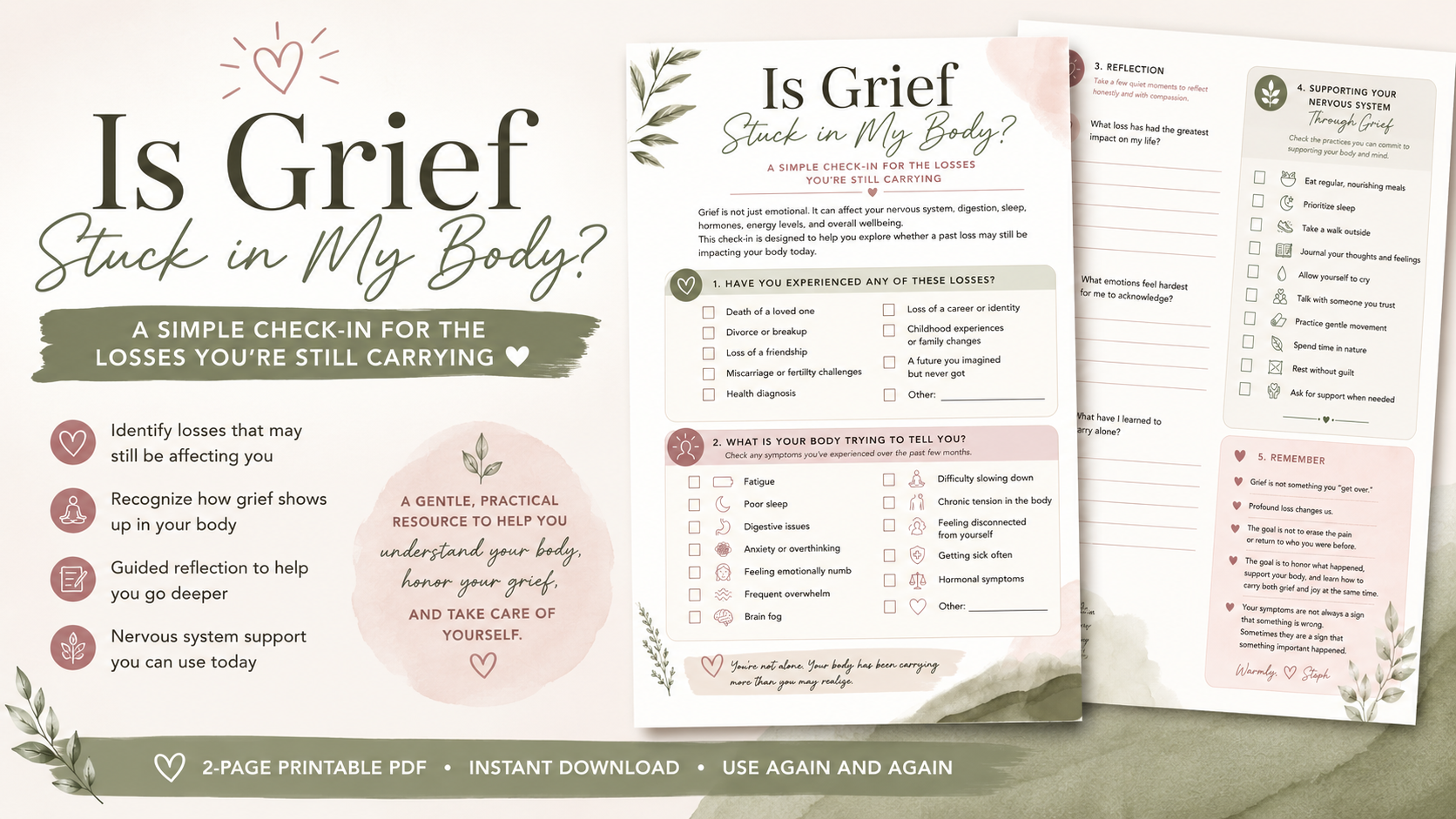
Free Guide: Is Grief Stuck in My Body? A Simple Check-In
Grief isn't just emotional — it can show up in your digestion, sleep, hormones, and energy levels without you ever connecting the dots. This companion guide walks you through identifying the losses you may still be carrying, checking in on how they're showing up in your body, and building a few nervous system supporting practices you can return to whenever you need them. Download it here: Patreon companion resource
You can also join Steph's free Patreon community here: The Inner Script Patreon

Meet Your Host: Stephanie Baubie, NP
Stephanie Baubie is an integrative nurse practitioner and the host of The Inner Script Podcast, where she explores the deeper stories behind health, healing, identity, and transformation. Through a blend of functional medicine, nervous system awareness, emotional insight, and honest conversation, Stephanie helps women better understand their bodies while questioning the narratives they’ve inherited about wellness, worth, and what it means to truly feel well.
On The Inner Script, Stephanie sits down with physicians, founders, thought leaders, and experts in women’s health, while also sharing solo reflections on the transitions and inner shifts that shape our lives.
Follow Steph on Instagram.
FAQs
Why does grief cause physical symptoms in the body?
Grief is not only emotional, it activates the nervous system the same way a physical threat would. In this episode of The Inner Script, Stephanie Baubie explains that losing someone who felt like safety causes cortisol and adrenaline to rise, inflammatory markers to increase, sleep to fragment, and heart rate variability to drop. She notes there's even a recognized condition called stress-induced cardiomyopathy, or "broken heart syndrome," where acute grief can temporarily weaken the heart muscle, which is physiological evidence of just how deeply grief registers in the body.
Can unresolved or suppressed grief lead to chronic illness?
Yes. Stephanie Baubie explains that when grief goes unprocessed, the resulting inflammation can become chronic rather than temporary. On The Inner Script, she connects long-term suppressed grief to conditions like IBS, autoimmune issues, thyroid dysfunction, chronic fatigue, hormonal imbalance, and skin flares, since the gut and nervous system are closely linked through the vagus nerve. She's careful to note that not every chronic condition is grief-based, but unprocessed grief is one of the most under-discussed drivers of systemic inflammation.
Why does grief come back years after a loss?
Grief isn't linear, and it doesn't follow a timeline that ends. In this episode, Stephanie Baubie explains that attachment doesn't simply disappear, so grief can resurface through milestones, memories, or even a smell or song years later. She shares that graduations, weddings, and career wins can all trigger a resurfacing of loss, and that this doesn't mean someone has regressed — it just means the connection to what was lost is still there.
What is the difference between healing from grief and adapting to it?
Stephanie Baubie distinguishes between healing, which she associates with experiences like heartbreak where you rebuild and return to a version of yourself, and adapting, which she reserves for profound loss like the death of a loved one. On The Inner Script, she explains that with profound loss you don't rebuild the same structure, you become a different person with a hollow space that shrinks over time but never fully disappears. Her framework reframes the goal from "getting over" a loss to integrating it.
How do I support someone who is grieving?
According to Stephanie Baubie, the most important thing you can do is not stay silent. In this episode, she explains that people who are grieving are already thinking about their loss constantly, so bringing it up won't make things worse — avoiding it often does. She recommends against saying "I know exactly how you feel" or offering solutions and timelines, and instead suggests simple acknowledgments like "I'm so sorry you're going through this" and "I'm here," since grieving people are usually looking for validation, not answers.
Are the five stages of grief accurate?
Not in the way most people assume. Stephanie Baubie explains on The Inner Script that the five stages — denial, anger, bargaining, depression, and acceptance were originally developed around people facing their own terminal illness, not bereavement, and were never intended to be linear. She describes grief instead as cyclical and unpredictable, where someone can feel acceptance one day and be triggered the next, without that meaning they've regressed.
How can I support my nervous system while grieving?
Stephanie Baubie recommends a handful of physiological anchors during grief: prioritizing sleep even when it's disrupted, eating regularly to stabilize blood sugar, getting gentle movement and sunlight without over-training, and finding safe connection rather than isolating completely. In this episode of The Inner Script, she also talks about the value of ritual whether that's a consistent daily schedule or a personal practice like talking to a lost loved one, cooking their favorite meal, or visiting their grave as a way to regulate the nervous system and maintain connection without forcing closure.
-
Everything shared here is for educational purposes and personal reflection only. Not medical advice. Always work with your own healthcare provider for individual care.
Hi everyone. Welcome back to the Inter Script. today's episode we're going to be talking about grief, and I've talked about how grief showed up in my body in the fourth episode, and it showed up in terms of my. Chronic digestion issues for years. And after that episode, I got a good amount of feedback on that.
You know, people really feeling seen who have dealt with similar issues. So it kind of just reinforced my thought. And belief that grief is something that is very overlooked, especially in the medical community and health and wellness. I don't think we fully realize the impact that grief has on our body and chronic symptoms and conditions.
So I really wanted to dedicate. A whole episode on grief. On top of it, I think it's helpful to kind of have more knowledge about grief, how to process it, and if you haven't been through grief before, just to get a better understanding of it and how to be there for somebody who is going through it, how to respond to them, because it's really something you don't know.
How to respond to, unless you've been through it, unfortunately. And it's just something we all go through at some point in our lives, which is kind of like a weird thing to think about. Just something so profound and sad is, you know, we're all gonna. Deal with this at some point in our lives. So I really wanted to dedicate a whole episode on it.
You know, I wanna emphasize what I'm going to dive into today in terms of grief. It's not the tidy five stages, linear inspirational version. We're talking about profound loss, the kind that alters your biology, the kind that changes who you are at your core. And we're gonna talk about two things today, what grief actually does to the body, and how to support someone who is grieving and how to support yourself if you are.
I wanna start off by saying, you know, healing is not linear and never is. And in some cases when we're talking about grief, especially profound loss, healing isn't even the right word. So, you know, what kind of grief are we even talking about today? And grief can mean. Many things. It can be a breakup, a divorce, a job, a version of yourself, the life you thought you'd have, and all of that is valid, and all of that is grief.
But today I really wanted to focus on profound loss, the death of a loved one, because heartbreak hurts, but losing a loved one. Forever. That doesn't just break you. It truly shatters you. And it leaves this hollow space in your body that can feel as big as the world, maybe more than that, or maybe bigger than that.
And I think we minimize how disruptive that is, not just. Emotionally, but physically and biologically, if this is your first time listening or if you didn't listen to the fourth episode, totally fine. Just kinda wanted to have a background. You know, I lost my dad to lung cancer when I was eight years old, and at eight you don't have the cognitive or emotional framework to process something like that.
You just kind of survive it. And I didn't really process my grief until I was a teenager. If I could even really like say that that was processing, I don't know. I just, that's the kind of the first moment I remember truly, like fully understanding what happened. Yeah. And honestly, I still am processing it at times and I'm 33 years old right now, almost 34.
So it's not linear. It's just something we are constantly going through and. I once had a spiritual healer, like this was like in my early twenties or maybe like mid twenties. I can't remember, whatever, it doesn't matter. But she told me I hadn't healed from losing my dad, and that just did not sit well with me.
It really rubbed me the wrong way, and I'll give her the benefit of the doubt. Maybe she meant there was a core like wound or inner child wound I hadn't fully integrated yet, so that can definitely be true, but that whole. Statement of saying I hadn't healed from my dad, just did not sit well with me. The reason for that is because I truly believe you are not supposed to fully heal from something like that.
When we frame profound loss as something you're meant to get over. We set people up to feel like they're failing and almost like their feelings are not valid. For me, at least, when it comes to grief and profound loss, you don't heal, you adapt. And I think that distinction matters because the intention behind integrating loss changes.
So healing versus adapting, like you might be thinking like, what the hell am I talking about? So let's talk about the difference. So when I think of healing versus. Adapting. For instance, with a breakup, you heal. You experience heartbreak, you grieve a scar, forms, you rebuild, your spark, comes back, and sometimes your light shines even brighter when you're on the other side of it.
But with profound loss, you don't rebuild. That same structure, you become a different person. You are shattered. And what's left is this hollow space, and at first it's massive. Feels like it can swallow you whole, but over time that hollow space shrinks. Maybe it becomes so small, it's the size of a pea, but it never disappears, and you don't shine brighter on the other side of profound laws, you shine.
Differently. And I think that's where people can get uncomfortable because we all love a redemption arc. You know, we love a comeback story. We love what doesn't kill you, makes you stronger. But sometimes it just makes you softer, more perceptive and more aware of impermanence and that's not weakness, that's depth.
It helps more let's go through kind of. What grief does to the body biologically. Yeah. Let's talk about what's happening physiologically when we're talking about grief and profound loss. Because grief is not just emotional. When you lose someone who felt like safety, your nervous system registers that as a threat.
And attachment is biological Safety is biological. It's core to your nervous system, safety, nervous system regulation, and when that anchor disappears. Body doesn't interpret it as sad, it interprets it as destabilization. And here's what we can see happen. Cortisol increases, which is your stress hormone.
Adrenaline increases inflammatory cytokines rise in the body, sleep becomes fragmented. Heart rate variability drops, which is your body's ability to recover from stress and just shows how resilient your. Nervous system is digestion, slows or becomes dysregulated immune function weakens. There is even a condition called stress induced cardiomyopathy, often referred to as broken heart syndrome, where acute grief contemporarily weaken the heart muscle.
And look, that's not poetic, that's physiological. My reason for sharing that piece, it's for people to truly understand what sadness and grief, how profound that feeling is, and how severe that can show up in the body. And it's because this grief increases systemic inflammation and if it remains unresolved or you know, suppressed that inflammation can become chronic.
And this is why. We often see irritable bowel syndrome, autoimmune conditions, thyroid dysfunction, chronic fatigue, anxiety disorders, hormonal dysregulation, skin flares. For me, it was my gut, decades of digestive issues because the gut. The nervous system are inseparable. They are so linked. The vagus nerve runs from your brainstem to your gut and grief disregulates.
Your vagal tone. Your vagus nerve is like literally responsible for so many things in the body. So when your vagal tone is getting dysregulated, things can go haywire, shit can hit the fan. On top of it, when you suppress the grief, your body holds it in high functioning women. If you are listening to me, I'm sure you are a high functioning woman.
We are very good at suppressing, which we shouldn't be proud of, but or very good at it. So let's get into more high functioning women and suppressed grief, because as I said, if you're listening this. Probably resonates and this is a mirror for me. Hello. Been there and honestly, this is something I've really seen clinically all of the time.
You know, women who are productive, successful, holding it together no matter what, caring for everyone else. Accept themselves, but somewhere in their history there was a profound loss. You know, instead of collapsing, they accelerated and they became hyper independent, hyper capable, hyper functioning, because if they slowed down, they might feel it.
And suppressed grief keeps the nervous system subtly activated and chronic. Subtle activation leads to so many hormonal disruptions. Things like estrogen dominance, progesterone depletion, cortisol dysregulation, poor sleep, blood sugar, instability, and we often treat the hormones, but we don't. Treat the grief.
So we tend to medicalize symptoms before asking what the body has been through. And look, I'm not saying every chronic condition is grief based, but unprocessed grief is one of the most under-discussed. Drivers of systemic inflammation. I also kind of wanted to touch on childhood grief versus adult grief because these are both very different and you know, the body processes things differently because we're in very different developmental stages and losing someone as a child versus an adult are very different experiences.
One. It's not worse than the other. It's just different. And when you lose someone in adulthood, you really have context memories, a fully formed attachment. And when you lose someone as a child, you lose not only the person but the life you are supposed to have with them. And that's. Developmental grief, you know, you grieve again at milestones and this is something I can really speak to you grieve at graduations first, relationships, career wins, weddings, and you know, for me, weddings are always kind of a tender spot or any wedding I go to, it's definitely reminds me of what I don't have.
You know, it's not that I'm actively sad there, it's just I feel that hollowness there. Crying, happy tears for people getting married. But I can still feel that kind of hollowness that I was talking about earlier. You know, both can be true. You can feel joy and you can still feel absence. And that's adaptation.
That's integration. I also wanna touch on the myth of the five stages of grief, and I think we've all heard of the five stages of grief, denial. Anger, bargaining, depression, and acceptance. Here's what doesn't get talked about. What I learned, and this is actually recently, those stages were originally conceptualized around people facing their own terminal illness, that bereavement, and even then they were never meant to be linear.
Grief is cyclical. Nonlinear, unpredictable. You can feel acceptance one day and rage the next. You can feel stable for years and then triggered by a smell, a song, a random Tuesday. And that doesn't mean you regressed, it just means that attachment doesn't disappear. And supporting someone who is grieving, what can that look like?
If you haven't experienced profound loss, you might feel uncomfortable around someone who has, 'cause you don't know what to say and that is totally fair. That's so valid. You know, you don't wanna make it worse. You don't wanna bring it up in case they're not thinking about it. But what I will say is you will not make it worse by bringing it up.
They're thinking about it constantly, especially if it was recently. And even if they're not acutely thinking about it, there isn't a day that goes by that they don't think about it. So it might be that hour. They didn't think about it, but they think about it every day. So you're not gonna make it worse by bringing it up.
What does make it worse is silence. And here's the most important thing. Don't say I know exactly what you're going through, even if you've experienced loss context. Matters always. You know, I lost my dad when I was eight years old. One of my best friends lost her dad in her thirties. Completely different realities.
And I never said to her, I know exactly how you feel, because the reality is, I don't, we lost our dad at completely two different stages of our lives. So I don't know exactly how she feels. I might be able to empathize with her better than somebody who hasn't lost a parent. But again, I didn't say to her, I know exactly what you're going through.
What I did say was, you know, I'm so sorry you're going through this. There's no right way to navigate something like this. And I'm here. No solutions, no timelines. No, it gets easier because it doesn't, not quickly at least, and people aren't looking for solutions at a time like this. They're looking for validation and something I kind of wanted to bring up was kind of like dating and grief for me.
It's like whenever I would. You know, go out on a first date with somebody or a second date, whatever, and they ask about my family. And this would have to get brought up a lot with strangers. And sometimes it was like hard to navigate. It's not that I was upset talking about it, but you know, it just, it's one of those things where it can just kind of feel heavy at times, and it's something that would always just be in the back of my head before going on a first date and just having to be a little bit more vulnerable than maybe.
You would want to be on a first date. Yeah. And it's, it's something that kind of showed up for me in dating, which was interesting. And I just, I kind of felt like I wanted to share. And what I will say is there is a different depth when someone has experienced something that shook them, like a profound loss or a death in the family.
It doesn't have to be death. It could be something that altered their identity because it really creates. Empathy and perception and nervous system maturity. And when someone hasn't experienced that, there can be this subtle panic in their response. When I share something like that, and it's not them being cruel in any way, but I can just kind of sense their discomfort.
When I share something because they don't know what to say and they feel bad for bringing it up. And then I find myself in this situation where I'm managing their discomfort instead of just sharing my truth and my experience. So if you are. Dating and somebody shares something like this, all that needs to be said is, that must have been really hard.
Thank you for sharing that. Like that's literally it. And what I will say is many of my serious relationships have experienced a death of a parent. It's not that I was seeking that out, but it just kind of, I think I was attracted to that level of understanding, and I mean, I don't necessarily think that's a coincidence.
I'm not like looking for somebody who has experienced that, but I think I was, you know, I felt. Really comfortable sharing my truth in that situation. So I just, I don't know. I kind of wanted to share that. 'cause I think it's kind of interesting and it's just something we both had gone through. I just feel like there's maybe a little bit of a deeper understanding of each other.
Okay. So how to support your own nervous system through grief. I was trying to think about this. If you are. Currently grieving or if you have suppressed grief, here are a few things that matter physiologically. You always wanna try and prioritize sleep. You know, as hard as that is grief, disrupt, circadian rhythm.
So you really wanna try and protect it, and it might be where. You know, maybe you need to take some melatonin or magnesium glycinate or hanin supplements just to help kind of lower that stress response just for short term. And, you know, really trying to eat regularly. And look, I hear you like. Grief and stress can really suppress your appetite.
Believe me, that's how it shows up for me. Like I can't eat anything, but you have to just try and like even snacks throughout the day can really make a difference. Blood sugar instability really amplifies your emotional responses. Trying to get some gentle movement in, you know, not over training, trying to get outside in sunlight, just going for a walk.
Certainly not over training 'cause we don't wanna get. Cortisol overloaded and trying to find safe connection. Isolation can really worsen inflammation during a time like this, but obviously alone time is needed at times to decompress, so that is totally valid, but it's just kind of finding maybe even like one or two people you feel a hundred percent safe with where you can just sit in silence and just have that presence there I think can be really helpful and trying to have some type of ritual.
You know, like waking up at the same time, eating meals at the same time, going to bed at the same time, getting your movement in at the same time. Something just to help kind of keep a schedule or, and it can also be, when I say ritual and schedule or just. When we're talking about rituals alone, something to lower your stress or something that's going to regulate your nervous system, our nervous system loves ritual.
For me, what I've learned in kind of my adulthood, early adulthood, like in my twenties, I really started leaning into my spirituality as kind of a ritual and a weight. To connect to my dad and I talk to him. I feel very connected to him. I can feel kind of his presence at times. For someone else, it might be cooking their favorite meal, listening to their favorite song, writing letters, visiting their grave.
You know, there is no correct ritual, and I think it's helpful to know that the goal is never closure. The goal is integration and still kind of maintaining that even small form of connection to them because that is like such a beautiful thing and I really can't emphasize that enough. So if you're listening right now and you've experienced profound loss, take a breath.
Place your hand on your chest and just notice the hollow space. You don't have to eliminate it. You don't have to fix it. Just acknowledge it. That space exists because love existed and love doesn't disappear. It transforms. The hollow space shrinks, but it states and maybe supposed to. We will all experience grief and profound loss at some point in our lives, and if you are in it right now, you are not broken.
Your body isn't malfunctioning. It is adapting to the absence of someone who felt like safety. Be gentle with yourself. You don't heal, you adapt, and that adaptation is strength. Alright guys, that's all I have on grief and Profound loss. I know it was kind of a heavy one today, but I thought it was needed.
I think it's just, as I mentioned in the intro, it's just something we kind of forget or don't realize how much it can affect us on every level in our lives, physically, mentally, emotionally, spiritually, and I want more people to kind of understand how this can really impact them on a day-to-day basis.
I've certainly seen it in myself. In my patience. I just think it's such an important topic. So please rate, review and subscribe to the Inter Script podcast. It was so good chatting with you guys today. If you have any questions, feel free to send me a DM on the Inter Script pod on Instagram. So good to chat with you guys today.
I will talk to you guys next week.
If you wanna connect with like-minded women and dive deeper into these conversations, join my Patreon community. There's a free option and it's where we can talk about each episode together. The link is in the show notes and I can't wait to see you there.
Disclaimer
Everything shared in this episode is for educational purposes and personal reflection only. It is not medical advice. Always work with your own healthcare provider for individual care.
We sometimes include links to products and services we find interesting. These may or may not be affiliate links. Thanks for your support.
Podcast production by Jamie Brooke.
