Is Stress Causing Back Pain? The Hidden Connection Between Your Emotions & Body
Listen now by clicking your favorite podcast app below:
Have you ever wondered why your back or hip pain keeps coming back, even when your scans look normal and no one can explain what’s wrong?
In this episode of The Inner Script, Stephanie Baubie, NP sits down with movement coach and yoga teacher Ira Iz to explore the connection between chronic back pain, stress, emotions, the nervous system, and movement.
After experiencing years of persistent lower back and hip pain, Ira began to realize that healing wasn’t simply about finding the perfect exercise, stretch, or treatment. She started looking at what else was happening in her body and life, including chronic stress, anxiety, emotional suppression, and a constant drive to stay productive.
Ira shares how learning to recognize and make space for her emotions changed her relationship with her body, and why movement and breath became tools for getting out of her head and reconnecting with what she was physically experiencing.
Stephanie and Ira also explore what fascia actually is, why regular movement helps keep it mobile, and why more intense exercise isn’t necessarily better when your body already feels chronically tense. Ira explains how slowing down, moving gently, and giving the nervous system an opportunity to settle became an important part of her own healing.
They also discuss the pressure many high-functioning women feel to constantly be doing, achieving, and planning, and why learning that “resting is part of working” helped Ira rethink productivity altogether.
Most importantly, Ira shares how she stopped seeing pain as something she needed to fight and began approaching her body with more curiosity, trust, and compassion.
This episode is for you if…
- You experience recurring lower back, hip, pelvic, or other physical pain without a clear explanation
- You notice your body feels tighter or more painful during stressful periods
- You have a hard time truly relaxing, even when you’re technically “resting”
- You spend a lot of time planning, worrying, overthinking, or living in “go mode”
- You’re curious about fascia and how movement affects it
- You tend to push through discomfort rather than slowing down and listening to your body
- You want to better understand the connection between emotions, stress, movement, and chronic pain
Episode Timestamps
00:00 When Chronic Pain Has No Answer
02:27 The Stress and Pain Connection
05:46 Learning to Understand Emotions
10:39 What Healing Actually Looked Like
12:53 Movement and Nervous System Regulation
15:48 Releasing Emotion Through the Body
18:17 What Fascia Actually Is
21:42 How Movement Hydrates Fascia
22:24 Strength Training vs. Mobility
25:13 How Productivity Affects Pain
27:22 Why Rest Is Productive
30:42 Rebuilding Trust in Your Body
33:04 Changing Your Relationship With Pain
35:01 Where to Begin With Chronic Pain
Resources & Mentions
- Chronic back and hip pain
- Fascia and movement
- Nervous system regulation
- Breathwork
- Emotional awareness and release
- Slow and intentional movement
- Strength training and mobility
- Stress and anxiety
- Productivity and rest
- Acupuncture
Curious about a supplement Steph has mentioned in the episode?
If you’re looking for products Steph personally recommends in practice, you can browse her dispensary here: Stephanie’s Fullscript dispensary
Please consult your healthcare provider before starting any new supplement. Food, lifestyle, and nervous system support always come first.
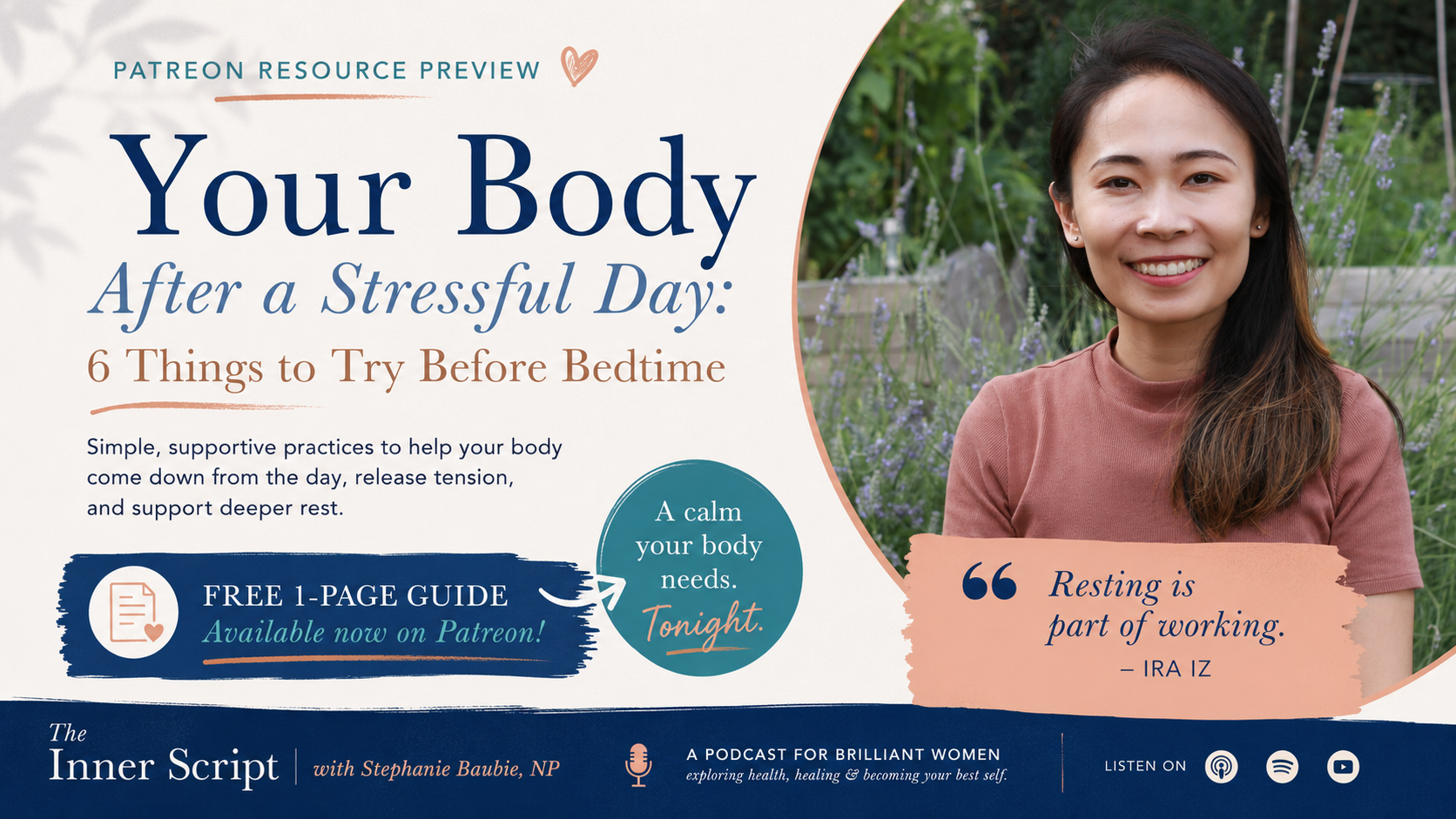
What does your body need from you after a stressful day?
To accompany this episode, Steph created Your Body After a Stressful Day: 6 Things to Try Before Bedtime, a free one-page guide with simple ways to reconnect with your body and intentionally come down from the day before you head to sleep. Download it here: Patreon companion resource
You can also join Steph’s free Patreon community here:
The Inner Script Patreon

Meet Ira Iz
Ira Iz is a movement coach and yoga teacher who helps people recover from lower back and hip pain that doesn’t come with a clear answer, including pain that persists even when doctors say nothing appears to be “wrong.”
Having navigated her own healing journey through chronic pain, Ira understands firsthand how confusing and isolating the search for answers can be. She helps people make sense of how their bodies move, hold tension, and respond so they can build confidence, restore functional movement, and create sustainable strength and resilience that extend far beyond the yoga mat.
Rather than offering one-size-fits-all exercises, Ira combines movement science with an understanding of the nervous system, mindset, and emotions to help people discover what works uniquely for them.
Connect with Ira:
Website: https://www.byiraiz.com/
Instagram: https://www.instagram.com/blissmove/
YouTube: https://www.youtube.com/@blissmove

Meet Your Host
Stephanie Baubie, NP is an integrative nurse practitioner and the host of The Inner Script Podcast, where she explores the deeper stories behind health, healing, identity, and transformation. Through a blend of functional medicine, nervous system awareness, emotional insight, and honest conversation, Stephanie helps women better understand their bodies while questioning the narratives they’ve inherited about wellness, worth, and what it means to truly feel well.
On The Inner Script, Stephanie sits down with physicians, founders, thought leaders, and experts in women’s health, while also sharing solo reflections on the transitions and inner shifts that shape our lives.
Follow Steph on Instagram.
FAQs
Can stress contribute to chronic back pain?
Ira describes noticing that her persistent lower back and hip pain often overlapped with periods of significant stress and anxiety. In the episode, Stephanie and Ira discuss how stress, nervous system activation, muscle tension, movement, and emotions may all influence the experience of chronic pain.
Why can back pain continue when scans look normal?
Ira’s experience led her to look beyond a single structural explanation for her pain. She began considering her body as a connected system and looking at movement, stress, emotions, mindset, and nervous system responses alongside the physical symptoms she was experiencing.
What is fascia?
Ira describes fascia as connective tissue found throughout the body, including around and within muscles and around organs. She explains that fascia helps different structures move and glide and plays a role in transmitting force throughout the body.
How does movement affect fascia?
Ira explains that movement helps fascia glide and move fluid through the tissues. She emphasizes that this doesn’t necessarily require intense exercise. Walking, gentle movement, exercise, and passive movement such as massage can all involve movement of the tissues.
Can intense exercise make your body feel tighter?
For Ira personally, doing more strength training left her feeling chronically tight even though she was also stretching. She explains that intense or fast exercise requires greater physical and nervous system activation, while slower movement can give the body an opportunity to settle afterward.
How can productivity and stress affect the body?
Ira describes how constantly planning, accomplishing, and thinking about the next task made it difficult for her to fully relax. She eventually had to learn how to simply be without feeling as though she should always be doing something productive.
How can you change your relationship with chronic pain?
Ira encourages approaching pain with curiosity rather than immediately fighting against it. She describes pain as a protective signal from the body and suggests becoming more interested in what the body may be communicating while treating yourself with greater gentleness rather than blame.
-
Everything shared here is for educational purposes and personal reflection only. Not medical advice. Always work with your own healthcare provider for individual care.
Stephanie Baubie: Hi, everyone. Welcome back to The Inner Script. I am joined today by Ira. Ira is a movement coach and yoga teacher who helps people recover from persistent lower back pain and hip pain, even when the scans look normal and no one can explain why they're hurting. After navigating her own years-long journey through chronic pain, Ira realized that healing wasn't about finding one perfect exercise.
It was about understanding how the body moves, how it holds stress, and how the nervous system, emotions, and mindset influence pain. Today, she combines movement science with a holistic understanding of the body to help people rebuild confidence, restore functional movement, and reconnect with their bodies in a way that lasts.
Rather than offering one-size-fits-all solutions, Ira believes healing is deeply individual and that movement should feel less like another obligation and more like coming home to yourself. Welcome, Ira. How are you doing?
Ira Iz: I'm doing good. Thank you for having
Stephanie Baubie: I'm so thrilled for you to come on and talk about your experience because as a nurse practitioner, back pain is probably one of the most common things I see as a clinician.
I've always felt there was, like, such an emotional root to it, so I'm so excited to dive deeper into this. I wanna start off just kind of with your own personal experience. You spent years searching for answers to your own chronic pain. What was happening in your body at that
time?
Ira Iz: The chronic pain I have is around the lower back and the hip, and it didn't really start as chronic pain. I had a journey of figuring out what's going on, and I had other pains in my body that is more like a acute pain. It's more intense. I go to physio. I went to check what's going on and just to understand and want to get better.
Through that process of checking other different parts of the pain, then the lower back pain start to develop. And then I did physio work. For example, my neck pain got better, my shoulder blade pain got better, but this part kind of just stayed. Gradually, I start to also have hip pain, like the lower back area, closer to the hip area and the groin area and pelvis floor area.
So there I have, um, a couple of spots. I don't have a long period that I have multiple place hurting at the same time, but they were, like, overlapping from time to time. Sometimes here, sometimes there. So my pain is kind of just around the pelvis and lower back. If I look on what's happening in my life, I'm having a lot of stress at that moment, and then I am also experiencing a lot of anxiety.
But if you just interact with me regularly, you wouldn't notice 'cause I wouldn't show much on my face like I'm experiencing pain or having anxiety. 'Cause most of the time I look calm. I think I got trained really well to, like, look calm. I remember when the doctor asked me, "Do you have anxiety?" I was like, "I don't think so."
A lot of people ask me that question, which I start to question myself. I'm like, "Okay, can you explain what's anxiety? I'm not sure I fully understand." And then the doctor was saying, "Oh, do you constantly worry?" I was like, "Yeah, I do worry. I worry about my future," but do I constantly worry? Then I think about it for a second.
I'm like, "Yeah, I am constantly worrying," but I still feel like I don't have anxiety. 'Cause if I check people around me that do publicly admit they have anxiety, you can see it. I don't see it in myself. I don't express it, and I don't feel like I have it. But if I check the description of it, it sounds like I do.
From then on, I start to realize more and more about my stress and my anxiety and how it's connected to the chronic pain, and I was like, "Okay, I think it's all related."
Stephanie Baubie: When the doctor was asking you if you're anxious, this is something just as a clinician I'm really curious about because I think chronic stress, emotional suppression can really show up physically in the body, and bringing this up with patients is really important. But you also don't want the patient to feel like you're dismissing their pain.
So I think people can feel very triggered in a sense when somebody's like, "Well, is this stress?" How did that conversation go? Were you at first like, "No, this isn't stress"? What's a good way for a clinician to maybe say that so that people don't feel dismissed?
Ira Iz: In my experience, I didn't feel I'm dismissed. I actually feel like the doctor brought up something that I never thought about. The doctor did a good way for me is like, "Do you think you have anxiety?" It's not like, "Oh, you have anxiety," right there. Because I feel like if somebody told me, "You have anxiety," I'm like, "Do you even know me?
I just got on this call with you. I don't even know you. You don't even know me, and right there you're telling me this?"
Stephanie Baubie: So it's kind of more of an open dialogue of do you feel anxious instead of telling you, "Oh, you're
Ira Iz: Like a prompt of self-reflection. I also learned to ask question, like a lot of people ask me, "Are you stressed?" Ask me enough for me to like, I probably should check in with myself and see if I'm stressed, or I probably should understand better what's anxiety. Then I ask the question
Stephanie Baubie: That's really helpful. I love to kind of hear someone who is a patient and their experience with that because we never want to make anybody feel dismissed in a sense. Okay, so you go to the doctor, kind of have this, a light bulb goes off in your head in a sense of like, "Oh, wow, maybe this is kind of stress is contributing to this."
Then what does your experience look
like?
Ira Iz: After that, I start to understand better about my emotion. I also had a couple of time that I'm really struggling with understanding emotionally what's going on with me. Like, I had a moment, I'm feeling this way, I feel weird. I usually don't. It's very strong. I just don't know what it is. I don't understand.
I don't know how to process it. I start to seek for help, for counseling therapy, just to learn what's going on. There are so many blank spot in my brain that I'm not understanding, so I seek for help. Gradually, with reading, with all the helps, different kinds of therapy that I experience, I start to piece different information together.
Like, oh, okay, this is not just a singular body pain. It's very complicated and individual, and how emotion influence it to show up, how stress influence it to show up. I kind of need to take a step back and see, okay, I think I went through a period of stress is not good. I'm feeling stressed, and then I become more stressed about it 'cause I'm in the stress.
I know it's not good. Gradually, as I learn more and more, I learn that, oh, stress is not either good or bad without a context. And I remember my yoga teacher tell me, she said, "A healthy amount of stress makes the body strong." I was like, "Wow, you are right." It is how we get strong physically. And then I start to look at, oh, okay, maybe I shouldn't be so stressed about I am stressed, and instead, can I react in a different way?
Can I face stress in a different way? I could be stressed, I could be aware. Can I be okay about it? And takes a process of getting there, also understanding my emotion, not feeling okay about feeling certain way, to finally, like, I have the right to feel anything. There's no bad, no good. I just want to experience it.
It's human life. What I do about it is important. Somebody can take a strong emotion and do violent stuff, but I can take the emotion that maybe looks really bad and do something different about it. The labeling our emotion, I feel like I really learned how to separate from the emotion itself to the behavior that comes after it.
Stephanie Baubie: In terms of trying to own your feelings, name your feelings, what was that process like? Was it movement? Was it just kind of like sitting in solitude? Was it journaling? Like how did you connect with your emotions? 'Cause I feel like a lot of people struggle with that
Ira Iz: It's a long journey for me 'cause I didn't have a lot of vocabulary for emotion. So a lot of times I feel it, I don't even know how to describe it to other people. And then my therapist was like, "Okay, have you tried, there are different tools and there are cards with faces." I checked them online. I was like, "This doesn't vibe with me," because most of the time I look calm. I check the face, I still don't know how I feel 'cause I don't make those face. Gradually, I think I looked online, I have it right here. I bought this card. This is a card, the box of emotion. Inside, they categorize the emotion in different, I think, energy. There is zen, there is bliss, but they don't have face.
I'm a visual person, I really like pretty stuff. But what they have is this, colors, shapes. I kinda use this as a gateway to, "Okay, I don't really know how I feel. Let me pick something," and then I will read about it. They have a explanation behind. Sometimes it's about history. I think all of them have, like, how that emotion feels like.
And then I will check. Sometimes agree, sometimes I was like, "I don't know. I really don't know." Then just learning about it. It doesn't matter if it's resonate with me or not, I just wanna learn about it. And then gradually, my vocabulary becomes better. I can describe it better to other people, so when I'm seeking for help, they could help me better too.
That's how, kind of how I learned how to understand the emotion and process it in a healthy way.
Stephanie Baubie: I think that's so helpful for people because it sounds like maybe like least important to name the feeling instead of just allowing yourself to feel it, not naming it, not pathologizing it, just kind of allowing it to kind of go through your body. That's such a good perspective. How long were you feeling this pain before you started looking at this kind of emotional stress component?
Ira Iz: It's been a long time for me to start from the beginning to deal with everything. I finally feel good. How long? I think around 2021 was the point that I start to check in with my emotion, but my pain start around the end of 2019 and 2020, I think for about a
Stephanie Baubie: When you started exploring the emotional aspect, how long did it take for you to notice a difference, and what did that look like in terms of changes in your body when you started to address the emotional root?
Ira Iz: I would say for at least a year, 'cause at the beginning, I'm fully blank, fully confused, don't know what's going on. I don't even know if the therapist that I found will be able to help me. And I had some question before we eventually start to work together. I remember asking this, and I still confused after hearing the answer.
I was like, "Okay." She said, "After processing what you experience, you will start to feel healed." I was like, "Can you explain how does healed looks like?" And she said, "You would not feel this strong emotion or reaction towards the thing that happens to you." But back then, the thing just happened to me. I just had a strong emotion breakout.
In my brain, I don't know how that looks like even though she described it. I was like, I truly don't understand what you mean." I didn't say this. This is just how I felt, and I was so desperate of understanding. I was like, I'm just gonna give her a shot. Let's start working together and see where it goes, 'cause I do not like to stay where I am.
So that's kind of the timeline.
Stephanie Baubie: Pain started 2019, it sounds like. Started kind of the emotional route in 2021. Where are you now in terms of the pain?
Ira Iz: I don't have chronic pain anymore. Full disclosure, if you ask me, "Do you still have pain?" I would say yes, but it's human experience. I would have maybe an episode of flare-up when I'm super stressed, but I know how to take care of myself. It never stayed. I am really, really happy about where I am today.
Yeah We're never going to be 100% healed in a way because we're all gonna have stress at some points. Sometimes it's just our body communicating with us, and it's a signal. But that's amazing. You don't identify with chronic pain anymore. It was obviously you were learning the vocabulary of emotions, processing emotions, feeling them, releasing them.
Stephanie Baubie: Where did nervous system regulation, mindset, and movement play into this as well, into your, uh, healing journey, if there was anything part of that?
Ira Iz: Because the pain is physical, I always thought movement is important. And wherever I go, physio, massage therapist, all of them were like, "Um, you sit too much." And which I do, I have a sitting job. Very hard to avoid. Before the pain, I exercise regularly. It's like already part of my life. I was just looking for a way, like, how do I move in a way that could improve this chronic pain?
When I learned about stress, one of the way to de-stress the body, to make the body go back to calm or more regulate states is to move. Right now, movement is my everyday routine, especially when I have a stressful day. I will make sure before I go to bed, I move my body. That really helps me to get out of my brain, just reconnect with my body.
'Cause if I just sit and work without moving, I tend to stay in my brain, and that's very easy to get stressed, and also that's very easy for me to get anxious, just worrying about stuff. And moving will break that pattern. And in terms of the nerve system downregulation, I use breathwork other than moving.
I think moving already kind of downregulates me a bit. And then I'll use breathwork if I feel like, oh, I'm really stressed, and that really helped me to calm down and center myself. Especially if I have, let's say I have a flare-up episode that is really bad, I make sure I move with the regulated breath.
It's slow movement, is regulated breath together with the movement, and that significantly help me to ease the pain and let it go. In terms of the mindset, I really need to be aware about where my brain goes, cause if I'm not careful, I will get like into monkey brain. Let's think about this, think about that, and then worrying about this, worrying about that.
And then if I notice that, I'll be like, "Okay, no, no, let's not go there." Come back to your body. The easiest, the most accessible way to come back to our body is by breathing. Once you notice your breath, you're back. I use that as a anchor point. If I have the space or if I have the accessibility to move, I'll move.
They are kind of all play tangled with each other inside of my toolbox. And the emotion part is probably the hardest part for me. Sometime I will still have emotions that I'm not understanding fully, but I will make sure I take some space for myself. Either write it down or go outside to think about it.
Go where the nature is, think about it there, where it's a calm and I feel safe. Or sometimes I just let it out in nature, and it feels very releasing and relaxing in that way.
Stephanie Baubie: When you say let it out, what do you mean
by
that?
Ira Iz: Sometimes I could just sit there and cry. I think I did it maybe once or twice. If it's an open area and I feel the surge of just shouting, I could just do like, "Ah!"
Stephanie Baubie: so good for you. It's literally the best thing to do for you. And that's funny you say that sometimes you just let it out. There was a period of time when I was really going through stressful period of time and I was in a yoga class, and we were doing pretty intense hip stretches. I was all of a sudden just started crying, like had no control over that.
Especially in women, I think a lot of us carry our emotions in, like, our pelvic region, but also our inner hip region. And it was like that stretch was like something was moving through me, and it just had to get released. So is that something that has happened to you? Do you see that in your clients as well?
Like, that's... You could say it's a good sign at the same token, right? Do you see that in your clients as
well?
Ira Iz: I do as well. I can't really talk much about client, like what happens to the client. I'll use myself as the example. So the hip area is a very sensitive area. A lot of energy gets stored there, and also tension, stress. They kind of all stocked up there. And when you get a release, crying is a very common thing to see.
I remember I had this growing pain before. It bothers me to walk. It just showed up. I was like, "I don't know what's going on." And back then I was going through acupuncture. I happened to have a acupuncture session booked the next day, so I went there. I talk about my struggle. I didn't know if it's gonna help or not, because we were treating the back all the time.
And then I bring up a new stuff, and she's a great practitioner, and she said, " Are you okay if I put some needles there?" And I was like, "Hmm, what do you mean am I okay? If you need, you need." She's very caring. She's like, "It's a very delicate area, and it's very sensitive." I was like, I didn't care much about my emotion back then, and I didn't know much about it, so I just feel like I need it.
Just go ahead. And she put the needle in. I start crying uncontrollably. I couldn't understand what's going on. I also feel bad about it, crying in the session. But she was just being there and trying to just give me a tissue and just make sure that the tear doesn't bother me. I don't know how long it lasted, but I remember it was an intense session.
My tear just pouring. I don't feel like I'm feeling something. It's more like a physical reaction. It was, wow, just out.
Stephanie Baubie: It's powerful. You can feel yourself releasing that tension. I think everyone kind of needs to experience that at some point to really understand how much the body can store, 'cause it's quite transformative. You also talk a lot about fascia. Can you explain a little bit what fascia actually is, why we should care about it, I see it a lot on social media right now, and why it's important to hydrate the fascia? Fascia is connective tissue in the body, and it's literally everywhere in your body. So it's in your muscle. Let's say the smallest muscle fiber, outside there is fascia, and the smallest muscle fiber will form the muscle itself. Each one has a fascia, and outside of your muscle there is fascia, outside of your organ there is fascia.
Ira Iz: So it's like a endless web. You can say bag inside of a bag, but they are all connected to each other. That's the connective tissue in the body that helps the body to move smoothly so that you don't feel the friction between your organ. It's moist, it's wet, and it is also transmitting force for your body to generate force and perform a movement.
So that's what fascia is. And also, the shape you see is not the shape of the muscle. The shape you see is the shape of the fascia, because fascia is inside your muscle as well So it's everywhere. If you glide your finger, just glide a little bit, your skin kind of moves. So the very outside just underneath your skin, you have a whole shape of your body, and that's a layer of fascia as well.
So they are deep inside and they're on the surface as well. It's very... In terms of structure, it's complicated and it's everywhere inside of your body. Why it's important is that it helps to deliver the nutrition. So the vessel is not the only thing that delivers nutrition to your body. It's not the only thing.
You have the fascia and they kind of communicate with each other, and they glide the fluid towards a place. When it is not functioning very well, sometimes you may feel a knot inside your body. It's very common to feel it at the back. We didn't move enough, then the knot would start to form. When that happens, you basically...
Let's say this is a fascia and you kind of twist it, and this part is not smooth. So nutrition doesn't get there very, very well. And then because this part is tangled, it is pulling other parts. Even though sometimes you may have pain in a certain area, but you would find, okay, the cause of it is somewhere else.
That's why it matters a lot in terms of your whole body's health. When we don't move enough... So study have shown when we sleep, we didn't move much. The next day we wake up, the fascia will get sticky and they will become harder to glide. And the only way you can break that stickiness is by movement, either passive movement or active movement.
So passive movement, you can consider going to a massage therapist because they are moving your body in a certain way. They kind of dissolve that stickiness away. That's why you feel like, "Oh, I'm so relaxed after a session." Therapist may even recommend you please drink a lot of water even though you didn't work out.
It's more like to move that fluid even more. And then active movement would be like you're moving your body, walking, running, exercise. That's how we hydrate the fascia and break down that stickiness.
Stephanie Baubie: Are there specific exercises or stretches that can really help to hydrate the fascia?
Ira Iz: In my opinion, what's more important is you enjoy the movement and you're moving your body. It's not like the more intense the better. In my body, if I just wake up and do intense workout, I can tense up more, 'cause that's just how my body react to a certain thing. But if I do slow movement or if I just simply walk, and it's not even fast, it's slow walk, that helps
Stephanie Baubie: what are your thoughts on people who do a lot of strength training, not enough mobility
work?
Ira Iz: I would say it works to a certain scenario. It's not a solution that fits to all, 'cause I did that. If I do too much strength work, my body reacts more like stressed. Three times a week, but I feel my body's tight. I also do stretches. I still feel it's tight. Now, I do once a week. I feel great. My mobility is better than before.
So yeah, I think there is a place for that, for what you just said. But we really need to look at each individual and say, "Okay, how is the body reacting to this method? Are they enjoying it? Are they tensing up or it's something else?"
Stephanie Baubie: I ask that because in my 20s I did a lot of HIIT strength training. I didn't stretch a lot. I didn't do a lot of mobility work. I was exercising a ton. And then now I still do strength training, but I add Pilates mobility in there, like twice a week for sure. And I've noticed I still get sore, but I'm not stiff anymore.
I used to get on my bed and just feel like so stiff. I still get sore muscles here and there, but I very rarely feel stiffness. Is that because the fascia is moving?
Ira Iz: Yes and no. Let me explain. When we move fast, the nervous system need to get up to a alert level. For that to happen, the body has to get ready. For the body from a relaxed position or relaxed state to get ready for movement, there is a moment of your body doing this. You see the subtle movement? That is requiring your body to be on alert and your muscle needs to tense a little bit.
I'm exaggerating. Maybe not a lot, but you need to tense a little bit to get up to do any sort of movement, and the HIIT kind of movement requires a lot of that. So the body's just getting ready and move and getting that benefit of the cardiovascular movement or benefit. But if we don't let the body calms down, the tension in the body doesn't go like, wow. So your fascia could stay or your muscle could stay just tight all the time, and that becomes the issue of chronic tightness. Even though you stretch, you couldn't feel, I'm relaxed, 'cause the nerve system, the whole body is in that state. And then when you do some others... When you slow down, the slow movement makes you more calm.
Your nerve system is not like, I need to be ready. I need to move this way, or fast or more." Once we are out of that state, the body's more like, "Oh, okay, I can relax." When the nerve system can calms down, the body can be like, "I can just relax." So the subtle chronic tension doesn't build up and it doesn't stay there, 'cause you gave the body the opportunity to settle down
Stephanie Baubie: Yeah, so it's kind of this like chronic activation that the body is in, so then it's going to feel stiff and tense and pain develops. I talk a lot about over-functioning women or people, anyone who identifies as a female, just overall like overproduction, and I think you've mentioned some of that as well.
How is that shaping chronic pain in your experience?
Ira Iz: The overproductivity or the productivity, I think there is a pattern there for us to do more within less time. The mindset there, I think the mindset plays a big role in my life. In that culture is like, the more I can do with the less time, the better, or the more achievement I do, because time is equal to everybody, but if I do more, I will feel better in that sense. You just get trained in that mindset, and what happened to me is I got into the habit of just doing stuff. Just go, go, go. One thing after this, one thing after this. So in my brain, I'm always planning. If on a good term, I'm planning that I'm looking ahead, I am being organized, but if I do that too much all the time, it becomes anxiety.
And that plays into the chronic pain, 'cause if I'm always worrying, planning, I don't let my body to really relax, or I don't really have a moment of just being there. I had a hard time just learn how to be there, not doing anything. And I had a hard time if I'm not doing anything, my whole body tense up and I'm like, "I wanna do something.
This feels wrong." I really need to learn that, like, I can just sit there and do nothing and be okay about it, and just give my body an opportunity to let go of whatever tension I'm holding. That's how that productivity culture shaped my mindset and influenced my pain, how it showed up, how it aggravates it, 'cause those type of mindset doesn't really help healing
Stephanie Baubie: A lot of unlearning we really have to do if we have to earn rest. Our identity is tied to what we produce. That's just not the way it should be
Ira Iz: I learned how to redefine what's productivity for me. My partner told me one sentence that really, really helped me. He said, "Resting is part of working."
Stephanie Baubie: I love that. I say rest is productive. Literally, your body has to rest in order for it to detox appropriately, recover, all of the things. So that's such a good takeaway. I do wanna go into a little bit about your movement coaching business, and if you're comfortable talking about how you work with clients.
Obviously, you don't have to give specifics on clients, but just how you work with them. Where do you start?
Ira Iz: I would start understanding their situation first. I'll let them tell me what has been going on, and if they have pain, I will take a close, detailed note on, like, where is the pain? Do you find any pattern relating to your pain? Like, is there any trigger? Sometimes they know, sometimes they don't. And then I will take a step back on not just the physical body.
I will ask them, "How stressed are you?" Also asking them to reflect on maybe do they have pain flare-up usually after a stressful day? Just for me, and also for them, for them it's more like a reflection on their experience. For me, it's to understand and try to find is there any pattern I can see, not just from the physical body, that contributes to their pain, to their current situation.
So I start from there, and then I would see, okay, which angle would be effective to go in for this person to start breaking that pattern and integrate that in the daily life.
Stephanie Baubie: I mean, a lot of this has to do with finding ways for people to reconnect with themselves too. Do you feel like there can be a lot of resistance to that?
Ira Iz: Like a reconnection?
Stephanie Baubie: Yeah, with some people
Ira Iz: I think yes and no. I feel like the resistance doesn't come from a place that they don't want to connect. The resistance comes from a place that they've tried so many stuff, and it didn't work, and then they end up in a place like, "Oh, I'm gonna try a new thing. I don't know if this is gonna work."
And then that kind of create the resistance. Someone told me, like, "I really don't react w- very well with cuing, how you describe a certain move with your language to help you connect." I was like, "Okay, that's very good to know. Thank you for sharing that with me." I still use the verbal, but I'm also, like I said, I'm a visual person.
Visual helped me to learn to connect with my body. So I usually would bring up, like, a 3D software that shows the human body, shows where the muscle locates and how does it move that particular muscle. So when I show that, not just one client, uh, many client find that's helpful to reconnect with where is that part on their body.
And then with the cuing, I try different ways because people respond to different word differently. Even with this client saying, "I have trouble with the cuing, I usually don't react well," but I found if I get the right word for this person, it works. That has been my general either guideline or experience with working on different body and different people.
Stephanie Baubie: Say somebody, you're working with a client who is feeling that resistance connecting to themselves, not because they don't want to, but because they've tried so many things. How can we get them out of that mindset?
Ira Iz: The first thing I would try different ways for them to first get into their body, 'cause the resistant is the brain worrying and running at the background, anxiety going on. I would maybe ask them to pay attention to your breath right now. And also, I try to cue in a way that keeps their brain busy so that they don't have the capacity to think about that. I would say, "Okay, take a full breath in and a full breath out. When you take a full breath out, try to feel your core, or put your hand at your core and feel that sensation on your hand that the hand is dropping." When they breathe, they need to focus on the movement of the body. Then gradually, I would start moving their body.
Once I feel like they have calmed down a little bit, less in their brain but more in tune with their body, I would start slow movement, the thing that they can do, the thing that they feel they have no trouble doing because I want to build their confidence or capacity that they can still move. Even though they're struggling, there are things they can do.
It's not like, "Okay, I have this. There's nothing I can do." Sometimes the brain does that, and it's not good for us. I will start with the slow movement, and then I'll start trying things that can break the pattern. Sometimes they will meet, like, a threshold, or maybe it's really struggling for them. And I will say, "You don't need to do it all the way up.
Just maybe lift your leg the amount you feel comfortable with." As they practice, usually what happens when they repeat many times in a way that they feel comfortable, they're not against themself anymore. They can do more, and they want to do more. So that's how I kind of shape the session to make sure we are not in a position of inner conflict.
Stephanie Baubie: Kind of building that trust in your body again because I think a lot of it has to go back to self-trust, and it sounds like you're really guiding them in connecting with themselves but also kind of trusting their body to be able to move again
Ira Iz: Another piece I would bring to this would be if I feel they're open to it, I would start asking about the pain perception. 'Cause when we think about pain, it's like, "Oh, this is so much suffering." But if we look at it objectively, yes, there is discomfort or pain, hurting happening in the body. That part is absolutely not pleasant.
But there is, if we look at pain, the mechanism itself is a protection mechanism in the body. So the body is trying to protect us, and it's trying to communicate with us to say, "Hey, I have something you need to pay attention. Please notice me." But we haven't really learned how to interpret it, that signal or that message.
So it's very easy to like, "I just don't want pain." But by pushing it, it's like inner conflict again. You are experiencing this, yet at the same time you are pushing it away. So it's fighting each other. Can we dance with each other? Can we work or hold hand with each other?
Stephanie Baubie: It's like partnering the mind and the body
Ira Iz: Yes, it's protecting me, so then what can I do to understand this?
Stephanie Baubie: Do you notice any patterns with specific emotions and how it shows up in maybe a particular area of the body? If you're angry, it shows up in your shoulder, or is it just completely different for everybody?
Ira Iz: I think it's very different for everybody, but I, I know a very common one is stress. Stress is physical and emotional, and it's usually showed up in the hip area and the neck area. It's very common to see that
Stephanie Baubie: Do you work with both men and women?
Ira Iz: Yes, I do
Stephanie Baubie: Awesome. Obviously, there's a lot of women with chronic back pain. I see it all the time in men. I feel like I haven't met a single man who hasn't had some type of back issue. Do you see that pretty frequently as well?
Ira Iz: To be honest, I also have more percentage of female clients, so I don't really have, like, objective data on that
Stephanie Baubie: You know, we're gonna close soon, but I want to ask one more question for you. If someone listening today has been fighting their body for years due to chronic pain, where would you encourage them to begin?
Ira Iz: First, I would like to acknowledge or even give the credit to them that they're here, because I feel the human body is, is extremely resilient, and each individual ... Like, if you're dealing with chronic pain, you are extremely resilient. And the fact you landed here means that you are searching for an answer, and that is a drive.
You didn't give up. You're here. So really, really see that for yourself, and you're doing this for yourself. Where to start is you're already doing it. You are gathering information from wherever you can get. And I do feel like listening to other people's story with similar experience really helped me to see hope, to know that this is possible.
I don't have to live with pain. I never had a thought of, "Oh, I'm gonna live with pain forever." I never had that. Because I have the anchor of seeking out and seeing other people, what they're doing, I'm like, "This is possible. I can do this, too." And then I start to gather information just to understand what's going on, like, understand my experience, is extremely important.
And be friend with your body, your mind, your emotion, your mindset. Be friend in all kinds of ways. Be gentle with yourself. I feel it's easy to blame when you have pain for a long time. It's like, how did I end up this? What did I do wrong? It's easy to see that. But I feel it's, it's extremely important to be gentler and kinder to us so we don't have a lot of inner conflict.
And once we could be with ourself the way we are, no matter what we're experiencing, I feel the energy or the things that's stuck in the body will flow. I think that's where I would start. Like, if, if I'm talking to my younger self, knowing what I know today, that's where I would end.
Stephanie Baubie: And I loved how you said if you're dealing with chronic pain, even a chronic illness for anybody listening, your body is already resilient. I think that is such a good reframe because so many of us, I feel like we start to identify with the symptoms we're dealing with, like that becomes our identity, and we feel like our body is betraying us, and we feel weak.
But you've actually built so much resilience for even going through the thing. So I think that is such a beautiful thing you
said
Ira Iz: It's going through, and on top of that, you need to live, do other responsibilities. So the energy it requires is significant, and you can do it
Stephanie Baubie: I love that. Thank you so much for coming on. Where can people find you to work with you, your website, social media? We'll put all your info in the show notes
Ira Iz: Yeah, they can find me on my website. It's byiraiz.com. So by, B-Y-I-R-A-I-Z.C-O-M
Stephanie Baubie: Awesome. Thank you so much for coming on. This was such a beautiful conversation, and I learned so much. This was so great. Everyone, please let me know if you have any questions. Feel free to send me a DM on Instagram at The Inner Script Pod. I will talk to you guys next week. See you
later
Speaker 2: If you wanna connect with like-minded women and dive deeper into these conversations, join my Patreon community. There's a free option and it's where we can talk about each episode together. The link is in the show notes and I can't wait to see you there.
Disclaimer
Everything shared in this episode is for educational purposes and personal reflection only. It is not medical advice. Always work with your own healthcare provider for individual care.
We sometimes include links to products and services we find interesting. These may or may not be affiliate links. Thanks for your support.
Podcast production by Jamie Brooke.
