Should You Trust Your Gut in a Relationship? Intuition, Old Wounds & the Whispers We Ignore
Listen now by clicking your favorite podcast app below:
Have you ever noticed something small in a relationship that didn’t feel quite right, only to convince yourself you were overreacting?
In this solo episode of The Inner Script, Stephanie Baubie, NP reflects on more than a decade of dating and relationships and a question she keeps coming back to: How do we know when a feeling is intuition, when it’s useful information, and when it’s an old wound being activated?
After listening to Oprah discuss the idea of “whispers” in relationships, Steph began thinking about the tiny interactions she can still remember from relationships years later.
They weren’t necessarily the biggest fights or most obvious problems. They were often small moments she logically dismissed at the time but could still remember years later, including exactly how they made her body feel.
Looking back, some of those moments eventually appeared to be early examples of larger patterns.
But that creates a complicated question.
If you’re anxious, highly sensitive, hypervigilant, or have experienced betrayal, abandonment, or hurt in a previous relationship, your body can also react strongly to something happening in the present. Sometimes your body may be noticing useful information. Other times, what’s happening now may be touching something you’ve already lived through.
So how do you tell the difference?
Steph shares four questions she’s started asking herself: Is this new or familiar? Does it happen once or repeat? What happens when I name it? And what am I going to do with this information?
These questions aren’t designed to prove that your intuition is right or convince you that you’re simply overreacting. They’re a way to slow down long enough to understand what you’re actually experiencing.
Steph also explains why a “whisper” doesn’t automatically mean something is wrong with the other person or that you should end a relationship. Sometimes it’s simply an invitation to pay closer attention, get curious, communicate, and see whether a tiny detail becomes part of a larger pattern.
What happens after you communicate matters too. How does the other person respond when you tell them something bothered you? Are you met with understanding and curiosity? Does the same thing continue to happen? Or does the conversation give both of you a better understanding of each other?
But this episode isn’t only about evaluating another person.
Steph turns the same framework toward herself and asks a much harder question: What are my brown M&Ms?
She reflects on the patterns she knows she brings into relationships, including becoming quiet when she’s hurt, needing time to process conflict, retreating into independence, and struggling to let someone in precisely when she needs connection most.
Because the “whispers” in a relationship can go both ways. The other person is also experiencing small moments with us, noticing our patterns, and deciding what those moments mean to them.
These reflections are also coming at a particularly personal time for Steph as she navigates a relationship ending of her own. Rather than focusing on the details of that relationship, she reflects on what endings can bring up in us: grief, loneliness, the pressure to immediately find the lesson, and the realization that being capable of doing life alone doesn’t mean you always want to.
Steph shares her tendency to intellectualize difficult experiences by immediately asking what she learned and how she can grow. But sometimes there isn’t an immediate lesson. Sometimes something can make sense and still hurt.
She also reflects on the difference between being independent and wanting to be alone. You can build a full life, travel by yourself, go to dinner alone, handle your own problems, and know you’re capable of taking care of yourself while still deeply wanting partnership, connection, and someone to share that life with.
Ultimately, this episode isn’t about blindly trusting every gut feeling or dismissing uncomfortable feelings as anxiety. It’s about learning yourself well enough to pause and ask: Is this intuition? Is this information? Or is this a wound?
And then getting curious about the answer.
This episode is for you if…
You’ve had a nagging feeling in a relationship that you couldn’t fully explain.
Past relationship wounds sometimes affect how you interpret something happening now.
You’re highly sensitive or hyperaware of small changes in someone’s behavior.
You’ve dismissed something because it seemed too small to matter.
You’re trying to understand whether something is an isolated moment or a recurring pattern.
Episode Timestamps
(00:00) What endings can teach us
(02:10) The whispers in relationships
(04:50) The brown M&M story
(10:00) Intuition or an old wound?
(11:42) Learning to know yourself
(12:43) When something becomes a pattern
(13:08) What happens when you name it?
(14:04) Past wounds in new relationships
(15:20) What a whisper really means
(16:26) Grief after an ending
Resources & Mentions
Van Halen’s brown M&M story
Relationship “whispers”
Curious about a supplement Steph has mentioned in the episode?
If you’re looking for products Steph personally recommends in practice, you can browse her dispensary here: Stephanie’s Fullscript dispensary
Please consult your healthcare provider before starting any new supplement. Food, lifestyle, and nervous system support always come first.
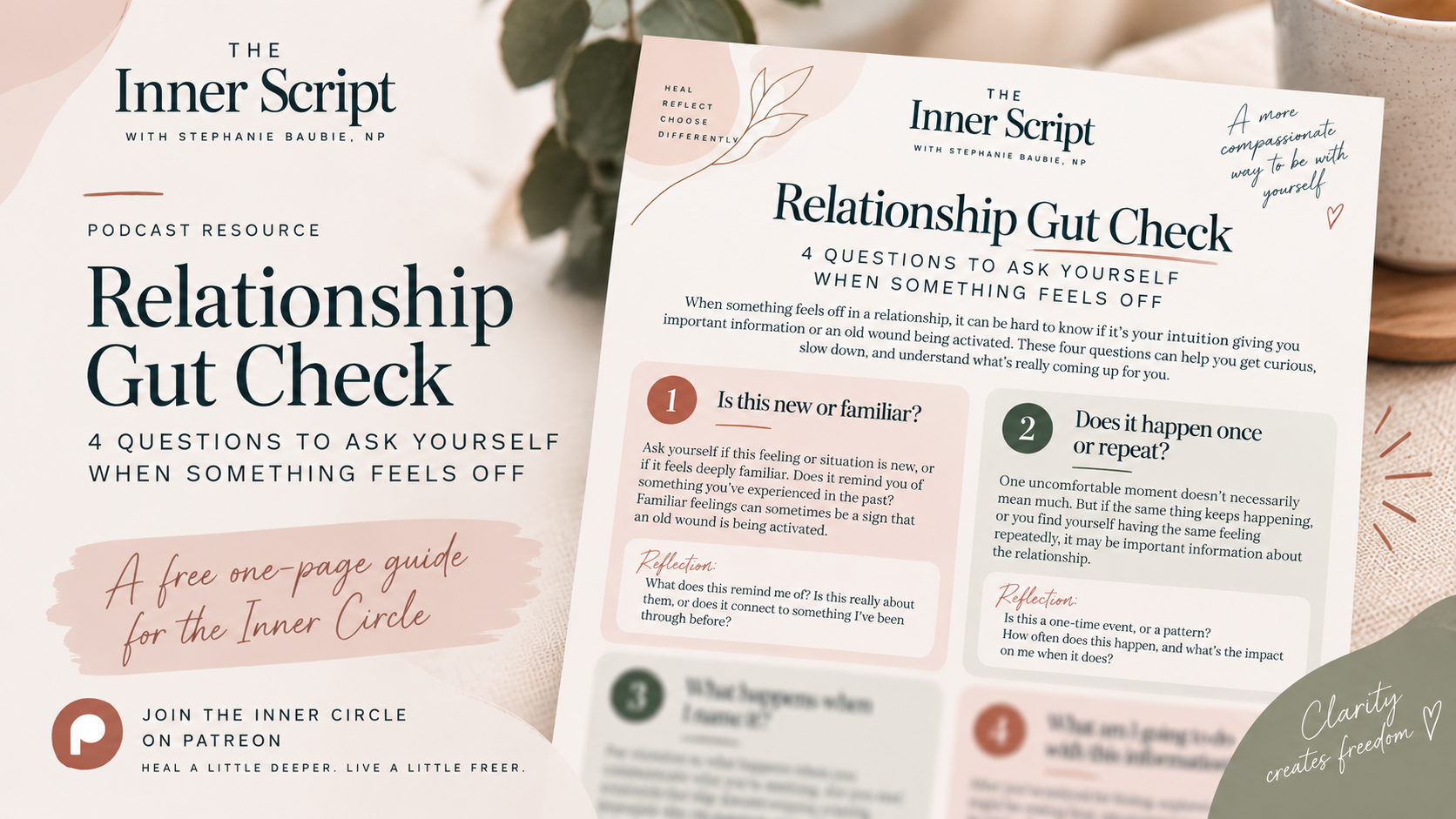
What is your gut actually trying to tell you?
To accompany this episode, Steph created Relationship Gut Check: 4 Questions to Ask Yourself When Something Feels Off, a free one-page reflection guide based directly on the four questions she shares in the episode: Patreon companion resource
You can also join Steph’s free Patreon community here:
The Inner Script Patreon

Meet Your Host
Stephanie Baubie, NP is an integrative nurse practitioner and the host of The Inner Script Podcast, where she explores the deeper stories behind health, healing, identity, and transformation. Through a blend of functional medicine, nervous system awareness, emotional insight, and honest conversation, Stephanie helps women better understand their bodies while questioning the narratives they’ve inherited about wellness, worth, and what it means to truly feel well.
On The Inner Script, Stephanie sits down with physicians, founders, thought leaders, and experts in women’s health, while also sharing solo reflections on the transitions and inner shifts that shape our lives.
Follow Steph on Instagram.
FAQs
How can you tell the difference between intuition and an old relationship wound?
Steph suggests beginning with curiosity rather than immediately assuming a strong bodily response is telling you the truth about the current relationship. Ask whether the feeling seems new or whether it has the familiarity of something you’ve experienced before. An old wound may create a strong response even when what’s happening now is different from what happened in the past.
What are relationship “whispers”?
Steph uses “whispers” to describe small interactions or details that seem insignificant enough to dismiss but continue to stay with you. A whisper isn’t necessarily proof that something is wrong. It can simply be information asking you to pay closer attention.
How do you know if a small relationship issue is part of a bigger pattern?
Steph suggests looking at repetition rather than immediately assigning meaning to a single interaction. One uncomfortable moment can simply be someone being human. When the same behavior or feeling continues to appear, it may give you more useful information about the relationship.
Can past relationship wounds affect how you react in a new relationship?
Yes. Steph shares how a previous experience affected the way she reacted in another relationship, even though the person in front of her hadn’t given her the same reason for concern. Recognizing that distinction helped her understand when an old wound was influencing what she felt in the present.
What should you do when your gut says something feels off in a relationship?
Steph recommends resisting both extremes: immediately dismissing the feeling and immediately treating it as proof that something is wrong. Instead, notice the reaction, get curious about where it may be coming from, communicate, and watch for patterns over time.
Why is communication important when something feels off in a relationship?
What happens after you name a concern can provide important information. Steph encourages paying attention to whether both people can hear one another, get curious, and work through what’s happening rather than focusing exclusively on the original incident.
Can you trust your gut if you have anxiety or past relationship trauma?
Having past wounds doesn’t mean you should automatically distrust what you feel. Steph’s approach is to become curious about the feeling rather than immediately treating it as either fact or anxiety. Understanding your own history can help you distinguish between something happening in the present and something familiar being activated from the past.
Why is it important to examine your own patterns in relationships?
Steph emphasizes that relationship discernment isn’t only about noticing what another person does. She reflects on her own patterns, including withdrawing when she’s hurt and leaning heavily on independence, and encourages considering the “whispers” we may be creating for the other person too.
Why can a relationship ending hurt even when you understand why it ended?
Understanding an ending doesn’t eliminate grief. Steph reflects on her tendency to immediately search for lessons and growth and recognizes that sometimes it’s important to simply acknowledge sadness rather than trying to turn it into meaning right away.
Can you be independent and still want a relationship?
Yes. Steph reflects on being capable of traveling alone, eating alone, navigating life independently, and taking care of herself while still wanting someone to share life with. Independence and the desire for partnership don’t have to contradict each other.
-
Everything shared here is for educational purposes and personal reflection only. Not medical advice. Always work with your own healthcare provider for individual care.
Hello, my friend. Welcome back to The Inner Script. I am finally home after traveling for what feels like forever. To be honest, I've been reflecting a lot since I've been back. You know, specifically, I've been thinking about what endings teach us about beginnings, you know, our next chapter in life. And to be honest, I was traveling for most of this trip with someone I had met earlier this year, and we recently decided to end things.
I'm not gonna go into details of that relationship. I have a lot of respect for him. I have a lot of love for him. I just think some things, you know, deserve to be kept between two people, so we're gonna leave it at that. But, you know, I do wanna talk about what that ending brought up in me because I think every ending, whether it's a relationship, career, friendship ending, anything that we can label as an ending, it really always gives us information.
And it's not necessarily what the other person did wrong, quote unquote, but it's really about ourselves, you know. What did I learn from that experience? What matters to me now that maybe didn't matter to me 10 years ago? What can I tolerate? What can't I tolerate anymore? And what are things that no longer feel aligned in a relationship?
This isn't labeling anybody as the wrongdoer in what I'm going to bring up today. It's more so how we evolve as people and how we Grow and what maybe just doesn't work for us anymore, and I think that's okay. A lot of the times it's just endings happen because it's two people that can't get on the same page.
Honestly, it's less about this specific relationship even, but it's really what over 10 years of dating and relationships have shown me. And I'll start off by bringing up, you know, a few weeks ago, I was listening to Oprah's podcast, and she was interviewing Bel Burton, and it was about her book called Strangers.
Very popular book. They're gonna make it into a movie. Highly recommend. I think I finished it in, like, a day. I was captivated. It's basically a memoir about the collapse of her 20-year marriage, and Bel really didn't see it coming. And what struck me in that interview is Oprah started talking about whispers in relationships, and it's those things we notice that we logically dismiss but can't fully forget.
It's that nagging feeling about a situation where you, like, weeks, months, or even years, maybe even decades later, that still don't sit well with us. But it feels so small that we logically dismiss it, but it never fully goes away. And I haven't stopped thinking about that because what exactly is a whisper?
Is it your intuition? Like, how do we know the difference between a whisper and somebody simply being human? And, you know, your partner is going to disappoint you at times. They're going to be inconsiderate, say something stupid, misunderstand you, and you're going to misunderstand them, and you're gonna make your own mistakes in a relationship.
So when is something just a simple, honest mistake versus when is it information? And again, it's not information that this person is wrong, but simply, like, are we just not a match, or are we incompatible in some ways? And around this, that same time, I was talking to one of my friends about a relationship I had years ago.
And I was telling her about this tiny moment that happened so early in the relationship, and I said something like, "It just felt way too trivial to end a relationship over." And she goes, "Stephanie, it's all in the details." And then she told me the Van Halen story.
riverside_episode_34_stephanie's_studio: Apparently when Van Halen toured, their contract rider had all of these incredibly specific technical requirements because their stage productions were huge and complicated, had a lot going on, a lot of things could go wrong if it wasn't followed to a T.
And buried inside all of those requirements was this bizarre request. There had to be a bowl of M&M's backstage with every single brown M&M removed, which sounds like the most obnoxious request imaginable, except it wasn't really about the M&M's. It was a test, because if the band walked backstage and there were brown M&M's in the bowl, it meant someone hadn't carefully read the contract, and they weren't going to play.
And the reason for that, they wouldn't play at that venue, you know, if they missed that detail, what else did they miss? Did they miss something involving electricity, weight requirements, stage construction, something that could actually put someone in danger? So the brown M&M's wasn't the problem. It was information about the system.
And when my friend told me that, something just clicked. Relationships have brown M&M's. Those are the whispers. There are these tiny moments that sometimes reveal something much bigger about how a person operates. And I've started thinking about those moments more as, you know, data, information. The detail isn't necessarily the problem.
Sometimes the detail reveals the problem. So I started looking backward, and I'm talking about more than ten years of dating and relationships. And I started asking myself, like, what were the moments I remember that seemed really small that left this nagging feeling in me that I fully couldn't dismiss?
And the interesting part is it's not like I remember every mistake possible, and it wasn't even the biggest fights we had. It wasn't like an annoying habit. It was these very incredibly specific moments I can still remember ten years later, and I remember exactly how my body felt in those moments when they happened.
My stomach dropped. The best way for me to explain it is I felt like I had this wave of a full body sensation that almost felt like I was in a lucid dream. It was like a split second of like a lucid dream moment, forcing me to be present and notice how that made me feel. It was like this internal, oh, like it just...
it brought me back to the present. It's the best way for me to explain it, and the moment itself seemed so insignificant that my brain immediately came in afterward and explained it away. You know, then I started thinking, "You're overreacting. That's not a reason to end a relationship. Nobody's perfect.
Give him a chance. Maybe he didn't mean it like that." And yeah, sometimes those things are true 100%, but what's fascinating to me is when I look back now, all of those tiny moments were early manifestations of the exact pattern that eventually ended the relationship. They were symptoms And I'll give you some examples from relationships I've had over the years.
It's the joking comment about you in front of other people that doesn't feel funny. It's technically a joke, but something inside you knows that was at my expense. Or your boyfriend stares at a woman a beat too long, and you explain it away, but I remember my stomach being in literal knots. Or watching someone become disproportionately impatient with a waitress because the order came out wrong.
Or telling a partner that you are genuinely scared to do an activity, and realizing their first concern isn't whether you're okay, it's how it's going to look if you don't participate. And look, none of these things in isolation make someone a bad person, and it's not like, "Yep, we're gonna end the relationship over that."
I wanna be so clear because that's so important. Because I'm not interested in labeling anyone as good or bad. I'm just interested in the information of what this taught me. Because for me, those moments eventually revealed much bigger things in the relationship, much bigger incompatibilities, and it was this feeling of, you know, not feeling considered, not feeling heard, feeling dismissed, and overall leading to just a mismatch maybe of values at the end of the day.
So it doesn't put anybody in the wrong bucket. They were tiny windows into something bigger. But this is where I think we have to be really careful because if you're somebody who's naturally anxious, hypervigilant, highly sensitive, has experienced betrayal, abandonment, trauma, your body can react strongly to something that isn't actually a threat.
And I've talked a lot on this podcast about trusting your body does not mean treating every bodily sensation as objective truth. That's not discernment. Sometimes your body is responding to the person in front of you, and sometimes your body is responding to somebody who came before them, and that's not fair for the person in front of you.
And that's really where the work gets complicated. So I've been asking myself, like how do I know whether this is an intuition, information, or it's an old wound, it's something that is a me problem? And I don't have a perfect formula for this. I don't think anyone does. I don't think this exists for anyone because all of our experiences are wildly different.
There's no way to fully know. But I've s- been starting to ask myself, like how do we actually discern between the two? And what I've come down to is this I think we all have had that nagging feeling about a situation, the thing we just can't fully dismiss, and it continues to show up, cause anxiety, and put us in an overthinking loop.
Every single time that nagging feeling, for me, has turned into something bigger. It was a symptom. However, I think it's also important to mention that in order to decipher between intuition and an old wound, you really have to know yourself. You have to work on the core wounds and integrate them so that they stop showing up and triggering you.
Or you're always going to get triggered, but it's giving yourself the opportunity to recognize the trigger and not react to it. So it's being really able to ask yourself these questions. You know, is this new? Is this familiar? And if it's familiar, it can feel like an old worn groove underneath the feeling, like I've been here long, long before this person, and that's usually a clue that it's not just about them.
The second question is, does it happen once or does it repeat? One brown M&M really can just be one brown M&M. A single tired, snappy comment after a long day isn't a red flag. That's someone being human. But if I notice the same feeling in my body three times, five times, 10 times in response to that same kind of moment, that's not me being sensitive.
It's, it's a pattern, and patterns are data And the third is, what happens when I name it? And I think this one might be the most important because, you know, whisper isn't just information about the other person, it's information about the relationship itself, about where two people are in terms of compatibility, values, and capability.
Can each person be met? And if they can't, this doesn't mean one person is in the wrong. It can simply mean they are just not right for one another. And the fourth question honestly is the hardest one. What am I going to do with this information? Because discernment is noticing, it's staying curious, and then actually letting what I find change something, even if what it changes is small, even if it's just a conversation, an adult conversation.
Let me give an example of something that came up for me that I kinda had to own. You know, a huge wound of mine from a prior relationship was a partner hiding so many things on his phone, and I, I remember in that relationship when he would be on his phone, I just, I had that nagging feeling. It was that gut feeling that he was hiding something on there.
He was always on it. It just I-- it just was this nagging feeling, woman's intuition, and this turned out to be accurate. He was hiding several things. And then I get into a new relationship, and I find myself being uneasy about his phone, and this put my body and mind in hypervigilance, but I caught it. I realized this is an old wound.
There's no reason for me to be this way with him. And instead of making this his problem, I took ownership for it. I would ask myself, "Has he given me any reason to question his intentions, you know, his consistency, his honesty?" And it went away. And my point in sharing this is we can't allow our current partner to be responsible for our past.
So overall, the body's job is just to notice. Mine is to get curious about what it noticed, and I don't think the answer is always available in the first five seconds. I actually think sometimes the first sensation is simply an invitation to pay attention. It's not run, not this person is bad, not this relationship is doomed.
Just pay attention. Something landed here, and it's time to get curious, and I think that's where I've landed with the idea of a whisper. A whisper isn't necessarily an instruction. It's information. It's your body saying, "Something about this matters to me." And instead of immediately overriding it because it seems trivial, maybe we listen.
We get curious. We watch what happens next. We have an adult conversation with the person because one brown M&M- Doesn't tell you everything about a person, but if you keep finding them, you might wanna read the rest of the writer. And I'll be honest, doing all of this reflection after another relationship ending is hard.
There is a part of me that always wants to find the lesson. I'm very good at meaning-making. I'm very good at saying, "Okay, what did I learn? How did I grow? What did this teach me?" And I still believe in doing that, but I also think sometimes we use growth as a way of getting ourselves out of grief faster.
And right now, I'm sad, and I've always just found it to be more difficult to connect with someone. That's just kind of how I've al- how I've always been. So when I go through a relationship ending, it tends to hit me harder, I feel, than someone else. That might not be true. It's just kind of how it appears to me.
And I can understand why something ended and still wish it didn't have to. You know, those things can really exist together, and we can admit that. And right now, when this is being recorded, I'm 34. I'm incredibly independent. I've built a life that I'm really proud of. I know how to take care of myself. I can travel across the world by myself.
I can build a career. I can start a podcast. I can figure things out. But sometimes I don't wanna have to figure everything out by myself, and I don't know why we feel so ashamed to admit that. Sometimes when things end, I feel like we try to force positivity. I certainly have in the past, where, you know, I'm trying to find the positivity, and when you're doing that, sometimes you're not naming how you actually feel in the moment.
You're not naming your emotions, and then you're overriding them. You're repressing them. I think there are aspects of this, of being about a tough situation, that are necessary, but the positivity prevents us from actually naming how we feel, and I think sometimes that can stem from shame. And I'm trying to be better about this, to actually admit how I feel and not feel shame around it.
So, you know, the night I got home, I was super jet-lagged. I fell asleep at 8:00 PM. I woke up at 2:00 AM wide awake, and I texted my friend who's in Central Time that I was home from Europe, and she texted me back a few hours later asking if I was still awake, so it was like 4, 4:00 AM. And I said, "Yes." And she called me on her way to work, and I told her kind of everything that happened, how I was feeling.
I told her how sad I was, and I admitted to her, I was like, "I don't wanna be alone anymore." And I immediately started crying. But that's important because the thing we say out loud that evokes such an emotion like that is the thing we need to address, and I wish we knew that, you know, earlier. I wish I knew that earlier.
It's the thing that's getting stored and repressed. You have to name it in order to release it And I was telling her, I was like, "It's not necessarily just about this ending. I know I'm capable of building a beautiful, happy life for myself. I have wonderful friends, great family, a great career, all of the things.
You know, I know I'm independent to a fault at times because I've had to be, but sometimes I don't wanna be." And I was telling her I'm laughing because I'm... it's, like, like, self-deprecating right now, but when I was, like, telling her, I was traveling by myself in that instance after it ended, I was traveling home, where all you want is to be held, and you're rolling two suitcases, and I felt really fucking alone.
I didn't want to be doing that. All I wanted to do after I was pulling my suitcase off of the, like, the luggage belt or whatever, I just wanted to cry. And she was like, she was like, "Well, I would have." She was like, "Did you?" And I was like, "Yeah, I did." So I guess my point in sharing this is, like, sometimes you just want someone else to grab the suitcase, and life has really taught me resiliency.
We've all had to learn how to be alone the hard way, and I don't think admitting that makes me or anyone else less independent. I actually think I've spent enough of my life proving that I can do everything alone. I know I can, and that's not really the question anymore because I don't want a relationship simply so that I don't have to be alone.
I want a relationship in which I feel less alone because I'm in it, because I also know what it feels like, lonelier to be in a relationship that doesn't feel aligned. And maybe that's another detail I've learned to pay attention to. You know, do we make each other's lives a little lighter, easier? Not every day, not perfectly, but overall.
And there's another side to this I don't wanna skip because it would be easy for me to sit here and only talk about the whispers I've picked up on other people. That's always the more comfortable direction. It's much harder to ask, what are my brown M&Ms? What are the moments I've been the one somebody had to explain away?
Because I promise you, I have them. I am far from perfect. Here are some of mine. I know I can get quiet when I'm hurt instead of saying what's actually wrong. I sometimes can have difficulty communicating in the moment 'cause I have to process things first. And I've been really trying to get better about that.
I know I can retreat into being independent and capable exactly when what I need is to let someone in and be met. I know it can appear that I lack emotions during conflict when in reality I am in freeze mode. When I've ended things, I've been called harsh. I've been called cutthroat, mean, because for me, seeing the person after a breakup literally guts me.
It feels like I am getting run over by a bus Putting salt on an open wound. So I avoid it the best I can because I know what it will do to me. And this is not me avoiding the conversation of a breakup. It's avoiding the meetups after it when another person is trying to find closure. I would have loved to see the person, but I know what that will do to me.
It will make me incredibly sad. Those are my patterns. You know, those are the moments somebody else probably remembers 10 years later with their own stomach dropping, and I'm sure there's things here that I haven't named. And I think that's actually the deeper work underneath all of this. It's not just learning to read someone else's whispers.
It's being accountable enough to hear your own. The ones other people have tried to hand me, and the ones my own body has been sending me about myself for years. Because if I only ever use this framework to evaluate other people, I'm going to end up hypervigilant, picking apart every person, and then somehow staying exempt from the same scrutiny myself, and that's not growth.
That's just a more sophisticated way of avoiding my own shit. So the question I'm sitting with right now isn't just, you know, what did their behavior tell me? It's, what does my reaction tell me about me? What am I bringing into a relationship that someone else has to quietly learn to navigate? So maybe that's what I'm taking from this ending, and it's not like we have to have it all figured out.
We don't have to have every aspect of us 100% healed. It's about having self-awareness and being able to name it and explaining it to somebody and having emotional capacity for the other person, for yourself, and to get curious about each other. That's what I'm taking from all of this. Listen to the whispers.
Don't catastrophize them. Don't turn every uncomfortable sensation into prophecy. Don't expect perfection from another human being. Instead, notice, get curious, communicate, watch, and pay attention to the pattern, including your own, and trust that nagging feeling. It's there for a reason. Because sometimes the smallest details aren't telling you to leave.
They're just simply asking you to look closer and maybe just have a conversation. Honestly, I wish I could end this episode with some clean takeaway and neat little bow tied around all of it, but I don't have it figured out right now. I'm trying. I'm taking the details, the whispers, the grief, and I'm trying to make lemonade out of lemons.
Not because sadness needs to be productive, just because it's now what I know how to do, and because part of me still believes something good is on the other side of this. I know something good is on the other side of this. If you know anyone going through an ending, send them this episode. We all need to hear it and to feel less alone.
Like, this is obviously, like, not easy for me to record. I probably sat on this for a good week before hitting record because I'm like, "Is this too much? Am I just giving away too much about my inner thoughts?" But at the end of the day, I'm like, "No." Like, we all need to hear this. We all need to stop feeling ashamed for how we feel.
So send this their way, and I'll talk to you guys next week.
If you wanna connect with like-minded women and dive deeper into these conversations, join my Patreon community. There's a free option and it's where we can talk about each episode together. The link is in the show notes and I can't wait to see you there.
Disclaimer
Everything shared in this episode is for educational purposes and personal reflection only. It is not medical advice. Always work with your own healthcare provider for individual care.
We sometimes include links to products and services we find interesting. These may or may not be affiliate links. Thanks for your support.
Podcast production by Jamie Brooke.
