Why Do We Get So Defensive in Relationships? How Childhood Patterns Follow You Into Adulthood
Listen now by clicking your favorite podcast app below:
Have you ever been in an argument and wondered why you suddenly feel so desperate to be understood, prove your point, shut down, or get the other person to admit they were wrong?
In this episode of The Inner Script, Stephanie Baubie, NP sits down with licensed marriage and family therapist and Transform author Joni L. Davis to explore why our reactions during conflict may have roots that go much deeper than the argument happening in front of us.
Joni explains how childhood and developmental experiences can influence the way we see ourselves and relate to other people as adults. When emotional needs go unmet or we learn that certain parts of ourselves aren’t welcomed, she explains, we may develop defensive strategies designed to protect us from deeper fears.
Those strategies don’t always look aggressive.
For some people, defensiveness means arguing, blaming, criticizing, or desperately trying to be right. For others, it may look like people-pleasing, over-explaining, shutting down, withdrawing, or trying to manage everyone else’s emotions.
Stephanie and Joni explore what may actually be happening underneath these reactions, including fears of being misunderstood, unheard, unimportant, unlovable, not good enough, or like your experience simply doesn’t matter.
They also talk about one of the most powerful tools Joni uses in relationships: validation.
Rather than immediately trying to convince another person that they’re wrong, Joni explains how recognizing the underlying feelings, wants, and needs in a conflict can help both people move out of defensiveness. And that process begins internally, by learning to recognize and validate what is happening inside yourself before reacting.
The conversation also explores how emotions show up physically in the body, why becoming the observer of your feelings can change your relationship with them, and how curiosity can help you recognize when you’ve moved out of your authentic self and into an automatic defensive pattern.
Most importantly, Joni encourages us to stop treating our defensive reactions as fixed parts of who we are and instead get curious about where they came from, what they’re protecting, and how we might respond differently.
This episode is for you if…
You become defensive or reactive during arguments
You tend to people-please or over-explain yourself
You shut down or withdraw when conflict becomes uncomfortable
You have a hard time letting go of something someone said
You feel desperate for another person to understand your perspective
You find yourself trying to prove that you’re right
You wonder whether your relationship triggers come from the present or your past
You want to communicate more openly without abandoning your own needs
Episode Timestamps
00:00 How Childhood Follows Us
03:33 Essence vs. Defenses
07:11 Why We Get Defensive
10:45 What Counts as Developmental Trauma?
13:11 Breaking the Cycle
19:42 Validation During Conflict
25:16 Are You Managing Their Emotions?
27:04 Why Some People Shut Down
31:00 Becoming the Observer
37:31 Triggers, Boundaries and Repair
Resources & Mentions
Developmental trauma
Childhood emotional needs
Defensive strategies
People-pleasing
Emotional validation
Conflict and communication
Relationship triggers
Emotional awareness
Mind-body awareness
Curious about a supplement Steph has mentioned in the episode?
If you’re looking for products Steph personally recommends in practice, you can browse her dispensary here: Stephanie’s Fullscript dispensary
Please consult your healthcare provider before starting any new supplement. Food, lifestyle, and nervous system support always come first.
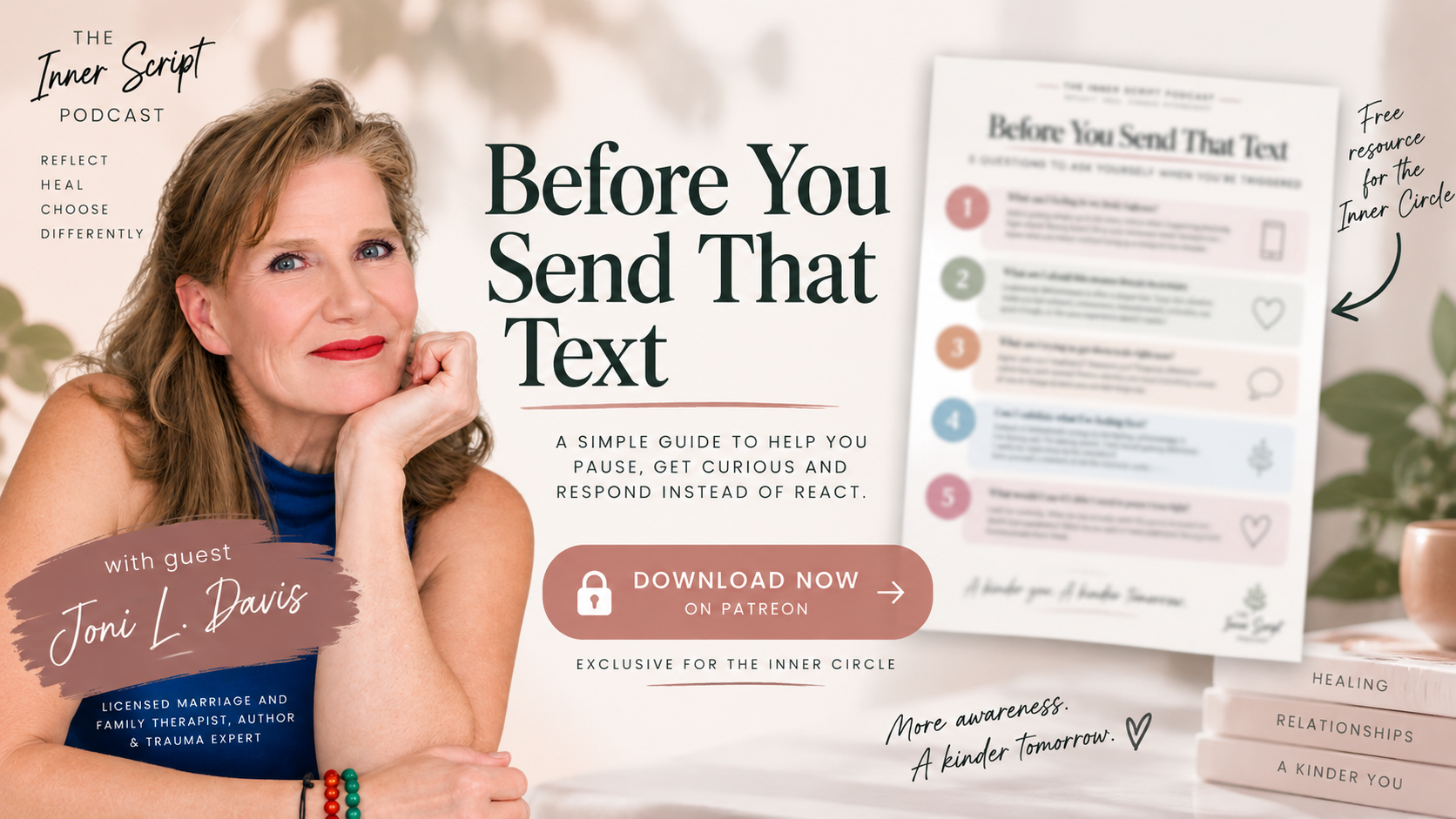
About to send a text while you’re triggered?
To accompany this episode, Steph created Before You Send That Text: 5 Questions to Ask Yourself When You’re Triggered, a one-page guide designed to help you pause, recognize what’s happening underneath your reaction, and get curious before responding. Download it here: Patreon companion resource
You can also join Steph’s free Patreon community here:
The Inner Script Patreon

Meet Joni L. Davis
Joni L. Davis is a licensed marriage and family therapist specializing in childhood and developmental trauma, complex PTSD, relationships, and body-centered awareness. She is also the author of the new book Transform.
Joni is passionate about helping people understand how childhood and developmental experiences can shape the way we see ourselves, navigate relationships, respond to stress, and make choices as adults. Her work explores authenticity, emotional awareness, people-pleasing, boundaries, attachment, trauma, the mind-body connection, and what it takes to move beyond survival patterns and reconnect with a more authentic sense of self.
Connect with Joni:
Facebook: https://www.facebook.com/profile.php?id=61589595245559
LinkedIn: https://www.linkedin.com/in/joni-l-davis-745a07410/
Learn more: https://prbythebook.com/experts/joni-davis/
Transform: https://www.amazon.com/Transform-Tune-Turn-Your-Authentic/dp/B0GY28YLP3/

Meet Your Host
Stephanie Baubie, NP is an integrative nurse practitioner and the host of The Inner Script Podcast, where she explores the deeper stories behind health, healing, identity, and transformation. Through a blend of functional medicine, nervous system awareness, emotional insight, and honest conversation, Stephanie helps women better understand their bodies while questioning the narratives they’ve inherited about wellness, worth, and what it means to truly feel well.
On The Inner Script, Stephanie sits down with physicians, founders, thought leaders, and experts in women’s health, while also sharing solo reflections on the transitions and inner shifts that shape our lives.
Follow Steph on Instagram.
FAQs
Why do I get so defensive during arguments?
Joni explains that defensive reactions can arise when a situation activates deeper fears about ourselves. An argument may touch fears of being misunderstood, unheard, unimportant, unlovable, not good enough, or as though our experience doesn’t matter.
Can childhood experiences affect how you communicate in adult relationships?
Joni describes childhood and developmental experiences as an important influence on how we learn to handle emotions, conflict, needs, and relationships. Patterns that once helped us navigate our family environment may continue automatically in adulthood until we become aware of them.
Why do some people shut down during arguments?
Joni explains that shutting down can become a protective strategy. Someone who learned that their voice didn’t matter or that withdrawing helped conflict end may continue using that response automatically in adult relationships.
Is people-pleasing connected to childhood experiences?
Within Joni’s framework, people-pleasing is one type of defensive strategy. Rather than openly acting from what we feel, want, or value, we may focus on being good, nice, acceptable, or what another person needs us to be.
What does validation mean during conflict?
Joni makes an important distinction between validation and agreement. Validation does not require accepting another person’s accusation or deciding they are right. Instead, she focuses on recognizing the underlying feelings, wants, and needs present in the interaction.
How can I tell whether I’m reacting from a trigger?
Some signs Joni discusses include repeating the same point, becoming unable to let go of something that was said, needing the other person to behave differently before you can settle, and losing curiosity about other possible perspectives.
How can I stop reacting immediately when I’m triggered?
Joni recommends turning inward first. Notice what is happening physically and emotionally, validate your internal experience, and become curious about what fear or need may be underneath your reaction. This can create space between experiencing a feeling and automatically acting on it.
-
Everything shared here is for educational purposes and personal reflection only. Not medical advice. Always work with your own healthcare provider for individual care.
Stephanie Baubie: Hi, everyone. Welcome back to The Inner Script. Today, we're talking about something that I think touches almost every relationship we have, the experiences we had growing up and the ways they continue to shape how we connect, communicate, set boundaries, and respond to conflict as adults. My guest today is Joni L.
Davis, a licensed marriage and family therapist specializing in childhood and developmental trauma, complex PTSD, relationships, and body-centered awareness. She's also the author of the new book, Transform. Joni's work explores how our developmental experiences shape the way we see ourselves navigate relationships, respond to stress, and make choices, and importantly, how we can begin moving beyond those survival patterns and reconnect with a more authentic sense of self.
Joni, welcome to The Inner Script
Joni Davis: Thank you very much. I'm very happy to be here, and I can't wait to see what you and I create together
Stephanie Baubie: We were already chatting and we're already vibing, so this is gonna be a good conversation. I kind of already know within a few seconds how the vibe is gonna go, and I'm like, "Okay, Joni gets it. Can't wait to dive in."
Joni Davis: And I think if we're gonna talk about some of this really intense stuff, man, we gotta keep the humor going. We gotta keep the playfulness active.
Stephanie Baubie: There's just no other
Joni Davis: Yes,
Stephanie Baubie: I wanna start with the premise behind Transform Your Book that you wrote. What did you feel people were missing about childhood experiences and their impact on adulthood that made you wanna rewrite the book? Because I think we all logically know childhood wounds, developmental trauma, we all know that, but then it's this aspect where we're not really integrating this knowledge.
Talk to me a little bit more about the premise why
you
wrote it.
Joni Davis: First, I wanna really acknowledge and validate the thing that you said about we're learning all these concepts, but then the question, how do I integrate that into my full system so that I can feel that it's embodied, and then I can tell that it's in me, and now I can act from it? Instead of just having it up here as I get that concept, now I'm gonna go try to use it, and an hour later or a day later, I've already forgotten.
I'm back in my old pattern. I've already forgotten that concept 'cause it wasn't integrated. The point that you bring up about how important it is to integrate these concepts so that we have a new experience with them is vital to the book Transform and vital to each of our transformations from defenses and fear-based selves back into our essence, authentic self.
What I thought was missing was internal actions. In order to integrate a concept, we need to be able to get our mind super interested in this innerness and what's going on in here, and the only reason we're not is because there's a lot of pain from childhood left over in here that we don't understand.
We just know that when it activates inside of us, it feels so intensely horrible, uncomfortable, vulnerable, fragile, powerless, hopeless, helpless, shamey. It just feels so intense That we don't wanna feel it, that we end up trying to control everything out there in the external world to try to make sure this never gets activated instead of learning how to transform it so that the external world can just do the things it needs to do.
We can let go of controlling it because now we know how to regulate our emotional systems and nervous systems from the inside out. So the last little bit to answer your question, I think this is important, and you'll see that I like to use my hands a lot. It's very important for me because the defensive strategies like blame and shame and fault finding and judging and comparing, those defensive strategies, I want to stay out of those.
So as we talk about childhood experiences, we do have parent to child relationships that are going on, and I wanna make very clear that I am pro-parent and pro-child. And I think we all just do the things that were passed on to us that we don't realize we're doing. It's running under our awareness until we become aware of it.
What we have, because as the overall culture here in America, we are really screwing up the feeling part of relationships. We are really screwing up what to do with feelings. And so the psychological field, we're not teaching parents how to regulate feelings through internal actions. We've got a child that comes into the planet in their essence qualities.
Our essence qualities are things like curiosity, compassion, patience, openness, flexibility, creativity, determination, aliveness, all kind. I've got three hundred and fifty different essence qualities in the book. As you listen to them, your body will even relax 'cause you know those are the best parts of our humanness.
Compare those to judgment and blame and withdrawing and accusing and attacking and overpowering or underpowering and complaining and gossiping and all these things that we do when we're stuck in the defensive part of ourselves, and then you can feel your body tighten up in that version too. So we come on the planet in all these beautiful essence qualities, and our parents, they meet us from their essence qualities.
And when a human being is in their essence qualities, they're so relaxed in their system. They're not feeling any fear about the sense of self, no threats about, am I doing it right or am I doing it wrong? They're just so relaxed in themselves that they send an energy to the other person, in this case, the child, that you're okay just the way you are.
We're capable of seeing each other's essence in that moment. And so the child imprints that they are their essence qualities And I wish that's the only thing that happened, but it's not the only thing that happens. The other thing that happens is that sometimes parents are in their defensive strategies, and when parents are in their defensive strategies, all the defensive strategies are trying to be right and trying not to be wrong.
When the parent goes from their beautiful essence, a free-flowing energy inside that's open and loving and warm and kind and compassionate and available, and they contract into a defensive strategy, for the child, it feels like they're taking away everything good from the child. And the child interprets that with a young brain, with a young mind, is, "I'm not okay in my essence, and I need to step out of my essence and step into a people pleaser and be the way my parents' defensive strategies need me to be, not the way my essence is."
What do you think of all that?
Stephanie Baubie: Essentially, your essence is your authenticity. It's kind of who you are without the social
conditioning
Joni Davis: At the basic core of your being, you are this benevolent being that wants to do good in the world, wants to get your own needs met, and really cares about other people's needs too, and other species and the planet. In that essence-y state, man, we can really show up and be proud of ourselves as human beings 'cause we're acting from our core values.
We're thinking about each other and considering each other's experience. We're creating things that are good for us and good for others and good for the planet, instead of just something that's good for us
Stephanie Baubie: I think everyone can relate to feeling defensive in an argument. Where does this stem from? Why do people get so defensive in an argument? We've all done it, and as you mentioned, it's like trying to get them to see your point. But then there's this disconnect because there's two people in the conversation.
So where is this defensiveness stemming from?
Joni Davis: Defensiveness comes from our own fears. There's never a time that any of us are in defensive strategies that we're not already afraid underneath. And here's the kicker, is that some people can be aware that they're afraid underneath, and some people's sense of self is so identified with the defensive strategies, and they're so afraid of being the wrong one.
That's the fear, is that finding out I'm wrong. And all the versions of wrong, Stephanie, all the fears about the sense of self are the fear that the sense of self is fundamentally wrong. And now these are gonna start sounding familiar. So the versions of fundamentally wrong are not good enough, failing, unlovable, unworthy, not mattering, unseen, unimportant, not being considered, not being heard, being misunderstood, not being known.
Those are all deep fears inside of us that, remember, get imprinted when a parent's being right defensive strategies send being wrong energy at the child Boom, the wrongness imprints in us, right? And so I call all of those powerlessness beliefs. All of those are powerlessness fears that get imprinted in something I call our unconscious procedural manual.
We all have this unconscious procedural manual inside that's running 95% of our being every day, and it's automatic. It's procedures. And it's obvious with things like physical stuff, like you just moved your hair away from your eye. You didn't have to think about doing that. Your unconscious procedure went, "Something's weird up here.
Let's smooth it out a little bit." The parts that we forget about is that unconscious procedural manual is imprinted with all our fears about the sense of self, all those fears. I know for me, a big fear that I have is that my experience doesn't matter and that my experience won't be considered, and I think a lot of people have that fear about themselves.
And that fear in my life has caused me to go into defensive strategy. Once you feel those fears, now you gotta start trying to keep yourself out of those fears. So now you gotta try to turn the power on by stepping into some defensive strategies. And the defensive strategies are things like, I whittle it down, there's all kinds of defensive strategies, but I whittle it down to three basic categories.
People pleasers, which is the best part of our defensive strategies. It's the part of us that's trying to be good and trying to be nice, but it's still a defensive strategy. Our essence is over here. These defensive strategies don't have a connection to our essence qualities. So the people pleasers, a really kind part of us.
The protectors in us, that's another category. The protectors in us are always trying to limit us or control and limit other people or events to try to keep us from feeling the fears that we already feel inside. And then we've got these punishers that are just mad as hell and not gonna take it anymore and feel justified in punishing people 'cause they punished us or they attacked us.
Powerlessness is victim powerlessness. Any time I experience myself and perceive myself as being victimized, then I'm very susceptible to going into a defensive strategy and becoming the villain, justified because you did something to me, and going at you and blaming you and making you wrong and attacking you in whatever way my defensive strategies have taught me to do that, in whatever way got passed down through my family of origin.
Stephanie Baubie: So the root of kind of these defensive strategies, being a people pleaser, kind of everything you just named, it's pretty much rooted in developmental trauma. But when people hear trauma, they immediately think something terrible, catastrophic had to have happened to them. But what counts as developmental trauma, and what are some experiences that people may have minimized growing up because it was just kind of
normal?
Joni Davis: me, anything that knocks us out of our essence qualities is developmental trauma. Just keep it that foundational. Anything that knocks us out of our essence qualities was trauma because it shook up our belief in ourself. It shook us up. It required us to bring fear into the concept of the sense of self, and wonder if we were okay just the way we are.
For me, trauma is any time, as a parent and a child are relating, any time that either one gets knocked out of their essence, trauma is going to ensue
Stephanie Baubie: That kind of knocking somebody out of their essence. That might just be like, "Come on, hurry up, tie your shoes. You're taking
too
long."
Joni Davis: Labeling, name-calling, yes, those are all defensive strategies. Those are all things that we do because I'm dysregulated inside. Like think of a mother who really does, she has one agenda and the child has another agenda. The mother, she knows the timeframe. She knows we need to get to school, or we need to get to work.
I gotta drop you off at daycare. And the child is doing what a child's brain does. "I started to put my shoes, but then I saw this bright, shiny thing over here, and I wanted to see how that worked, and I got a little distracted." And so for a mother to be able to go inside and take an internal action to settle her own fears about being late so that her whole mind, body, energy, and structure is now present, available.
Not gonna make the child wrong, but gonna teach the child about time and teach the child about staying with a certain activity and teach the child. She's capable of speaking to the child in a way that will settle and regulate the child's nervous system. If the mom doesn't regulate her own fears about being late, come back into presence.
Presence is an essence quality, where you're just right there in the moment. Then the mom will bring a defensive strategy to the child, and then we've got that scenario happening I was talking about before, where the parent who does not want to make their child wrong, that is not their intention at all, unconsciously will send you're doing it wrong energy at the child, as if the child is doing something to the parent if the parent meets that moment in defensive strategies instead of essence.
Stephanie Baubie: So how do we break this cycle? Because it's just this constant loop
Joni Davis: I think what we gotta do, Stephanie, is we've gotta develop an essence-y voice inside. We've got voices of our people pleasers, we've got voices of our protectors, we've got voices of our punisher. They're in there talking all the time. They are our inner voice. And in order to teach our pleasers and our protectors and our punishers and our powerlessness how to transform back into essence, we don't wanna create a voice that's trying to get rid of this.
There's authenticity in all of this fear-based structure of us. We wanna create an essence-y voice that brings the understanding of compassion to this part of ourselves. So the way that I have discovered that works really quickly and really well is by speaking something I call simple truths or validations to ourselves inside first, and then it gets real easy to do it to your child, or real easy to validate or speak a simple truth in conflict.
Because simple truths and validations, they take out the right or wrong of it. They require your mind. If I start with something like blame and I say, "You hurt me. What you said to me, it really hurt me, and I'm never gonna be able to forget." You can't unsay that. I have couples having these k- kind of things happen all the time in here.
Now, what I'm actually doing there is I'm not expressing m- a feeling. I'm not expressing what's true inside of me. I'm expressing my victimhood. Now, I could have been victimized. There's a big difference between getting stuck in victimhood and being victimized. My partner could have said some pretty mean things to me, and I am truly being victimized in that moment.
But if I let my inside stay in a victim perception and I express that victim perception to my partner as if you did this to me, we all know where that's gonna go. My partner is not gonna be able to hear that as, "Oh, you're right. I totally did you wrong there, and I will never do that again." My partner's gonna go into defenses.
But I didn't mean it the way you think I meant it, but I didn't say it like that. We're just gonna go in a roundabout defensive versus defenses. But if I go inside first and I speak a simple truth to myself, and I say to myself, "I'm realizing that when somebody else goes into their defensive strategies, we can misinterpret that as meaning something about who we are," and then I notice how my body responds, and I'll settle back into my essence so that I can see that my partner goes into defensive strategies, may not know it yet, may not be in their conscious awareness yet.
And if my partner's in defensive strategies, I definitely don't want to take that personally, because they're not speaking the truth when they're in defensive strategies. They're actually speaking their fears, their biggest fears. And I would be basically projecting and speaking my biggest fears right back at them.
Once I calm and soothe myself, Stephanie, now I'm back in a state where I've just regulated my emotional system and my nervous system. My nervous system is the autonomic nervous system. You know about this. I just taught my insides how somebody else's defensive strategies mean nothing about who I know myself to be.
I just reminded myself of that so that I don't misperceive their defensive strategies as being an attack on my essence, just like what happened to me when I- I was a kiddo. I separate all of that in that moment with one simple truth, and it's not just speaking the simple truth, it's speaking the simple truth and then noticing how your inner body responds to that simple truth.
Can I try one with you real
Stephanie Baubie: Yeah,
let's do
it.
Joni Davis: I just want you to say out loud, "It's hard." Then notice how your body responds to that. What'd your inner body do when you said it's hard?
Stephanie Baubie: My chest contracts
Joni Davis: It does, doesn't it? So it's hard is a victim powerless perception. It's coming from a victim perception. Do you get that? Any time we come from a victim perception, our inner body contracts.
It's not in that open, easygoing state. If I speak a simple truth to myself like this, though... So I want you to repeat after me. You ready? Boy, there's this thing that's happening.
Stephanie Baubie: Boy, there's this thing that's
happening.
Joni Davis: I've never faced it before,
Stephanie Baubie: Never faced
it
before,
Joni Davis: I'd better tap into my courage
Stephanie Baubie: so I better tap into my courage
Joni Davis: face this thing that's happening.
Stephanie Baubie: to face this thing
that's
happening.
Joni Davis: happens to your inner body?
Stephanie Baubie: I mean, it relaxes because we're not labeling it necessarily. It's just kind of naming the experience
Joni Davis: Yes, totally. Like it brought it down to its foundational level, reminded ourselves of who we are at our foundational level, reminded ourselves that these ways that we've been trained to label things are often revealing what we're really afraid of, and they're not tapping us into our essence. I tapped you into your courage.
It's a huge essence quality, and whenever you remember that you've got courage in here, okay, I'm ready. It's an unknown, but I got my courage. And then you remember, oh, I got all my other essence qualities, too. What else am I gonna need? I'm gonna need my ingenuity, great essence quality. I'm gonna need my clarity, great essence quality.
I'm gonna need my fortitude. I'm gonna need my resilience. I'm gonna need my presence. I'm gonna need my creativity to be able to come up with new ideas in the moment. If I'm interacting with someone else, I might even need my empathy and my compassion. Oh, now I'm remembering all of those are in me, and alls I need to do is activate 'em, and then I'm in this part of me that is actually my most powerful self
Stephanie Baubie: I mean, that's so true because I think in any argument, a lot of us want to win the argument or be right 'cause it has to do with your ego as well. But then when you're rooted in your authenticity, you don't really care about being right or wrong
Joni Davis: No, you lose that, you lose your interest in being right because the being right, now think about it, the being right only comes from the fear of being wrong. There's never a reason that we would ever need to be right, to have the right opinion, to be doing it the right way, to be saying the right thing.
Think how many times we rehearse from our people pleaser to say the right thing as we're driving to work in the morning. We're wasting so much of our precious energy in defensive strategies, especially the kind one, the people pleaser. And most of us wonder why I go to work all day and then I'm too tired to have any energy for my family at night.
It's 'cause we're in people pleaser all day, and these defensive strategies, 'cause they're running from powerlessness, powerlessness is draining us of energy, and the defensive strategies are trying to turn the power back on so our energy is all split inside. No wonder we're tired at the end of the day.
Stephanie Baubie: I mean, it's emotionally
exhausting
Joni Davis: It's emotionally exhausting, and yet we think, most of us have been trained to identify and think that we are our people pleasers instead of that we are our essence
Speaker 3: Hey friend. If there's someone in your life who you think would also love this conversation, please send them this episode. Sharing it with a friend makes you look like the exceptional friend that you are. Oh, and it helps the podcast grow too. Thank you.
Stephanie Baubie: When I was reading your book, one of the things that really stuck with me where I was like, "Oh my God, yes," is when you were talking about validation and how everyone just wants to feel validated when they're dysregulated or upset in any way. It's all we want. It's validation. So when, say, a couple is arguing, and say, like, maybe one or both person are getting really reactive or activated, dysregulated, do you end the conversation right there and come back to it?
Or is that when you try to incorporate validation?
Joni Davis: If you're already in defensive strategy and you've already said some things, done some things that are repetitive, if your partner is doing their stuck strategy, it's gonna activate your powerlessness. So you always wanna shift into validation. Now, you never validate anything that isn't true. You don't validate that somebody is a victim and they get to stay in the victim position.
You validate needs, wants, and feelings. And the reason that it's difficult to transition-- I've had so many couples sit on my couch over here and have worked with them about how to shift from powerlessness and defensive strategies back into essence with a validation. And the real difficulty with that transformation and that transition shift is because we've all been taught that if I don't point out what you're doing wrong, if I don't get you to see it in this moment, I'm letting you get away with it.
We weren't taught that if I validate the fear that's going on underneath... Here's a validation: "I know you want me to understand what you're saying, and I want to understand what you're saying. Give me a minute to get down to the bottom of it so that I can understand what you want at your core, 'cause I care about what you want."
That just reminded the-- my partner or my colleague that I am willing to consider their experience. That just created environment of safety between me and the other person. Validations, they're not affirmations, they're not positivity, they're not trying to make some kind of experience go away. With validations, you actually understand the wisdom that if I validate the bottom of it all, the underlying experience of the human being, they actually melt back into their essence qualities, and then they'll take responsibility for the thing I was trying to get them to take responsibility for that they couldn't take responsibility 'cause they were too busy defending themselves.
We work so hard to get other people to take responsibility when a validation could s-- do it and shift that argument back into loving connection in seconds flat. We've gotta get past that defensive structure, that victim in us that tells us that you did something to me, and therefore I need to do something to you to get you to stop doing that.
Shift out of that and shifting into realizing I could say or do something right now that could turn this whole thing around. That's how powerful I am. If I can shift my insides first, I will probably need to do a validation to my own insides before I'm ready to do it to my partner.
Stephanie Baubie: What would that look like and then internally and then telling
your
partner
Joni Davis: A validation to my insides would be me saying to myself, "We're really scared right now. I can feel it. I can feel how scared we are. I can feel how tight our body is. I can feel us being stuck in one dimension of thinking, just trying to drive home this one point. I can feel us doing that." I know when we get in this state, we're not in our open-minded essence.
We're in our closed-mindedness, which just so happens to be exactly what we're accusing them of doing. And so you can hear, I cultivate this essence-y voice inside of me that calms and soothes me, takes me out of the right or wrong game. Defensive strategies argue about who's right, who's wrong incessantly.
The voice of my essence takes me out of that right or wrongness and drops me into the truth, which is my partner's in defensive strategies, I'm in defensive strategies. Nothing new happens when we go into defensive strategies. And then if I notice how my body responds to that, I actually will feel settled.
Notice how I didn't try to make myself feel better. I just brought myself down to the most foundational, truthful level of what's going on so that I could feel the truth inside of me again. And what I've noticed, Stephanie, is when I can feel the truth inside of me, I don't need my partner to see the truth so incessantly in that moment.
I can be more forgiving and allowing, and recognize that my partner's in their own pain, and they're projecting that pain onto me. I can settle myself by being able to see all that, and I can let go of all the content that we just said to each other that was really rotten. You know, that's one of the hardest things to do, is let go of that thing that somebody said to you while they were in a defensive strategy, 'cause it's pretty rotten, and it's the thing that we're most afraid of usually.
But if I can let that go by dropping down to the truth level... Oh, that thing that they said really wasn't about me. It definitely wasn't about my essence. If I look at it from a more open view, it gives me some clues about what their pain is, and now I'm ready to validate their pain. It depends on the situation.
That doesn't mean, like, if it's a colleague at work, that I'm going to give the same kind of empathy maybe or compassion that I would to a small child that I'm parenting or to my partner. But I can do just gentle when they're not being gentle with me. I can be kind when somebody's not being kind with me.
I can be patient when somebody's not being patient with me. I can now be present when somebody doesn't know how to be present with me. And what I've noticed is that the more that I do that internally and have this internal experience of a voice inside that's taking internal actions to settle and soothe me and keep me connected to that truth inside of me, the more people want to move toward me, the more people drop into that deep truth inside of themselves, 'cause I'm leading with essence instead of being auto-reactive like I have been in my past, because that's what we've all been trained to be, auto-reactive
Stephanie Baubie: So how do we know when we are turning to our essence or providing validation versus almost, you know, managing the relationship in a way, managing somebody's emotions who may not have the emotional capacity? Where is the line
for that?
Joni Davis: I would say curiosity. If your curiosity is active, because you can't have empathy for another human being until you're curious. You can't even have compassion and empathy for yourself until you get curious. And so I'd say if you can tell that you're curious, that means you're willing to try on more than one angle of what's going on.
Your mind is open with curiosity. That's how you can know that, okay, yeah, I can trust myself. I'm in essence. If you're stuck in one dimension, if you keep saying the same thing over and over and over, if you can't let go of something that was said, or if you can't let go of your own defensive structure, if you need the person to be a certain way to prove that they love you or, or that they care about you, if you need them to change first, if you need something outside of you to change first, probably not in your essence.
Your essence knows I go inside, and with these internal actions and validations and simple truths, I drop myself into the truth. That creates a change inside of me, and then I approach the person or the event or the circumstances from the change I've already made inside, and then that changes everything else
Stephanie Baubie: So with these defensive strategies, 'cause when you're defensive, a lot of the times that can kinda lead to maybe raising your voice or yelling, hypervigilance. What are some core wounds associated with that? Or is it kinda just, like, all over the board? And the flip side of it, when somebody's just, like, super quiet and shuts down, what are those core
wounds?
Joni Davis: The core wounds are gonna be different. The thing I wanna make clear is that we all have numerous powerlessness beliefs, which are the same thing as core wounds, which are the same things as unmet needs in childhood. So I'm gonna say that again 'cause it's so important. The core wounds that we have are the same thing as powerlessness beliefs, which are the same thing as powerlessness fears, which emanate from emotional unmet needs in childhood.
Most parents do a great job of meeting so many different needs for their kids, but like I said before, the emotional part of it is where we're all screwing things up in our families of origin. If a parent didn't receive validations for their emotions from their own parents, how would they ever know how to do that for their kids?
They never got exposed to it. We don't like it. We try really hard. We saw what they did to each other. We promised ourselves we wouldn't do it as we went into our own relationships, and then we do it because all of that, our powerlessness fears, not mattering, not having a voice. People who often shut down and don't speak during conflict were taught that their voice doesn't matter, were taught that the defensive strategy, if I shut down, then the pain will be less.
If I shut down, then the person will eventually stop talking at me. So the powerlessness beliefs are passed down from our families of origin. The defensive strategies are passed down from our families of origin. And remember, you and I, we could look at all of our friends, we could look at our partners, current partners, past partners, we can look at all of our family, and you and I can easily see their defensive strategies.
And we could probably, even with this information we're talking about today, probably come up with a good idea of what their powerlessness fears are. Being unworthy of love if I'm just who I am. But because your defensive strategies and powerlessness and my defensive strategies and powerlessness are running in our unconscious procedural manual, not in our conscious procedural manual, it's very difficult for us to see our own, and that's why we're all running around out there seeing each other's, but being pretty sure we're not doing it ourselves.
It's just because we haven't brought it into our conscious awareness yet.
Stephanie Baubie: So how can we bring that into our conscious awareness? For people listening, how do we kind of figure out the way we are handling
conflict?
Joni Davis: Yeah. I think because it all comes down to emotionally unmet needs, we all need to be very clear about what those needs are. I hear couples arguing all the time about, you know, "You just don't know how to meet my needs." "Well, you don't know how to meet my needs." But they don't know how to clarify what those needs are.
In the book Transform, I talk about all the emotional needs that went unmet in our childhoods, and those are-- The emotional needs that went unmet are things that you wouldn't think of. Regulating our emotional system and nervous system is an emotional need that went unmet in most of us, meaning we weren't trained to take internal actions to regulate our emotional system or nervous system.
We were definitely trained to take external actions, and that means trying to control people, trying to keep people from seeing us a certain way so that doesn't bring up our fears, trying to keep people doing things the way we need them to do that's easier on us so that we don't ever feel these fears inside.
Emotional unmet needs are we need our parents to teach us that the truth is inside of us, and how to connect to that truth by being able to speak in a voice inside of us that whittles everything down to the truth instead of getting caught up in the right or wrong system that our culture is very caught up in right now.
We are lost in the right or wrong system, and everybody thinks they have the facts. " I have the facts," and now we're arguing about all the facts when there's always a truth underneath those facts that we could speak that takes the rightness or wrongness out of it. And when you take the rightness or wrongness out of it, everyone's emotional systems and nervous systems settle, and we can be our authenticity.
We can tap into our essence qualities. We don't need to defend ourselves once we get outside of that right or wrong system. But you can understand why we all need to defend ourselves in that right or wrong system, and it's about cultivating a voice inside, an inner presence, becoming the observing awareness.
For example, think about how most people experience feelings. When we have a feeling, the feeling is us. If I feel sad, then I am my sadness. So what tends to happen is I might be happy-going. I might be Happy-going Joni, and I'm having a great day, and then somebody s- looks at me wrong, and I get really sad because I'm ruminating, like, "What?
Did I do something to this person?" I'm in my defensive strategy. Ruminating is a defensive strategy. And I'm asking myself, "What happened here?" And I feel this sadness emerge inside of me. Well, most of us, like I was Joni that was having a great day, and then when my sadness emerged as body sense, then my sense of self actually became the sadness.
Instead of being the observing awareness of my sadness where I could t- actually take care of my sad, now I am my sadness, and there's nobody home inside of me to comfort. And most of us were taught that system, and we were taught that system with fear and sadness and anger, and those are the three tough feelings that everybody almost screws up these days and that screw up, that we get in conflict about.
So here's what... In the book Transform, I talk about how our sense of self can fuse with our feelings and how you can step out of that fusion and become the watcher of your feelings by talking yourself through it. So if somebody looks at me funny and I feel this shame or this sadness emerge inside of me, if I can immediately start talking to that shame, then I'm outside of the shame.
I'm like, "I didn't know that I could still feel shame from somebody looking at me like that," but wow, listen to the story. And I just watch the energy of shame as body sensations trigger and flourish and settle, just by being the watcher and validating it as my body sensations of a feeling, then I'll settle in seconds.
But here's the system that we've all been trained. We've been trained that our body sensations trigger, flourish, and then nobody validates us on the flourish, so then we start telling ourselves the powerlessness stories on the flourish, and we never make it back to settle. And then we go and we try to talk to that person while we're in the flourish.
We know how that goes, like it- we don't get the results we want there at all, even though we're working really hard to get the results we want. So having a ability to shift into being the observing awareness of the body sensations of our feelings, to watch them trigger as body sensations and flourish, and then validate ourselves right on the flourish, "You heard me do it.
It's okay that I'm sad. I'll discover why we're sad. Let's just let it settle for a little bit." There's an observing awareness. What I've noticed in- with my clients is that it is such a breakthrough for them to be able to, as they start to feel these big waves of feelings that they often feel in a therapist's office, 'cause that's the one place it's still okay to feel all this stuff, and I watch them get pulled into it, and then I ask them to tell me what the body of the sensations are.
They pull right back out of it, and they settle very quickly. And then they notice they have a new experience, Stephanie, of being with their feelings, and then all of a sudden you can see it in their face and in their body. "I could've been doing this with my feelings all along? My feelings aren't so overwhelming if I'm not lost in the middle of them, if I'm the watcher of those feelings."
And then that new experience of feeling feelings differently as the observer of the feelings now allows them to be less afraid of their own innerness. So now they start talking about things that matter to them more, 'cause they're no longer trying to only talk about things that don't bring up those scary feelings inside.
Now we've got a deeper, more intimate version of the person starting to emerge through, the essence, the authenticity. That's a lot.
Stephanie Baubie: Yeah, it is a lot, but I talk about how emotions can show up in the body, and body is just, it's a system. So how do you start to have those conversations with your clients? Could you give an example of if, say, somebody's, like, very overwhelmed with the emotions, how would that conversation
Joni Davis: Most of the time they're gonna be in the defensive strategy. Most of us are pretty stuck in defensive strategies, so we all need a plan or a process of what we're gonna do, a theory of how to handle other people's defensive strategies. 'Cause right now nobody really has an idea of, "Yeah, I wanna have an approach.
I wanna have something that I do uniquely." So what I've learned is that when I came out of my family of origin automatically tightening up whenever somebody else went into their defensive strategies, and I believe we all do it because it's instantly unsafe. Now, you know, that person's in the right or wrong system, so I gotta protect myself from being the wrong one.
And so I noticed when my clients, they're not talking about me, they're not having any difficulties with me, right? They're talking about their lives and they're going into defensive strategies. Early on I noticed that I tightened up even when they went into defensive strategies 'cause that old pattern was still running.
And when I tightened up, I didn't have as much empathy for them. I was like, "Where's my access to my compassion right now?" I didn't actually have access to it when I tighten up and go into my own defensive strategies. And I was like, "What? Oh my God." That's really why I'm reacting to that person's defensive strategies is because they're having no empathy or compassion for me, and some part of me can feel that.
And so I learned to go with the defensive energy. I don't actually validate the particular opinion or the belief system that's coming out of my client when they're in defensive strategies, but I'm in here trying it on and I'm in here understanding how this defensive strategy is protecting them from feeling their fears.
And that allows me to go with the energy instead of resisting against it, and then I can feel my empathy and compassion. And then I notice, because my empathy and compassion lead me into saying beautiful validations, I can just validate. "I can feel how you're trying to feel powerful by everything around you because you don't like to feel that out of control feeling inside.
I wonder if you and I can teach you how to get that out of control feeling inside more back in control by taking internal actions so you don't have to work so hard with all these external actions." And that's how we'd approach it.
Stephanie Baubie: It's dropping your defenses at the end of the day. I mean, it takes a lot of practice because that's how we were taught to get our point across. It's your inner child too, kind of screaming like, "Listen to me!"
Joni Davis: matter how kind they are, no matter how gnarly they are, under every defensive strategy is a little version of Joni or a little version of Stephanie or a little version of whoever's listening to this that just wants to know that their experience is valid. And if we remember that, we can spend our time not suffering from somebody else's defensive strategies, even when they're coming at us, and we can validate what's really going on underneath so we both go-- instead of arguing up here, we both go down to this deeper level of both of us, and that's where we can work anything out together.
We can say things to each other like, "We're gonna figure this out together." Up here we're like, "Nope, you gotta see like I do or I can't trust you. Nope, you gotta see like I do or I can't trust
you."
Stephanie Baubie: Say someone is getting triggered during an argument, which sometimes that's not always avoidable. It's just gonna happen. Obviously, you don't wanna project your wounds onto somebody else, but when you're getting triggered by something they're saying, how do you know whether it's from a prior wound due to childhood or a past relationship versus this person's behavior is interfering with a boundary?
Is there a difference?
Joni Davis: Such a good question, and I'm gonna be so bold to answer it with absolute, like, Stephanie, there's nothing that we get anxious about, nothing that we fear, nothing that we get defensive about that isn't about us, that isn't about our fear of feeling powerless in the world. Nothing. Nothing else. There's nothing out there that causes it once we're in adulthood.
It's our own powerlessness beliefs that are stuck in us that cause us to go into this version of ourselves that is not truly empowered. Think about how many essence qualities are in us. Think about how resourced we feel when we can feel those essence qualities in us, and think about how awful we feel in our defensive structure and powerlessness fears because we can't sense all those resources inside of us.
Then all of a sudden it makes sense why we're fighting for the external resources, because we can't feel the internal resources. Everything comes back to unmet needs and us learning how to validate and meet those needs internally first. Not to do it alone forever, but to do it first. Until I, Joni, have met the needs of my little Jonis inside, I won't believe that anybody else cares about me.
I won't have those needs balanced enough to feel worthy enough to actually receive it when somebody else tries to meet that.
Stephanie Baubie: It's amazing to even imagine, I guess, what would be your definition of healthy conflict repair? Is it just dropping your defenses, having an adult conversation? It doesn't have to escalate
necessarily
Joni Davis: I would say transforming, transforming my defenses, transforming defenses. We each actually have the power to transform somebody else's defenses, strategies, and powerlessness if we choose. We never have to do that. It is each of our responsibility, but we actually have the power to do it just by creating a safe environment in us, around us, and between us by getting outside of that right or wrong system, by conveying to the other...
Like, if I convey to you, Stephanie, that I'm willing to understand you and I'm not interested in evaluating you, your whole body will relax. But if I come in with the energy of let's see if you've got some knowledge here, Stephanie, if you really are somebody. If I come in with an evaluative approach like that, your body's gonna tighten up.
You're not gonna feel relaxed inside. You're not gonna be able to drop into the undefended part of you that I actually wanna talk to.
Stephanie Baubie: Do you think this is the reason why so many marriages are failing right now?
Joni Davis: Absolutely. Yes
Stephanie Baubie: can't believe we're coming up on close here, but I think this would be a really good closing question. Anyone who is in a relationship or single, whatever, what would be one piece of advice you'd recommend in a relationship to build healthy, lasting relationship with healthy communication?
Joni Davis: Get curious about what was passed down to you that isn't your authenticity, that wasn't your parents' authenticity, that wasn't your grandparents' authenticity. Get really curious about that 'cause it's still in you. You can tell yourself that you're gonna take the good from your family of origin and leave the bad behind, but the bad, whatever it was, got in your unconscious procedural mind.
So I would say get curious, self-reflect, take responsibility, recognize that there's things that you don't know about yourself and h- even how to be authentic. There's things that you may not know about how to be with your own emotions or to be with someone else's. And find books like Transform. Find books that require you to take a look at what's really going on inside so that you come into the marriage or partnership being able to not only feel the essence of love...
Think about it, Stephanie. The first six months to two years of a relationship, both people are really essency. Both people are... Essency is a word I made up, and that means, like, really tapping into our essence qualities, and that's why we called it love. We feel so amazing 'cause both people, think about it, in the first part of a relationship, both people are interested in each other, they're curious, they're giving energy to each other and attention to each other.
Asking each other questions, and that makes both parties feel like all my needs are being met. Nobody's in fear yet. But what happens in a relationship is about six months or to two years, one of the people starts getting afraid. Their powerlessness beliefs show up. And when those powerlessness beliefs show up, they start getting defensive with each other.
They lose that beautiful essence connection, and then more and more of their interactions get defensive. And then more and more they're trying to get the other person to take responsibility for their powerlessness fears when only they can inside. And so even though I'm being silly and playing with it, I feel sadness every day that in our culture, in America, so much good love is being covered up by defensive strategies and, and knocked out by powerlessness beliefs.
There's so much love, so many relationships that didn't need to go by the wayside because two human beings didn't know how to understand their powerlessness fears and their defensive structure. They didn't know how to self-reflect about the two different versions of them inside. They thought they were just the whole thing, and so they defend their defensive strategies instead of being able to self-reflect.
"Did I do that? I could totally have done that. I've done that before in my defenses." You know? Like, there's the self-reflection that l- allows us all to relax.
Stephanie Baubie: Some people just aren't willing to do
that
though
Joni Davis: They aren't willing to do it because their defenses are still stuck in believing that the only way to be who they are is to be right. They believe that their defensive structure is who they are.
And I can definitely say to those people, you are not your defensive structure. You are this effervescent aliveness of your essence qualities that wants to take those internal resources and meet the moment from benevolence instead of acrimony, from helping yourself and helping others instead of, "I gotta get mine."
And it is my intention in writing this book and coming forward with this to help as many people as possible to know what their authenticity is. Because if we can get this message out there, man, we can all realize, I wanna be more authentic. I think everybody wants to be authentic. I think they just don't know how.
I know when I was younger, I didn't know how to do it, and I did a lot of harm when I never meant to do harm
Stephanie Baubie: Well, I think that's the perfect place to end. Where can everyone find you? Where can they buy your book? If you're on social media, all the
things
Joni Davis: Yeah, I'm on Facebook and Instagram. Just look up Transformationships, or you can go to jonieldavis.com, and I've got a website set up there. You can buy the books on Amazon, Barnes & Noble online. On Amazon, you can get the audiobook. If you have trouble reading books anymore, get the audiobook first. I would say to everyone, the first two chapters are pretty dang intense.
Read a little bit at a time, self-reflect, self-reflect. But the rest of the book is super easy, so hang in there with it, 'cause those first two chapters really have a lot in it. It is even a simplified version of it, but it is the way for you to become more authentic. It is the pathway for you to trust and know your authenticity
Stephanie Baubie: And you even wrote this in the book, not to go on a tangent, but when you lead with vulnerability first, it allows the other person to kind of put down their defenses. And obviously you don't want to do that all the time with people, but sometimes you have to take the first step, and that's not a weakness.
That is such a strength, and I think that's such a powerful reframe to have because you are then in a regulated state. People will respond to that way more than dysregulation.
Joni Davis: They will. They'll respond from essence. That's how much control we have. Depending on where I come from, I can actually activate your defensive strategies or your essence qualities. I have that much power. But I would say this, I would say that the vulnerability that we feel is our authenticity. It's an authenticity that didn't get validated in us.
That's the only reason it feels vulnerable. And so the more you bring it forward and you see that it gets the results that you want, the more you start to trust the authenticity that's in that vulnerability, the more you validate it. When I feel vulnerable, like I did even before this podcast, I talk to myself and I say, "Hey, you know, that vulnerability is our authenticity that's just waiting to happen."
We're gonna go into this podcast, and we're gonna tap into our essence qualities inside, and then we're gonna let them activate inside of us, and we can't know in advance what's gonna happen. We're just gonna see what those essence qualities wanna create with Stephanie. That's what we do
Stephanie Baubie: And even something as simple as if somebody hurts your feelings, like we're so scared to say, "Hey, that hurt my feelings." Something as simple as that. But- I have a lot to learn
still
Joni Davis: I have a suggestion about even that, though. Like, I have said, "No, you hurt my feelings a lot too." That's in our vernacular in our country. But if you really step back from it, it is coming from a victim powerless perception. So I would reframe, "You hurt my feelings," because that'll activate somebody's defensive strategies 'cause now they're gonna translate it as I did something wrong.
I would even shift that backwards to, "I feel sad, not because you did anything. I feel sad, and let me take care of my sadness for a moment. It's my sadness, and let me settle my sadness and comfort you of my sadness so that I can, like, get clear about what I want here. I want you to consider my experience."
That person is going to be able to hear, "I want you to consider my experience," so much easier than, "You hurt my feelings." All of us have been trained to say those kind of things. That's what I mean by getting curious. We all need to get curious. We have so much in us that's passed down from our culture, a culture that isn't quite SNC yet, and keep transforming those into SNC simple truths that really work and don't activate anybody's defensive strategies 'cause they don't have any rightness or wrongness in them
Stephanie Baubie: So good. Well, thank you so much for coming on, Joni. We'll put a link to your website and to your book in the show notes. I will chat with you guys next week. Thanks so
much, Joni
Joni Davis: you, my friend. It was
lovely
Speaker 2: If you wanna connect with like-minded women and dive deeper into these conversations, join my Patreon community. There's a free option and it's where we can talk about each episode together. The link is in the show notes and I can't wait to see you there.
Disclaimer
Everything shared in this episode is for educational purposes and personal reflection only. It is not medical advice. Always work with your own healthcare provider for individual care.
We sometimes include links to products and services we find interesting. These may or may not be affiliate links. Thanks for your support.
Podcast production by Jamie Brooke.
