The Mistake We Make When Treating Anxiety and Depression | Looking Beyond the Diagnosis
Listen now by clicking your favorite podcast app below:
Why do anxiety and depression happen and are we asking the wrong questions about them?
In this deeply personal solo episode of The Inner Script, Stephanie Baubie, NP shares her own long relationship with anxiety and depression from childhood grief and intrusive thoughts to a difficult stretch in her mid-twenties that eventually led her to medication. She opens up about why she no longer believes she was simply "born anxious," and how learning to understand her own sensitivity and nervous system wiring completely changed the way she views mental health.
Stephanie pushes back on the idea that anxiety and depression can be fully explained or resolved by a diagnosis alone. Drawing from her own healing journey and her work as a nurse practitioner, she walks through the deeper contributors that so often get left out of the conversation: nervous system dysregulation, childhood experiences, high sensitivity, sleep, nutrition, gut health, and emotional processing. Using her Six Pillars of Health framework — diet, digestion, movement, sleep, stress, and detox — she explains how something as ordinary as too much caffeine or an undiagnosed vitamin D deficiency can look and feel exactly like anxiety.
This episode is ultimately an invitation to ask better questions about your own mental health. Instead of "what's wrong with me," Stephanie encourages listeners to ask, "what has my body adapted to?" It's a compassionate, whole-body look at anxiety and depression for anyone who has ever felt like their symptoms were a problem to suppress rather than a signal worth listening to.
This episode is for you if…
You struggle with anxiety, depression, overwhelm, or low mood and want a deeper understanding of what may be contributing.
You consider yourself a highly sensitive person and often feel overstimulated by people, environments, or stress.
You're curious about nervous system regulation, holistic mental health, and addressing root causes rather than symptoms alone.
Episode Timestamps
00:00 Introduction
01:12 Rethinking "Born Anxious"
08:08 Sensitivity and Nervous System Wiring
11:16 College, Mono, and First Medication
13:01 A Second Depressive Episode
17:01 A Psychiatrist Who Changed Everything
20:26 Anxiety as Signal, Not Pathology
22:09 The Six Pillars of Health
22:40 Nutrition, Blood Sugar, and Mood
26:16 Cortisol, Sleep, and Regulation
28:26 Boundaries and Root Causes
Resources & Mentions
Zoloft (Sertraline)
Wellbutrin (Bupropion)
Vitamin D testing and supplementation
Salivary cortisol testing
Magnesium, L-theanine, glycine, and phosphatidylserine
Stephanie's Six Pillars of Health framework (diet, digestion, movement, sleep, stress, and detox)
Curious about a supplement Steph has mentioned in the episode?
If you’re looking for products Steph personally recommends in practice, you can browse her dispensary here: Stephanie’s Fullscript dispensary
Please consult your healthcare provider before starting any new supplement. Food, lifestyle, and nervous system support always come first.
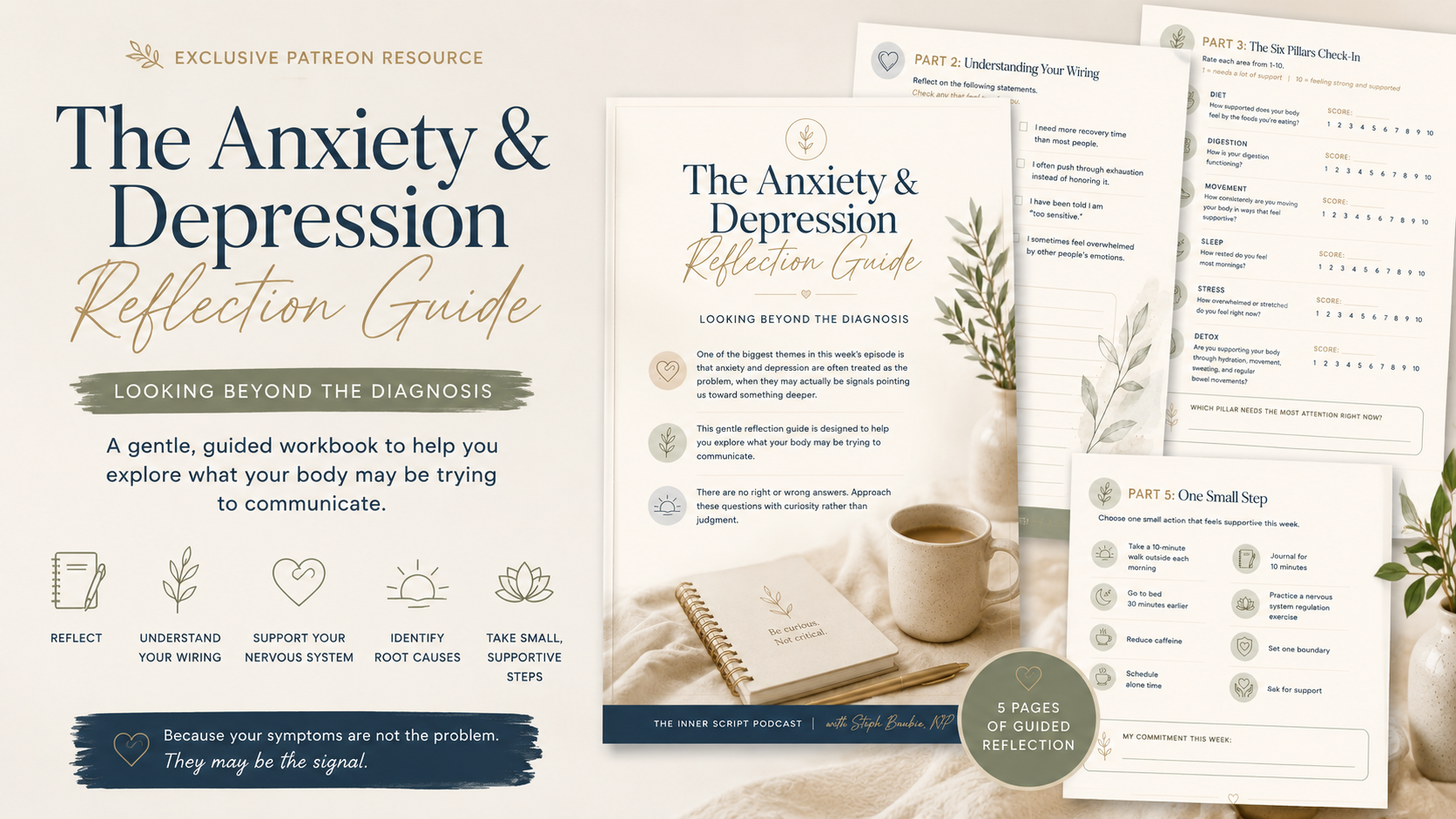
Free Guide: The Anxiety & Depression Reflection Guide
This free reflection guide walks you through a wiring self-assessment, a Six Pillars check-in, and one small supportive step you can commit to this week so you can start exploring what might really be underneath your anxiety or depression. Download it here: Patreon companion resource
You can also join Steph's free Patreon community here: The Inner Script Patreon

Meet Your Host: Stephanie Baubie, NP
Stephanie Baubie is an integrative nurse practitioner and the host of The Inner Script Podcast, where she explores the deeper stories behind health, healing, identity, and transformation. Through a blend of functional medicine, nervous system awareness, emotional insight, and honest conversation, Stephanie helps women better understand their bodies while questioning the narratives they’ve inherited about wellness, worth, and what it means to truly feel well.
On The Inner Script, Stephanie sits down with physicians, founders, thought leaders, and experts in women’s health, while also sharing solo reflections on the transitions and inner shifts that shape our lives.
Follow Steph on Instagram.
FAQs
Can anxiety and depression be caused by more than brain chemistry?
Yes. In this episode of The Inner Script, Stephanie Baubie explains that anxiety and depression can have multiple contributing factors, including nervous system dysregulation, childhood experiences, grief, unprocessed trauma, lifestyle habits, nutrient deficiencies, gut health, and chronic stress. She encourages a whole-body approach to understanding mental health symptoms rather than stopping at a diagnosis.
What is nervous system dysregulation, and how does it relate to anxiety and depression?
Stephanie describes nervous system dysregulation as a state where the body remains stuck in stress, vigilance, or overwhelm. She shares how her own dysregulated nervous system rooted in childhood grief showed up as intrusive thoughts, anxious attachment, and eventually a low, persistent sadness in her mid-twenties.
Can highly sensitive people experience anxiety differently than others?
According to Stephanie, highly sensitive people may be more affected by energetic shifts, other people's moods, lack of sleep, and overstimulating environments. Without the tools to regulate that sensitivity, it can easily be mistaken for anxiety itself, which is exactly what happened to her growing up.
How do lifestyle factors like diet, caffeine, and sleep affect anxiety and depression?
Stephanie discusses how blood sugar swings, caffeine on an empty stomach, vitamin D deficiency, poor digestion, and lack of sunlight can all mimic or worsen symptoms of anxiety and depression. She shares real patient examples, including how simply reducing caffeine intake or correcting a vitamin D deficiency led to a noticeable improvement in anxiety.
Are anxiety medications and antidepressants meant to be taken forever?
Not necessarily. Stephanie shares her own experience with both Zoloft and Wellbutrin and describes how her psychiatrist viewed medication as one tool for resetting neurotransmitters rather than a lifelong requirement. She emphasizes that every medication decision should be made individually with a qualified healthcare provider.
What are Stephanie Baubie's Six Pillars of Health?
Stephanie's Six Pillars of Health — diet, digestion, movement, sleep, stress, and detox are the framework she uses with patients to look beyond a mental health diagnosis and identify what might be contributing to anxiety or depression on a deeper level.
-
Everything shared here is for educational purposes and personal reflection only. Not medical advice. Always work with your own healthcare provider for individual care.
Hi, everyone. Welcome back to The Inner Script.
Today, we're talking about something that is incredibly common, and for whatever reason, it's still taboo, which is very interesting, and it's mental health, and specifically anxiety and depression. And I want to have a very honest conversation about both because I think we're still stopping the conversation too early.
And I do think it's still interesting that, you know, mental health continues to be such a taboo topic, and people can sometimes feel uncomfortable sharing their own experiences, even though many of us have felt a low mood or an anxious mood at some time in our lives. And I'll start off by saying, you know, I've definitely had my own experiences with both, but I hear all the time from people, "You know, I was born anxious."
And yes, people can definitely have genetic predispositions to mental health disorders. I certainly do. A lot of people in my family have had anxiety and/or depression. But I do think it can kind of come down to our own wiring and possibly ignoring how we are wired, and that can be why a big reason some of these conditions start to emerge.
More specifically, I think it's, you know, our sensitivities, how we regulate ourselves, how understanding how empathic and sensitive we are to external stimuli really need to be part of this conversation. I don't think I realized until the last few years that I don't necessarily run anxious, but more so that I didn't know how to work with my own wiring, my empathic side, and my sensitive side And the truth is, I get overwhelmed very easily when I'm overstimulated, and I just didn't know how to support myself in that period.
And what I did instead was kind of suppress and ignore, which doesn't work . Long story short, I remember always feeling that there was something wrong with me because I would feel really drained or exhausted from things that my friends had no problem doing, and I would really ignore these cues. And guess what?
Then I would kinda turn anxious. And I also felt things very intensely. I would feel energetic shifts in a room very easily, tension, a sense of unease when I was around someone super negative or anyone kind of sinking into me energetically, if you kinda know what I'm talking about. And looking back, this was really my own wiring, and I was living this way, not actively regulating my nervous system and not really giving myself the time I needed to decompress and support myself.
And the first time I really remember feeling anxious, but I, you know, didn't have the words for it, was when my dad passed away, and I've talked about this a lot on this podcast, and I was eight. At this time, I really started to have intrusive and OCD-like tendencies. I would develop different behaviors, like I would knock on wood all the time if I had a negative thought.
I would flick on and off light switches all the time. And I really didn't know what I was doing at that time, but- Looking back, it was really my nervous system trying to find some avenue of control at that time, and I never told anyone about that. I just kind of thought everybody did it. I also had, like, a lot of intrusive thoughts about something happening to my mom, and it was just a lot of panic.
Again, I obviously didn't know how to express this feeling. That just kind of led to a lot of suppressed emotions. But, you know, I've also had issues with kind of feeling depressed and just feeling lower mood. That, for me, that was more situational aspects, which I'm gonna get into. But, you know, it was never severe, but I felt like there were times in my life where it, I felt like I really had to do a lot more than the average person to make me feel happy and kind of make me feel like I was this carefree person.
I just kind of felt heavy at these times, like I just couldn't kind of snap out of it. There were times I felt like I was just waiting for the other shoe to drop, um, when in reality, this is a major clue to a dysregulated nervous system. When you're kind of just on alert and waiting for something bad to happen, that's just no way to live.
So when we think about mental health, I think we always think of it in terms of extremes. But like everything in the body exists on a spectrum, conditions exist on a spectrum. And I think in medicine, we stop the question at the diagnosis of anxiety and depression. We have people fill out these questionnaires, and we give you a score if you're mild, moderately, or severely depressed or anxious.
Then we kinda talk about medication in most instances, in kind of conventional medicine. Then we kinda stop the conversation. I think it can be really due to, in terms of anxiety and depression, I think it can be due to anything from an environmental toxin to a gut issue, a vitamin deficiency, to a dysregulated nervous system, to maybe something in our childhood we haven't processed.
I don't think it's only one of these. I think all of these matter, and I think it's really taking a whole body approach to mental health disorders to really understand what's going on underneath. Here's where I think we do tend to get it wrong. We say go to therapy, maybe take some medication, talk about your thoughts, and all of those things can be incredibly helpful, 1,000,000%.
But we often stop there. We don't ask why is the nervous system in this state to begin with? Like, why are we anxious? What is the body holding onto, and what didn't get processed possibly from childhood? Which can be a really scary and intimidating thought. It's not always easy to ask these deeper questions, I totally wanna emphasize.
Because a lot of the time, anxiety and depression are not random. I don't think we're necessarily born anxious or born depressed. I think these conditions are adaptive, they're protective, and they're really rooted in something deeper. And if you're feeling anxious or depressed, I often think that's a symptom of something else Going on.
And while genetics matter, that doesn't always mean you're going to develop anxiety or depression. So as I mentioned before, like, for as long as I can remember, I felt like it took a lot more effort for me to feel joy at certain times of my life. It wasn't all of the time, but it was definitely maybe some of the more sad times.
Looking back now, I really understand why, and it wasn't that something was wrong with me because that's kind of what I thought at the time when I was younger. It was that I had a dysregulated nervous system that was really rooted in grief from losing my dad, and then anxiety and panic over something happening to my mom, and just not really understanding my sensitivity and empathic side, not knowing how to support myself and my own wiring.
And I wanna talk about sensitivity for a second because we hear that word and we immediately think emotional. And while, yes, you know, I have a lot of emotions, but I don't really consider myself to be an emotional person. For me, sensitivity is more like I just feel a lot in general. I feel energetic shifts.
I pick up on a lot. I'm very sensitive to environments. Again, energetic shifts, other people's moods, smells, food, lack of sleep, just to kind of give some examples. If I don't sleep well, I feel it immediately. If I'm in a chaotic environment, I feel it immediately. And growing up, that really made me feel like I was super high maintenance.
And you might be listening to this and think that I am high maintenance, and maybe that's the case, but I can't really help the way I'm wired, and I think that's important to distinguish, like, you really can't override your own wiring. And that took me a long time to fully accept and realize. Yeah, but now I understand, you know, my sensitivity wasn't the problem.
It was an unregulated nervous system trying to process too much too early and not having the tools. So when I was younger, my anxiety looked different. I mentioned I had more OCD tendencies. I had intrusive thoughts about something happening to my mom, so what I did instead was I tried to cope and control, and I followed my mom everywhere.
When I was younger, she called me her shadow, not in a demeaning way. It was, like, in a loving way. It really was. It was in a, "You're my buddy." Type of way. And I never took it in a negative way at all. But just trying to give s- some piece of, like, how attached I was to her. I really couldn't be away from her for more than a night or two until I was maybe even in middle school.
Yeah, it was just, I developed a very anxious attachment to her. Instead of that being understood, it was definitely joked about by other people, and I wanna be clear that it wasn't joked about in my immediate family. I think they definitely just understood that's kind of the way I was at that time. So no one joked about it in my immediate family, but it was kind of other people would notice it and joke about it.
And, and it obviously made me feel really embarrassed. It just kinda took time for me to grow out of that. But again, what that really was, was a nervous system that wasn't regulated and trying to control an environment in whatever way possible. I also, just kind of a side note, I dealt with really poor self-esteem growing up.
I've mentioned in a prior episode kind of about this, but I was a late bloomer. I always looked super young growing up, and I still look very young right now, which I'm good with now. People would always say, "You're gonna love it when you're older." I rolled my eyes, and they were right. But growing up it just wasn't fun to, you know, hear how young I looked all the time, and people would just comment on my appearance.
None of it was ill-intent. I know that. It wasn't malicious in any way, but that doesn't always negate impact, and I think we forget that intention behind something that we say doesn't negate the impact it has on somebody else. One thing away from this conversation is I just don't think we should ever comment on a child's appearance, as somebody who's been there, 'cause it can be damaging to their self-esteem.
And again, none of that from what people said to me was ill-intentioned in any way. I logically obviously know that, even mentally, emotionally know that, but I just think we should never comment on a child's appearance. So that's just something I'm going to stand very firm on. Yeah, so that was kind of background, younger years, and we'll kind of fast-forward to college in my junior year At that point, everything kind of collided at once.
You know, I was living in a shared space in a sorority house, which was a lot for my nervous system, and I also got really sick with mono at this time too. And my lifestyle wasn't great. Drinking a ton of alcohol and not exercising, eating like crap, not sleeping well, just all at once, not good lifestyle whatsoever.
And I also felt really rejected in relationships at this time too. And slowly, it was kind of this really slow build, but I was starting to get this really low-grade sadness. Again, nothing dramatic, I just felt really off. And, you know, I talked to my mom and my sister about it, and I went to a psychiatrist, and I ended up going on Zoloft for a few years, a very low dose of it.
And I wanna say this very clearly, it definitely helped me. It made me feel lighter, gave me kind of more space and like mentally and emotionally, and I did definitely feel a difference. And then, you know, after college, I really started trying to do a lot of right things, right things in general, just to be healthy.
I started exercising more, really eating well, you know, focusing on good quality sleep, cleaned up my diet, all of that, and definitely Wasn't drinking as, I mean, I was still drinking alcohol in my early 20s, let's be real, but definitely not as much as what I was doing in college. I overall just had more structure in my life, and eventually I just kind of came off Zoloft.
I- it wasn't intentional. Felt like I didn't need it. My mood was in a good place, and I think the, those lifestyle changes, looking back, really, really helped, and I definitely didn't realize the extent of lifestyle on mental health at that time. But that certainly made a huge difference. You know, for a while I felt okay.
I felt really good. And then in my mid-20s, I went through another really difficult period of time. I think this was around, I think I was 25 at the time, and this one just felt a lot different than the others. It was just this really, really persistent medium-grade sadness, I would say. I was very tearful, and I just couldn't get out of it, and it lasted for about six months.
And on the surface, you would've looked at me and not really know anything was wrong. And I think in most cases, that does happen with people when they're kind of just in this low-grade feeling sad, lower mood, you know, depressed. When we think of depressed, we think, you know, can't get out of bed, can't go to work, can't go to school.
But again, it's on a spectrum, so it doesn't always operate that way. Yeah, and then at the time I was in talk therapy and, you know, I was doing the work. We were talking through things, identifying patterns, kind of really trying to figure things out and trying to get me to feel better. And nothing was really shifting.
I was still trying to live my best in terms of a healthy lifestyle, eating well, exercising, all the things, but it just wasn't really shifting. And I remember my therapist eventually saying to me, "You know, I actually think you could benefit from medication right now," and I was really averse to it. I was like, "I just, I really don't wanna go back on a medication."
I don't know why, I just, I really didn't want to go back on it. I do think there was probably a pride aspect of it, like I wanted to do it on, quote-unquote, my own. I don't know, I was 25. Who knows? I just didn't wanna accept that I may need a little bit more help than I needed. So anyways, I sat on it and, you know, I really trusted my therapist and I think that's why having such a good therapist matters 'cause I was like, "Look, if she really thinks this could help me, then, yeah, let me try it."
So I met with the psychiatrist and she was amazing. She really set the tone for me in terms of treating mental health disorders, I will say, because, you know, at the time, I was in school to be a nurse practitioner. Yeah, I was, like, in my first year of nurse practitioner school, and she really set the tone in, like, as a mental health professional.
In our first intake, she spent two hours with me to get my full history, understand my family dynamics, and really get to the root of what was going on so she could pick the right medication for me. I say this because internal medicine providers, they're not mental health professionals, and I think we forget that, and I'm going on a tangent here, but it's something, you know, I feel really passionate about as somebody who has struggled with their mental health in the past.
It's hard to find a good psychiatrist or one that kind of takes insurance. Primary care providers, a lot of the times, have to kind of step in and do this work, but there were times it made me feel uncomfortable treating more resistant anxiety and depression just because of my own experience with my psychiatrist and how great she was.
And I don't know, I'm going off on a tangent, but I just wanna say that because there are so many medications out there and I think with depression, we immediately think just to put somebody on an, an SSRI or a selective serotonin reuptake inhibitor like Zoloft or Lexapro, whatever. And there's so many more medications out there that as, you know, with internal medicine, we don't, we don't know.
We're, again, we're not mental health professionals. That's why we have psychiatrists. So anyways, that's a long tangent to summarize my experience with my psychiatrist who was absolutely amazing. So yeah, so I met with my psychiatrist for the first session for two hours, and I had told her I'd been on Zoloft before and she was like, "Look, I don't want you to go back on Zoloft.
You know, that's an SSRI. It can cause low libido. You know, you're 25. I do not want that to happen to you," and she just, like, got it. She was like, "Yeah, and I just don't think that's the right medication for you," and she instead put me on Wellbutrin, which is NDRI, which is a norepinephrine dopamine reuptake inhibitor, so it acts more on your dopamine receptors rather than your serotonin receptors.
And Wellbutrin, I had such an amazing result with that. It really, really helped. On top of that, she said something to me as well. She was like, "I look at these medications as more as tools in your toolbox. Like, this is not something you have to be on forever." She's like, "I actually don't want my patients to be on an antidepressant or an anti-anxiety medication forever."
She's like, "I think this is a way to kind of reset your neurotransmitters because your brain can be operating on such a lower baseline in terms of your neurotransmitters for so long that sometimes you just need a reset." And she's like, "That's kind of how I view medication, and hopefully we can get people off of them, or if you wanna stay on it, great, you know, whatever works."
But it was just such a completely different perspective, and that really shaped how I viewed treating mental health disorders professionally as well. Amazing experience with that woman. She was the best.
Hey friend. If there's someone in your life who you think would also love this conversation, please send them this episode. Sharing it with a friend makes you look like the exceptional friend that you are. Oh, and it helps the podcast grow too. Thank you.
So I started Wellbutrin, and honestly, people around me noticed the difference before maybe even I did, and I just felt so much lighter.
I had more energy. I felt like I was out of this mental fog, and I just felt normal again. I just felt like myself, and it was really great. And to be honest, I was only on it for about six months, and I wanna be really clear here, that's not something I universally recommend, and everyone is certainly different, and medication decisions should always be made with a provider.
But in my case, I actually just forgot to keep taking it because I just felt normal. It just wasn't on my mind anymore. I just completely forgot to take it, and it's just kind of funny in hindsight. And when I told my psychiatrist, she said something that stuck with me. She was like, "Well, that's probably your body telling you you're good."
She's like, "I would've rather titrated you off of it, but if you're feeling fine and not having any side effects, then I think we're good. You can just stop it, and good riddance." So yeah, and really since that, I really haven't been on any medication. And to be completely transparent, there have definitely been times where I probably could have used it again.
But You know, even like a couple years ago when I was super anxious, honestly a little bit of Lexapro probably could have helped, but I just, I don't know, I just didn't really think of it at the time, and I'm also in a different state. And in terms of, like I'm in California versus Illinois, it would just be really hard for me to find a psychiatrist who is as great as the one I saw in Chicago.
Honestly, neither here nor there. But I also think what's different now too is, you know, I understand my body so much better, and I understand my patterns, I understand my nervous system, and I have kind of more tools in my toolbox to f- figure out and know what's going on. So when I'm kind of feeling anxious or lower mood, that usually means I'm at capacity in some way, and I just know how to understand and support my system better.
So I view it more as a signal rather than pathology at this point. It's also kind of giving ourselves grace. You know, we are not going to feel happy and amazing 100% of the time. Again, that's like a toxic positivity person, which I have absolutely no desire to be around. If you're happy 100% of the time, that's, that's exhausting and not realistic, and you're not my people.
It really comes down to understanding my wiring. And when I really lean, leaned into nervous system regulation, tuning into my cycles, listening to my body, somatic healing, inner child work really changed everything for me. I still get like anxious here and there, but I don't really identify myself as much as an anxious person anymore.
It's kind of just more so, all right, if I'm feeling anxious, okay, what's going on? Let's tune in. Let's figure it out. Or who was I around recently? Because that all matters. If you are a highly sensitive person, I think you'll get that. So When I work with patients, I usually, you know, take a step back and try to look at the bigger picture with them when they're coming in with anxiety and depression.
I think about it in terms of my six pillars of health, which I've talked about many times, and it's diet, digestion, movement, sleep, stress, and detox. Let's kinda go through these. With diet, what you're eating directly impacts your brain. You know, protein helps build neurotransmitters like serotonin and dopamine, which in these conditions can often get depleted, so we need to be eating the right things to, for, such as protein, so that we have amino acids to create neurotransmitters, which is crucial for our mood.
Omega-3s reduce inflammation and have also been shown to reduce anxiety. Blood sugar swings can literally feel like anxiety. Drinking coffee on an empty stomach can literally feel like anxiety. I had a patient one time, he was drinking five coffees a day and feeling anxious, and I'm like, "Please reduce this to even, like, two or three.
Don't drink it on an empty stomach. Let's chat in a few weeks." And his anxiety almost went away, reducing caffeine. It's just so important to, like, ask these bigger questions. And then also, vitamin D deficiencies are hugely linked with mental health disorders, especially anxiety. I had a female patient who had one of the worst cases of anxiety I have ever seen.
You know, she was already on medication for it, and, you know, I also checked her vitamin D, and she was extremely deficient, like in the single digits. I put her on a vitamin D supplement, and we had a call a few weeks later, and she was like, "I don't know if it's placebo, but I feel like my anxiety has reduced significantly.
Like, I don't know what's going on." So Did it fully go away? No. But she felt more, quote-unquote, normal. She felt just kind of like herself. Those things can definitely get overlooked. With digestion, your gut and your brain are constantly communicating. We all know about the gut-brain axis and how linked those two are.
So it's, you know, really about supporting your digestion because i- if it's off, you know, your mood will be, too, and even, even on a really basic level, like if you're constipated, you feel heavy, sluggish, uncomfortable, like, and that affects your mood, too. Like, how does it not? So always supporting digestion, daily bowel movements, formed, all the things so that your digestion feels great.
You know, movement, and this isn't always about, like forcing workouts you hate. I find all the time, you know, people are like, "Yeah, well, I run because it's good for you, but I hate it." Well, I mean, is it really worth it? Is it really worth it to force an exercise you don't enjoy doing? I don't think it is 'cause it's gonna make it really difficult to show up and actually do it.
So it's overall viewing movement as moving your body in a way that feels supportive and not like you hate doing it as simple as that sounds. So in thinking about really bringing it to the basics of movement, like walking outside in the sunlight, getting outside consistently, these things matter way more than people think.
You know, I've had so many people tell me that they work from home and they don't leave their house until, like, 3:00 or 4:00 PM, and they feel anxious or depressed, and we were not meant to be inside all day. So it's like just trying to get outside within an hour of waking up for, like even 10 minutes makes a huge difference or on your lunch break, going for a 10-minute walk.
Like, those things can really shift your mood and kinda get you out of that foggy feeling. It's not fun. And I wanna say, like- People always say, people always, people have challenged me on these things, and it's like, "Well, this just sounds too simple." And it's like sometimes it's the smaller shifts that create the biggest impact, and I will say that time and time again.
Okay, sleep. I have talked about sleep so much. Sleep is foundational. If you're not sleeping, everything is off, and especially with, you know, anxiety, depression, a lot of the time sleep can get impact. It doesn't feel as restorative, especially if you're anxious. When you're depressed, you can definitely just feel some, like, underlying fatigue.
So, you know, there's ways maybe to check your salivary cortisol levels. You can have low levels, which can feel like depression, or kind of higher cortisol levels, which can feel like anxiety, and you could have mixed states. So a lot of the time symptoms alone can kind of tell you if you have a specific cortisol pattern, but we always say test, don't guess.
So testing salivary cortisol at four to five different times of the day can kind of show your cortisol curve, which can be helpful because cortisol impacts sleep, which is your stress hormone. So sometimes it's supplementation with, you know, magnesium, L-theanine, glycine, phosphatidylserine, but taking these medications, things like L-theanine can suppress your cortisol even more, so you don't always want to take L-theanine if you're in a low cortisol state.
That's why testing is very important. What I will say is magnesium you can't really go wrong if no matter where your cortisol is at, it can help enhance cortisol production. It can also help Kind of lower stress as well. So magnesium is usually my go-to if we're not testing salivary cortisol. And nervous system regulation tools, especially before bed.
And not only that, like meditation, breathwork, just getting your body in that rest/digest phase so that you can relax. It's also like emotional processing, which is really helpful, whether it's journaling, an actual journal dump where you're not just saying surface level shit. It's like, "Today really sucked.
This person really pissed me off. This person sucks. I feel really shitty today." Just like really getting deeper into it because you'd be surprised what comes up once you start going. And maybe some people, it's better for them to do this before bed or some it's better kind of in the afternoon 'cause it can feel really heavy, but emotional processing is really important.
It's kind of that somatic aspect of releasing stored emotions. So yeah, it can be journaling, it can even be like talking it out by yourself. Just release it any way that makes sense, what feels right. And even like shaking your limbs out, shaking your hands or stretching is really helpful, too. Anything that makes sense.
You kind of have to figure out what feels right for you. And then, uh, stress management. So this is a really big one, and we are never going to eliminate stress. That is never the goal. We're not telling you to quit the job. That's not what we're saying. What we are saying is trying to increase our ability to handle it, and that's really what nervous system regulation is.
It's boundaries, time alone, saying no. Limiting exposure to people who drain you is key. This is also a time where I start to ask my patients deeper questions in terms of where their biggest stressors are, and it's kind of a time for them to really get honest with themselves.
And I always meet them where they're at. But it's a good time to just really dive a little bit deeper into things. And I'll ask things like, "What was going on in your life when you first felt anxious or depressed? Like, what happened a few months before?" And we really get to breakthroughs of, "Yeah, I started this job," or, "I started working on this project," or, you know, "I switched teams," or had to deal with this specific person, or you know, I moved, whatever it is.
A lot of the times it starts to kind of follow a story or a pattern. So I think that's the first step is, like, kind of self-awareness of, okay, maybe this isn't just my biology, maybe it's situational, it's my environment as well. And then one thing I will say out of personal experience, once you start regulating your nervous system, your capacity to be around people who drain you, and they call them energy vampires, which anybody can relate to, and it's just so true 'cause they really do drain your energy.
That capacity actually reduced because it's almost like it felt like it was violating an internal boundary. And overall, I just-- I kind of felt like my tolerance for it reduced as well, and that's not a bad thing. When I say tolerance, I more so mean you kind of just, like, excuse yourself quietly, you don't fight back, and you just don't even bother.
So it's not like you're freaking out more or getting more anxious, it's just kind of like, "Okay, I'm at capacity. I gotta leave this situation," whereas before you might have tried to push through and to try and be more accommodating. But anyways, it's just an interesting observation I had. Last is detox, and again, this isn't about extreme protocols, it's just about supporting what your body already does, like hydration, bowel movements, sweating, movement, all the things can really help.
That's what detox means. It's not something you're doing one time, your body is constantly doing it, but trying to help support detox systems in the body because anxiety, depression can definitely help to, not shut them down, but desensitize them a little bit. Overall, just when your body feels lighter, your mind often follows, so it's just having the daily bowel movements, drinking enough water, like all of those things really do help.
Again, it sounds simple, but it makes sense. You know, at the end of the day, medication can support your chemistry. I'm the First person to honor that, recommend a medication for six to nine to 12 months just to kind of reset your neurotransmitters. I've been there. But it doesn't always resolve the root.
And for me, the root was a dysregulated nervous system, unprocessed grief, high sensitivity without tools, and early experiences that shaped kind of how safe I felt with myself. You know, instead of asking what's wrong with me, a better question might be, what has my body adapted to? Because sensitivity, it's not a weakness.
It's awareness, it's depth, it's intuition, it's your wiring. Without regulation, it can feel very overwhelming, so give yourself some grace and some TLC, because we need it. All of us do. So if you're someone who feels really deeply, who struggles with mood or anxiety, which is most of the population even if they don't wanna admit it, hot take, I want you to know there is nothing wrong with you.
Your body is responding to something. Healing doesn't mean thinking positively 100% of the time or never having a negative thought ever again. That's not realistic. It's about learning how to feel alignment in your body again. It's all just feeling inner peace, which I know sounds corny, but I truly believe that.
So that's all I have to say about mental health, anxiety, depression. I get it. I've been there. It's hard. Just know it's often is a symptom of something else going on. That's not taking genetic predisposition away, because it definitely, of course, contributes. But again, anxiety and depression, we often stop the conversation too early, in my opinion.
I think there are so many factors to it. It's biological, it's emotional, it's genetic, it's mental, it's spiritual, it's environmental, like everything. Vitamin deficiency, microbiome, all of it. So let me know what you think about this episode. Feel free to send me a message on the Inner Script Pod on Instagram, and rate, review, subscribe.
Would really appreciate it, and I'll talk to you guys next week.
If you wanna connect with like-minded women and dive deeper into these conversations, join my Patreon community. There's a free option and it's where we can talk about each episode together. The link is in the show notes and I can't wait to see you there.
Disclaimer
Everything shared in this episode is for educational purposes and personal reflection only. It is not medical advice. Always work with your own healthcare provider for individual care.
We sometimes include links to products and services we find interesting. These may or may not be affiliate links. Thanks for your support.
Podcast production by Jamie Brooke.
