Why High-Functioning Women Feel Exhausted All the Time | Acupuncturist Explains
Listen now by clicking your favorite podcast app below:
Why are so many high-functioning women exhausted, even when they’re doing everything right?
What if your exhaustion, hormone symptoms, anxiety, bloating, or fertility struggles aren’t proof that your body is broken, but signs that it has been trying to protect you all along? In this episode of The Inner Script, Stephanie Baubie, NP sits down with Dr. Nikki Cerone-Fancher, a Doctor of Traditional Chinese Medicine and licensed acupuncturist, for a grounding conversation about why so many high-functioning women feel tired, wired, and stuck in survival mode, and what it really takes to help the nervous system rest and heal.
Together, they break down what Chinese medicine and acupuncture actually are (it’s so much more than needles), why women who overfunction tend to burn out, and what yin depletion looks like in everyday life. Dr. Nikki also shares how unprocessed emotions can show up as physical symptoms, why so many women carry stress in the pelvic region, and how chronic stress and survival physiology may affect hormones, circulation, and fertility.
From burnout vs. fatigue to Chinese herbs, progesterone, and simple nervous system regulation practices like legs up the wall and longer exhales, this conversation is a reminder that rest isn’t a reward. It’s biological repair your body needs to function. If you’re tired of pushing through, this one is for you.
This episode is for you if…
You feel exhausted even when you’re “doing everything right,” and you’re wondering why your body still feels off.
You’re navigating burnout, anxiety, restless sleep, hormone imbalance, or fertility challenges and want to understand the role your nervous system plays.
You’re ready to stop pushing through and want simple, realistic ways to rest, regulate, and feel safe in your body again.
Episode Timestamps
00:00 Introduction
04:31 What Acupuncture Actually Is
10:42 Why Women Burn Out
18:27 Yin Depletion and Rest
25:08 Emotions Stored in the Body
33:15 Stress in the Pelvic Region
39:12 Fertility and Nervous System Safety
47:30 Chinese Herbs and Progesterone
55:11 Burnout vs. Fatigue
01:02:20 Daily Nervous System Tools
Resources & Mentions
Women’s Health & Fertility Services: Services at New Mission Acupuncture
It Starts with the Egg by Rebecca Fett
Dopamine Nation by Anna Lembke MD
Preggo Pilates with Stephanie Forster
Curious about a supplement Steph has mentioned in the episode?
If you’re looking for products Steph personally recommends in practice, you can browse her dispensary here: Stephanie’s Fullscript dispensary
Please consult your healthcare provider before starting any new supplement. Food, lifestyle, and nervous system support always come first.
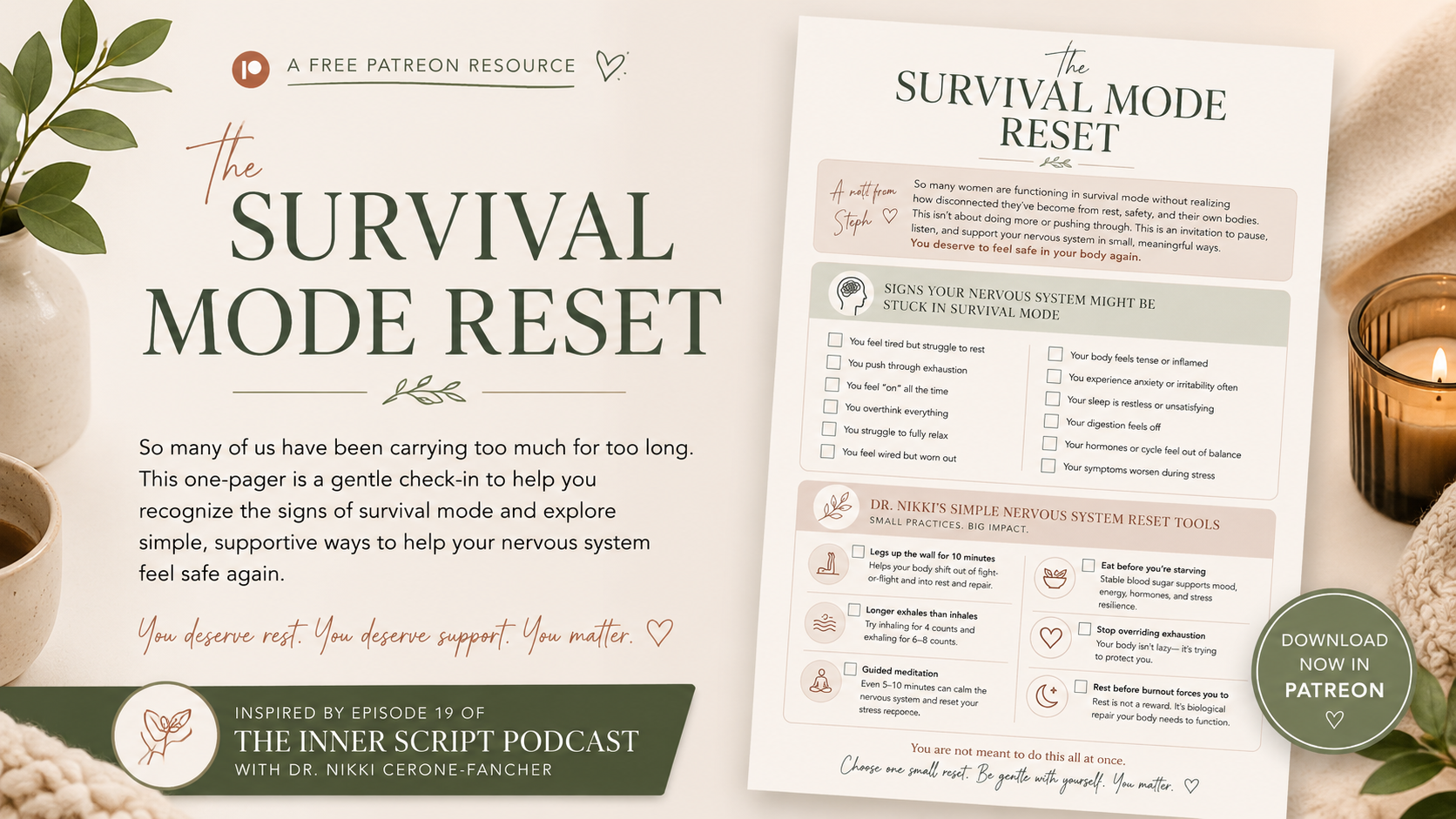
Free Download: The Survival Mode Reset
This gentle one-page checklist helps you spot the signs your nervous system may be stuck in survival mode and gives you Dr. Nikki’s simple reset tools, from legs up the wall to longer exhales, so you can start feeling safe in your body again. Download it here: Patreon companion resource
You can also join Steph’s free Patreon community here:
The Inner Script Patreon
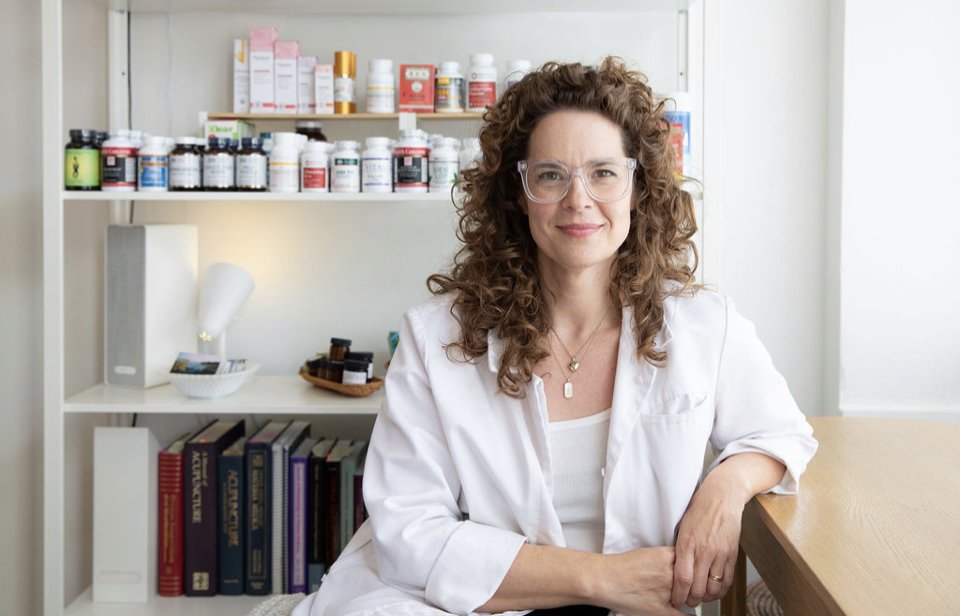
Meet Dr. Nikki Cerone-Fancher
Dr. Nikki Cerone-Fancher is a Doctor of Traditional Chinese Medicine and licensed acupuncturist based in San Francisco. She specializes in women's health and the role of nervous system regulation in healing, supporting women through fertility, pregnancy, postpartum recovery, and midlife hormonal transitions. Known for her warm, collaborative style, she practices at New Mission Acupuncture in Mission Dolores and offers Collective Rest, a communal ear acupuncture circle designed to help the body shift out of stress mode and into deep rest. Website: https://www.newmissionacupuncture.com
Instagram: https://www.instagram.com/newmissionacupuncture
New Mission Acupuncture Website & Instagram
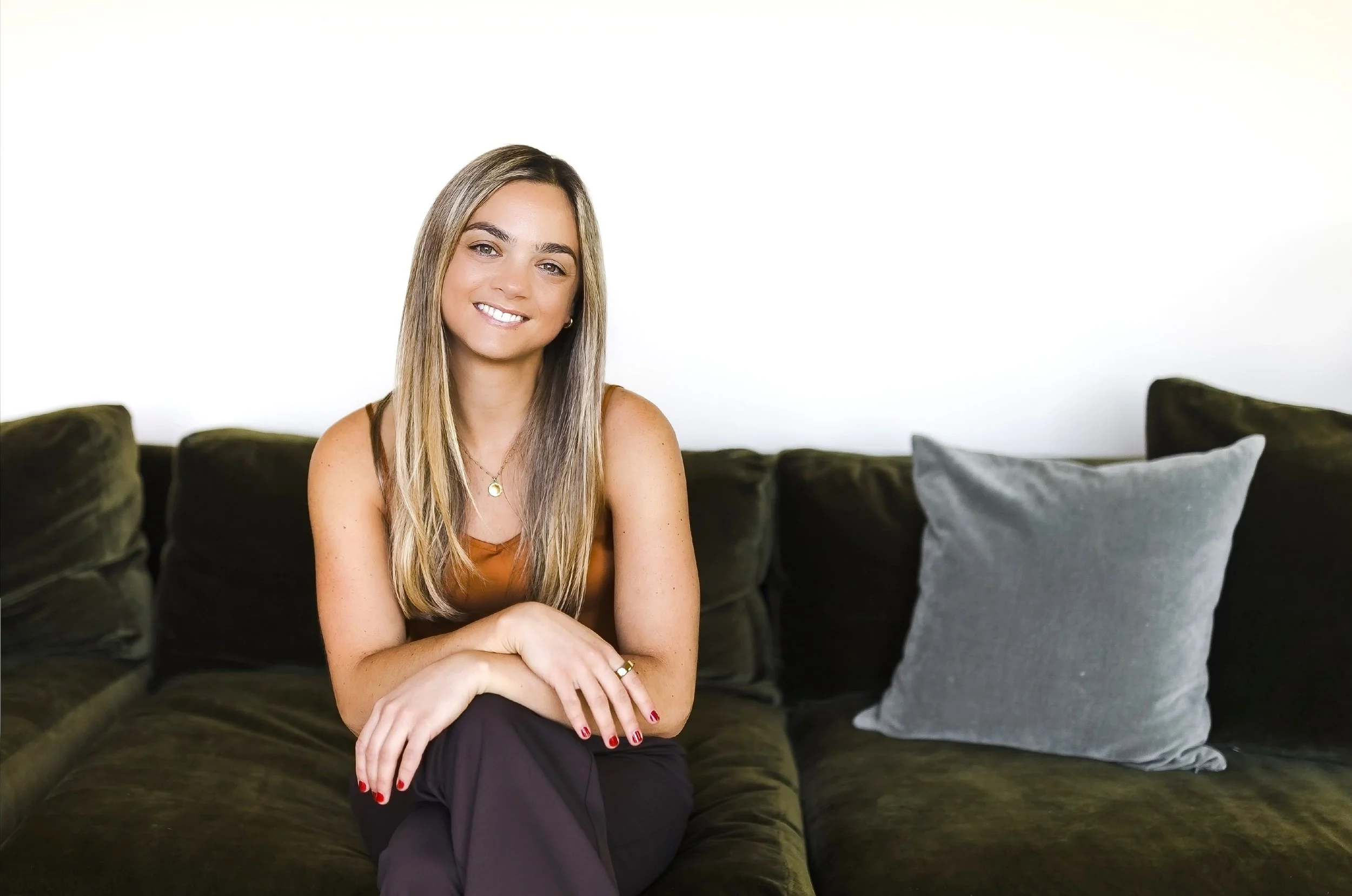
Meet Your Host
Stephanie Baubie, NP is an integrative nurse practitioner and the host of The Inner Script Podcast, where she explores the deeper stories behind health, healing, identity, and transformation. Through a blend of functional medicine, nervous system awareness, emotional insight, and honest conversation, Stephanie helps women better understand their bodies while questioning the narratives they’ve inherited about wellness, worth, and what it means to truly feel well.
On The Inner Script, Stephanie sits down with physicians, founders, thought leaders, and experts in women’s health, while also sharing solo reflections on the transitions and inner shifts that shape our lives.
Follow Steph on Instagram.
FAQs
Why do high-functioning women feel exhausted all the time?
In this episode of The Inner Script, Dr. Nikki Cerone-Fancher explains that many women learn to find their value in accomplishments and in keeping everyone around them happy, so they keep pushing past their capacity. Over time, that chronic overfunctioning can wear the body down, and the body eventually “votes” through burnout, hormone imbalance, digestive issues, or other symptoms. She and Stephanie Baubie discuss why stopping when you’re tired is one of the most powerful (and most overlooked) forms of self-care.
What does acupuncture do for the nervous system?
Dr. Nikki describes acupuncture as placing very fine, solid needles at specific points to access the nervous system and connective tissue, helping the body shift out of fight-or-flight and into rest-and-digest. She explains that it isn’t adding something to the body. It’s asking the body to return to its natural state of balance. Clients who are new to acupuncture, or who have been living in adrenaline for a long time, may feel sleepy for 12 to 36 hours afterward as the body gets the message that it’s safe to rest.
What is yin depletion in Chinese medicine?
On The Inner Script, Dr. Nikki explains that yin is the material, nourishing, restorative side of the body, and she compares it to a bank account. Overriding exhaustion, poor sleep, and constant “doing” are withdrawals, while rest, quality sleep, and easy-to-digest, nourishing foods are deposits. She also shares why even a practice like yin yoga may still count as “doing” when what the body needs most is true rest.
Can stress and nervous system dysregulation affect fertility?
Dr. Nikki explains that when the body is in survival mode, blood flow is redirected away from areas like the uterus and ovaries, and reproduction naturally becomes less of a priority. She is clear that this is not about blame, since babies are born under stress every day, and she encourages women to make friends with their bodies, learn their baseline hormone markers earlier rather than later, and build nervous system regulation into their routines. She also discusses how acupuncture and Chinese herbs are used to support circulation and reproductive health.
Can unprocessed emotions show up as physical symptoms?
In Chinese medicine, emotions and organ systems are deeply connected, and Dr. Nikki explains that emotions we stuff down don’t disappear. They go somewhere. She describes how stagnation, or a lack of flow, can show up on physical, emotional, and spiritual levels at the same time, and why many women tend to hold stress in the pelvic region. Stephanie shares what she sees in her own patients, from digestive issues to irregular periods and pelvic pain.
What is the difference between fatigue and burnout?
Dr. Nikki thinks of fatigue as a signal, almost like a stop sign, telling you something needs to change. In her experience, burnout carries a layer of panic, while fatigue carries more of an uneasy, drained feeling. Together, she and Stephanie discuss why listening to these signals early, before the body forces you to stop, matters so much for long-term health.
What are simple ways to regulate your nervous system at home?
Dr. Nikki shares a handful of easy practices you can start today: legs up the wall for about 10 minutes (even on your bed), breathing with a longer exhale than inhale, and a short guided meditation. She also encourages listeners to stop overriding exhaustion, eat before they’re starving, and rest before burnout forces them to. You can find these tools in the free Survival Mode Reset on Patreon.
-
Everything shared here is for educational purposes and personal reflection only. Not medical advice. Always work with your own healthcare provider for individual care.
Stephanie Baubie, NP: Hi everyone, and welcome back to The Inner Script. Today's episode is for the woman who feels like she's doing everything right, but her body still feels off. What I've learned, both personally and in my practice, is that so much of this comes back to the nervous system. I am joined today by Nikki Fanter.
She is an acupuncturist at New Mission Acupuncture here in San Francisco, specializing in women's hormonal health through the lens of nervous system regulation. I actually found Nikki through a former patient of mine, and I went to see her during a time when my own nervous system was completely dysregulated, and since then, I've referred countless patients to her, and I've seen the impact it's had on their lives.
And today, we're talking about what it actually takes to get the body out of survival mode and into a place where it can finally rest and heal. Hey, Nikki. How are you doing?
Dr. Nikki Cerone-Fancher, L.Ac.: I'm so excited to talk about this
Stephanie Baubie, NP: Yes. And also it's Dr. Nikki.
Dr. Nikki Cerone-Fancher, L.Ac.: Yes, Dr. Nikki. Some people call me Dr. Nikki. I think as women it's important that we put our education out there
Stephanie Baubie, NP: thousand percent. So we were actually chatting a bit before I hit record, and, you know, I wasn't going to talk about this, but now I think it will be a good thing just to kind of have you guys get a bigger picture of acupuncture Chinese medicine and kind of...
I recently got news that I have a small polyp in my endocervical canal. So I was chatting with Dr. Nikki about it because I haven't seen her in a minute, and I was talking to my gynecologist because I've been having heavier periods. I had an ultrasound performed, which showed a small polyp, and the recommendation would be for me to have a hysteroscopy, which can be quite invasive, and I- I'll do it if I have to, but I was just getting Dr.
Nikki's opinion on it. Yeah, and you made me feel a lot better. So can you just summarize that maybe for anyone else who's had a polyp before, kind of what that means? And then we'll jump into everything else.
Dr. Nikki Cerone-Fancher, L.Ac.: Of course. So essentially what I tell my clients or people who come to see me with polyps is that we like them to be, or I like to- them to be three millimeters or less. They could be a lot of polyps, multiple polyps at three millimeters or less. You know, six millimeters we are less likely to see results, but I have seen results for 12 millimeters, so completely gone.
This one particular client that I'm thinking of had it look like a bloat, but it was the polyp, and she was so pleased. So, you know, in Chinese medicine... Well, for me personally, I never tell a client not to do Western medicine if they want to. I like to assess what's the emergency. Do we need to do it right now?
Are we doing an embryo transfer? Are, are we trying to get the endometrium in a certain state right away? If not, do we have time? How much time do we have? I mean, that's the same in any case. In birth, how much time do we have? Do we have three minutes or do we have 20 minutes to make a choice? So for you, I would recommend Chinese herbs for this.
This would be very, very helpful. Probably also some acupuncture, maybe even some electrostim just to get the uterus moving and flowing. What's a polyp? In Chinese medicine, it's stasis, it's stagnation where there should be flow, typically of blood or dampness. Is it fluid-filled? Is it more solid? You know, we have what's called chocolate cysts.
We think of those as blood stasis. We have what's more polycystic ovaries. We think of that as dampness. So it would be more about correcting the flow, getting the herbs in to kind of help you get rid of it, and then assessing after a couple bottles of herbs and going from there
Stephanie Baubie, NP: No, this is a good reminder. I always think the universe works in crazy ways, and we were actually supposed to have this podcast interview a few weeks ago, so we wouldn't even be talking about this right now
Dr. Nikki Cerone-Fancher, L.Ac.: No, it was actually perfect for me as well because we were supposed to have this conversation two weeks ago. My kid got the stomach flu. Like, there was all these nervous system dysregulations for me, and I had to pull from my basket of tools, and I was like, "Oh, right, this is the reminder that, like, we are all subject to this issue that we're gonna talk about today."
And then also, just to go back, Stephanie, the idea why I asked you to name your Paula, because so much of our struggle is the suffering that we have for things, and the suffering really is in the attachment that things are right or wrong, right? So I wanted you to make friends with your Paula so that we could kind of welcome it and then ask it to go, you know, kind of thing, instead of being in c- conflict and contrast and stress around it, symptom checking, freaking out.
Let's get your limbic system behind you
Stephanie Baubie, NP: So guys, I am prone to all of this stuff as well. And I also think it's important to say sometimes we have to look at our symptoms as like this polyp, for instance, like this isn't my body like betraying me. It's actually was trying to protect me. It's probably years of stress that I was dealing with, and in that kind of developed this as a way to compensate for my chronic stress.
So it's just important to note that symptoms suck. Obviously, my polyp isn't great, but just that reframe is helpful. It's just like my body's way of trying to protect me. It's a good reminder for all of us
Dr. Nikki Cerone-Fancher, L.Ac.: It's a good reminder that your body is no different than anyone else's body. You know, we see a symptom as pathology, that there's something wrong with us, but why is everyone breaking exactly the same way? There's a beauty to it
Stephanie Baubie, NP: Okay. Well, enough about me. Let's get back into this. So first, I want you to kind of briefly explain what Chinese medicine and acupuncture are, because I don't think a lot of people have a full understanding of it. They immediately think, "Oh, just the needles," but it's so much more than that
Dr. Nikki Cerone-Fancher, L.Ac.: Yeah. So I could go full nerd on this one and talk for hours, but I will try to be concise. The way I describe it to my clients is Chinese medicine is a complete medical system. Similar, I explain like Western medicine is a complete medical system. So I think of it like a board game, like Monopoly or the Game of Life.
In Monopoly, there are rules to the game, there are pieces, there are ways of understanding, similar to the Game of Life. And you wouldn't necessarily take pieces from one board game and play another board game, but by themselves, they're a complete system of understanding. So the basics of Chinese medicine is that we look at the body, for lack of a better term, holistically.
We look at it as one integrated thing, and all systems are working simultaneously with each other. We look at the body as mind, body, spirit simultaneously. They've never been separate. In Western medicine, there's a lot of research about mind-body connection as if it was ever separate. And then acupuncture within that system is just one tool.
They're very fine needles. Most of us know that. They're not hollow, they're solid, and what they're doing is accessing the nervous system, the connective tissue, what we say in Chinese medicine is the energy or the chi of the body, to create change. And the system is extremely sophisticated, but on a basic level you could say it's asking the body to function optimally.
And we look at the body as having patterns of balance and imbalance, and so we're gonna try to take you out of imbalance. And actually what acupuncture is really doing is just asking the body to be back into its normal state. It's not adding something to the body. It's not like taking a supplement or, you know, taking a drug.
It's actually just placing fine needles in the body in very studied points, areas of the body to create balance and change, and the body does the rest. It's beautiful
Stephanie Baubie, NP: It is beautiful. It's just bringing up our bodies into homeostasis so it can just operate optimally. You know, I talk a lot about high-functioning women on this podcast too, and also, you know, I send a lot of my patients or former patients to Dr. Nikki as well, and they're kind of-- I feel like we all have this common theme of kind of high-functioning, maybe over-functioning a little bit.
But why do you think so many women have become so dysregulated?
Dr. Nikki Cerone-Fancher, L.Ac.: I mean, this is such a big question, and it's such a beautiful question because, you know, at its core, it's really about where we find our value, and that is cultural, it's within the family, it's within ourselves. You know, on another level, where do we have control, and where do we get seen? So most of us find our value in our accomplishments, and the messaging that we're given is that it's our job to really be perfect, and we're only as good as how happy everyone else is around us.
That's a big one. And you know, I have a nine-year-old daughter, and prior to having her, I had a lot of resentments towards how I was raised in the culture. But then I was starting to make her act in these ways because it was easier for me. It was easier for me if she tied her shoes. It was easier for me if she ate her lunch.
And I had to really start to question. About kindergarten, she started reflecting that it was her job to make people happy, and the alarm bells went off. I was like, "Oh, no, no, no, no." So luckily, she was, you know, five at the time, and we're still working on it. But, you know, she's in a larger system now. She goes to an all-girls school.
She's surrounded by good girls, smart girls, and just interrupting where her value comes from. I'm trying to get her to be selfish, but of course, not too selfish
Stephanie Baubie, NP: Totally. It's a balance. You have to find, it's like boundaries even
Dr. Nikki Cerone-Fancher, L.Ac.: Yeah. So, you know, after a while of always making everyone else happy, finding achievement through doing, we're gonna burn out because we're pushing past capacity, and it really depends where you burn out. It's just a question of what period of time are you gonna burn out? Are you gonna burn out in your teens?
Are you gonna get something early like PCOS? Are you gonna burn out in your 20s with Hashimoto's, in your 30s with IBS, in your 40s? Like, where are you gonna burn out? The body eventually votes is what I like to say
Stephanie Baubie, NP: I love that. And it just requires kind of this reframing that self-worth doesn't equal kind of what we're producing too, and that can be really hard to, I guess, rewire in ourselves. And is there also, like, a balance with masculine and feminine energy as well with, like, in the overdoing? Are we tapping too much into our masculine energy in that time, or does that not really have anything to do with it?
Dr. Nikki Cerone-Fancher, L.Ac.: I think that's an interesting question, right? Because my undergrad degree is a women and gender studies degree, and it's with a pre-med emphasis. So women and gender and how it exists within our culture is really interesting to me. And then in Chinese medicine, we have this idea of yin and yang, male, female, receptive versus kind of action.
But then we look at the cultural. We look at so many of my clients, and you might want to take this out of your podcast, but by midlife, so many of my clients want divorces. They get their value from being perfect. They get their value from how happy people are around them. They unfortunately infantilize their partners.
They don't let them do anything because they're not doing it right. Their partners aren't doing their career right, so we have these overachieving women that just burn out. We hit midlife, we hit the biggest hormone shift, we, we down-regulate our hormones. I had a client recently reflect to me, like, "I just can't output as much as I used to."
And I was like, "Because that wasn't sustainable. That wasn't real. Your beautiful body was trying so hard for you because you were pushing it, and now it just can't anymore, and it never should have." So, so many of my younger clients that you've referred to me, who I love, are getting married. They're getting married and, you know, two in particular, and I said to both of them, "If he does the dishes wrong, let him figure it out.
You can't spend your whole life correcting problems. Either, you know, be creative, hire somebody. Like, don't double function for the people in your life."
Stephanie Baubie, NP: I love that. Don't double function
Dr. Nikki Cerone-Fancher, L.Ac.: So your question about masculine and feminine, like sure, in Chinese medicine, we think of material as the yin, the physical body as the yin, as the feminine, and we think of the energy, the function, the, the heat as the yang.
So what we're doing is all yang. We're just doing, doing, doing. Even my clients will say like, "Well, what about yin yoga, Nikki?" And I'm like, " Well, it's still yoga, right? It's still doing." Yin is rest. Yin is sleep. You know, the ultimate yin is death really. You know, we don't really wanna go there, but we really need to be nourishing more, you know, the physical body, the material, resting, grounding.
Yeah. So masculine and feminine, I guess I could say that it needs to be balanced throughout for everyone
Stephanie Baubie, NP: Yeah, love that. Such a good answer. So when you have a client coming in to see you, you like to check their tongue first, and then we get on the table, you check our pulse as well. What are you looking for in the tongue and the pulse?
Dr. Nikki Cerone-Fancher, L.Ac.: So, you know, I like to say there was no MRI in ancient China, and I like also say there was no Netflix. So people had a lot of time on their hands to observe, and there was a practice, the earliest kind of Chinese medicine texts were around the time when Daoism was a philosophical system in China. So there was a lot of life-sustaining practices.
The ultimate goal in Daoism was to live forever. So to live forever and to change lead into gold, like they were selfish too. So to live forever and have lots of gold. So a lot of Chinese medicine is about longevity, which is why it resonates so much with our current needs and our culture. It's not about an afterlife.
It's not about, well, it doesn't matter because in heaven everything will be fine. It's like, no, no, no, you wanna live forever. The tongue, I like to say, is the only internal organ that we can stick out and not kill somebody. We didn't have to cut you open, and we can see, okay, what's the internal body looking like?
Is it swollen like mine? Does it have a crack in the center like mine? Teeth marks? Yeah, look at those teeth marks. A little bit yin deficiency. Well, you've got the overthinking, and you're still-- your yin needs to be nourished. Yeah
Stephanie Baubie, NP: That's just like a constant thing at this point. We're just constantly working at it
Dr. Nikki Cerone-Fancher, L.Ac.: And unfortunately, we have this idea of the body, the constitutional body, the who you are as a person, which is a big genetic component, and then we have the life stages. So eventually, your life stage is gonna be one of yin depletion, and you're already yin depleted, right? If you cho- choose to have a baby, that time period, you're giving your yin, you're giving your material to another life.
You're terraforming life is, like, what I like to say, out of your own body. So again, there's gonna be these times when the pattern of the person and the pattern of life are gonna be mismatched, and my job is to harmonize them to try to help you meet them. Okay, but let's go back. So- The tongue, if it's swollen, there's inflammation.
If it's red, there's what we call heat. You know, if there's a crack in the center, we have, you know, long-term yin deficiency. That for me, it's in my stomach. The scallops on the side are overthinking, and then the whole body is kind of re- represented in the tongue. Chinese medicine thinks of the human body as a reflection of the greater universal law, and then it also looks at individual places in the body as a reflection of the whole body.
So it's this idea of the microcosm and the macrocosm. And then the pulse is similar to that as well. So the pulse, similar to Western medicine, we're looking at strength, we're looking at speed relatively. But then there's also the different... You know, when we take a pulse, we actually have the different organs in Chinese medicine that we can feel.
So the upper body, the middle, and the lower internal organs. And so that also tells us what's going on internally. It's good to remember that this is a medical system that really developed with the scientific method. We can see the cultural value in China was to write things down, and it was also lineage based.
So things that worked, you know, twenty five hundred years ago in the Yellow Emperor's Classic, some of those things we still do today and some we don't 'cause it didn't work. There were certain associations that didn't quite work. It didn't bear out scientifically. So we have a three thousand-year-old scientific method for this system, and I'm blown away by the amount of research that's coming out more and more that's showing exactly why the things that we know worked three thousand years ago, why they work biomedically.
I'm a naturally skeptical person, so like sometimes I, you know, I remember in school being like, " Why would cupping the upper back make, you know, your lungs bronchitis better?" But it's because it releases cytokines when we create microtrauma and those cytokines are kind of stupid. They go around looking for repair everywhere.
So more and more we're getting this research back that's showing that this thing, this, this medical system that has been proven effective why it works. And I think that in the next twenty to thirty years, every single thing of Chinese medicine is gonna be proven why it works. So it's giving me more kind of joy and enthusiasm for even the kind of more what we would call esoteric parts of Chinese medicine, the more spirit based parts of Chinese medicine, thinking we're just, we're on the precipice of learning that this is, you know, a complete medical system that works.
Stephanie Baubie, NP: It does. And Chinese medicine's been around longer than prescription medications, Western medicine. Look, I'm not saying... Yeah, there, there's a time and place for Western medicine, but Chinese med, it works. It's remarkable. And as we've said, you've helped so many of my patients, like, get their cycles back, regulate cycles, all of that.
So I definitely wanna get into fertility at some point. We're gonna definitely touch on that. But I feel like a lot of women probably need to nourish their yin, as you were mentioning before. What are ways women can do that?
Dr. Nikki Cerone-Fancher, L.Ac.: So yin is really material, and I like to think about the body like a bank account. So there are ways that we can pay into a bank account to keep it healthy, and there are ways that we can not take from the bank account. So, you know, not taking from the bank account, so not overspending, would be stopping when you're tired.
Can you imagine? Stopping when you're tired. When your body says, "Whoa, I'm exhausted. I need to sit down," how many times have you said to yourself, "Okay, in like five minutes, just this last thing." When we do that, when we get that message and we override that, we're going past capacity. We're not only depleting our yin in Chinese medicine, we're actually depleting what I call the trust fund, which is the, the essence.
So long term, that's gonna age us faster. That's the bank account. That's the taking out, and then the paying in, yin. How you pay into yin is you rest, you sleep well. You have to make sure your sleep is, you know, solid, unfortunately for all of us. And then yin is really nourished easily with food. You know, Chinese medicine really emphasizes nutrition and has a very sophisticated nutritional dietary theory.
So foods that nourish yin are gonna be your meats. They're gonna be the things that are physically made out of material. Organ meats, unfortunately, too. But, you know, all meat. I know, most of my clients are like, "Ugh." Luckily, you can get liver that's dehydrated from grass-fed cows. You know, a lot of that goes around.
And then dark leafy greens. There's a whole bunch of wonderful yin. Yin tends to be, you know, yin is more watery, so like bok choy, watery vegetables. Yin and yang. Yin and qi are very related, so eating foods that are easy to digest because you, you could eat a steak, but if you don't have enough... Western medicine, we would think if you don't have enough stomach acid to digest it all, like you're just wasting it.
So we wanna have the energy, the digestive energy to break down our food, so that means we should be eating food that's easy to digest.
Stephanie Baubie, NP: All of that matters. And when you are evaluating somebody and getting them on the table, what is happening to them when you put needles in certain areas? It's very specific to the client that you're seeing. But what is happening when they get into... when they drop into that st- that state? 'Cause it's kind of like a dream-like state.
My Aura Ring picks up on me taking a nap, but it's very, like, dream-like. So what's happening there?
Dr. Nikki Cerone-Fancher, L.Ac.: it's ethereal. We're in the dream state, but we're-- The... I give myself acupuncture as frequently as I can, and I'll be thinking, and then it'll be a weird thought. So I'll be like, "Oh, I'm awake." And I'm like, "No, that's not an awake thought," but I'm conscious of it. I've had clients wake up from that state and say, "Oh, I thought when I woke up, I was in my high school bedroom."
It's like it's familiar, but unfamiliar, where it's like, I, I didn't know where I was. So, you know, on a basic level, we're dropping out of fight or flight and into rest and digest. We're going sympathetic, parasympathetic. So for a lot of my clients, especially if they haven't had acupuncture in a long time or it's their first time getting acupuncture, once the body gets the message that they're in rest and digest, they'll stay sleepy for twelve to thirty-six hours.
So I've had some clients stay sleepy for three days, and I warn people. I try to warn people if I think they've been living in adrenaline or they've been living in, you know, kind of that fight or flight, that your body's getting the message that it's okay to rest now. You might be sleepy. I even have a couple of clients recently, they bring in their kids, and then they'll have like a soccer practice afterwards, or one was a soccer and one was swimming, and they're t- too tired, and it's like it even happens to children.
It's not just, you know, adults that are living kind of in a stressed-out state.
Stephanie Baubie, NP: Yeah. So it's very, it's very dreamlike, very relaxing. I love that. I talk a lot about unprocessed emotions on this podcast too. So I kind of wanted to get your take on that and where that kind of lands in the body and how that maybe shows up in your clients
Dr. Nikki Cerone-Fancher, L.Ac.: And this is also a big topic that I could talk about a lot. I remember being little and learning that emotions aren't physical. And I thought to myself, "Well, if they're not in the body, where are they? Are they floating above my head?" And it just felt like a lot, you know? It just felt like a lie to me. It didn't make any sense
Stephanie Baubie, NP: Kids are so intuitive too. I always say that. Like, you know as a child, like you just knew
Dr. Nikki Cerone-Fancher, L.Ac.: So where is it? If it's not, if it's not me, where is it? Is it above me? Like, it just made no sense whatsoever. So luckily, Chinese medicine and Chinese culture looks at the emotions as integrated with the organ system or the theory of the body. And also that idea, I think that kind of... I mean, it crosses cultures, this idea that when we stuff our emotions, we're stuffing them, they actually go somewhere.
So I tell my clients that a lot, right? Like you getting by, you stuffing your emotions, they're gonna sit somewhere. And you know, in Chinese medicine, it's a very sophisticated theory of which particular organs hold which emotions, and it bears out in how we see it with pathology as well. Like grief is what we say is lung and skin, but also large intestine, right?
So I know you have a podcast about grief and the digestion. It goes on and on, but the sophistication of the theory is pretty intense. We have the liver we say is our great general. I call it the party hostess organ. It's in charge of keeping everything smooth. The heart is the, we call the emperor of emotions.
It's kind of like in charge. I had this wonderful teacher, Dr. Sue, and he said, "Americans don't always understand Chinese medicine, but they understand the Chinese heart." This idea that we feel it, we feel our emotions in our heart, and that's a Chinese medicine concept. So in general, all pathology from a Chinese medicine perspective is lack of flow, lack of stagnation of some kind.
When we're not in flow, we get kind of stuck. So it's if you look at like, like a creek with like a rock in the way, that backup of that rock is what's gonna cause disease, and that's gonna cause physical, emotional, spiritual disease simultaneously. A sprained ankle is on all three levels. IBS is on all three levels.
Eczema is on all three levels. So the job of Chinese medicine is to create flow and often to nourish at the same time
Stephanie Baubie, NP: Love that. And I think for women specifically, like in my experience, so many of my female patients, just a lot of their chronic symptoms have to do with their pelvic region, whether it's like digestion issues, you know, fibroids, irregular periods, pelvic pain with sex or pelvic pain in general, chronic UTIs, vaginitis, all the things, and I just think that's so such a sensitive area for women.
Is that kind of adding into what you were-- Like, do you tend to see more reaction in a female there versus a male, for instance?
Dr. Nikki Cerone-Fancher, L.Ac.: Of course. I mean, I think with men you get like vascular issues of the scrotum or things of that nature. But we'll talk about women. You know, it's very cool that, you know, a bao. A bao is a dumpling. But bao in Chinese also means container or bag. So your stomach is a bao, and your uterus is a bao. They have different words ahead of them, but they're baos.
They hold. And then we also have what's called the Dai Mai or the pel- the translation is belt meridian. So all of our Chinese meridians kind of lay upright. They go top to bottom or bottom to top, and then we have one belt that goes around the center. I think of it in imaging like pic... Do you remember pickup sticks?
The game where you just like drop and they like scatter. So without the belt, everything kind of sags and scatters and... But the belt is where we tuck kind of philosophically, where we tuck kind of our concepts of self. So that meridian tends to, in women, we tend to see estrogen dominance, right? We get bigger hips, you know, larger belly, polyps, cysts.
And then also, you know, we, we can't deny that a lot of trauma has happened to us epigenetically, sexually, in, in our f- families. So, you know, epigenetics is a huge part of why women hold there. I also think women are just crafty. We're like, "Oh, I'll pick that up. I'll put it there. Let me tuck it here," right?
"Let me stuff it right here. Yeah, I got a space for that." And you know, like we talked about with Pauline the polyp, like we're just Pauline. We're... It's functional. It has to go somewhere. Having my kid and knowing that emotions have to be processed, and it's really hard to teach something that wasn't taught to us.
So sitting, I struggle with, but I try to sit with my daughter's hard emotions. And what I do is I just, 'cause I don't want them getting stuck in her body, and I just say, " Babe, I'm gonna sit here, and I know it hurts, and you can cry on me." And 'cause I wanna get it out of her. I don't want it in her. She left something at a restaurant, and I was like, "I refuse to go back.
Girlfriend, I told you not to bring that in the restaurant." And it's in Oakland, and it's a 45-minute drive. You know, I was like, "No, I'm having boundaries, but I will sit with you with this injustice, this hard feeling." 'Cause I don't want her... I mean, there's an adapting to life. You don't want someone who's gonna fall apart and not have resiliency.
But at what expense did we learn our resiliency?
Stephanie Baubie, NP: Yeah, too hard sometimes
Dr. Nikki Cerone-Fancher, L.Ac.: So I think on a deep level, we need to really re-parent ourselves. When we have a feeling, you know, feelings aren't facts, they're feelings. There are so many tools for dealing with our feelings and letting them out of our bodies. TikTok is full of them. Go to start TikTok.
Figure it out. I saw this recently, I saw this like... I'm not on social media. I read Dopamine Nation, and I was like, "All right, Nikki, you need to stop with your..." So much of what we do when we're dysregulated is we, we go for that, that dopamine fix, right? We go for that feeling of pleasure, and we don't know another way, right?
We kind of numb out. But I saw something recently that was this, it was like, "Hey, do you wanna quickly learn to regulate your nervous system?" I was like, "Cool. Yeah, I do that all the time. Like I'm doing... Yeah. Yeah. Like we need to find something easier than acupuncture for my clients to have access to." And he was like having you do, which I know works, but like head tilt, eye tilt work for the nervous system.
And he was like, "Okay, now look down to your left, right corner and then stick your tongue." And I'm like, "Oh my God." It's like that's not easy. No. Shaking Qigong, that's easy. Legs up the wall, that's easy. One out breath that's longer than your in breath, right? Easy
Stephanie Baubie, NP: Love that. Love it.
Stephanie Baubie, NP: You mentioned water retention too in, like, hips. Some of my patients have come in in the hips and thigh area. I mean, that's so layered, so many causes for that, but, you know, there's estrogen dominance can certainly cause that. But what does that necessarily mean in Chinese medicine?
Is that still, like, stagnation that you were talking about earlier as well?
Dr. Nikki Cerone-Fancher, L.Ac.: Yeah. You've got it. It's all stagnation. But, you know, at the root of stagnation is often depletion. So in the differential diagnosis of trying to figure out why someone's edema is that person's edema, we have to do the differential. So we have a couple organs, we say in Chinese medicine, that are involved.
One is the kidneys, which is kind of more the reproductive organ, and one is the spleen, which in Chinese medicine-- I know when I heard that I was like, "Spleen? That recycles red blood cells? Spleen?" But within the mem- remember, it's in a whole complete medical system. We wouldn't take one, you know, pieces from one board game and play the other board game.
So in Chinese medicine, they've named it the spleen is in charge of transportation and transformation. So digestion, separating the clear from the turbid, we like to say. It's very poetic. Or the waste from the, you know, nutrients. And the spleen's job is to kind of keep everything from getting too damp.
And when the spleen is out of sorts, so overthinking and worry, heavy foods, spleen-depleting activities, then we start to get dampness in the body. So we'll see that in a lot of different target places, and sometimes you get all of them, and sometimes you get one of them. So, like, you know, all of them would be you have cysts, you have cloudy thinking, you have bloating, you have edema.
If you've ever gone for, like, a foot massage or even a pedicure and they rub the inside of your shin and it hurts, that's the spleen channel. So I remember doing that and being like, "Ow, ow, ow, ow, ow, ow, ow." And I was like, "All right. That's my spleen channel." Yeah, you work the spleen, you g-- And again, like the idea of the bank account, right?
Like how do we help the spleen? Well, we don't tax the spleen. We give it easy food to transform and, and transport. So we give it easy to digest food. We give it spleen nourishing foods. So we re- we're not taking out as much, and we're paying in more
Stephanie Baubie, NP: Love that. Okay. That's, like, so helpful because I feel like so many women deal with that, like that puffy, bloated feeling. Okay, I wanna switch into fertility. Why are so many women dealing with fertility issues? That is such a huge question, I know
Dr. Nikki Cerone-Fancher, L.Ac.: My basic answer is survival. I mean, we're not gonna reproduce if we're trying to survive. The body is so smart. Fight or flight. Look at fight or flight. It's this beautiful transformation in the body. The, the blood is shunted to the lungs and to the heart. All the micro capillaries of the body, all those fine little capillaries of the body shut off.
That means the uterus isn't getting the circulation, the ovaries aren't getting circulation, the skin isn't getting circulation. We're so vain, we do all, you know, 12 step process for our faces at night. But if we're in fight or flight, we're not getting that micro capillary circulation to our faces. You know, when we're in survival mode, let's be honest though, babies are born.
We've been in wars since humans have been around. We're unfortunately a very violent people. You know, if someone comes to me with fertility needs and support, you know I'm not gonna say, "It's your fault." Babies are born. People get pregnant. We also have to look at how unfortunately sperm count is going down, and yet the sperm test values keep meeting that.
You know, 20 years ago when I first started this work, what was considered a good sperm or a bad sperm is now considered average. So we have to look at those kind of factors, environmental factors, unfortunately, processed foods. You know, so many of my clients... You know, I only see women, so I just do women's health now.
And so many of my clients come in for fertility, and I ask them, "Well, what about the male factor?" And they're like, "Oh, no, no, we're not going there." They're not going there. It's either because they think their partner can't accept that or their partner refuses to do the sperm analysis or even refuses to change their underwear choices, right?
We know that like looser underwear, there's a reason why the scrotum is outside the body. It needs to be cooler than the inside of the body. So it's getting better. I've noticed that it is getting better. A lot of my clients' partners are willing to take supplementation that's been shown to increase sperm values.
But the cool thing is, is that when I prescribe the supplements that work for fertility, right, we have all this great data. For women, it's 10 different bottles, and for men, they've put it all in one pill. Like could you do that for women, please? Could you put it all in one pill?
Stephanie Baubie, NP: Oh, God. That, like, elicited, like, an angry response just then that, like, you can't go there with your partner. That sucks 'cause it's, it's not always the women, and yet you tend to take that on when it comes to fertility
Dr. Nikki Cerone-Fancher, L.Ac.: would take everything on. We tuck it in our belt and we move forward. I had this client this week, and she was like, "I, I feel like this is a miracle what you're doing for me." And she's early 50s, and, you know, we're correcting something, something that I think is easy to correct, but that she didn't realize she had, but her husband was like, "Oh, no, you've been complaining about this for 30 years."
And I was like, "Listen, you know, women, we move forward." It's like when you get a rock in your shoe, and you're like, "Oh, it kind of hurts. Oh, wait, it moved to the side. Oh, it's fine, it'll be fine." And our whole lives, we just keep accumulating rocks in our shoes. And then at a certain point, I mean, when I see a client, at a certain point, all I'm doing is taking the rocks out of their shoes.
I mean, it's such an easy fix
Stephanie Baubie, NP: Yep, but we weren't taught how to think that way
Dr. Nikki Cerone-Fancher, L.Ac.: Wait, stop and get the rock out of my shoe. I was on a field trip with my daughter yesterday and her whole third grade class to Angel Island, and a kid got a rock in her shoe. And we had 40 kids walking, and I had this moment where I was like, "Nikki, stop. Wait for this kid to get the rock out of her shoe."
Like, it literally, mind, body, spirit right here. You know, teach this nine-year-old that it's okay to stop and get that rock out of her shoe
Stephanie Baubie, NP: I love that. That's so crazy that that happened though too. Such a good reminder
Dr. Nikki Cerone-Fancher, L.Ac.: But to go back to your question, Stephanie, what I do for my clients is I question the premise of the question. Like, someone comes in in front of me with fertility or infertility issues, and they're already thinking a thousand things about how their body has failed them or how they would never succeed anyways kind of thing, and it's so layered what's going on.
We're having our children... I had my, my daughter at 39. And I tell, tell my clients that all the time, and that's kind of the average in my practice. Less, I would say recently I'm getting a lot of babies with women in their 30s. I think something happened with the pandemic. I'm getting a lot of second and third babies to people, which is shocking to me.
Do you know how much preschool costs in San Francisco?
Stephanie Baubie, NP: I know, I know
Dr. Nikki Cerone-Fancher, L.Ac.: But I think people are really prioritizing live-work balance. I have three clients this year who have all planned... Now, hopefully nobody listens to this. All planned their, like, exit date for their tech jobs because they just can't do it anymore, and they're waiting for their bonus or whatever it is.
You know, one is currently walking the Camino in Europe right now. So, you know, people, women are rebalancing. They're body voted, and they're doing what they need to do
Stephanie Baubie, NP: Good. I'm glad to hear that. So when you're treating fertility or infertility, a lot of times, I guess in the Western world, it can be due to low progesterone. So with herbs, are you optimizing progesterone? Is it addressing the cortisol? What are kind of some of the herbs that you recommend, if you feel comfortable sharing that?
Dr. Nikki Cerone-Fancher, L.Ac.: Well, so I have a master's and a doctorate in Chinese medicine, and my doctorate was a specialty in women's health. And I did a lot of kind of functional medicine supplement kind of research and education in that. So there's a really wonderful book called It Starts with the Egg, and I think it was written by an economist that just, like, looked at data and research and looked at, like, which supplements actually increase conception rates.
So egg quality, uterine lining, you know, all the things that kind of go into making a baby. So I, I do a lot of that work with people. Obviously, chaste berry or Vitex for progesterone. Progesterone, also low progesterone is a problem in perimenopause as well. It's kind of what initiates our perimenopausal symptoms, and that's really because of lack of blood flow.
One of our tools that we use in IVF is we increase blood flow to the ovaries and to the uterus using electrostim and acupuncture. So we double blood flow or we... I guess the study I'm talking about is the Steiner-Victorin study, and it decreased impedance by 50%, which is like a double negative saying it increased blood flow by 50%, uh, or doubled blood flow.
Herbal-wise, I will be as brief as I possibly can. Chinese herbal medicine is extremely sophisticated. You know, this history of Chinese herbal medicine is that it's from China. It was more the southern part of China. The more agricultural part of China is where it developed in that scientific method.
Moxibustion and which is the herb we burn on the, the acupuncture points and acupuncture is more northern China and then it, like, came together. But the herbs themselves are extremely sophisticated and what it's looking at is those patterns of imbalance. So again, like edema can be a couple different patterns in the differential, so too can anything.
So fertility can be a very sophisticated patterns of imbalance and we learn and study about 5,000 different herbs and those herbs go into a formula in a very sophisticated way. And we have kind of throughout the millennia different formulas from different texts and then modifying those formulas. So the formulas take on a kind of...
You've got a chief herb And then you've got deputies, and you've got assistants, and then you've got harmonizers. So it's kind of interesting to me when I get a client that comes in and they're like, "What do you think of He Shou Wu for hair growth?" And I'm like, "Well, right, it's a blood tonic. It translates to Mr.
He's black head, so it's good for your hair." But we would never give an herb by itself. We would always give it in community. So herbs are one of the things that when I was diagnosed in my early 20s with polycystic ovaries, herbs got my period. I was having a period every six to eight months, and herbs got my period back within 15 days, and I've been regular ever since.
I actually have my empty bottle of herbs still from 30 years ago. I have my empty bottle of herbs that I keep almost like a little talisman, like a little wooby. This was magical for me. And I just remember my acupuncturist saying like, "Oh, you have PCOS." I was 265 pounds and I had the full picture. I had, you know, facial hair, everything, edema.
I was yang deficient. I was lacking energy to move the yin. I was all yin, and the herbs really saved me. And so sometimes herbs are inconvenient for people to remember. It's not like taking a birth control pill that's that tiny. You have to take like three to six pills twice a day. But I have to remind myself, as much as I like to give ease to my clients, it does work really well.
And if I have a client who's kind of hitting a wall, I will often say, "Hey, would you like to try a Chinese herbal formula in addition to acupuncture?"
Stephanie Baubie, NP: Love that. Yeah, I took, I took some herbs for a while, and it definitely helped my sleep. I was dealing with a lot of insomnia, and that went away with the herbs. So I can attest to that
Dr. Nikki Cerone-Fancher, L.Ac.: And you have that tool now. 'Cause most likely that pattern of imbalance is, I think of it as like a worn groove. That's a pattern. You've had it. Now you're in a new pattern. You've worn the healthy groove. But there are times when you're gonna fall back into that pattern, and most likely you probably won't have to see me.
You'll say, "This is my old pattern. It deserves the same herbs." The herbs fit the pattern. So every once in a while I get clients that, you know, I've been doing this for 20 years, and they'll text me and say, "Should I still be taking these herbs?" And sometimes I say yes, and sometimes I say, "You know, I don't know.
I don't know. Is this a new pattern or not? Let's reevaluate."
Stephanie Baubie, NP: You mentioned, you know, you were feeling like, like you had no energy, feeling depleted when you were going, in your 20s when you were going through some of your PCOS and the symptoms. Is feeling fatigued and being dysregulated the same thing?
Dr. Nikki Cerone-Fancher, L.Ac.: So fatigue, I like to think of fatigue as a signal. And like any signal, body, mind, spirit. It can be a spiritual signal. It can be a physical signal. It can be an emotional signal. As we know, it's all three at once. So for me, fatigue is like a stop sign. Fatigue tells me I'm doing something wrong. I will even be...
Especially, like, fatigue that makes no sense. You're like, "Wait, I slept fine. I don't get this. I'm ti- more and more tired every day, and I'm sleeping okay. I'm eating okay." It's a signal that the body is wanting you to stop. For a lot of us, especially practitioners, my favorite signal is getting a cold. Are you like this?
I used to get a cold every time I didn't stop. My body was like, "No way around it. You gotta stop." I will not see clients sick, so I've gotten so sick right before a vacation so many times, just pushing through, and I don't do that anymore. I started taking herbs, actually, for my immunity. And actually, currently, my daughter's home sick today, and I'm taking my herbs 'cause I don't wanna get it.
But I used to get every single one of her colds, and it was terrible for my practice 'cause I don't work. But dysregulation, when we look at dysregulation, and then when we look at burnout, what's the difference between burnout and fatigue? For me personally, what I've noticed is that there's a level, for me, of panic in my burnout.
There's a level of uneasiness in my fatigue. As much as I'm not on TikTok, like, I've heard that it's now calling bed rot. It's called bed rot when you go to your bed and just get on your Netflix and eat Starbursts and, you know, wear cozy clothes for days and don't wanna see anybody, right? You go to your bed to rot, and that's not fatigue.
That's dysregulation. That's burnout. That our bodies are voting on that level. And of course, now I'm seeing more and more what we would call chronic fatigue. So women's bodies voting with something like PEM, uh, post-exertion malaise, or chronic fatigue or long COVID. And that level of chronic fatigue, I'm seeing more and more.
Stephanie Baubie, NP: So if you could give maybe three simple things somebody can do to optimize fertility, I know that's like a loaded question, what would you tell them?
Dr. Nikki Cerone-Fancher, L.Ac.: Number one, stop worrying. You make friends with yourself. That's still number one, Stephanie, is to make friends with yourself. You know, we have this idea that our bodies are broken from the get-go, from the start, for some reason. I think it's biblical, but I won't talk about that. I think the church did that on purpose to control us.
You know, Eve's, Eve's great sin causing us to have pain in labor, but your body's not broken. There are tools. You know, unfortunately, I see a lot of people burying their heads in the sand, so they're being an ostrich. Women at 35 being like, "I'll deal with this later." So for most of my clients that come in, even if they come in to me for a completely unrelated reason and they're around the age of fertility, I'll say, "Hey, what's our plan here?"
Because a lot of my clients are trying to have babies in their late 30s and early 40s, and that's fine if you've got an ovarian reserve that can sustain that, if you've got practices to bring circulation and flow. So having this conversation early, getting your AMH tested, your anti-Müllerian hormone tested to see how many follicles you have, and your FSH and your estrogen, your estradiol tested just to see how you are.
For me with PCOS, when I started to, um, try to conceive, I had an AMH so high I'd never seen it that high. It was a seven. And you know, I usually deal with women and it's one or less for fertility. And you know, I knew it was possible. I wasn't regularly cycling. It's almost like kind of getting your baseline, you know, in your 20s so that you can make choices is what I recommend.
So make friends with yourself, baseline, and then learn to regulate your nervous system, unfortunately. I'm doing a lot of collective acupuncture, ear acupuncture circles using the Five Needle Protocol. I've been doing them like... I did one at a retreat in France, and I did one at Blackbird Books with sound and, and then I was like, "Yeah, I'm just gonna do it in my office."
You know, I have a tiny little studio. I can seat eight people in a little circle. And I gave them all a, you know, double-sided sheet of paper. I was born in the '70s. I like printed things. I gave them a printed handout that has a, a picture of a basket on it, and I personally don't do things consistently, but I do a lot of things a lot.
So it's like having a drawer of snacks. I like a, a selection of snacks. So I gave them probably 30 ways, tiny ways to drop us out of fight or flight and into rest and digest. And with the encouragement that, again, you're not, you're not perfect. This is not about being perfect. This is a gift to yourself.
This is not about doing more. And then on the back I put the, kind of the five that I like the best. Do you wanna hear what those are?
Stephanie Baubie, NP: Yes, I would love
Dr. Nikki Cerone-Fancher, L.Ac.: Legs up the wall. Super simple. And you know, I'm such an overachiever, I'll put headphones in and listen to binaural beats or theta waves or guided meditation, legs up the wall.
You know, obviously I need to learn the Taoist way and chill out. But I'm like, "No, check, check, I got them both done." So that ... Those are two: legs up the wall, binaural beats, theta waves, or guided meditations. I personally think that overachieving women need someone telling them to relax. So a guided meditation over something like a more e- elaborate meditation practice where you sit in silence, I think for me has been more helpful.
You know, 10 minutes as opposed to a 45-minute sit. But if you can do that 45-minute sit, great. In breath shorter than out breath, or out breath longer than in breath. So my favorite thing to do is three four-second in, two-second hold, six-second out. Four in. So it's six on each side, but you're holding for two, and then you're out for six.
I can usually only do about three of those before I start ... My breathing starts to panic a little bit because we naturally just want to breathe normally. But again, that's a technique that is kind of using the diaphragm to trick the brain. It's using the vagus nerve to trick the brain. Guided meditation is using the brain to trick the vagus nerve, to trick the body, right?
Stephanie Baubie, NP: Yeah, those are all great ways, simple ways. You know, legs up the wall for like even 10 minutes. We all have time to do that to help regulate ourselves
Dr. Nikki Cerone-Fancher, L.Ac.: Yeah, and then I put my feet to the side and then... Well, actually, you know, it's actually a really wonderful tool for fertility as well because we're getting that blood flow to the uterus. We're toning the vagus nerve. We're pushing the va- the vagus nerve gets soft from this. So it, it, on so many levels, it's such a good tool to have.
You can do it on your bed. So many people think like, "We have to lay on the floor." No, you just, you can do it on your headboard if you want. You know, you could cross your legs. You don't even have to have them straight
Stephanie Baubie, NP: I'll do that for Pauline. She'll love it. So with your program Collective Rest, can anybody join?
Dr. Nikki Cerone-Fancher, L.Ac.: Well, so it's for women, but anyone can join that. Right now I'm kind of doing it spring, so the second Tuesday of every month in the spring. I also have another really cool program coming up in April where it's in a garden, guided meditation, acupuncture, and then collage art with a fine collage artist.
Just this idea that when we drop into creativity, when we drop into rest and digest, like what comes out of that? You know, as women, we really are output oriented, and to have that creative like collage postcard and there's snacks. And then I'm doing another one with Stephanie Forster at Prego Pilates. So we're doing like a mini retreat for moms.
So restorative pelvic floor Pilates, not like building, but more like, almost like flow Pilates, like cat cow, and then acupuncture and then snacks. Fun times.
Stephanie Baubie, NP: I love that. I have one last question for you. Before we go, what belief about a high-functioning woman do you think is quietly harming people the most?
Dr. Nikki Cerone-Fancher, L.Ac.: On the outer level, that our value comes from our function, and we're only as valuable as how happy everyone is around us. Often I will say to my clients, 'cause I know this is true, it's true for me, it's true for my clients. You know, they know it's not serving them. They're not doing well, and when they don't do well, the people around them aren't happy either.
When mom's upset, everyone's upset. So sometimes I say, "Listen, I know it's hard. Maybe trick yourself. Say it's for your kids. Show your kids what it's like to care for yourself. Show them what it's like for a woman." Even if you have a boy child. If you have a boy child, if you have a girl child, they need to see a woman prioritizing her happiness, focusing on herself, setting boundaries, caring, resting.
I once saw this woman, she was, you know, at, at an event with her kids, and I was with my kid, and she said to her kids... They were handing her things, and she said, "I'm not an octopus." And that was so perfect. I was like, yeah, we're just women. We're humans. We deserve rest and care
Stephanie Baubie, NP: Such a good note to end on. We deserve rest and care. If anyone can take anything away, I feel like it's that. So where can people find you? I know you're not on social media, but your website to book an appointment, where, where can they do that?
Dr. Nikki Cerone-Fancher, L.Ac.: Yeah, my website's themissionacupuncture.com, and I'm in The Mission at Guerrero and 22nd, so Mission Dolores. And it's a studio. It's a very relational practice. I don't... I see one client an hour. It's not a large practice. I like to help women through all the transitions of their life, and then eventually see their kids if they need me to, but really just helping women with those.
It's really in the transitions that we break. It's kind of like when we shift gears on our bike and the chain falls off. It's those transitions. In Chinese medicine, that's what we think. These transitions are hard for us, and that's when we need the most support
Stephanie Baubie, NP: Well, guys, book your appointment. I'm going to for Pauline here. We're gonna come in, and for everything else. Yeah, it's always just a good reminder to have a little check-in, so we're definitely gonna, gonna do that. So everyone, thank you so much for listening. Please rate, review, subscribe. If you have any questions, feel free to DM me on the Inner Script Pod on Instagram.
I will see you guys next week
Stephanie Baubie, NP: If you wanna connect with like-minded women and dive deeper into these conversations, join my Patreon community. There's a free option and it's where we can talk about each episode together. The link is in the show notes and I can't wait to see you there.
Disclaimer
Everything shared in this episode is for educational purposes and personal reflection only. It is not medical advice. Always work with your own healthcare provider for individual care.
We sometimes include links to products and services we find interesting. These may or may not be affiliate links. Thanks for your support.
Podcast production by Jamie Brooke.
