Trying to Fix Your Health But Still Dealing With Bloating, Fatigue, Anxiety, PMS and Other Symptoms?
Listen now by clicking your favorite podcast app below:
What if the reason you feel like you have five different health problems is that you’re looking at each symptom separately?
You’re bloated, so you start trying to heal your gut.
Your PMS gets worse, so you start researching hormone imbalance.
You're exhausted, so you wonder whether your cortisol is the problem.
You're anxious, so you add nervous system regulation to the list.
Soon you have a probiotic, a hormone supplement, a cortisol supplement, a food sensitivity test, an elimination diet, and a nervous system routine.
But what if you don't actually have seven completely separate problems?
In this solo episode of The Inner Script, Stephanie Baubie, NP explores what can happen when we stop treating the body like a collection of isolated symptoms and start looking at the communication happening between the gut, brain, hormones, and nervous system.
Steph begins with the connection between the nervous system and digestive system.
The gastrointestinal tract contains an enormous neural network called the enteric nervous system, while the autonomic nervous system helps regulate digestive processes including motility and secretion.
It’s why being extremely nervous can sometimes make you suddenly need the bathroom, lose your appetite, or feel nauseated.
But the communication also travels in the other direction.
Your gastrointestinal tract sends information back to your brain through neural, immune, and metabolic pathways. The gut microbiome is part of that conversation too, although Steph cautions against turning emerging microbiome research into sweeping explanations for every thought, craving, mood, or symptom.
Then there are hormones.
Steph explains why saying “my hormones are imbalanced” often raises more questions than it answers. Cortisol, insulin, thyroid hormones, estrogen, and progesterone are different hormones with different functions and regulatory pathways.
She also explores one factor she believes is frequently overlooked in women: energy availability.
Are you actually giving your body enough energy for everything you're asking it to do?
Maybe you're working a demanding job, exercising five or six days a week, trying to hit 10,000 steps, restricting carbohydrates, eating in a calorie deficit, drinking lots of coffee, maintaining a social life, and trying to get enough sleep.
Steph explains how chronic physiologic stress, inadequate energy availability, and excessive exercise relative to intake can affect reproductive function.
The communication also travels from reproductive hormones back to the brain.
Estrogen, progesterone, and metabolites of these hormones can influence neurotransmitter systems involved in mood, sleep, and stress responsiveness. That can help us understand why some women notice changes in anxiety, sleep, sensitivity, or stress tolerance during different phases of their menstrual cycle without automatically assuming something is wrong.
Steph also explores research into the relationship between the gut microbiome and estrogen metabolism.
But this leads to one of the most important distinctions in the episode:
Mechanism is not diagnosis.
Knowing that a biological pathway exists does not prove that pathway explains what's happening in your individual body.
Instead of trying to identify a separate solution for every symptom, Steph wants you to start somewhere else.
What changed?
What changed with your sleep?
Are you eating enough?
Did your exercise suddenly increase?
What changed with your stress?
Where are you in your menstrual cycle?
Did you start a medication or supplement?
Were you recently sick?
Did your bowel habits change?
Did your period change?
And perhaps most importantly:
What changed first?
Because the loudest symptom isn't necessarily the original problem.
At the same time, Steph emphasizes that interconnected physiology should never become another explanation that prevents someone from getting an appropriate medical evaluation.
Sometimes fatigue warrants investigating iron deficiency. Certain combinations of constipation, fatigue, hair changes, feeling cold, or menstrual changes may warrant evaluating thyroid function. Pelvic pain may need an evaluation for conditions such as endometriosis or uterine fibroids. Persistent gastrointestinal symptoms may require an actual GI workup.
Nervous system regulation isn't a replacement for medical diagnosis.
Ultimately, Steph's message isn't that you need to optimize your gut, hormones, and nervous system simultaneously.
It's almost the opposite.
Stop treating yourself like a collection of things that need to be fixed.
Zoom out.
Get curious.
Look at the timeline.
And listen to the conversation happening between the different systems in your body.
This episode is for you if…
You feel like you’re constantly trying to fix something about your health
You’re experiencing several symptoms at the same time
You’re dealing with bloating, constipation, fatigue, anxiety, poor sleep, PMS, or menstrual changes
You’ve tried approaching your gut, hormones, cortisol, and nervous system as separate problems
You keep adding supplements, protocols, dietary changes, or wellness practices without understanding the bigger picture
You exercise frequently and wonder whether you’re adequately fueling your body
You want to understand how different systems in your body communicate
You want a more nuanced approach than assuming every symptom comes back to cortisol, hormones, trauma, inflammation, or gut health
Episode Timestamps
(00:00) Your symptoms aren't isolated
(02:25) Seven symptoms, one picture
(03:52) The nervous system and gut
(07:36) Adding hormones
(08:44) Are you eating enough?
(11:53) Hormones and the brain
(13:34) Gut health and estrogen
(14:56) What changed first?
(16:20) When symptoms need investigation
(18:12) Ask better questions
Curious about a supplement Steph has mentioned in the episode?
If you’re looking for products Steph personally recommends in practice, you can browse her dispensary here: Stephanie’s Fullscript dispensary
Please consult your healthcare provider before starting any new supplement. Food, lifestyle, and nervous system support always come first.
What is your gut actually trying to tell you?
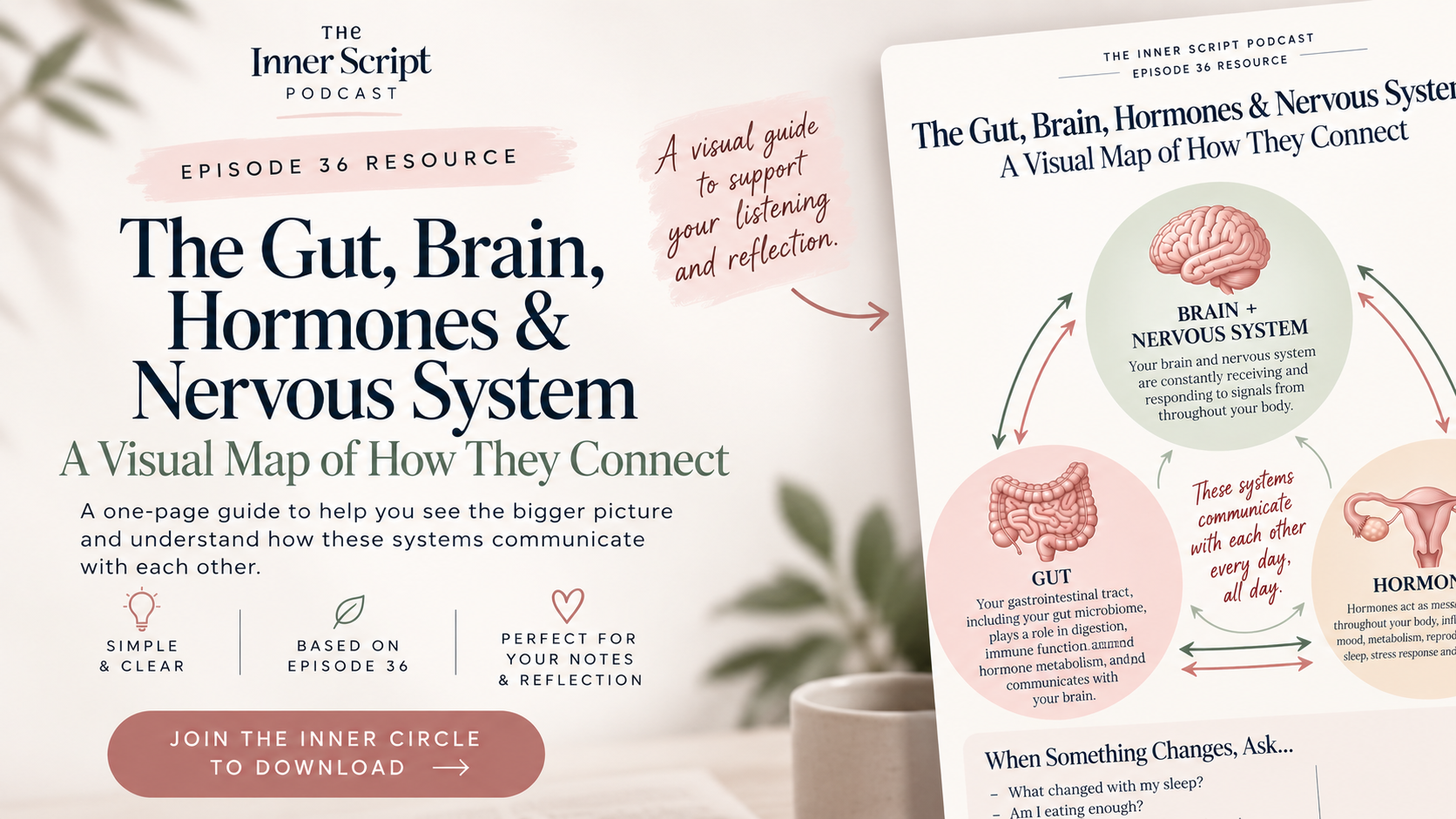
Trying to understand how all of these systems interact can get complicated quickly, so Steph created a free one-page visual companion to Episode 36. The guide maps the connections between the gut, brain and nervous system, and hormones, giving visual learners a simple way to see the bigger picture discussed throughout the episode. Patreon companion resource
You can also join Steph’s free Patreon community here:
The Inner Script Patreon

Meet Your Host
Stephanie Baubie, NP is an integrative nurse practitioner and the host of The Inner Script Podcast, where she explores the deeper stories behind health, healing, identity, and transformation. Through a blend of functional medicine, nervous system awareness, emotional insight, and honest conversation, Stephanie helps women better understand their bodies while questioning the narratives they’ve inherited about wellness, worth, and what it means to truly feel well.
On The Inner Script, Stephanie sits down with physicians, founders, thought leaders, and experts in women’s health, while also sharing solo reflections on the transitions and inner shifts that shape our lives.
Follow Steph on Instagram.
FAQs
Why do I have so many different health symptoms at the same time?
Steph explains that symptoms involving digestion, sleep, mood, reproductive function, and energy do not necessarily represent completely separate problems. The body’s systems constantly communicate with one another, which is why she encourages looking at the bigger physiological picture while also investigating symptoms medically when appropriate.
Can stress affect your digestive system?
Yes. Steph explains that the autonomic nervous system helps regulate digestive processes including motility and secretion. During periods of stress, some people may experience constipation, diarrhea, nausea, reflux, appetite changes, or increased sensitivity to sensations coming from the gut.
Can stress and not eating enough affect your period?
Steph explains that chronic physiologic stress, inadequate energy availability, and excessive exercise relative to food intake can affect reproductive function. She cautions against oversimplifying this into claims that a stressful week automatically causes a particular hormone imbalance.
Why can anxiety or sleep change throughout the menstrual cycle?
Estrogen, progesterone, and metabolites of these hormones can influence neurotransmitter systems involved in mood, sleep, and stress responsiveness. Steph explains that noticing these changes at different phases of your cycle does not automatically mean your hormones are “imbalanced.”
Does gut health affect estrogen?
Steph discusses research examining relationships between the gut microbiome and estrogen metabolism, sometimes referred to as the estrobolome. However, she emphasizes that identifying a biological mechanism does not prove that it explains an individual's symptoms.
What does “mechanism is not diagnosis” mean?
Just because researchers understand a pathway through which something could happen does not mean that pathway is necessarily causing your symptoms. Steph encourages listeners to distinguish between interesting physiology and an individual medical diagnosis.
Where should I start when I’m dealing with multiple symptoms?
Steph recommends zooming out and looking at your timeline. Consider what changed with your sleep, food intake, exercise, stress, menstrual cycle, medications or supplements, recent illness, bowel habits, and period. Then ask: What changed first? Persistent or significant symptoms may also warrant an appropriate medical evaluation.
-
Everything shared here is for educational purposes and personal reflection only. Not medical advice. Always work with your own healthcare provider for individual care.
Hello, my beautiful friend. Welcome back to The Inner Script. Today, I wanted to mention something I've been noticing more and more in the wellness space, and it's really people talking about hormones, the nervous system, and the gut. And I feel like we're still not fully acknowledging how interrelated everything is.
You know, I think we tend to simplify the things that are actually way more complex and then overcomplicate things that are actually quite simple. Something I'm seeing is you're exhausted, it's your cortisol You're bloated, you need to heal your gut. Your period is awful, your hormones are imbalanced.
You're anxious, you need to regulate your nervous system. And listen, I talk about all of these things. I talk about hormones. I talk about gut health. I probably talk about the nervous system more than anything else on this podcast. But I think we've gotten into this habit of putting symptoms into these nice, neat little boxes.
There's gut problem, hormone problem, nervous system problem, when physiologically the body doesn't work like that. These systems are communicating with each other every day, all day. You know, your nervous system affects your digestive system. Your digestive system sends information back to your brain.
Your hormonal environment can influence your mood, sleep, and stress response. And stress and energy availability can influence reproductive function. It's not a straight line. It's really more like a triangle, and that's what I wanna talk about today, what I'm calling the gut-brain-hormone-nervous system triangle.
Because I think understanding this relationship can help us stop chasing individual symptoms and start asking a much better question. What is actually happening in the body upstream? So let's talk about the woman with seven different problems, and I have seen some profile of a woman like this so many times, so I think it's very relatable.
So imagine a woman comes to me and says, "I'm bloated all the time. I've gotten more constipated. My PMS is terrible. I'm waking up at 3:00 in the morning. I'm exhausted during the day, but somehow wired at night. I'm more anxious before my period, and foods I used to tolerate suddenly seem to bother me." As one does, she goes online and starts researching every symptom individually.
Like, we all do this, and the bloating tells her she needs to heal her gut or go on, like, an elimination diet. The PMS tells her she has estrogen dominance. The insomnia tells her she has high cortisol. The anxiety tells her she has a dysregulated nervous system, and before she knows it, she has a probiotic, a hormone balancing supplement, a cortisol supplement, a food sensitivity test, and a nervous system regulation routine But what if she doesn't have seven separate problems?
What if we're looking at several manifestations of interconnected physiology? And just as importantly, what if one of those symptoms actually warrants a medical workup? And I think that's the nuance we're losing. So let's start with the nervous system and the gut. One of the things I really want people to understand is that your digestive system and your brain are not operating independently.
It never is, and it never was. Your GI tract has this enormous neural network called the enteric nervous system, and there is constant communication happening between your brain and your gastrointestinal tract. So think about something really simple. Have you ever been extremely nervous and suddenly had to go to the bathroom or lost your appetite or felt nauseous?
That's not imaginary. That's physiology. Your autonomic nervous system helps regulate processes involved in digestion, including motility and secretion. So when your body is experiencing stress, those processes can change. For some people, things speed up. For other people, things slow down. Some people become constipated.
Some experience diarrhea. Some notice reflux or nausea, and stress can also change how sensitive we are to sensations coming from the gut, which is an important distinction because sometimes people hear stress is contributing to your GI symptoms as it's all in your head And that's not what that means.
Your brain and your GI system are literally communicating with each other. But here's the part that often gets left out. The communication goes the other direction, too. Your gut is also talking to your brain. Your brain isn't sitting in your skull completely disconnected from what's happening below your neck.
It is constantly receiving information about the internal state of your body. Your GI tract communicates with the brain through neural, immune, and metabolic pathways. Your gut microbiome is part of that conversation, too. And I want to be careful here because the microbiome is another area where really interesting emerging science has sometimes become enormous wellness claims.
Your microbiome matters, but I don't think we need to tell people that every thought, craving, mood, or personality trait is being controlled by their gut bacteria. The more useful point to me is your nervous system responds to the physiological environment it's living in, and that environment includes what is happening in your GI tract.
So when we talk about nervous system regulation, we can't only talk about breathwork, meditation, somatic exercises, and vagal toning. Those things can absolutely have value, but regulation also exists in the context of whether you're sleeping well, whether you're eating enough, whether you're in pain, whether you're constipated, whether you're sick, whether you're consuming large amounts of caffeine while under-fueling, whether something medical is going on.
And sometimes your nervous system isn't failing to regulate. Sometimes your body is responding appropriately to the information it's receiving And I think that's a really important distinction.
It helps more.
Okay, now let's add hormones. This is where the triangle gets even more interesting because we tend to use the word hormones as though hormones are one thing.
They're not. Cortisol is a hormone. We have insulin, your thyroid hormones, estrogen, and progesterone, and these systems have different jobs and different regulatory pathways. So when somebody says, "My hormones are imbalanced," my medical brain immediately wants to ask which hormones and based on what?
Because hormone imbalance isn't really a diagnosis. So let's take stress physiology. Your hypothalamus communicates with your pituitary gland, which communicates downstream with your adrenal glands, and that's part of what we call the HPA axis. Then we have reproductive signaling. Again, the hypothalamus is involved, the pituitary is involved, and then we're communicating with the ovaries.
Different system. But the important part is that the body doesn't run these systems in complete isolation. Sleep disruption matters, illness matters, psychological stress matters, exercise matters, and something I think gets overlooked constantly in women is energy availability, meaning is your body actually getting enough energy for everything you're asking it to do?
Because imagine what we sometimes ask of women's bodies. We're waking up early, working demanding jobs, taking care of kids, working out five or six days a week, trying to hit 10,000 steps, restricting carbohydrates, eating in a calorie deficit, maybe intermittent fasting, drinking tons of coffee, trying to maintain a social life, trying to be productive, trying to sleep eight hours, and then we're confused when the body starts sending signals that something isn't working.
And in more significant states of low energy availability, reproductive function can absolutely be affected. And I wanna be very clear here because this is another place wellness information gets exaggerated. One stressful week does not automatically mean your body stole your progesterone to make cortisol Human physiology is way more complicated than these catchy explanations.
And I think in the wellness space of what I'm seeing is we simplify things that are meant to be complex and complicated and have many roles in them, and then we overcomplicate things that are actually quite simple. I don't know where the disconnect is. But chronic physiologic stress, inadequate energy availability, and excessive exercise relative to intake can affect reproductive function.
Your body is always paying attention to the environment it's operating in. And one tangent I wanna say is because I think we forget how much emotional stress affects energy availability and why sometimes when we're going through a stressful period of time, sometimes our energy needs increase. Like, we may even need to eat more because emotions are quite taxing on the body.
They require energy. Think about the times you've had a very emotionally charged conversation. Think about how you felt, like, 30 minutes after. I've had those, and I have felt completely drained, like I needed a nap. I needed to eat something. So it's just good to put that in perspective of how intense emotional stress can be in the body.
And it's not that we're never going to have those conversations or never feel them, but it's having that awareness so we can take care of ourselves and be like, "Okay, maybe I need to go to bed an hour earlier today because of that conversation," or, "I need to eat more carbohydrates or eat a snack right now before dinner."
So just wanted to throw that out there. Now let's reverse the arrow again because we're talking about how hormones talk back to the brain. Because reproductive hormones aren't only doing things in your ovaries and uterus, they also interact with the brain. For instance, estrogen and progesterone and metabolites of these hormones can influence neurotransmitter systems involved in mood, sleep, and stress responsiveness.
And one really interesting example is allopregnanolone, which is a metabolite of progesterone and interacts with GABA receptors in the brain. And this helps us understand something women have been telling us forever, "I feel different at different points in my cycle." Maybe your sleep changes, maybe anxiety is a little worse, maybe you're feeling a little bit more sensitive, maybe stress tolerance feels different.
Maybe you feel great around ovulation and noticeably different several days before your period. That doesn't automatically mean something is wrong, and it doesn't automatically mean your hormones are imbalanced. Your brain is experiencing a changing hormonal environment throughout the menstrual cycle.
There's physiology behind that, and I actually think understanding that can be very empowering because there's a big difference between saying, "My body is broken and I need to balance my hormones," and saying, "I'm noticing a pattern in how my body responds during this phase of my cycle. What information can I take from that?"
One creates fear, the other creates awareness. Now let's connect the gut and the hormones. This is probably one of the most interesting and, in my opinion, one of the most oversimplified parts of this conversation. There is legitimate research looking at relationships between the gut microbiome and estrogen metabolism.
You'll sometimes hear the term estrobolome referring to gut microbial activity involved in estrogen metabolism. Interesting? Absolutely. Does that mean that if you don't poop every day, estrogen is immediately being recirculated through your body and causing all of your hormonal symptoms? That's where I think we need to slow down.
Bowel regularity matters, fiber, nutrition, the microbiome all matter, even your metabolic health matters. But there is a huge difference between saying these systems interact and saying this explains your symptoms. Those are not the same statement. This is something I want you to start noticing when you're consuming wellness content.
Mechanism is not diagnosis. Just because there is a biological pathway through which something could happen does not mean we've proven that's why it's happening to you. That distinction is incredibly important. So what happens when the whole triangle gets disrupted? Let's go back to the woman I described at the beginning, except now let's add context.
Six months ago, she started to lose weight. She cut her calories. She started exercising more. She's doing five intense workouts a week and trying to walk 10,000 steps every day. She's also going through a stressful period at work. She's sleeping six hours a night. She's drinking more coffee because she's exhausted.
Then she starts becoming constipated. She feels more bloated. Her sleep gets worse. Her period changes. Her PMS is awful. She feels more anxious, and because she's bloated, she starts removing foods. Now she's eating even less. Because she's tired, she drinks more caffeine. Because she feels anxious, she's convinced her cortisol is broken.
Because her period changed, she's convinced she has a hormone imbalance. Because she's bloated, she's convinced she has a, a gut problem, and suddenly she's trying to fix five different systems. But what changed first? That is the question I want you asking. Maybe the upstream problem wasn't that her gut suddenly broke.
Maybe her body is dealing with insufficient energy availability, increased physiologic stress, and inadequate recovery, and those changes are now showing up across multiple systems. That doesn't mean that's everyone's story, but it illustrates why chasing symptoms individually can sometimes keep us from seeing the bigger picture.
And here's where I need to put my clinician hat on because there's another side to this conversation that I think the wellness industry sometimes gets wrong Not everything is your nervous system, not everything is cortisol, not everything is gut health, and not everything is your hormones. Sometimes you're tired because you're iron deficient, especially if you're menstruating heavily.
Sometimes constipation, fatigue, hair changes, feeling cold, or menstrual changes warrant looking at thyroid function. Sometimes pelvic pain isn't something you need to regulate your nervous system through. It may warrant an evaluation for conditions like endometriosis or uterine fibroids. Persistent gastrointestinal symptoms may need an actual GI workup with a colonoscopy and a stool test.
Major changes in your menstrual cycle may warrant evaluating pregnancy, thyroid disease, PCOS, prolactin abnormalities, low energy availability, or other potential causes depending on the person. And this is why I will continue saying nervous system regulation is not a replacement for a medical diagnosis.
Breathwork can be wonderful. Meditation I love. Somatic work has been life-changing for me. Nutrition is so important. Exercise is amazing. But none of these things mean we stop practicing medicine. And you can believe deeply in the mind/body connection while also ordering a CBC or recommending a medication for a period of time, like that might be necessary, and those things are not mutually exclusive.
In fact, I think that's what good integrative care should look like. So what do you actually do with this information? I don't want you finishing this episode thinking, "Okay, Steph, so now I need to optimize my gut, hormones, and nervous system." No. Please don't make yourself another protocol. Instead, I want you to become curious.
Like, when your body starts changing, instead of immediately asking, "What supplement fixes this?" ask, "What changed?" And be radically honest with yourself. Who or what entered your life? Who or what left your life? Be radically honest with yourself. And it's also asking things like, "What changed with my sleep?
What changed with my food intake? Am I eating enough? What changed with my exercise? Did I suddenly increase my training? What changed with my stress? Where am I in my menstrual cycle? Did I start a new medication or supplement? Did I recently get sick? Did my bowel habits change? Has my period changed?" And maybe most importantly, what changed first?
Because the loudest symptom isn't necessarily the original problem Your bloating might be what gets your attention, your PMS might be what gets your attention, or maybe it's your anxiety, but try your best to zoom out and look at the timeline. Sometimes I even ask my patients when they're coming in with, like, a very complex story, give them homework.
I'm like, "Okay, I want you to write down the timeline of everything and when your symptoms emerged," because we'll get there. We just, we need that timeline. We need to zoom out. When we do that, we're looking at the whole person. That's what I have learned to do as a clinician when it comes to having somebody come in with seven different complaints when in reality they are interrelated.
We're going to find the connection at some point. Ironically, I think it's something we have still lost in both conventional medicine and wellness culture. One side can become so compartmentalized that every symptom belongs to a different specialist. The other side can be- come so reductionist that every symptom somehow comes back to cortisol, inflammation, trauma, or the gut, and I don't think either extreme serves us.
The body is interconnected. It's always trying to achieve homeostasis. So maybe that's the real takeaway from today's episode. Your body isn't a collection of individual problems that need to be fixed. It's a communication system. Your brain is receiving information from your body, your gut is responding to your nervous system, your hormonal environment is communicating with your brain, your sleep affects all of them, your nutrition affects all of them, your environment and behavior affects all of them, and sometimes symptoms are your body's way of telling you that something in that system has changed, and that doesn't mean you need to panic And it doesn't mean you need another supplement.
It means you get curious, you ask better questions, you look upstream, and you get radically honest with yourself, too. And when something doesn't feel right, you don't automatically assume it's just stress or just your hormones. You investigate when investigation is warranted, and that's why you go see a clinician to help you.
You support your body where support is warranted, and you stop treating yourself like a collection of isolated symptoms because your body doesn't exist in pieces. And maybe health isn't about controlling every piece of the triangle. Maybe it's about learning how to listen to the conversation happening between them.
So if you know someone who's struggling with their health, even a few of these symptoms we touched on, send them this episode. I think just this is so helpful to, like, be able to zoom out and look at yourself from the outside in. Every symptom is kinda telling us a story, and to pay attention, get curious, get radically honest with ourselves, and there is a solution.
You're not in this alone. I can't tell you how many of the same conversations, similar conversation I have had with my patients because we've all kinda been there at some point. So just know that you're not alone. And yeah, I will chat with you guys next week.
If you wanna connect with like-minded women and dive deeper into these conversations, join my Patreon community. There's a free option and it's where we can talk about each episode together. The link is in the show notes and I can't wait to see you there.
Disclaimer
Everything shared in this episode is for educational purposes and personal reflection only. It is not medical advice. Always work with your own healthcare provider for individual care.
We sometimes include links to products and services we find interesting. These may or may not be affiliate links. Thanks for your support.
Podcast production by Jamie Brooke.
