Why High Achieving Women Get Trapped in Chronic Stress, Poor Sleep, and Survival Mode
Listen now by clicking your favorite podcast app below:
Do you ever feel like you're doing everything right and still can't shake the exhaustion?
In this episode of The Inner Script, Stephanie Baubie, NP breaks down why so many high-achieving women feel wired, overwhelmed, and disconnected from their bodies, even when their lives look put together on paper. She opens up about her own recent identity crisis after dyeing her hair back to her natural brunette, and how that small moment cracked open a much bigger conversation about chronic stress, nervous system dysregulation, and what it actually means to feel safe in your body.
Stephanie breaks down the biology of the nervous system in an easy-to-understand way, explaining why cortisol isn't the villain, how the "stress bucket" analogy can help explain burnout, and why so many people mistake a nervous system problem for a motivation problem. She also gets personal about her own years-long struggle with sleep, the habits and supplements that finally helped, and why modern wellness culture might actually be making our stress worse.
This episode is less about eliminating stress and more about building real resilience: learning to recognize when your body is asking for support, and giving yourself permission to rest, feel, and recover without guilt.
This episode is for you if…
You struggle with chronic stress, anxiety, or feeling constantly "on."
You have difficulty sleeping, relaxing, or slowing down without guilt.
You want practical, realistic tools to support your nervous system and build resilience.
Episode Timestamps
00:00 A Surprising Hair Change
02:05 Why We Feel Exhausted
04:29 Feeling Safe In Your Body
07:10 When Peace Feels Unsafe
13:25 Stress Becomes Physical Symptoms
16:31 Cortisol Isn't The Enemy
18:53 The Stress Bucket Analogy
23:27 Sleep Becomes A Stressor
24:37 What Finally Improved My Sleep
26:45 Is Wellness Culture Stressing Us
29:35 Building Resilience, Not Perfection
31:34 Practical Nervous System Tools
Resources & Mentions
Magnesium glycinate
Glycine
Meditation
Journaling
Walking and gentle movement practices
Curious about a supplement Steph has mentioned in the episode?
If you’re looking for products Steph personally recommends in practice, you can browse her dispensary here: Stephanie’s Fullscript dispensary
Please consult your healthcare provider before starting any new supplement. Food, lifestyle, and nervous system support always come first.
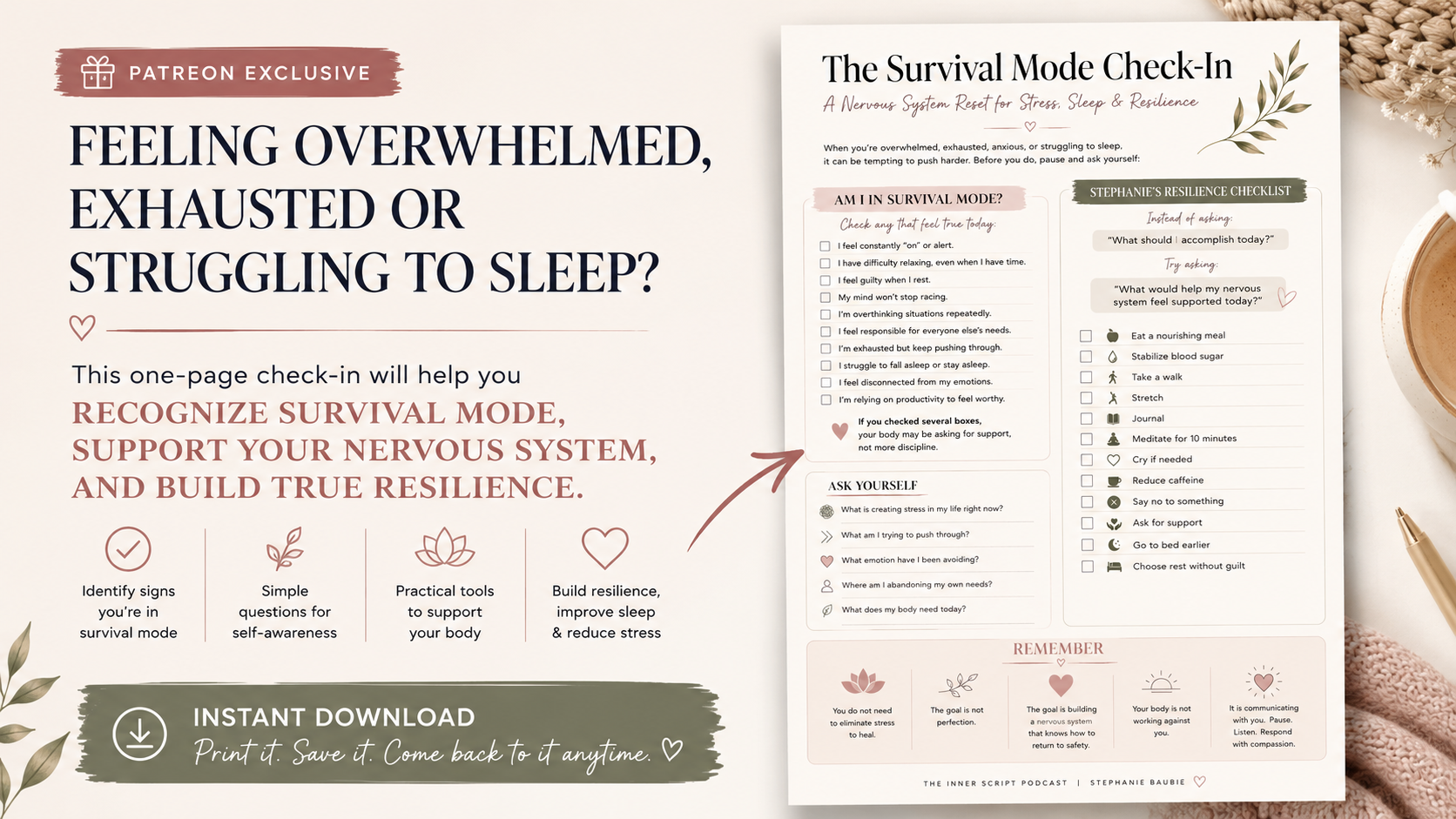
Free Guide: The Survival Mode Check-In
This free one-page guide helps you recognize the everyday signs of survival mode and gives you a simple resilience checklist, so you can support your nervous system instead of pushing harder. Download it here: Patreon companion resource
You can also join Steph's free Patreon community here: The Inner Script Patreon

Meet Your Host: Stephanie Baubie, NP
Stephanie Baubie is an integrative nurse practitioner and the host of The Inner Script Podcast, where she explores the deeper stories behind health, healing, identity, and transformation. Through a blend of functional medicine, nervous system awareness, emotional insight, and honest conversation, Stephanie helps women better understand their bodies while questioning the narratives they’ve inherited about wellness, worth, and what it means to truly feel well.
On The Inner Script, Stephanie sits down with physicians, founders, thought leaders, and experts in women’s health, while also sharing solo reflections on the transitions and inner shifts that shape our lives.
Follow Steph on Instagram.
FAQs
What are the signs of nervous system dysregulation?
On The Inner Script, Stephanie Baubie explains that nervous system dysregulation can show up as chronic anxiety, overthinking, insomnia, digestive issues, hypervigilance, emotional numbness, difficulty relaxing, and a constant feeling of being "on." She notes that for many high-functioning people, these symptoms have become so normal that they no longer register as a problem at all.
Why do I feel exhausted even when I'm being productive?
Stephanie discusses how many high-functioning people mistake nervous system burnout for a motivation problem. When the body has been stuck in a chronic stress response for too long, exhaustion can start to feel like a normal, unavoidable part of life instead of a signal that something needs to change.
Can chronic stress really affect hormones and digestion?
Yes. In this episode, Stephanie explains how prolonged stress can impact cortisol levels, digestion, blood sugar regulation, inflammation, sleep quality, and hormone balance. She describes the body almost like a bucket that keeps filling with stress until it eventually overflows into physical symptoms.
What does it actually mean to "feel safe in your body"?
Stephanie clarifies that feeling safe doesn't mean never feeling stressed or anxious. It means your nervous system trusts that it can handle what it's feeling without needing to stay on high alert. Biologically, that sense of safety is what allows the body to shift into rest, digest, and repair mode instead of staying stuck in survival mode.
How can I start regulating my nervous system naturally?
This episode shares practical, realistic strategies, including meditation, journaling, emotional expression, gentle movement, stable blood sugar, adequate nourishment, supportive relationships, and learning to listen to your body's signals instead of overriding them. Stephanie emphasizes that regulation looks different for everyone and doesn't require overhauling your entire life.
Is it possible to become too obsessed with tracking stress and wellness?
Stephanie shares her own honest take on this, pointing out that parts of modern wellness culture can make dysregulation worse by encouraging people to optimize, track, and measure every part of their lives. She encourages listeners to use tools like wearables as helpful information, not as a replacement for actually checking in with how their body feels.
-
Everything shared here is for educational purposes and personal reflection only. Not medical advice. Always work with your own healthcare provider for individual care.
Hi, everyone. Welcome back to The Inner Script. Got a good one here today. before we get going, if you are looking at the video right now, my hair is completely different. I just need to address that. I am now brunette. Actually, my natural hair color is brunette, so I'm very close to my natural hair color right now.
I was blonde for about 10 years. Decided to say, "Fuck it, and let's go dark. Let's go back to brunette." I was also like kinda thinking about it too, because I really try to live like a non-toxic lifestyle as much as possible, and like I won't even use dryer sheets, but I was bleaching my hair. Like look, it's all about balance.
I am with you. I went to my hair guy in San Francisco, and he actually did a, I guess, more of a temporary toner, so it's not gonna be as dark as this just because, you know, he was like, "I just wanna make sure you like it, 'cause we're going pretty drastic here." Yeah, we're gonna see in about like what it looks like in like 20 to 30 washes, and I think that's how it will actually look.
I will also say since dyeing my hair, I definitely was spiraling. I was like, "Oh my God," like, "What's going on?" The last time I was brunette, I was 22. I was a senior in college. So I was like freaking out, having an identity crisis, even though this is my natural hair color.
And it's kind of perfect what we're diving into today, which is we are gonna talk about how to really manage your stress, mitigate the spirals. Mitigate them, not eliminate them, because I think some spiraling, we are All gonna do no matter what. But yeah, like really kind of dive into stress, sleep, and how to actually optimize those things.
Yeah, so stress, sleep, and how to really address chronic stress, what to do, how to address sleep issues, because we all know those are important, and usually the advice is manage your stress, make sure you get enough sleep, but nobody really tells you how to do that. Some people are kind of just like left to whatever to kind of figure it out on their own, but I think it's really important to understand the necessity behind this and what it actually does to the body.
And one thing I will kind of start out by saying is, you know, I think as a society and a culture, like we're really taught how to perform and produce, achieve, push through, be productive, stay composed, and really keep functioning no matter what and at all costs, but we were rarely taught how to slow down and regulate ourselves, get in touch with our emotions, and actually feel what we're feeling and have words and the language for them.
We didn't really know how to feel safe in our bodies and how to recover when we do go through those spirals, which if you're wired anxious like I am, you're gonna spiral, and that's okay. That's not the abnormal part at all. We're all meant to have periods of stress spiral from time to time, but it's increasing our resilience to it and figuring out how to bounce back from the spiral instead of allowing it to consume you.
I also think this is why so many people feel so exhausted right now. You know, you're not lazy, you're not weak, you're just so tired because chronically stressed, lack of optimal sleep. Like at some point, something is going to give. And a lot of people are functioning in bodies that have been literally in a bracing mode for years, like waiting for the other shoe to drop because we are not regulated and our nervous systems are not regulated.
And what I've learned both personally and in practice is most people don't have a motivation problem. They have a nervous system problem. Honestly, I think this is one of, if not the biggest missing piece in health and wellness because so many people are trying to optimize a body that still feels unsafe, and you cannot heal in chronic survival mode.
You cannot supplement your way out of a nervous system that never feels safe enough to rest. And I think that really brings up a deeper question. Like, what does it actually mean to feel safe in your body? 'Cause we're seeing that all over social media right now, where you need to feel safe in your body, you need nervous system safety, but I don't think people are diving deeper into what that actually means and how to get there.
Okay, so let's get into it. So feeling safe in your body is when your body no longer feels Like it has to brace against life. And I think people misunderstand this concept because they think safety means nothing stressful ever happens, you never feel anxious, you're calm 24/7, and everything in your life is perfect and going smoothly.
And that's just not realistic. Yeah, that's just not reality. Feeling safe in your body means your nervous system fundamentally believes, "I can handle what I'm feeling. I don't need to stay on high alert. I don't need to constantly protect myself. I don't need to abandon myself to survive, and I have the ability to process what's going on internally, and to name my emotions and communicate them."
And it's really an internal experience. And biologically, safety is what allows the body to shift into parasympathetic mode. That parasympathetic aspect of your nervous system, which is rest, digest, repair, recover, heal. Because when the body does not feel safe, it prioritizes survival instead. And I've mentioned that so many times on here.
And that's really why feeling unsafe in the body can show up as hypervigilance, chronic overthinking, difficulty relaxing, insomnia, shallow breathing. Like, so many people are breathing from their chest, and that's shallow. It should really be going down into your abdomen, and that's really diaphragmatic breathing.
That totally resets your nervous system. Also, tension, digestive issues, hormonal imbalances, emotional numbness, not even able to describe what you are feeling or feeling your feelings, needing constant control, over-functioning, inability to rest without guilt, feeling wired, panic when slowing down, and always anticipating something going wrong.
So when I'm mentioning these, and if it's ringing true for you, like, seriously, listen up. Like, it does not have to be this way. A lot of people don't even realize that they feel unsafe, because it's become their baseline, especially high-functioning people. If you're listening to this, you are probably a high-functioning person.
So you pretty much become used to pushing through and staying productive, ignoring your body's signals. Basically, that dysregulation starts to feel normal. That becomes your baseline, and safety in the body often feels unfamiliar at first, and this is something people don't talk about enough. A dysregulated nervous system can interpret peace as unsafe.
Anything that is outside of your baseline is going to be perceived as abnormal, quote, unquote. And that's why some people sabotage healthy relationships, feel uncomfortable resting, like literally cannot sit still, create chaos unconsciously, and feel anxious when life finally slows down. And one thing I will say when I'm meeting with a patient is whenever I'm sitting across from somebody, whether it's a patient or whoever, and they can't sit still, like their feet are on the ground and they're bouncing their knee up and down, that is the biggest clue to me that they're in a dysregulated state chronically.
I just want to say, like, that is your body trying to exude energy, and that is probably stressed or running on fumes. So tangent, but just kind of an FYI. So because the body Essentially becomes adapted to these stress hormones. Chaos becomes familiar. Hypervigilance becomes identity. Over-functioning becomes self-worth.
So safety in the body is not just take a bath and meditate, it's feeling emotionally safe enough to express yourself honestly, and not just to somebody else, but to yourself. And it's really trusting yourself, not abandoning your needs, and being around people who don't keep your nervous system activated, which is a lot easier said than done, especially if you work with somebody who's doing this to you, or unfortunately, if you're in a relationship or a family member.
And it's really also allowing rest without guilt, learning your body's signals, processing emotions instead of suppressing them, knowing your worth is not tied to productivity, and creating consistency and predictability for your nervous system is key. And honestly, one of the biggest signs someone is beginning to feel safe in their body again is softness.
It's that slowing down or being, even being able to slow down. You know, their shoulders relax, their digestion improves. They laugh more easily. They sleep deeper. They stop gripping life so tightly. They stop forcing, and they stop needing to control every outcome. Control is literally fear in the body, and fear repels people and opportunities on an energetic level.
Eventually, your body starts to believe, "I don't have to survive this moment," and that is really what starts to change everything. So today I'm gonna dive deeper into what the nervous system actually is, what chronic stress does to the body, why sleep becomes disrupted, why high-functioning people are especially vulnerable to burnout, and how to actually begin regulating yourself in a realistic way.
This is not in a move to Bali or Costa Rica and meditate for four hours type of way because that's not realistic, and who has the time to do any of that? I mean this in a realistic way. It's for people with jobs, families, bills, responsibilities, stress. So let's dive into it. I think the best place to start is really understanding what the nervous system actually is because people hear nervous system dysregulation or nervous system regulation all the time now.
And I think sometimes wellness language gets repeated so much that it starts losing meaning. Sometimes it's so interesting in healthcare, in health and wellness is we oversimplify things that are so complex and not meant to be simplified, and then we complicate things that should be simple. So I don't know if that's confusing, but it's Like a theme I see all the time, like I'll see like, manage your stress, nervous system regulation, but nobody talks about how to actually do it.
It can be a lot more complex than that. So let's try to explain this nervous system and try to simplify it a bit better, simplify such a complex system. And your nervous system is essentially your body's surveillance system. It's constantly scanning, am I safe? Am I supported? Can I relax? Can I digest? Can I repair?
Can I recover? And this happens subconsciously. You don't know when you are doing it. It's automatic in the body. And your body is constantly gathering information from your environment, your relationships, your workload, your sleep Your blood sugar, your thoughts, emotions, and your past experiences.
Literally everything that your body is processing is information. The autonomic nervous system has two main branches. There's the sympathetic nervous system, which is your fight or flight system, and the parasympathetic nervous system, which is your rest, digest, recover system. And both of these are basically automatic in the body.
You don't really have control over it at times with the processing. The sympathetic nervous system is designed to protect you. This is the system responsible for survival, so it's not that fight or flight is bad, it's that it becomes, you know, over required and it becomes chronic, and then your body is a consistently elevated heart rate, cortisol levels, adrenaline, heightened alertness, and blood flow starts shifting away from digestion toward your muscles.
And that's why a lot of people are honestly chronically constipated because your body is essentially compensating to do things elsewhere. It doesn't have the ability to make sure you're digesting things well. So again, if you're chronically dysregulated, it's really hard to get digestion under control if we're not working with the nervous system first.
It's always preparing you to survive a threat, and this system is incredible when it's used appropriately. If you almost get into a car accident, you want that response. If there's danger, you want that response. The problem is many of us are living in this chronic low-grade survival mode of what I was kinda mentioning before.
And eventually, the body stops distinguishing between an actual emergency and emotional stress. So your body does not fully differentiate between a toxic relationship, chronic people-pleasing, financial stress, constant pressure, emotional suppression, overworking, undereating, overexercising, lack of sleep, hypervigilance, and then danger.
Your body simply perceives, "I am not safe." And it really doesn't matter what the issue is. It's your perception of the stressor in front of you that's going to create this response, this cortisol response. So it's all it i-- it's that perception. It's not necessarily the workload, it's your perception of the workload, because everyone responds to different stressors differently.
So yes, your body simply perceives, "I am not safe." And when the body perceives that, it prioritizes survival over healing, and that's when symptoms begin showing up Kinda going into a little bit more into chronic stress. So it's not just emotional, and I think this is where people get confused because we often think stress is just emotional stress, deadlines, breakups, arguments, life transitions.
But physiologically, stress is anything straining the body. Again, anything your body perceives as stressful. It's that perception that I think is helpful to understand. Under-eating is stress. Over-exercising is stress. Drinking too much caffeine is stress. Blood sugar crashes are stress. Poor sleep is stress.
Inflammation, chronic illness, emotional suppression, not feeling your feelings are all stress. Even constantly overriding yourself is stress. And this is where I think so many high-functioning people get stuck because they are deeply disconnected from their body's signals and their intuition. They are exhausted, but they continue to force discipline.
They're overwhelmed, but continue over-committing. They're emotionally depleted, but continue performing, and society rewards this. That's the craziest part. High-functioning nervous system dysregulation is often praised. You're called a hard worker when you become disconnected with yourself. I know that's a big generalization, but I think you get what I'm saying.
You're called productive, driven, successful, resilient, hardworking. Meanwhile, your nervous system is screaming at you to slow the F down, and eventually, the body stops asking gently. You will not be able to ignore your body's signals anymore, and that's when sleep issues begin, IBS, panic attacks, skin flares.
Hormones become dysregulated, meaning you can start gaining weight. You have period issues, heavy periods, painful periods, irregular periods. Chronic fatigue develops, anxiety increases, and the body whispers before it screams. So we need to listen to those whispers so that it's not screaming at you. That's not comfortable.
And symptoms are often the body asking for a different environment Your chronic symptoms are literally your body trying to communicate with you, trying to give you information, and trying to keep you safe. So let's talk about cortisol, because cortisol gets villainized constantly online. And again, cortisol is not bad.
We need cortisol. It helps you wake up in the morning, it mobilizes energy, it keeps your blood sugar stable, and it really helps you respond to stress. So it is protective, but cortisol is meant to rise and fall in a rhythm. It is not meant to remain elevated all day long for years on end. And when cortisol becomes chronically elevated, the body starts adapting around survival.
So sleep starts becoming fragmented, progesterone gets suppressed, blood sugar destabilizes, inflammation rises, digestion slows, and recovery decreases. And this is why stress impacts literally every system in the body, because your nervous system influences everything. And I think that's really important to understand, that your body is never trying to sabotage you.
It always has your back, and it's always trying to protect you. I'm going to say this 1,000 times. And that reframe changed everything for me, my own experiences being in stressful environments. And when I've been in those toxic environments, that's when my health was the worst, and that's not a coincidence.
That's my body literally trying to get me out of those situations. At that period of time, you know, I had severe sleep issues, hormonal issues, digestive issues, skin flares, constant hypervigilance, overthinking, and I kept viewing my body as broken. But when I finally zoomed out, I realized my body had been surviving chronic stress for years.
This over-functioning, overriding, people-pleasing, pushing, performing, trying to hold everything together. And honestly, a toxic relationship was kind of the final overflow point for my nervous system. And a good way to think about this, this is how I explain stress to my patients. Think of it like a bucket, all right?
Throughout life, stress keeps getting added to the bucket You got your childhood stress, pressure, relationships, work, loss, burnout, emotional suppression, trauma, overstimulation,
undereating, overeating, overexercising, whatever. Keep adding it to the bucket, and eventually the bucket overflows, and usually that overflow is when physical symptoms can no longer be ignored. And I see this, again, constantly in my patients. So when I ask people their stress levels or I ask them about stress in those moments, they'll tell me, "Well, I'm not stressed."
And then I explain this to them. It's not always what's going on right now. Sometimes your symptoms start when you're actually feeling better because your body stops bracing, and then it's like, boom, shit hits the fan, your body kinda crashes, and symptoms start. So as I mentioned, I see this in my patients all the time.
They are living in environments where their body does not feel safe in anymore, whether it's a toxic workplace, a relationship, constant pressure, constant hypervigilance, and their body senses misalignment long before their mind fully processes it. And the headaches begin. Dizziness begins. Numbness, tingling, sleep issues because the body is always adapting to the environment it's in.
And I really want to spend time talking about sleep because sleep and stress, like, just completely go together. One, they're flowing at all times. Like, if you're stressed, you can't sleep, and then if you're not sleeping well, that makes you more stressed, so kinda have to address both at the same time in order to optimize them.
You know, I think most people don't actually have a melatonin deficiency. I think most people have a nervous system that no longer knows how to downshift so that they can actually fall asleep and have restful sleep. And sleep is not just rest. It's when your body finally feels safe enough to rest and repair, and that's huge because a dysregulated nervous system often interprets slowing down as unsafe, and I've certainly been there.
That's why some people cannot sit still, as I mentioned earlier in the episode. It's so funny when I see this. Not funny and like, ha ha, but I'm just like, "Okay, like I know exactly what we need to focus on in those sessions." You know, where people feel guilty resting, can't sit still, feeling anxious on vacation, need constant stimulation, struggle meditating, feel uncomfortable in stillness.
Their body associates slowing down with vulnerability. It feels literally unsafe in those moments. And biologically, if your brain perceives danger, it will continue producing stress hormones, which means you fall asleep exhausted but wake up at 3:00 AM and can't fall back asleep. Your mind races at night.
Your sleep never feels restorative because your nervous system never fully powered down. And honestly, I first developed sleep issues in 2021 during a, both a breakup and a job transition. This was when I was still living in Chicago. And before that, I never thought about sleep, and I think back those times and I'm like, "Wow, what a luxury I had, where I never had to take anything- to go to sleep.
I just got into my bed, felt tired, and fell asleep, like, no problem. And yeah, that just feels so wild to me now. 'Cause when you go through sleep issues, it's literally the worst, the worst. In 2021, when I was going through that breakup and a job transition at the same time, I was relying on things like melatonin, magnesium glycinate, sleep gummies.
They're, like, the Sleep Ally gummies, which are pretty good. And those things helped temporarily. Like, it helped me to fall asleep, but I needed to take something in order to sleep. But I still wasn't regulating my nervous system. I wasn't doing any nervous system practices. I was still, like, over-exercising when I probably needed to sleep.
I was probably under-eating, not knowing, 'cause I was stressed, and drinking too much caffeine. But, so I wasn't doing any nervous system regulation. I was just, you know, taking things to try and downshift so that I could sleep. And then three years later, yeah, 2024, during another extremely stressful period of my life, my sleep became severely, severely disrupted.
Difficulty falling asleep, difficulty staying asleep, anxiety around sleep itself, and this is another thing people don't talk about enough, sleep can become psychologically stressful. You start fearing not sleeping. Like, the thought of getting in bed becomes anxiety-producing, 'cause you're like, "Oh my God, am I gonna be able to sleep tonight?
Is it gonna be, like, difficult?" That of itself is a stressor. So just Add that to the already overflowing bucket, and you have probably, like, a puddle of stress around you or an ocean. So at that time, you know, my nervous system was just even more activated around bedtime, and I really tried everything: acupuncture, magnesium, CBD gummies.
They didn't have THC in them 'cause I was just nervous about that. Not that that matters. Some people can tolerate that. I just didn't want to. Melatonin, supplements, protocols, and while some things helped, the biggest shift came when I stopped viewing stress and sleep separately from physical symptoms, and then that really changed everything because I realized my body wasn't failing me.
I was overwhelmed. My body was overwhelmed. It could not keep up with how I was living my life anymore, and I started actually supporting myself differently. I skipped workouts when I needed to. I wasn't honed in on a need to exercise five days a week or else I'm failing. Like, no. I took that mindset and took it out of my brain.
I lowered the intensity of my workouts. I started eating more, increasing carbohydrates, journaling, meditating, slowing down, and actually feeling my emotions instead of overriding them. Like, sometimes it feels good to cry. You gotta cry. It's cool to cry. Honestly, I learned to stop over-functioning, and that, you know, I was a people pleaser for so long, and I still will probably always be a little bit of a people pleaser, but I really toned that down.
People pleasing is not a good thing It is compensating. You are compensating for a dysregulated nervous system. Yeah, prioritizing your needs is never selfish. This was just kind of altering my perception of stress, sleep, and what my body needs. Tuning into what I needed was the biggest shift. And because many of us are conditioned to override ourselves, and that's never going to work.
And I think especially women were taught to override themselves. You know, like learning to push through, keep going, don't be dramatic. Oh, you're crying? Like, don't be dramatic. Don't slow down. Don't inconvenience people. Be productive. And eventually, your body pays for it. So it's like, you know, if you find yourself having emotional outbursts at work like I did, that is your body literally communicating with you.
You are supposed to cry in those moments. I know it's embarrassing. I'm not saying... You know, there is a time and a place to cry. It should be at home. But if you're doing it at work, that is the biggest indicator something needs to change in your environment. But that's why sometimes we need to cry and not suppress it.
So want to get a little bit into modern wellness and why I think this is probably making people more dysregulated. Let's jump on the train here. And this might be a little controversial, but You know, why not? I honestly think parts of modern wellness culture are worsening nervous system dysregulation because now people are trying to optimize every second of their lives, and they're on top of it scrolling social media.
And look, I am part of the problem, all right? I'm just gonna, like, say that. I am on Instagram scrolling all the things, trying... Like, I catch myself doing this, so I am part of this, I want to point out. But I am seeing a lot, again, people trying to optimize every second of their lives. They are tracking everything, measuring everything, hacking everything.
And look, as I mentioned, I use wearables, too. I have an Oura Ring. I find them fascinating, but I also think we've started outsourcing our intuition to data. Our Oura Ring says we slept poorly, but maybe we should also ask ourselves, "How do I actually feel?" Because information is helpful, but it should never replace our relationship with ourselves.
I'm really seeing this all the time now, and I think the Oura Ring, you know, for me, I got it when my sleep was, like, at its worst. The data did help me in terms of giving myself permission to skip a workout when I saw I slept poorly, and I know that sounds kinda backwards, but I would see how... Like, I would wake up feeling tired, and then I would see my sleep score, like, not being great, and I'm like, "No, I'm gonna go to sleep for another hour."
So it kind of helped, like, rebuild that relationship with myself in a sense. But now that my sleep is a lot better, I still, like, look at my sleep score, but I'm also like, "Okay, like, how am I feeling?" 'Cause sometimes I'll have, like, a really high sleep score but feel tired, and that's another opportunity not to push through the workout.
It's really to listen and think about, "Okay, like, what type of exercise would feel good in my body?" And sometimes it's going on a walk and not doing a higher intensity workout, like going on a run or strength training. It's walking or stretching. I bring this up because I really am seeing a lot of people becoming disconnected from their body's actual signals because they're so focused on the metrics and the lab values.
And the irony is stress management itself then becomes Stressful. And now people are stressed about optimizing sleep, recovery, workouts, hormones, and they're still stuck in hypervigilance. You know, now it's, like, just wellness-flavored hypervigilance with all of this data. So I think it's, we have to find a happy medium to it, and I don't have the answer to that right now, but it's just something I want to point out because I've been there.
I've been the person trying to optimize every little value, and then you start to lose your inner compass and the connection with yourself. And none of that is healing either when you're trying to optimize every little thing. So how do we actually build resilience when it comes to stress? This is really the practical part because, again, the goal is never to become stress-free.
That's not possible. And the goal is building a nervous system that knows how to r- return to safety and to bounce back after stressful periods of time and knowing that it can handle things that are coming to them. And it really starts with honesty, and it's asking yourself, "What has my body survived?"
And not just physically, but emotionally. And it's going back to things your body has survived from childhood. It's really getting honest about that, and I know it sounds like, "Really? I really gotta go that far back?" Yeah, you kinda do. And i- because when you go that far back, you figure out what you've been normalizing in your life, what behaviors you've been normalizing in your life.
That people-pleasing, where is that coming from? What emotions are you overriding for years, decades on end? What environments are dysregulating you? What relationships feel unsafe? And where are you chronically abandoning yourself? Because resilience is not endlessly tolerating stress. It's increasing your capacity to move through stress and recover from it, and that's different.
And practically, this looks like stable blood sugar, adequate nourishment, sleep, rest, less over-exercising, emotional expression, boundaries, slowing down, supportive relationships, creating safety in the body. And regulation looks different for everyone. And for me, it's 10-minute morning meditations, and I do them when I'm literally still lying in bed.
Like, I'm not getting up into my seated position 'cause I lose steam after I'm out of the bed. I'm just, like, wanna get on with my day, so I find that makes me do it when I'm just still lying down in my bed. I close my eyes and I breathe. And that makes a huge difference. Also journaling when I feel overwhelmed or angry or kinda just, like, like shaking my hands out if, like, somebody is really bothering me.
Like, things like that really help. And it's really nervous system discharge, all... Like journaling, shaking, screaming, crying, all of that is breaking up that stored tension that would otherwise just get stored there and then create tension in the body. And other things that help too, walking, stretching, lower intensity movement, allowing myself to rest without earning it first, and not calling myself lazy.
And over time, my sleep has improved drastically. I still take magnesium glycinate and glycine almost every night. Like, those are kinda my go-tos right now. But lately I've noticed something really interesting. Sometimes I don't need them, or I just need one, not the other, or I'm noticing, oh, wow, like I'm actually kind of getting tired on my own and I don't need to take either, which is, like, very refreshing.
You know, that really feels bigger to me than anything else, that it's these practices I'm doing and changing my perception of how I'm living my life. That alone has led me to feel really good. So I guess what I want people to take away from this episode is we cannot separate stress from physical health, and I think we all know that.
We cannot separate sleep from nervous system safety. Your body is constantly responding to the environment you place in it, and healing is not forcing your body harder. It's creating enough safety for your body to stop fighting so hard to survive. And sometimes the most healing thing you can do is stop overriding yourself and actually listen to what your body is trying to tell you.
So slow down, feel what you're feeling, cry if you need to. Remember it's cool to cry. Build trust with yourself again, because your body has probably been speaking to you for a very long time, and maybe healing is finally listening. Thank you guys so much for listening to this episode.
If you have any questions, comments, please feel free to send me a DM on Instagram at The Inner Script Pod. Join my Patreon community. There's a free option, which is super fun. You get a lot of PDF documents about the episodes itself. So again, rate, review, subscribe, comment, whatever. Send me a DM. Love you guys.
See you next week.
Disclaimer
Everything shared in this episode is for educational purposes and personal reflection only. It is not medical advice. Always work with your own healthcare provider for individual care.
We sometimes include links to products and services we find interesting. These may or may not be affiliate links. Thanks for your support.
Podcast production by Jamie Brooke.
