Why High-Functioning Women Burn Out: The Neurobiology of Ambition, Hormones & Nervous System Regulation
Listen now by clicking your favorite podcast app below:
Why does slowing down feel more threatening than burning out?
In this episode of The Inner Script, Stephanie Baubie, NP breaks down why high-functioning women are so prone to burnout and why hormones alone don't explain it. Drawing from her own experience recalibrating after leaving a high-stress clinical role, Stephanie unpacks the neurobiology of ambition, showing how cortisol dysregulation, progesterone suppression, and dopamine-driven over-functioning quietly shape burnout long before hormones show up as "the problem."
She blends the science with a more energetic lens, exploring masculine and feminine energy, why linear output culture clashes with cyclical female physiology, and why rest can feel unsafe after years of chronic activation. You'll learn what's actually happening in the brain and body during burnout, how cortisol and progesterone compete with one another, and why symptoms often labeled "hormonal" are frequently downstream of nervous system dysregulation.
Stephanie also walks through what recalibration really looks like once you leave a high-stress environment including why heart rate variability (HRV) often dips before it improves, and why that dip isn't a setback. This episode is ultimately about redefining ambition: not shrinking your drive, but learning to lead from regulation instead of urgency.
This episode is for you if…
You feel burnt out even when your life looks "good" on paper.
You struggle to slow down or feel unsafe resting.
You've been told your symptoms are "just hormonal" but it doesn't fully explain it
Episode Timestamps
00:00 Introduction
01:09 Why High Achievers Burn Out
02:34 A Personal Nervous System Story
05:10 Body and Identity Misalignment
06:25 Cortisol and Chronic Stress
08:40 Progesterone and Estrogen Balance
11:16 Masculine and Feminine Energy
14:31 Dopamine and Ambition
16:57 What Recalibration Feels Like
27:54 Redefining Ambition and Regulation
Resources & Mentions
Eternal: Longevity wellness center in San Francisco and New York
HRV (heart rate variability)
VO2 max testing
DEXA scans
Biomarker testing
Cortisol regulation
Progesterone and estrogen balance
Curious about a supplement Steph has mentioned in the episode?
If you’re looking for products Steph personally recommends in practice, you can browse her dispensary here: Stephanie’s Fullscript dispensary
Please consult your healthcare provider before starting any new supplement. Food, lifestyle, and nervous system support always come first.
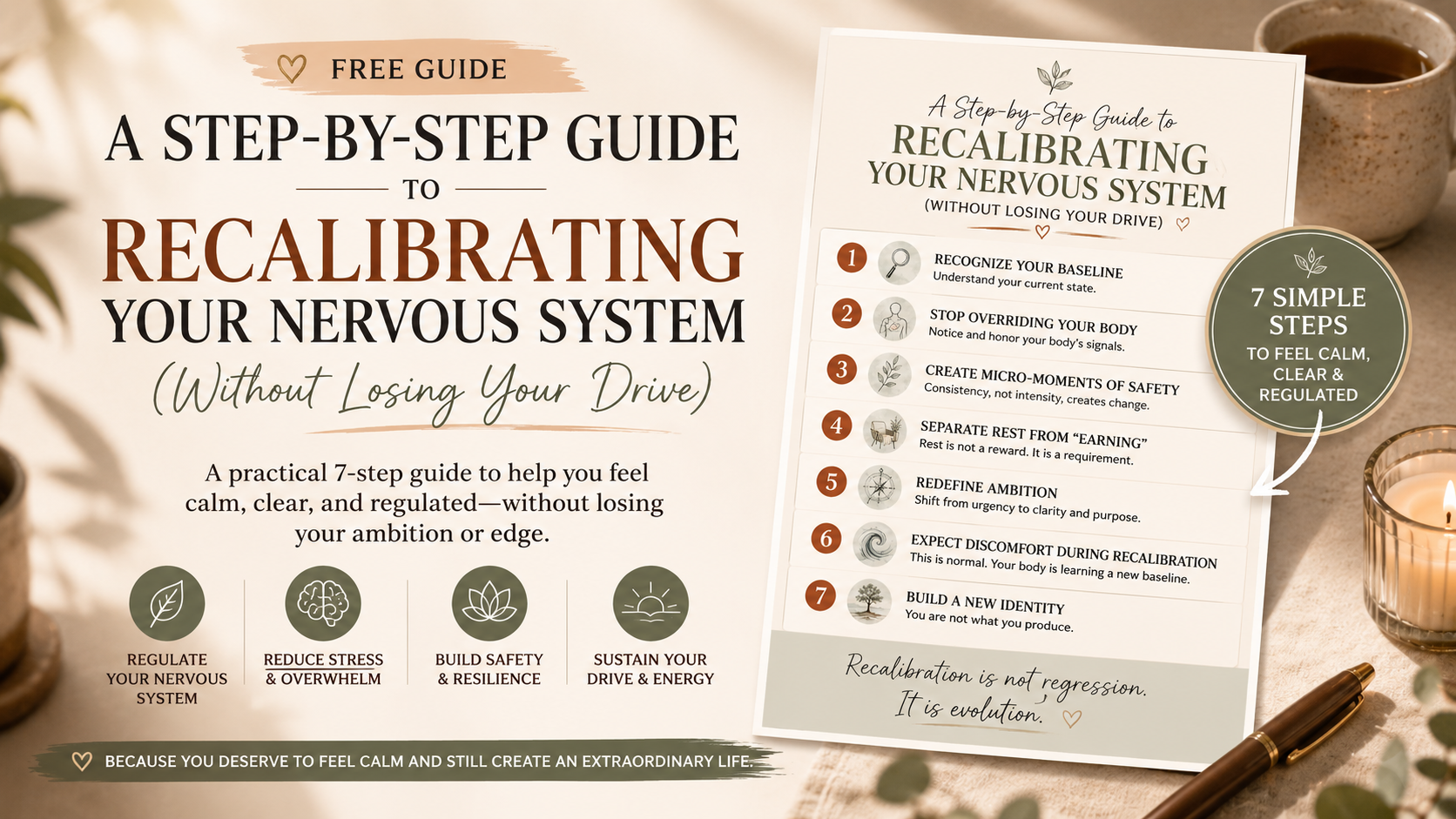
Free Guide: A Step-by-Step Guide to Recalibrating Your Nervous System, Without Losing Your Drive.
This free 7-step guide walks you through exactly how to recalibrate your nervous system after burnout from recognizing your baseline to redefining ambition without losing your drive or your edge. Download it here: Patreon companion resource
You can also join Steph's free Patreon community here: The Inner Script Patreon

Meet Your Host: Stephanie Baubie, NP
Stephanie Baubie is an integrative nurse practitioner and the host of The Inner Script Podcast, where she explores the deeper stories behind health, healing, identity, and transformation. Through a blend of functional medicine, nervous system awareness, emotional insight, and honest conversation, Stephanie helps women better understand their bodies while questioning the narratives they’ve inherited about wellness, worth, and what it means to truly feel well.
On The Inner Script, Stephanie sits down with physicians, founders, thought leaders, and experts in women’s health, while also sharing solo reflections on the transitions and inner shifts that shape our lives.
Follow Steph on Instagram.
FAQs
Why do high-functioning women burn out more than others?
In this episode of The Inner Script, Stephanie Baubie explains that high-functioning women often burn out because safety and self-worth become tied to productivity and performance. She breaks down how cortisol dysregulation, progesterone suppression, and a dopamine system wired for high stimulation all compound over time, so that burnout in ambitious women is rarely just a personality trait — it's rooted in neurobiology.
Is burnout caused by hormones or by nervous system dysregulation?
Stephanie explains that burnout is most often driven by chronic stress and nervous system dysregulation, with hormonal imbalances showing up as a downstream effect rather than the root cause. She describes how prolonged cortisol activation suppresses progesterone and destabilizes estrogen balance, which is why so many burnout symptoms get mislabeled as "just hormonal."
Why does rest feel uncomfortable or unsafe after burnout?
According to Stephanie Baubie on The Inner Script, when identity becomes tied to output and performance, the nervous system can interpret stillness as a threat rather than a relief. She explains that this isn't weakness or regression — it's a nervous system that has learned to associate constant activation with safety, and it takes time to unlearn that pattern.
What is nervous system recalibration after leaving a high-stress job or environment?
In this episode, Stephanie shares her own experience of her heart rate variability (HRV) dropping in the first weeks after leaving a high-stress role, even though her life felt calmer. She explains that the nervous system doesn't relax immediately after chronic stress ends — it recalibrates, which can temporarily look like a step backward before it becomes a step forward.
How are cortisol and progesterone connected in women's hormone health?
Stephanie explains that cortisol and progesterone compete with each other in the body. When cortisol stays chronically elevated, progesterone the body's calming, mood-stabilizing hormone gets suppressed, which can contribute to symptoms like PMS amplification, disrupted sleep, and low stress tolerance, particularly in the luteal phase of the menstrual cycle.
Can you be ambitious without burning out?
Yes. Stephanie is clear that healing burnout doesn't mean shrinking your ambition. In this episode, she describes what she calls "integrated ambition" drive without compulsion, leadership without constant urgency, and output followed by real recovery as a more sustainable way for high-achieving women to lead without sacrificing their nervous system.
What role does dopamine play in ambition and over-functioning?
Stephanie explains that ambition isn't just a personality trait it's driven by dopamine, the brain's motivation and reward neurotransmitter. She describes how years in high-output environments can cause the brain to normalize high stimulation, so that urgency starts to feel like baseline and rest can feel unfamiliar or even threatening.
-
Everything shared here is for educational purposes and personal reflection only. Not medical advice. Always work with your own healthcare provider for individual care.
Hi everyone. Welcome back to the Inner Script. So I have a fun episode here today and it's something that I kind of went down the rabbit hole with because of my own personal experience and it's really going to blend science in something a little bit more energetic, which is just so me. I love blending.
Kind of my eastern and western sides, my science and energetic sides, because I think it builds off one another. You really can't have one thing without the other. I truly believe that. So it's really talking about physiology and identity, and even more specific to that, it's hormones and ambition because.
I don't think high functioning women burnout just because of hormones, and I don't think ambition is just personality. I really think ambition goes back to kind of neurobiology and what kind of led me down this pathway or this rabbit hole, as I mentioned, is my own experience with burnout being in such an over-functioning.
Mode and really thinking about this in terms of ambition and why are higher functioning women more likely to burn out than somebody else? Is it social conditioning? Is it personality? Is it neurobiology? I was asking myself all of these questions because I recently started a new job in a longevity startup company.
It's the first time I've ever felt. In a job just so aligned, so calm and just this inner peace. I really can't believe the functioning I was doing before in my traditional kind of western medicine primary care job as a nurse practitioner. You know, it really kind of honestly took some getting used to not being in this high alert mode anymore, and my nervous system was recalibrating.
Almost on top of it, I was noticing so much more energy and my sleep was improving, but I was still kind of like my nervous system still felt like on high alert. And I even noticed, you know, within the first four weeks, I would say of starting this new job, my heart rate variability on my aura ring had kind of plummeted.
It definitely dropped back to kind of my depletion mode. I was really going through it with some of my ailments, I would say. So it got me thinking, you know, my body, my nervous system was still kind of on this high alert mode seeking out this threat because I'm not seeing patients back to back anymore.
I'm having such a better work life balance and. You know, I'm sleeping better, as I mentioned, but my nervous system is trying to kind of keep up with that. And it was a really good reminder for me because I hate to say it, I definitely went back into this like kind of panic mode. I was like, oh my God, what's going on?
Why am I taking like five steps backwards when I feel really well? And I just realized it was my body was just recalibrating and it was just such a good reminder for me, and it kinda led me down this rabbit hole of what is the science behind nervous system? Recalibration. What is the science behind ambition over functioning like why does this happen to women more than men in my experience?
So we're gonna get into it. But you know, as I mentioned, it's kind of, it got me thinking about all of this ambition. Is it a personality trait? Is it more than that? And I really kind of started to think about it in terms of neurobiology, and that really goes back to our physiology. Can go back to hormones, neurotransmitters of what that looks like for specific people, especially in high functioning women.
So let's kind of get into it and we're gonna blend this science and energetic. So I just think it's such a cool topic. And as I mentioned, I really went down a rabbit hole with it. You know, I wanna start off by saying, I think burnout. Is often misalignment between your nervous system, your hormonal rhythm, and honestly the identity you built around performance and output.
We're going to talk about why ambitious women are more likely to burn out what's happening in the brain. Why calm can feel destabilizing after chaos, which I can 1000% speak to. And how to evolve ambition without kind of losing your edge. You know, this isn't about shrinking, it's about refinement. Okay, so let's kind of get into why high functioning women.
Burnout. I'm gonna start off by saying, you know, after more than a decade of working in healthcare, I've noticed something hard to ignore a pattern, and the majority of the patients I see presenting with autoimmune diseases, gut dysfunction, chronic fatigue, inflammatory skin conditions, hormonal imbalances are just systemic.
Inflammation in general are women. And we could argue that, I would say, you know, this is a huge generalization, but I think women seek out medical care more so than men. So there could be a portion of that. Absolutely. But I think overarching theme here in my experience is kind of seeing more women with this, I would say.
Almost all of these conditions share one common upstream driver, which is inflammation, and one of the strongest drivers of chronic inflammation is cortisol dysregulation. It's a nervous system that has been over activated for far too long, and I wanna say cortisol is not. The enemy. Okay. We need cortisol.
Cortisol serves a purpose and when I say to kind of get people to understand is cortisol is like that one person we all know who is great around, who is really great in small doses, but then after a while we need a break. We kind of need to get away from 'em because it can be a lot. That's how I explain.
Cortisol to make sense. Specifically, cortisol wakes you up. It mobilizes glucose, which is energy. It keeps you alert and it helps you respond to stress. But again, cortisol is meant to kind of rise and fall in rhythm. And it's not meant to stay in this elevated state for years, which happens to so many of us.
And when cortisol does remain elevated, it leads to progesterone getting suppressed in females sleep architecture gets fragmented, meaning, you know, you're. Having issues falling asleep, staying asleep, waking up at weird times, unable to fall back asleep, maybe needing naps throughout the day. Blood sugar can destabilize inflammatory cytokines increase, which is just basically your immune system kind of going haywire, releasing various types of white blood cells because it's detecting a threat or an injury, whether it's emotional or physical.
The cytokines get released as a way to compensate and kind of take care of our body, but then that causes inflammation to increase. So it's really like a compensatory mechanism. And then the body starts to prioritize survival over repair. And here's the key for women and why this matters so much in women is progesterone is your calming.
Hormone, progesterone and cortisol compete with one another. Essentially, specifically progesterone helps to buffer stress. It stabilizes your mood. It supports sleep, and it counterbalances estrogen, but. Progesterone is easily suppressed by chronic stress because they are competing with each other, and our body starts to prioritize survival because cortisol becomes over required, so then we're producing the cortisol instead of the progesterone.
So that's why a lot of women specifically notice their symptoms worsen in their luteal phase, which is. After ovulation, before menstruation because your progesterone is supposed to rise at that time, and we don't have the capabilities for the progesterone to get produced because we're just so stressed out that we're in this kinda low progesterone state and then a high estrogen state on top of that because the ratio is off.
So that's why a lot of people deal with kind of this luteal phase dysfunction of what some people call it. I've been there and it's terrible. So what we see clinically is again, this kind of estrogen dominance, and it can be due to, again, too much estrogen, but a lot of the times it's due to high estrogen, relative to progesterone because that ratio is off.
And again, we see it more so in the luteal phase a lot of the times, especially initially because. Your progesterone isn't spiking. So some symptoms of estrogen dominance are water retention, breast tenderness, jawline, acne, PMS amplification. Like you literally cannot control your emotions at this time. If you.
Don't have enough progesterone waking up consistently at 3:00 AM or even like one to 3:00 AM feeling wired but exhausted. Subtle hair shedding and low stress tolerance. We label it hormonal imbalance, but hormones are often. Downstream with all of this.
Hey friend, it would mean so much if you left a quick rating or review on Apple Podcasts or Spotify. It helps more women find these conversations and it truly energizes me and keeps this podcast going.
what is the upstream driver? The upstream driver is a nervous system that no longer feels safe because of over-functioning.
So let's get into the energetic layer, which is like my favorite piece. I love this so much and just my energetic side because it often gets overlooked and it's called, people say it's woo woo, but there's actually science behind energy. Everything is created by or with energy. So let's get into it. So when I talk about specifically masculine and feminine energy, I want to be clear.
I'm not talking about gender, I'm talking about physiology. Masculine energy is linear. Think output. Structure, achievement forward motion and feminine energy is cyclical. So you think of rhythm, intuition, recovery, receiving. You know, I wanna be clear, every human has both masculine and feminine energy, but it exists on a spectrum.
So certain people can have male or female or non-binary, will however you identify, will have a certain amount of. Masculine and feminine energy just based on social conditioning, biology, physiology, kind of your own wiring. You know what I will say is bodies, not just gender, but bodies with cyclical, hormonal symptoms are not designed to function like linear machines.
So think about anybody with a menstrual cycle. Feminine energy is meant to be cyclical. And that goes with our hormones. Our hormones are cyclical, so that means there are certain periods of time where we're meant to slow down, listen to our bodies, have less energy at certain times of the month because our bodies are wired.
Based on cycles. Unfortunately, our culture rewards linear output, producing every day. Perform every day, ignore internal shifts. Be consistent, be sharp, be ahead. No matter. Where you're at in kind of your feminine energy or your cycle, that right there is misalignment. You're really not honoring yourself.
If your physiology is cyclical, but your lifestyle is rigid, your nervous system will eventually protest. Not because you are weak, because you're not weak. Built to override biology indefinitely. Every day when we wake up, we're going to feel differently, whether male, female, whatever, you know, we override those internal cues to just keep going, keep producing, and continue.
To give ourselves or give our job a hundred percent, but our 100% looks differently every day. So it's kind of honoring those fluctuations in your physiology and your energy, which a lot of us tend to override. Now, let's talk about ambition. Ambition is not just personality. It's dopamine. Dopamine is the brain's motivation and reward neurotransmitter.
It fires in anticipation, not just success. It responds to progress deadlines, pressure, you know, being needed, being evaluated, being praised, being relied upon. So if you're ambitious, your dopamine system likely fires often and you feel rewarded. By achievement solving problems, competence being indispensable.
But here's the nuance here, dopamine adapts. If you spend years in high output environments, your brain normalizes high stimulation. Urgency becomes baseline. Chaos becomes familiar. You become sharp in activation because you kind of compensate and there's no other option but to adapt, and your nervous system starts associating activation with power, and then we layer female physiology onto that.
Estrogen increases dopamine sensitivity, it amplifies reward, and it can heighten that drive and reactivity and progesterone strengthens executive control. It enhances inhibitory signaling and it buffers impulsivity. So when you have low progesterone, you can become more impulsive. Especially in decision making.
I just find that so fascinating because of this with progesterone, estrogen, and how dopamine is affected in the brain. You know, ambition in women is cyclical, but if cortisol remains chronically elevated, progesterone drops, which means. Less buffering, more reactivity, more drive without regulation, and that's when ambition becomes compulsion.
That's when rest feels unsafe. Stillness feels threatening and slowing down. Feels like disappearing or just even against the grain or against your nature, which is crazy. You know, I wanna talk about kind of recalibration after burnout, which is, I would say right now I'm starting to get out of it and just such a fascinating.
Concept to me or for me is this whole recalibration phase after you're getting out of a very high output environment. So this is, again, I would say this is where I am right now. I'm definitely getting out of it. I would say I've noticed. An improvement in some of the things I was noticing before, but as I mentioned earlier, I started a new job recently.
It's very aligned, it's expansive. I have so much more freedom and just more autonomy and less urgency. There's like not so much rigidity in my scheduling, and I'm also working with very like-minded people where we are all passionate about optimal health and wellness. And nutrition and exercise and just, we all just have this kind of shared drive of really wanting to help people optimize their health and wellness, and it's just been such a cool experience so far.
I'll name drop where I'm working. It's called Eternal, and it's again, a longevity wellness center. We have locations in both San Francisco and New York City. It's very geared towards people who kind of identify themselves as just very active. You could say athlete, but I think it's kind of more like peak living for active people or just honestly peak living.
For anyone that just wants to. Optimize their health and wellness. And you know, there's performance coaches who help do kind of performance based assessments to look at VO two max, which looks at kind of like exercise and endurance capacity. They look at strength and mobility DEXA scans, and we look at a good amount of biomarkers.
For blood testing to kind of see where everyone is at, and we all come up with a plan and there's registered dieticians. So it's just such a collaborative, supportive environment and we're all just happy to be there and I've never really experienced something like that before, so I really can't emphasize enough about this place.
Yeah. As I mentioned, just. Feels very aligned right now, and my sleep has been the best it's been in years. My inflammation is down, but as I mentioned, my HRV, my heart rate variability dipped at first for like four weeks. It went from being in the sixties on average, to getting into like the thirties back into like my depleted state like a year and a half ago.
So I kind of. Panicked and I had this moment of confusion and I was kind of spiraling a little bit. I will admit, I was asking myself if I'm calmer, why does my nervous system look like it's stressed? And then I realized, what if I'm not stressed? What if I am recalibrating? Because again, we are so used to instant gratification as a culture, myself included, hello.
Look at what happened to me that I didn't allow myself time for my body to adapt and recalibrate after I was in this crazy work environment situation where I was so overworked, so burnt out, always on doing, doing, doing. Zero rest emotionally, mentally, and I fell into that kind of category of somebody who just wanted instant gratification and for all my problems to go away once I got out of that situation.
And it just doesn't work like that. You know, I was in a high work stress environment for two and a half years. Like obviously there's going to be some recalibration and integration. Period where just we need to give our bodies a little bit more slack. So I just thought that was so, I don't know. I kind of laughed at myself.
I'm like, God, Stephanie, come on. You talk about this stuff all the time and you just did it. But yeah, so you know, I realized when you leave this high activation environment, your nervous system isn't going to immediately relax. It adjusts. It adapts and it can take time and your heart rate variability dips before it rises, which basically looks at, you know, HRV, which I've mentioned a good amount here, heart rate variability.
It basically looks at how well your nervous system is recovering to stress. Physical activity, and lower ranges like in the thirties kind of can tell us that you're having some difficulty recovering. Versus, you know, the higher you are shows, there's just more variability in how well your body is able to kind of bounce back and how resilient your nervous system is.
So that's. Basically what it's looking at and you know, sometimes calm can feel really destabilizing before it feels peaceful. And because your system is learning re this new regulation without urgency, it's kind of a new skill almost to like, oh my gosh, the threat is gone. What do I do now? It's kind of, I had this moment of like, okay, who am I without urgency and output?
Production. Like, who the hell am I? If you're not needed at a hundred percent capacity? Who are you? If you're not the sharpest, fastest, most reliable person in the room? Who are you? And there was this version of me that became extremely efficient in chaos. I felt validated. I felt competent. I felt like I could just.
Hold my shit together no matter what, but she was activated a hundred percent of the time at work. Activation for such a long period of time can start to feel like power, but urgency and power are not the same thing. What I will say, even now that I've had so much more energy, I'm like trying to figure out what to do.
Do with it because I used to leave work feeling so depleted and just exhausted. I knew I was burnt out and I definitely felt tired, but I really didn't realize the level of how I was operating until I left that job, and I really can't believe what I. Feeling and doing day after day, I realized I was like, I have all of this energy.
I need to do something. And I started running again. I used to run a good amount, like I was never a huge long distance runner, but I would love to, you know, maybe like do Tabata sprints or interval sprints after workout or go for like two to three mile fast run. And I really wasn't able to do that for the past.
Like two and a half years or even longer. 'cause I was just, I felt so exhausted, so depleted, thinking about running, like made me even more tired. And so now I'm getting back into running and it's something I really loved and that's been feeling really good. And, but I'm also being careful not to overdo it.
So we're starting small, we're going like two mile runs at the most right now. So we're integrating, adapting and recalibrating and not trying to overdo it. And kind of to tie this back into. High functioning women. You know, a lot of us were praised early for being mature, being responsible, handling things alone, hyper independence, being the caretaker, being easy, being high achieving, and all of this had to do with producing and output.
So. You know, you ask yourselves, what did your nervous system learn at this time? That safety comes from competence. Love comes from usefulness. Belonging comes from over functioning, and over time, that really starts to. Become your identity and when identity is tied to output, rest can feel like a threat, a physical threat.
And it's not because you don't deserve rest, but it's because your nervous system equates stillness with loss of relevance. Don't get me wrong, some like ambition is healthy drive, and it can even be. Nervous system strategy, but a strategy that's to stay needed, stay valuable, stay safe. When you start to remove those constant dopamine spikes that's tied to ambition and production and praise, producing all of that, your reward circuitry.
We'll start to recalibrate and during this recalibration you may feel restless, flat, less stimulated, or kind of unsure of your edge and almost like, am I doing enough? That doesn't mean your regressing, it means your system is learning that calm does not equal. Invisible in all of this it, none of this is, I wanna be clear.
It's not about shrinking ambition. Ambition is amazing. It's a beautiful thing. It's such a good quality to have. It's such an attractive quality to have, but it's really about integrating it. I think integrated ambition can look like drive without compulsion. Power without urgency, leadership without overproduction mode, output, followed by recovery.
And I think the most powerful women I know are not constantly activated. They're regulated. Think about somebody that goes into a room who is just moving without urgency but confident. They're calm, they give off, even inner peace. They're competent, but they're not in this production mode, and they're just walking with ease, with confidence without urgency.
And I think that's like such a magnetic thing, especially as a female, because you're just in your body. Yeah. You're not. Seeking all of this external validation for producing. And I think if you think about that versus, you know, somebody who walks in with urgency frazzled and is like, speaking really fast, blah, blah, blah, blah, blah.
It's gonna have such a different energy versus someone who is calm, collected, and powerful. Yeah. It's just, it's moving intentionally, recovering deeply and not performing. Urgency and not confusing. Exhaustion with worth. It's possible to build, lead, be visible, earn, expand, and still honor this cyclical rhythm.
And that integration I think is power. So I wanna leave you. With a few questions. Where are you overriding yourself? Where are you proving instead of pacing, where are you mistaking activation for strength, and even who are you? Without production and burnout is not weakness. It's a body that can no longer sustain a script.
It didn't. Right, and recalibration is not regression. It's evolution. Ambition is not pathology, but when urgency becomes your identity, your nervous system. We'll pay the price. And sometimes the most powerful thing an ambitious woman can do is prove to herself that she can feel calm and still feel powerful.
That's not softness, that's mastery in my opinion. And just to end on this, I am now kind of in this period where I feel like. My body is recalibrating and you know, I'm adjusting to this new work, normal, and it's been really cool to kind of feel calm and not showing up to chaos every day. And I know that is such a.
Blessing, and I am so grateful for that and not everyone is in that situation, but you know, I think there's a lot of other things we can do to kind of regulate ourselves and kind of keep this calm but powerful energy showing up in a way where we honor ourselves and not outsource our power and continue to stay true to ourselves.
Honor our cycles, honor our energy, and kind of reframe that rest is productive. And not to put so much emphasis on, you know, what we produce is who we are, because that's not the case. And it can be difficult to reframe that. And that's something I'm still trying to learn how to do is not put so much emphasis on what I am producing because that's not just who I am.
I'm a lot more than that, so that's where I'm gonna end today. Let me know what you think of this episode. Please rate, review, subscribe to all the things, wherever you listen to podcasts. It makes such a huge difference. It allows this podcast to grow and become visible, and I have been enjoying this so much with you guys every week.
So feel free to send me a DM with any questions, comments on the inter script pod on Instagram, and I will chat with you guys next week.
If you wanna connect with like-minded women and dive deeper into these conversations, join my Patreon community. There's a free option and it's where we can talk about each episode together. The link is in the show notes and I can't wait to see you there.
Disclaimer
Everything shared in this episode is for educational purposes and personal reflection only. It is not medical advice. Always work with your own healthcare provider for individual care.
We sometimes include links to products and services we find interesting. These may or may not be affiliate links. Thanks for your support.
Podcast production by Jamie Brooke.
