How to Rapidly Tune Into Your Body and Stop Outsourcing Your Decisions: Building Self-Trust and Intuition
Listen now by clicking your favorite podcast app below:
What if your body already knows the answer before your mind does?
In this episode of The Inner Script, Stephanie Baubie, NP breaks down what self-trust and intuition actually feel like in the body and why so many of us were never taught how to recognize them in the first place. Most of us were raised to be productive, agreeable, and responsible, but rarely to notice the subtle sensations, gut feelings, or quiet "pings" our bodies are constantly sending us. Stephanie shares how she learned to tell the difference between fear and true inner knowing, and why that distinction changes everything about how we make decisions.
Drawing on her own experience and years of working with patients, Stephanie explains that building self-trust isn't about getting it right every time. It's about learning how you specifically are wired whether your intuition shows up somatically, emotionally, visually, or through language and using expansion versus contraction as a simple, practical cue for whether a decision feels aligned. She also gets into why mistakes aren't proof that your intuition failed you; they're often the exact moments that teach you to recognize your own inner voice next time.
This episode is also a candid look at why true healing can't be outsourced. Stephanie talks about the discomfort that comes with taking full responsibility for your emotional state, your decisions, and your healing and why that discomfort is actually a sign you're stepping into your own authority. If you've ever felt like you second-guess yourself constantly or rely on other people's opinions to feel sure about your choices, this conversation offers a real starting point for rebuilding trust in yourself.
This episode is for you if…
You feel disconnected from your body or unsure how to trust your intuition.
You often second-guess your decisions or rely heavily on other people's opinions.
You want to understand the connection between self-trust, nervous system awareness, and true healing.
Episode Timestamps
00:00 Introduction
02:12 Never Taught To Trust
04:08 Intuition In The Body
06:30 Fear Vs. Inner Knowing
08:09 Understanding Your Patterns
10:23 A Real-Life Example
12:27 Practicing Self-Trust Daily
15:16 Self-Awareness Matters
18:36 Healing Can't Be Outsourced
22:59 Quiet Confidence Builds
Resources & Mentions
@theinnerscriptpod on Instagram
Somatic awareness and body signals
Expansion vs contraction as decision cues
Pattern recognition in past choices
Self-awareness and emotional responsibility in healing
Curious about a supplement Steph has mentioned in the episode?
If you’re looking for products Steph personally recommends in practice, you can browse her dispensary here: Stephanie’s Fullscript dispensary
Please consult your healthcare provider before starting any new supplement. Food, lifestyle, and nervous system support always come first.
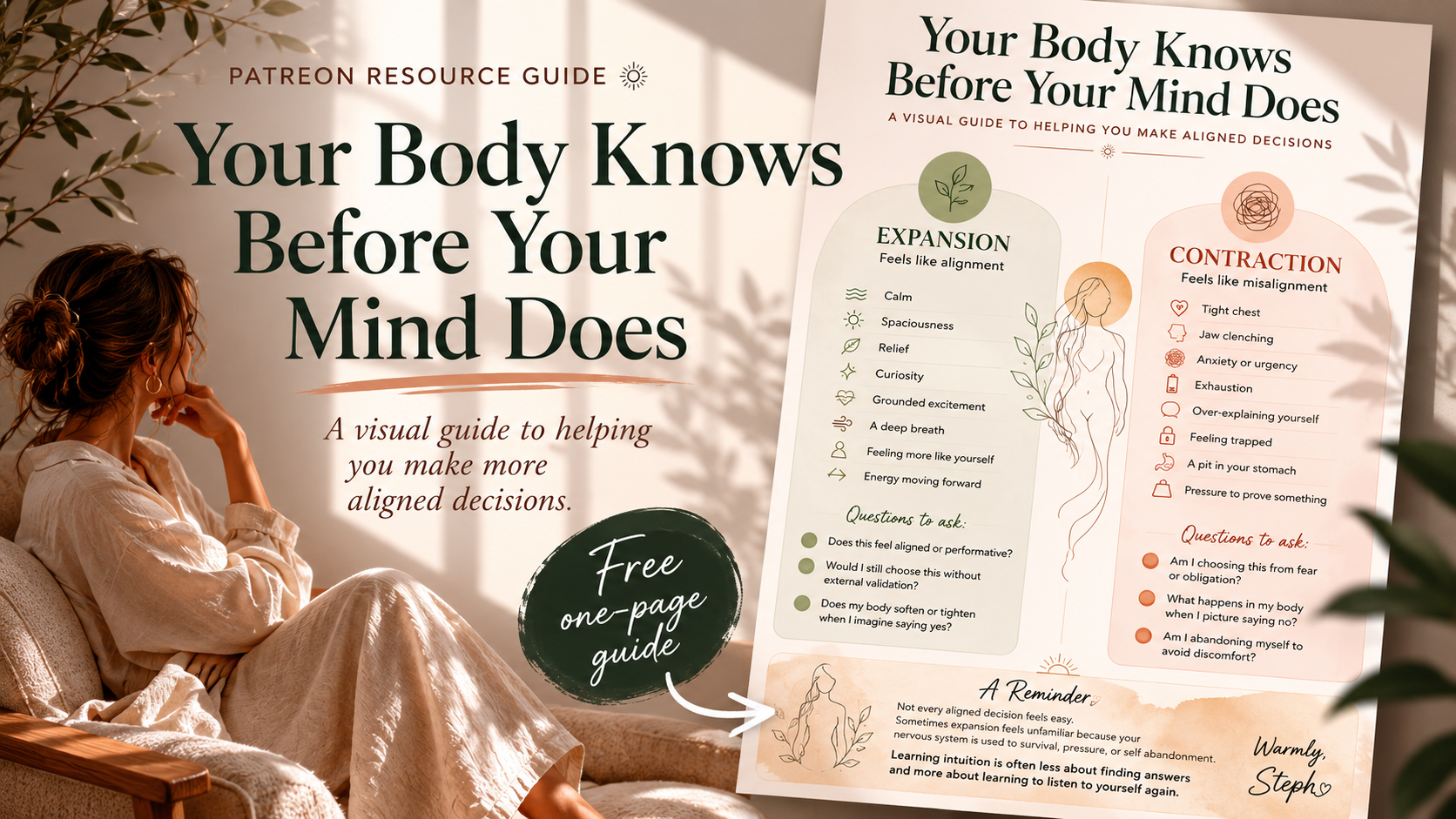
Free Guide: Your Body Knows Before Your Mind Does
This free visual guide breaks down what expansion and contraction actually feel like in your body, so you can start using them as real signals the next time you're facing a decision. Download it here: Patreon companion resource
You can also join Steph’s free Patreon community here:
The Inner Script Patreon

Meet Your Host
Stephanie Baubie, NP is an integrative nurse practitioner and the host of The Inner Script Podcast, where she explores the deeper stories behind health, healing, identity, and transformation. Through a blend of functional medicine, nervous system awareness, emotional insight, and honest conversation, Stephanie helps women better understand their bodies while questioning the narratives they’ve inherited about wellness, worth, and what it means to truly feel well.
On The Inner Script, Stephanie sits down with physicians, founders, thought leaders, and experts in women’s health, while also sharing solo reflections on the transitions and inner shifts that shape our lives.
Follow Steph on Instagram.
FAQs
How do I know the difference between fear and intuition?
In this episode of The Inner Script, Stephanie Baubie explains that fear tends to be loud, urgent, and demanding — it wants an answer right now, and it's often tinged with panic or paranoia. Inner knowing, on the other hand, is quiet and neutral. She compares it to a notification on your phone: information arriving without any attached emotion or urgency. Learning to notice that difference is one of the first steps to building real self-trust.
What does intuition actually feel like in the body?
Stephanie describes intuition as something she experiences somatically — a subtle sensation or a quiet thought that shows up without emotional charge. She explains that clarity shows up differently for everyone: some people feel it in their body, some emotionally, some visually, and some through language. There's no single "correct" way to experience intuition, only your own pattern.
Can you build self-trust if you don't already have it?
Yes. In this episode, Stephanie Baubie shares that self-trust is a skill built through practice, not something you either have or don't. She recommends starting with small, low-stakes decisions like when to rest or what sounds good for dinner and paying attention to whether the choice creates expansion or contraction in your body. Over time, those small reps build the muscle needed for bigger decisions.
Why do mistakes actually help build self-trust?
Stephanie explains that getting it wrong is part of how self-trust gets calibrated. When a decision doesn't work out, you can go back and notice how it felt in your body beforehand, which makes that same signal much harder to ignore the next time. Rather than viewing mistakes as failures of intuition, she frames them as the exact process that builds a stronger connection to your own inner knowing.
What is the connection between self-trust and healing?
According to Stephanie Baubie, real healing cannot be outsourced. While providers can diagnose, guide, and support, she believes lasting healing requires patients to take ownership of their own inner work and decision-making. In this episode, she discusses why that responsibility can feel uncomfortable at first, and why it's ultimately empowering rather than isolating.
How can I start listening to my body's signals if I feel completely disconnected?
Stephanie suggests starting by reviewing past decisions — a job, a relationship, a friendship and recalling how they felt in your body at the time. Did you notice calm and relief, or tightness and a subtle urge to override your gut? She explains that this kind of pattern recognition is one of the clearest ways to understand how your own intuition communicates with you.
Why does self-trust lead to quiet confidence instead of needing outside validation?
In this episode, Stephanie Baubie describes how building a strong relationship with your own inner voice changes the way outside opinions affect you. Once your internal validation becomes the thing you rely on most, other people's opinions can be considered without controlling your decisions. She calls this a "quiet confidence" — one that doesn't need applause or agreement from anyone else to feel steady.
-
Everything shared here is for educational purposes and personal reflection only. Not medical advice. Always work with your own healthcare provider for individual care.
Hi everyone. Welcome back to the Inner Script Podcast. I have a really good episode here today, and it's really talking about building self-trust and intuition. I often see so many questions about how to build intuition. How to build self-trust. So I thought this could be a really fun episode because I truly believe that building self-trust and intuition, it really is required to get optimal health and wellness so that you learn how to tune into your body because so many of us have been.
Just outta touch with our bodies sensations and that's nobody's fault. We weren't taught how to tune in and listen to ourselves and look at symptoms as clues. So, you know, let's get into it. Building self-trust is interesting, as I kind of already mentioned, because most of us were never taught how to do it.
And what we were taught was how to be responsible, how to be productive, you know, getting good grades, getting involved in sports, community, social activities. We were taught to be likable, not to be too much, to, you know, kind of just be somebody that maybe we're not. And it's funny because we weren't able or taught how to recognize.
Our inner knowing or what it feels like to trust ourselves. And in this episode, I wanna talk about how I built self-trust, how I built intuition. And it's not because I lacked intuition, but it was because I didn't understand how mine worked. And everyone's intuition. Works differently. So it requires us to really tune in and kind of ask ourselves deeper questions in order to learn this skill at the end of the day.
And what I will say is most of us already have the answers when it comes to making decisions, tuning into our bodies, understanding the mind body connection. A lot of us already have these answers. We just weren't taught how to tune in or how to distinguish fear from inner knowing. And again, self-trust isn't about always being right.
We're not meant to get it right a hundred percent of the time. Actually being wrong and making mistakes is what helps build that self-trust because you have the opportunity. To go back and be like, oh wow. Like I kind of felt something was off in that situation, but I overwrote it anyways. So making mistakes actually gets you to that place of self-trust, and it sounds counterintuitive.
But that's what life is all about to begin with, is making mistakes, learning from them and growing from 'em. And the same thing goes with self-trust and building intuition and learning how you're wired. Again, it's not always about being right, but it's about being in a relationship with yourself, which I have talked about before.
And here's the part people don't love about inner knowing. Building self trust is when you do trust yourself, you stop outsourcing. Responsibility. And what I mean by that is you don't get to blame circumstances. You don't get to blame other people, and you don't get to say, well, I didn't know. And that can be very uncomfortable because it requires a different level of accountability and inner work and understanding why you made a mistake or a decision in the first place because you are always responsible for you.
A hundred percent of the time. And again, that's uncomfortable. So if self-trust feels scary, it doesn't mean you're doing it wrong. It actually means you're doing it right and you're stepping into your authority, which is a beautiful thing. So for me growing up, I actually had a very strong inner knowing or intuition, but at the time I really didn't have the language for it.
It actually was very confusing for me, and it was something I would feel in my body, and I still feel this as an adult. Obviously this didn't go away. If anything, it's gotten stronger as I've leaned into it and began trusting myself more and more. Basically, I would feel something in my body or a thought would pop into my head about someone I just met or an opportunity or a situation.
Something would just kind of pop into my head and it felt very neutral. It wasn't emotional, it wasn't rooted in fear. It was just information. It was just kind of noise almost, but like very subtle. Information coming and flowing to me. And because I didn't understand it, I assumed I was overthinking because I was like, where is this coming from?
I'm like, like, this is so weird. It doesn't make sense, like, what's going on? And what I've realized is, for me, I only overthink when I've already overridden myself when I try to use. Logic instead of trusting my inner voice, then that's when I overthink and kind of really get into my head. And for me, the best way for me to explain intuition is for me, it speaks somatically like in my body or small internal.
Ping, and the best way I can kind of describe it for people to maybe understand what I am sensing in certain moments is it feels like a notification on your phone where when your phone lights up or vibrates, you don't immediately spiral. You don't attach meaning to it. You don't even know who's texting you or calling you.
It's just this information of somebody's trying to contact me. And again, it, there's no meaning towards it. It's again, just information trying to reach you, and that's what inner knowing feels like to me. It's just this kind of notification, but it's completely neutral. There's, again, no feeling, no emotion attached to it, and.
It's quiet, it's not urgent. And the best way to kind of decipher from okay, is this fear or inner knowing is fear is loud, there's urgency attached to it. There's almost like paranoia involved and it kind of demands an answer right now. And inner knowing doesn't rush you. And this is important self trust.
Doesn't always mean certainty. It means trusting yourself to respond if things don't pan out the way you wanted it to. So it's never with the intention of getting things right all the time, but it's having that trust of, okay, if I was wrong, I'll bounce back just fine. It's having that relationship with yourself, being in a relationship with yourself, and trusting yourself and trusting your resilience.
in order to build self-trust and intuition, you have to learn how you're wired, which I have said many times, and this is where it becomes practical. And the clearest way I learned how I'm wired was what happens to me when I ignore myself. When I ignore those subtle feelings. Those. Gut feelings, and for me, misalignment doesn't feel dramatic.
It feels like mental noise. So when I start to override myself where I am ignoring the sensations, I'm feeling that inner knowing in my body. I start getting into my head and using logic to make a decision or make a judgment, make an opinion, what have you. So I start justifying, looping, explaining, convincing.
And for me, when I find myself in that overthinking mode, which is very easy for me to do when I override my intuition, that's usually my cue that. I've overridden something and I'm not listening to myself. And understanding how you're wired isn't about labels, it's about pattern recognition. And the best way to look at your own patterns and to understand that inner knowing or how your body is trying to communicate with you is looking at past decisions.
So, you know, accepting a job position, getting into a, a relationship, starting a friendship, going on a vacation, or think about those big decisions you made and remember how they felt in your body. Did you feel expansion in some way? Relief, calm? Did you feel fear, pressure, urgency, or just something feeling off and.
The ones that didn't feel right was their tightness. That feeling of off in your body, a need to overwrite like a subtle contraction. All of those are clues, and that is your inner knowing. Speaking to you. And clarity shows up different for everyone. Some people feel it emotionally, some somatically, which I do.
I feel things somatically in my meaning, sensations in my body first. Some visually and some through language. So there's no right way. There's just your way. I think it's, that's a really good exercise. To jot down these bigger decisions you made and remember how it felt in your body, and then what happened after.
Like, did it work out, did it not? So that is. The first way to understand how you're wired and to understand your own patterns in terms of self-trust and building intuition. And I'm gonna give you an example, something I did recently, and again, as I mentioned, I've always had a very strong intuition, inner knowing, and it really did confuse me for a long time because I would get a lot of information kind of coming from.
Nowhere. And there were times I quite literally thought I was being judgmental because I was like, where is this coming from? But it was just my intuition and it was my inner knowing. It was me picking up on something that was neutral and trying to almost warn me in a sense, and for example. When I accepted my new job, my current job, which I've only been working there for a few weeks, but I didn't start with like a pro and con list, so I didn't do the pros and cons, but I shadowed and I really paid attention to my body and how I felt in that environment, how I felt talking to.
The person who was going to be my mentor or my boss talking to all of these other people walking around, how did I feel? Did I feel contraction or did I feel expansion? And I felt expansion, which is why I chose the job. You know, obviously you're using logic in other ways when accepting a position or negotiating something, but for me, I really needed to understand how a decision felt in my body and.
I felt that expansion and I just knew, I was like, all right, this feels really right, and I went ahead with it. And I will say there were times I have been in situations where I didn't listen to my intuition and I felt contraction in my chest or in my stomach. And looking back, I overrode what I already knew.
So if you're listening to this and thinking, I don't know how to do this, that's completely understandable, start small. I wouldn't recommend doing life altering decisions like jobs, but start with when to rest. If you're waking up feeling tired and you don't feel like you know, you should be exercising that day, it's listening to that.
And then how did you feel the rest of the day? It's when to say no to a social event or going out. Going to dinner or whatever and what feels energizing and leaning into that and what sounds good for dinner. Just little things and maybe even make it options like, okay, do I want super salad? Like very minimal decisions that's not going to totally alter your life.
So that's where I would start. And. It's built in reps. It takes practice, but the more you do it, the more you build that self-trust muscle and the easier it will be to tune in and completely trust yourself and understand your wiring. And I will say we're meant to get it wrong sometimes. That's how calibration happens.
That's how integration happens for this information. And getting it wrong actually can be helpful. In a way, I know we don't want to get things wrong, but it's a good way to flip it because you're like, oh wow. I knew that decision wasn't the right decision, but I overrode my own intuition and did it anyways.
And honestly, I guess, quote unquote mistake slack for a better word. 'cause I. I think we can ever make mistakes, but when we make mistakes, that's our way to learn from 'em, and that shows up in such a way in our body where it is so hard to ignore that the next time you encounter a similar situation. And that's really where you get that inner trust building significantly, and with self-trust, it requires self-awareness.
And this is where people can get uncomfortable, like myself included. It really requires us to understand how we are in social situations. It's to understand that. Self-awareness means recognizing how your energy affects others, and it's understanding your moods affect people. Your regulation matters and not everyone is wired like you, and you are really responsible for your emotional state.
Nobody else is responsible for your feelings and your emotions. And I think sometimes when all of us. Probably have done this in some shape or form where we are really not, say we're drained from work and we had these plans after work, and you're just like not in a good emotional state. Your energy is depleted, but you feel like you have to go to the dinner anyways.
Sometimes you're better off not going because your mood, you're draining energy. That can kind of affect everybody else, and it's that self-awareness that can be really uncomfortable to kind of look in a mirror and be like, oh wow, like I really shouldn't be going to this dinner based on how I'm feeling right now.
But you are responsible for your own emotional state if you are kind of. Overriding that notion of like, oh, well I should be going. Sometimes it's better to take the path of least resistance and to just to not go, go home. Yeah, if you can, obviously some obligations you can't cancel on, but it's just knowing that the way you show up is going to affect everybody else, and that can be very uncomfortable and.
I guess like sometimes triggering for people and you know, again, like being responsible for your emotional state, it's, I say that not in a shaming way. It's an empowered way because nobody is coming to save you and that's good news and it's accountability isn't blame self preservation, which I've said so many times, and the person who's going to save you.
Is yourself. And that's a beautiful thing. And I've noticed a pattern in my own life where I feel like I've often come into other people's lives as a catalyst, especially in relationships. Not to save them, not to fix them, but to collide for growth. So as much as I'm pushing growth in them, they're pushing growth in me, and I think it's such a cool thing.
To think about and realize is we underestimate our role in other people's lives, whether it is negative or positive. We play a role in so many people's lives, and I think we underestimate how important we are, and not in an ego way, just in a room for change and growth way of. How instrumental each and every one of us collectively have been in each other's lives.
And I think that's such a cool way to think about it. And we're all colliding within each other for growth and accountability. Learning from each other. And you know that saying some relationships are for a reason, some for a season, and some for a lifetime. And you know, we really forget that we are that person for others too, especially if it's a situation where we really got hurt in.
And just as much as we grew in that situation, the other person did too. And I think it's that awareness as well that. We are all just trying to figure it out at the end of the day, and I think self-awareness is important, but the awareness of how we affect other people is just as important too. And self-awareness is recognizing the role you played.
And it's without self-criticism. It's without self inflation, and it's just clarity. That's all. It's, and I will say I see this with my patients all the time. People come in expecting someone to fix them, and again, that's not their fault. I absolutely do not blame them. That's how healthcare has conditioned us, that somebody else has the answers for you.
But that really is not the case. And I tell my patients all of the time, I am here to help guide you, help diagnose you, give you information, but the real healing begins with you. No one cares more about your health than you do, and I think. It's really taking on that responsibility and that accountability can be very intimidating, especially if you're dealing with a chronic health condition.
But I really can't emphasize that enough. Like you are your own healer. And when we continue to outsource our healing, our symptoms, our conditions, our anything, we lose power. We're giving away our freedom. In a sense, and we are giving away our ability to connect with ourselves. And I will say not many of my patients, when I kind of explain this to them, they don't always receive it well.
And that's totally fine. I think it takes a certain person to understand where I'm coming from and you know, I say things like. Well, what do you think is going on? And I get a lot of pushback from that. I've gotten very angry comments about that and kind of defensiveness in a way of like, you know, well that's why I came here, so that you could tell me.
And of course, I am here. To diagnose you, treat you, give you information, but I think that question is so important of what do you think is going on? Because you're in your body, you're the one feeling those sensations again, I understand why that question can be triggering for people because you know, people are struggling for decades on end with a certain health condition.
So when somebody is asking them a question like that, you're just kind of in disbelief of like, wait, what? But I think it just asking that question can open up that avenue of communication and collaboration. So I digress. But it just goes back to this theme of self-awareness and accountability and achieving optimal health and wellness.
It's completely an understanding and realizing that you are responsible for your own healing, your own inner work, your own optimal health and wellness, and. We are all here. Providers are here to help you, teach you, guide you, but the empowering thing is you are the one that's going to heal yourself and that is a beautiful thing.
And yeah, guidance helps. Support matters. You can't heal in isolation, absolutely. But healing cannot be outsourced. Self-trust is a reclaiming authorship. And kind of to close this out, you know, building self-trust isn't about becoming fearless. It's about becoming familiar with yourself. And when you understand how you're wired, decisions stop feeling so chaotic.
The overthinking stops the what ifs stop. It's understanding how to tune in with yourself and what feels expansive and what does not. Sometimes it really can be that easy and not letting the noise get to you, not letting the logic part of you override what your body is trying to tell you or what your intuition is trying to tell you, and you stop shape shifting for approval.
You stop over explaining and you stop performing. And self-trust builds a really quiet kind of confidence because you don't need all of this external validation. And what is better than that when you don't need any validation other than your own. To know that you're on the right path, that is one of the best things to ever feel, and you really build such a thicker skin in life.
Because here's the thing, we are never gonna change people. People are always going to have opinions about what we're doing, what we're not doing, everything. But once we get to that spot where people are going to continue sharing their opinions. Even if we don't ask, or even if we do ask, but their opinions don't affect you as much because you have that self-awareness connection to yourself where the only thing that matters to you is your own internal validation, and that builds such a thick skin in and of itself where.
Your confidence is just quiet. You nod along when somebody shares their opinion about something that maybe you disagree with, and it's knowing that you're going to take their opinion in consideration, but it doesn't make it 100% the truth, and that was something for me. Took me a really long time to understand and grasp even starting this podcast.
I have heard people's opinions of what I should and shouldn't do. And you know, I would say even like a few years ago that would've messed with me and maybe changed the way I'm doing certain things, but I have built such a strong connection. To my inner voice and my intuition that the vision I have for this podcast is so strong.
And I obviously want to hear people's opinions and feedback and all of that a thousand percent, but you know, it's listening to something that contracts me. Or expands me, and that's what I'm relying on. And it's really cool to see how that has transformed in the past few years as somebody who definitely was seeking external validation from things.
So yes, self-trust builds a quiet kind of confidence that you can't get anywhere else until you trust yourself and it's the kind that really doesn't need applause. And when you're rooted in yourself, what's meant for you doesn't require force. It's you really become magnetic and things just come to you without any issue.
And things just start to simply align. And that whole alignment goes back to why I even started this podcast in the first place. It's something that many of us. Are not feeling on a day-to-day basis. We don't feel aligned in our career relationship city we're in. And it's such an uncomfortable feeling, and I've said this so many times, but that feeling of alignment is the foundation of who we are, of how we connect with ourselves and connect with each other.
And until we find that alignment, I don't see how we can achieve optimal health and wellness. I've said that a million times already, but I'm gonna continue sharing that piece of advice, and without this sense of alignment, inner trust and connection with ourselves, we cannot grow, we cannot heal, and we cannot fully be ourselves and fully step into our authentic selves.
I will say self-trust takes a lot of practice. We're not meant to get it right every single time. As I've said many times. Already in this episode, but it's learning from those mistakes which build the self trust, knowing you won't make that same mistake again. It's remembering how that mistake felt in your body and knowing you were never going to do that again.
And that's the beautiful part, why we come into each other's lives for a reason, for a season. Or for a lifetime. All right guys, that's all I have to say about self-trust, self-awareness, accountability in our healing journey. It is tricky stuff. It's hard. There's a lot of things come up in all of this, but you know, it's so important and please let me know if you guys have any questions.
Rate, review, subscribe. To this podcast and let me know what resonated with you in this episode. So good chatting with you. I'll see you guys next week.
If you wanna connect with like-minded women and dive deeper into these conversations, join my Patreon community. There's a free option and it's where we can talk about each episode together. The link is in the show notes and I can't wait to see you there.
Disclaimer
Everything shared in this episode is for educational purposes and personal reflection only. It is not medical advice. Always work with your own healthcare provider for individual care.
We sometimes include links to products and services we find interesting. These may or may not be affiliate links. Thanks for your support.
Podcast production by Jamie Brooke.
