Why Your Hormones Feel Out of Control (It’s Not What You Think) | Cycle Syncing, PMS, Progesterone Explained
Listen now by clicking your favorite podcast app below:
What if your hormones were never actually the problem?
In this episode of The Inner Script, Stephanie Baubie, NP breaks down the four phases of the menstrual cycle — menstrual, follicular, ovulation, and luteal and explains why symptoms like PMS, mood swings, low energy, and hormonal imbalance often come from living out of alignment with a cyclical body, not from broken hormones. Drawing from her own experience with low progesterone and an unpredictable luteal phase in her early thirties, Stephanie shares how chronic stress, under-eating, over-exercising, and nervous system dysregulation can quietly throw off hormone balance long before a lab test ever picks it up.
She walks through what's actually happening in your body during each phase of your cycle, why the luteal phase tends to feel the hardest for high-functioning women, and what she calls "cortisol steal" — the way your body prioritizes cortisol production over progesterone when it's under chronic stress. Stephanie also unpacks estrogen dominance in plain terms, explaining why it's usually a progesterone problem in disguise, and why PMS is often less a hormone failure and more a sign of everything you've been overriding all month.
This isn't another cycle-syncing protocol or rigid framework to follow. It's an invitation to stop applying discipline to a body that was never designed to feel the same every single day, and to start learning what your body actually needs in each phase — so you can finally stop fighting it.
This episode is for you if…
You feel like your hormones are "out of control," even though your labs keep coming back "normal."
You experience PMS, irritability, or emotional outbursts in the week before your period.
You want to understand your menstrual cycle and support your hormones without following a rigid cycle-syncing protocol.
Episode Timestamps
00:00 Introduction
03:20 The Four Cycle Phases
06:10 Inside The Menstrual Phase
10:45 Follicular Phase Motivation Boost
15:30 Ovulation, Confidence And Attraction
19:40 Why Luteal Phase Feels Hard
24:15 Progesterone And PMS Explained
28:50 Understanding Cortisol Steal
33:10 Estrogen Dominance Simplified
38:20 Supporting Each Cycle Phase
Resources & Mentions
The Inner Script Patreon Community
Stephanie's Fullscript Dispensary (trusted, quality-tested supplements)
Follow along on Instagram: @theinnerscriptpod
Curious about a supplement Steph has mentioned in the episode?
If you’re looking for products Steph personally recommends in practice, you can browse her dispensary here: Stephanie’s Fullscript dispensary
Please consult your healthcare provider before starting any new supplement. Food, lifestyle, and nervous system support always come first.
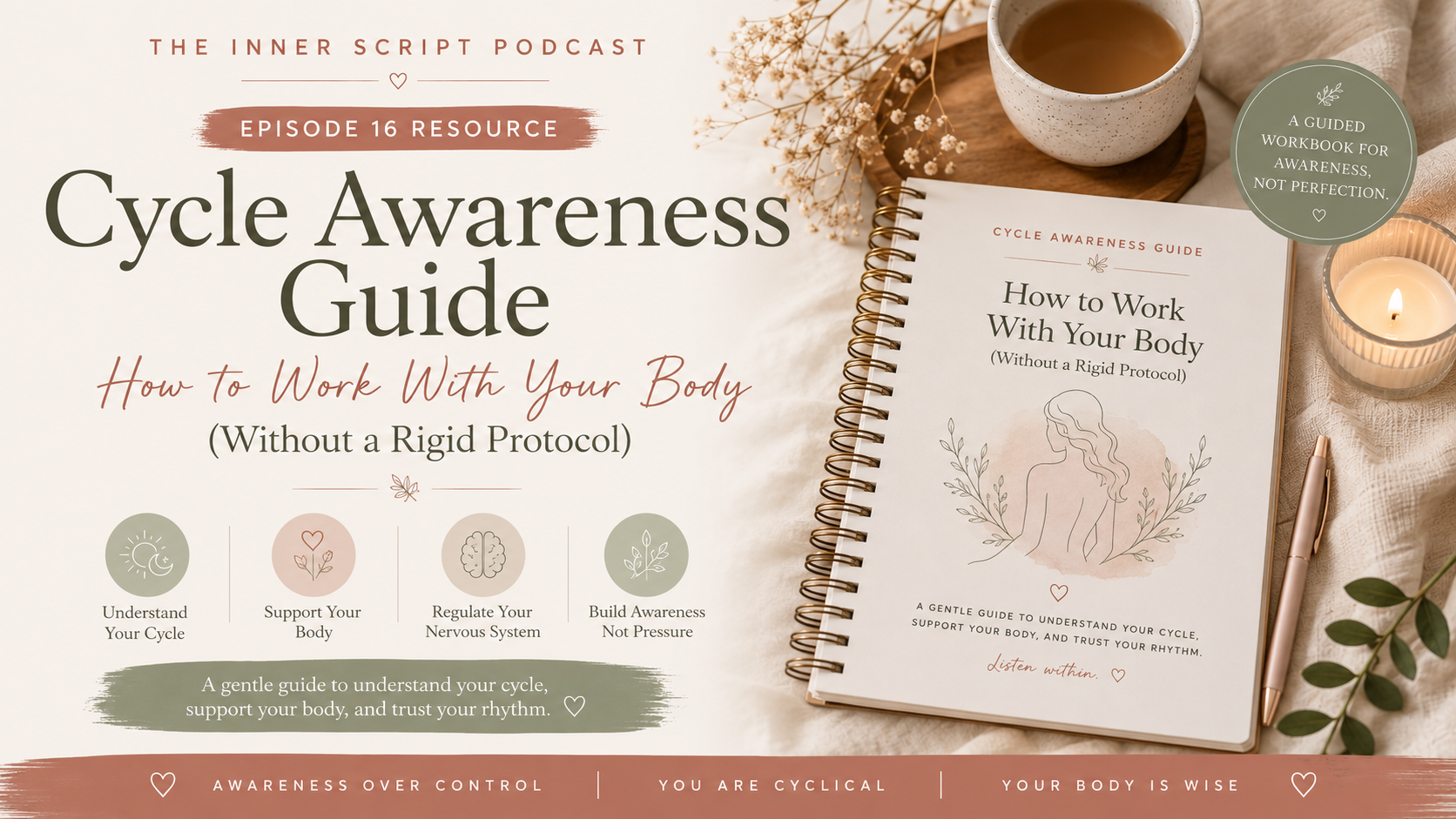
Cycle Awareness Guide: How to Work With Your Body (Without a Rigid Protocol)
This gentle, guided workbook walks you through each phase of your cycle — what it feels like, what your nervous system needs, and how to support yourself without a rigid protocol so you can start working with your body instead of against it. Download it here: Patreon companion resource
You can also join Steph's free Patreon community here: The Inner Script Patreon

Meet Your Host: Stephanie Baubie, NP
Stephanie Baubie is an integrative nurse practitioner and the host of The Inner Script Podcast, where she explores the deeper stories behind health, healing, identity, and transformation. Through a blend of functional medicine, nervous system awareness, emotional insight, and honest conversation, Stephanie helps women better understand their bodies while questioning the narratives they’ve inherited about wellness, worth, and what it means to truly feel well.
On The Inner Script, Stephanie sits down with physicians, founders, thought leaders, and experts in women’s health, while also sharing solo reflections on the transitions and inner shifts that shape our lives.
Follow Steph on Instagram.
FAQs
Why do I feel emotionally unstable or anxious before my period even if my hormones are "normal"?
In this episode of The Inner Script, Stephanie Baubie explains that luteal phase symptoms aren't always caused by abnormal hormone levels often it's about how sensitive your nervous system is to natural hormonal shifts. She breaks down how chronic stress, under-eating, and overexertion can lower progesterone and increase emotional sensitivity in the days before your period.
What causes PMS symptoms like irritability, bloating, and mood swings every month?
Stephanie Baubie explains that PMS is often a stress adaptation rather than a hormone failure. When the body is under chronic stress, it prioritizes cortisol production over progesterone, which can lead to mood instability, fluid retention, poor sleep, and increased emotional reactivity in the luteal phase.
What is "cortisol steal," and how does it affect progesterone?
Cortisol steal describes what happens when the body is under chronic stress — physical, emotional, or mental and prioritizes cortisol production over progesterone because cortisol is needed for survival. Stephanie explains that this isn't a hormone malfunction; it's the body compensating and choosing survival, which can leave progesterone too low to properly stabilize mood, support sleep, and buffer stress.
What is estrogen dominance, and does it mean I have too much estrogen?
According to Stephanie, estrogen dominance is usually less about having too much estrogen and more about having too little progesterone relative to estrogen. When chronic stress causes the body to prioritize cortisol, progesterone doesn't rise the way it should in the luteal phase, throwing off the ratio between the two hormones rather than reflecting an actual excess of estrogen.
How can I support my hormones naturally without a strict cycle-syncing protocol?
Stephanie shares that hormonal balance comes from learning your own body rather than following a rigid framework. This episode focuses on matching your energy output to each phase, eating enough (especially in the luteal phase), prioritizing rest, honoring cravings as clues rather than problems, and supporting your nervous system through the ups and downs of your cycle.
What are the four phases of the menstrual cycle, and how might I feel in each one?
Stephanie breaks the cycle into four phases: the menstrual phase (lower energy, more inward and reflective), the follicular phase (rising energy, motivation, and mental clarity), ovulation (peak confidence, energy, and social expression), and the luteal phase (lower stress tolerance, more emotional sensitivity, and a need for more rest and boundaries). She explains that fluctuating between these states throughout the month is normal, biological, and not a sign of inconsistency.
-
Everything shared here is for educational purposes and personal reflection only. Not medical advice. Always work with your own healthcare provider for individual care.
Hi, everyone. Welcome back to The Inner Script. Today's episode is something I genuinely wish every woman was taught growing up, because most of us have dealt with some type of hormonal imbalance at some point in our lives, but we were never taught about the different phases of our cycle and, more importantly, how to honor our bodies at these different times.
So, with hormone imbalances, we often think hormones are the literal problem, but it's way more upstream than that. Many hormonal imbalances develop because we were never taught how to work with our cycles. And we are not meant to feel the same every day, since we are living in a cyclical body, a body that lives off of cycles.
When we try to live like we're not cyclical, that's when things can start to feel off, and I certainly learned this the hard way. So, I'm gonna start this episode with my own experience. You know, at 32, this is when I really started to feel a difference in my body, especially in my luteal phase, which was kind of the week before my menstrual cycle.
About a week before my period, I felt way more irritable, having emotional outbursts. I cried at work a handful of times, like, not in front of a patient, but in between. And if you know me well, that is not like me. Like, I can really hold my shit together. So, when that was happening, I was very startled, to be honest.
I felt like I had zero control over my emotions at times, especially during this week, and I was holding onto a ton of water in my body, and my skin would flare. I truly remember thinking, like, "Why does this keep happening? What is wrong with me?" And what I finally realized is that these were all symptoms of low progesterone.
It's not that there was something wrong with the progesterone itself. It was that At that time, my lifestyle was completely out of alignment with what my body needed in order to produce the progesterone that was needed to make me feel my best during my luteal phase. So during this time when my symptoms were going haywire, I was over-functioning, overworking, constantly stimulated, pushing through exhaustion, and I had just gotten out of a relationship that emotionally depleted me, and then expecting my body to just regulate itself.
And plot twist, it never does. So what actually changed things for me, it wasn't just supplements, it wasn't just diet, it was finally learning how to tune into each phase of my cycle and give my body what it needed. So it was connecting to myself. And yes, diet helped, sleep helped, targeted supplements definitely helped, but the biggest shift out of everything I did was I stopped pushing my body to extremes, and I started leaning back and listening.
And this is where I want to be really clear. This isn't about following another cycle syncing protocol or framework. This is about learning your body, because we cannot apply frameworks to every single person or every single woman. We have to learn our own body and what it means to be in our bodies because we all have different thresholds.
This is not about controlling your body, optimizing every phase, or doing more, because in fact, most of the time we need to be doing less And again, this is about understanding your body so you can finally stop fighting it and overriding it. And if you are a high-functioning woman, one of the worst things you can do is to try and be more disciplined and do more and override the signals that your body is literally screaming at you.
You don't need more discipline. You need to soften. So let's dive into the different phases here. So we have the menstrual phase, the follicular phase, ovulation, and luteal. So we're-- I'm gonna go into each one. We're gonna start with the menstrual phase, and this is when you get your period. This is when estrogen and progesterone are at their lowest, and your body at this time is literally shedding and resetting.
So this is a repair phase. So how you might feel during this time, which is actually normal and your body basically doing physiology at this point, is you might feel lower energy, more inward, more emotional or reflective, and needing more space. And something I want to normalize here is if you feel more sensitive during this time, that's not a weakness.
It's also biological. Your hormones are literally at their lowest here, so this is normal, and it's really okay. That's actually increased awareness. So once we honor that, just noticing like, "Oh, yeah, I'm more sensitive. Okay. Well, that makes sense. I have my period. My hormones are at their lowest. Got it.
Cool." You acknowledge it, and you can move on from it. Your nervous system is also more open here, so you a lot of the times can feel more, process more, notice more. And instead of honoring it, we override it. We drink more caffeine, we push through workouts, we keep our schedule packed. And if you feel tired during your period, that is not a flaw.
That is your body asking for TLC. So what support can look like during this time of your cycle is slower movement, maybe it's stretching, lower impact workouts, walking, giving your body more rest, warm and nourishing foods that are easy to digest, and less pressure. And if you think about it, when our hormones are at their lowest, we are not able to sustain that same level of stimuli or production.
And I always tell my patients, "If you treated this phase with more care, you'd feel completely different the rest of your cycle." The next phase is the follicular phase, so this is after menstruation and before ovulation. So after your period ends, estrogen starts rising, and this is really your building phase, so you might feel more energetic, clearer thinking, more motivated, more open, an increased libido.
Side note, libido, okay? Low libido is one of the most common concerns I see and hear from women. And yes, it can absolutely be hormone related, but something that gets overlooked all the time is feeling safety in the body. If your body doesn't feel safe, whether it's from past experiences that haven't been fully processed or from being with a partner who doesn't make you feel emotionally or physically safe, your body will down regulate desire.
And I've seen this over and over in my patients, both men and women actually. They struggle with low libido and then when they leave the relationship that they were in and suddenly realize it wasn't their hormones, it was their body that didn't feel safe with that person. So often with low libido, we turn inward and assume something is wrong with us, when in reality it can be a mismatch between your body and your environment or your partner.
So yes, always rule out hormonal imbalances, but I always always ask my patients when they come in with low libido, "Do you feel safe in your relationship emotionally and physically?" Because your body will not open where it does not feel safe. Okay, back to the follicular phase. This is when dopamine starts increasing as well.
So you feel more driven, more focused, more capable, and this is also when your brain is more receptive to new ideas. So this is actually a really powerful time to start something new, like a new project at work or a creative outlet. Make decisions just kinda feel easier, and taking action on things. So support here can look like this is when maybe you do the higher intensity workouts, more social plans, really tapping into your creativity.
This is where a lot of women think, "Okay, I'm back. This is the real me." But here's the truth. That's just one version of you. And then going into ovulation, so estrogen peaks here, and you may feel more confident, more magnetic, more social, more expressive, and peak libido. And this is your most outward phase.
You know, I wanna talk about pheromones here. And something really interesting that not a lot of people talk about is men are actually biologically wired to pick up on ovulation, and they don't even realize it. But there are subtle shifts in pheromones, facial symmetry voice tone, even how you carry yourself when a woman is ovulating.
And all of these signal fertility on a subconscious level. And I actually had a really funny experience with this recently. Last month, I was walking down the street, and within a couple of hours, I got stopped twice by different men. And I remember thinking, "What the hell is happening right now? This is just so weird, like, just not a normal day."
And then it clicked. I was ovulating, and that is not a coincidence. They picked up on it not knowing. And it's just such a perfect example of how your body is constantly shifting, especially whether you're aware of it or not. I'm gonna say, if you're single, go out when you're ovulating and attract the men.
You've got the pheromones and the facial symmetry and the voice changes. Go out and see what happens, and let me know how it goes. Okay, next is the luteal phase. So this is the phase where over-functioning women can have the most difficulty, and this can be due to issues with progesterone, and it's something, as I mentioned earlier in the episode, that's what I was dealing with it.
The luteal phase is really where everything starts to shift. It's really where we need the most support, I would say. And here, progesterone is supposed to rise, and progesterone is your calming hormone. And as I mentioned, this is the phase I struggled with the most because I was overworked, exhausted, burnt out, and on top of that, not allowing myself rest in this phase.
I was just kind of expecting my body to operate the same way it was all throughout the cycle, which set myself up to fail. And instead of adjusting, I was just trying to maintain the same output I had no matter what, and I was getting frustrated with myself because I felt like I just couldn't keep up with it.
And eventually my body was like, "Absolutely not, bitch. You need to slow down," until I finally heard and listened. This is when I would feel the irritability, the emotional reactivity, the fluid retention, the skin flaring, and it felt unpredictable at the time, but it actually wasn't. So progesterone stabilizes your mood, supports sleep, buffers stress.
This is why some women experience, you know, pretty significant PMS or PMDD even, or premenstrual dysphoric disorder, and this is important. It's not always about having low progesterone. For many women, it's actually about being more sensitive to the natural hormonal shifts that happen before your period, especially the drop in estrogen and progesterone.
That can be very activating. And confusing for the body, especially if you're highly sensitive and have a highly sensitive nervous system. So your hormone levels may be completely normal, but your nervous system and brain are responding more intensely to those changes. That's something I wanna say is we really normalize PMS, and I don't really think it's fully normal, like, to have such significant issues with your mood and mood swings.
Like, yes, in your luteal phase, some fluctuations in mood and energy makes sense, but it shouldn't feel like emotional outbursts or it shouldn't feel abnormal, I guess is the best way for me to explain it, and that's how I was feeling. I think a lot of women are just in constant output mode, and a lot of women that I have seen, especially my patients, are very prone to developing these issues in their luteal phase, where they just feel totally off.
And I'm gonna get into that more and why that happens, but I just think it's something, the luteal phase is really where we need to kinda tune in with ourselves and see how we are feeling, especially the days leading up to our period. And I also think with that, issues with the luteal phase and even if you deal with PMDD, I do think that that is a clue and a time to look into, "How is my nervous system actually feeling?
Do I need to release something here? Is my body trying to tell me something that I haven't processed?" And I think nervous system regulation and somatic healing can really help to mitigate this kind of sensation of the drop in your hormones in your luteal phase. So as I mentioned, how you might feel in the luteal phase, you may feel slower, more introspective, lower stress tolerance.
Again, this is the phase where your body starts asking, "Can we slow down a little?" But most women don't. Then they try to maintain the follicular and ovulatory energy, and this is where things start to break down, especially when we are already overextending ourselves. What I wanna talk about is the cortisol steal.
This is huge and not talked about enough. If your body is under chronic stress, physical, emotional, mental, doesn't matter, body doesn't know the difference, it will prioritize cortisol production over progesterone production, and this was what was happening to me. Your body has limited resources, so it has to choose more progesterone to calm, regulate, support ovulation, support fertility, or make cortisol, which is, you need cortisol to survive.
It will choose survival every single time Time. So instead of getting frustrated with your body in a situation like this, it's literally compensating. It is trying to support survival because you are so activated at this point. This is just such a time we need to listen and slow the F down. And stress doesn't just mean emotional stress, as I've mentioned 1 million times at this point.
It can be under-eating, over-exercising, poor sleep, constant stimulation, or even over-committing to plans and just not giving yourself downtime. And what happens is your progesterone drops, so you don't have that mood-stabilizing hormone, so now you feel anxious, irritable, wired but exhausted. Like, you literally can't sleep even though you're so tired, and all you wanna do is sleep and you can't.
It's the most frustrating thing ever, which leads to poor sleep, obviously, and fluid retention. So you are a moody puffer fish all the time, or in your luteal phase I will say, with skin flaring and emotional outbursts, which is really fun. So this is not a hormone failure. This is a stress adaptation. One thing I will say, since working at this longevity clinic I am at, one of the biomarkers we test on everybody is leptin level.
Leptin is a hormone that basically tells us how satiated and fueled we are. Again, I'm working at a longevity clinic, so it does attract very active individuals, endurance athletes, cyclists, runners, marathoners, triathloners, swimmers, people who just love exercise, strength training, what have you, but it's not all endurance athletes.
It's kinda just a lot of active people. But what I will say is, I wanna say probably 95% of the patients I talk to have a low leptin level, meaning they are under-eating. So I just think There is such a reframe we have to do with food and fueling, especially with exercise, and I just think as a society we are not eating enough, and we love exercise, but we have to support our bodies with food, and there is so much unlearning we have to do.
And believe me, I get it I've been there. So I just want to mention that. Now I'm going to go into something called estrogen dominance, which is well-known in the functional medicine space. It's very controversial in Western and conventional medicine, this whole estrogen dominance concept. But basically, in the luteal phase, for instance, when you are chronically stressed, your body's prioritizing cortisol over progesterone.
Progesterone isn't spiking, so your body becomes or turns into this kind of estrogen dominant state because the progesterone isn't spiking and that ratio between the two are totally off. So we label this estrogen dominance, but most of the time it's not that that estrogen is too high, it's that progesterone is too low, and again, the ratio is off.
So it's a ratio issue, not necessarily too much estrogen in the body. And this is why women say, "I feel fine until that week before my period," because that's when progesterone should be helping you And it's not there. So now we have a woman who is overworking, over-exercising, under-eating, and constantly stimulated, and wondering why her body feels off.
And PMS is not your body betraying you. It is your body revealing what you've been overriding all month. So what actually helped me? So it really was tuning into my cycle, noticing patterns instead of resisting them, and I had to do a lot of unlearning when it came to diet and nutrition and discipline.
It was leaning back in the luteal phase. This was the biggest shift for me. It was skipping the workout and getting an extra hour of sleep when I needed it, not feeling bad about it, and it was just overall asking myself what was going to stimulate me less in terms of work, socializing, really being honest with myself of what I could handle, just feeling less intensity, and that looked like saying no to patients at work, you know, if they asked me to squeeze them in for an appointment, just h- kind of having those stronger boundaries, and if I can't show up fully for a patient, I am no help to anyone, especially myself.
Again, it was more rest, slower movement, and just giving myself the space to have grace for myself and saying no, just prioritizing me. And it really involved supporting my body, making sure I was eating enough, leaning into my cravings, and again, cravings are clues, not problems. Also, with food, it was noticing how much hungrier I was during my luteal phase, so guess what?
I ate more, and I lost the fluid retention that way, I will say. That definitely helped. And really prioritizing sleep. I really try to get that seven and a half to eight hours of sleep per night, where I was getting, like, maybe six to seven, and I really need the seven and a half in order to kinda feel my best.
I used targeted supplements to help promote progesterone production, kind of lowering my stress levels, which, again, helps kind of increase your resilience to stress in general, and nervous system regulation was huge, just doing something to relax me for even 10 minutes a day and honoring my body when I felt exhausted.
So this meant taking a nap if I needed to, which naps are still hard for me to take, but if I need one, I listen, and I lie down for 20 minutes. And it was skipping the workout, laying low when I needed to and just if I needed alone time, not making myself feel bad about it. So the healing wasn't in doing more.
It was in finally doing less when my body needed it. Okay, let's talk about diet. So any time we are trying to nourish ourselves and support ourselves, you have to match your energy. Number one, match your energy. Stop overriding your cues. Match your energy. I hope you guys get it by now. Stop expecting consistency from a cyclical body.
And movement, so with follicular ovulation, maybe that's when you engage in more intensity. Luteal and menstrual, maybe that's slower. But these also don't mean it has to be so rigid, because there are months where I'm like, "Oh, wow," like, "I'm feeling really tired this week," and I'm actually in my follicular phase, so that doesn't mean I'm gonna stop listening to my body.
I'm gonna like, "Okay," like, "let me just slow down here and then see what happens." And then sometimes in my luteal phase I have more energy. So it's really just learning how to listen and supporting yourself during those times. So again, this isn't like s- I don't want it to feel like such a rigid framework, because energy fluctuates all throughout the month.
You know, our cycles are going to change from month to month, so it's just kind of honoring that and leaning into it instead of running away from it. And eating enough, especially in the luteal phase. As- you know, I have more carbs, more minerals. I really think about what I am craving, because that means my body is signaling to me that I need something that I may not be giving it.
And your nervous system, so we have to focus on nervous system regulation. I mean, everybody does, but especially women, like we're cyclical, and our nervous system is never going to feel the same month to month, and that's okay. That's kind of normal, and it's not feeling bad about it and honoring it. And your hormones follow your stress, so it's really managing that cortisol overproduction first is really the key.
Hormones follow your stress always. And once you start honoring these parts of your cycle, especially your luteal phase, you will notice the luteal phase to not be so extreme anymore. Mine used to be one week of like this doomsday week where it was just like Brutal. And now, sure, I feel a tad more tired and a bit more emotional, like I might cry when I'm watching a show or something, but that's like the day before, but that's really it.
I don't... That's just kinda part of it, so it's just so mild, and I truly believe, as women, it just shouldn't be this like, "Oh my God, I'm PMS-ing." I don't think that's normal because it doesn't feel normal, at least it didn't for me. I don't wanna speak for anybody else, but it didn't feel normal for me. And now it should really be like, okay, you get your period and it's kind of a surprise, not this like, "Oh my God, when is it coming?
I need the release." That's just kind of my view on it. I just think in conventional medicine, we really normalize common things, and I have such a big issue with that, and I could do a whole other episode on that. I just think if you're not feeling normal in your body, then that is a clue. It's a signal that something is off.
But that doesn't mean we can't fix it. It's just having that self-awareness at the end of the day. So if you take anything from this episode, you are not inconsistent, ever. You are cyclical. Your body is not broken. It's responding, always. One of the worst things we were taught was discipline, for us to apply discipline in all areas of our life 100% of the time.
Because a cyclical body does not thrive on overriding fatigue, hunger, or cravings. It thrives on awareness. It thrives on adaptation. So your hormones aren't the problem. The way we've been taught to live is, and it's also never being taught how our cycles work in the first place, not being taught how to tune in and honor our bodies throughout these different phases of the month.
All right, guys, that's all I have to say about our menstrual cycles, and I hope that makes a little bit more sense. I think it's wild that we really weren't taught any of this in health class of how the female body actually operates, especially with hormones fluctuating throughout the month and how to tune in.
So I hope I made this a little bit easier to understand. If you have any questions, feel free to send me a message on the Innerscript on Instagram. Also, please like, subscribe, leave a comment for the podcast. It helps a lot. Appreciate it, you guys. I'll see you and chat with you next week
If you wanna connect with like-minded women and dive deeper into these conversations, join my Patreon community. There's a free option and it's where we can talk about each episode together. The link is in the show notes and I can't wait to see you there.
Disclaimer
Everything shared in this episode is for educational purposes and personal reflection only. It is not medical advice. Always work with your own healthcare provider for individual care.
We sometimes include links to products and services we find interesting. These may or may not be affiliate links. Thanks for your support.
Podcast production by Jamie Brooke.
