Grief Lives in the Gut: How Emotional Stress Impacts Digestion (and Why Nervous System Healing Often Matters More Than Diets)
Listen now by clicking your favorite podcast app below:
Why does your digestion feel “off” even when every test comes back normal?
In this deeply personal solo episode of The Inner Script, Stephanie Baubie, NP shares her decades-long journey with bloating, IBS symptoms, reflux, and chronic digestive discomfort — and the moment she realized her gut wasn't broken, it was communicating. Drawing on her own history with grief, stress, and nervous system dysregulation, Stephanie unpacks the gut-brain connection and why true digestive healing rarely starts with another diet or protocol.
Stephanie traces her symptoms back to childhood, through a stressful adolescence, an unhealthy college chapter, and years of restrictive eating and functional testing that never quite explained what was going on. She opens up about what actually helped: not another elimination diet, but foundational habits, nervous system regulation, and learning to see her body as an ally instead of a problem to fix.
This episode is for anyone who has been told their labs "look fine" while still living with bloating, cramping, nausea, or unpredictable digestion. It's a reminder that symptoms are signals, not failures, and that healing digestion often begins with safety, not restriction.
This episode is for you if…
You feel like something is off with your digestion, but your tests keep coming back normal.
You've tried diets, supplements, or protocols without finding lasting relief.
You're a highly sensitive person navigating stress, burnout, or emotional overwhelm.
Episode Timestamps
00:00 Digestion As Emotional Language
03:00 Gut As Emotional Communication
07:15 Childhood Grief And Anxiety
13:40 Stress And Worsening Symptoms
20:10 College Lifestyle And Reflux
26:45 Restrictive Diets And Anxiety
33:30 Functional Testing Insights
41:10 Foundational Digestion Support
49:00 Nervous System Regulation
57:00 Reframing Symptoms, Building Trust
Resources & Mentions
Lemon water with liquid minerals
Papaya, kiwi, and pineapple for sluggish digestion
Magnesium oxide
Zinc carnosine
Dandelion tea
Lymphatic drainage massage
Journaling and emotional release practice
Meditation and nervous system regulation
Curious about a supplement Steph has mentioned in the episode?
If you’re looking for products Steph personally recommends in practice, you can browse her dispensary here: Stephanie’s Fullscript dispensary
Please consult your healthcare provider before starting any new supplement. Food, lifestyle, and nervous system support always come first.
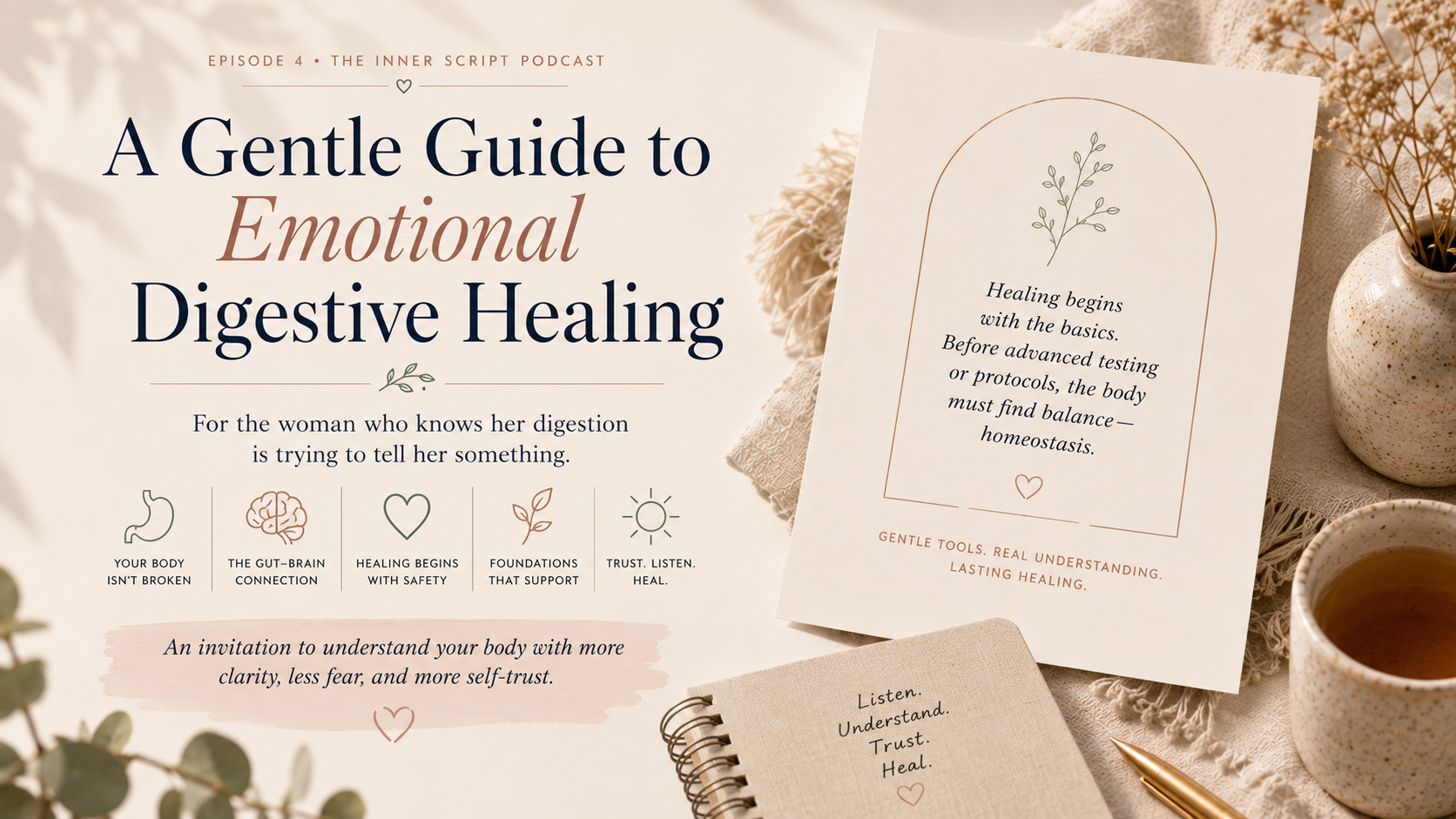
Free Guide: Grief in the Gut — A Gentle Guide to Emotional Digestive Healing
If you're ready to understand what your digestion has been trying to tell you, this companion guide walks you through the gut-brain connection, the emotional patterns behind common symptoms, and gentle foundations to help you rebuild trust with your body. Download it here: Patreon companion resource
You can also join Steph's free Patreon community here: The Inner Script Patreon

Meet Your Host: Stephanie Baubie, NP
Stephanie Baubie is an integrative nurse practitioner and the host of The Inner Script Podcast, where she explores the deeper stories behind health, healing, identity, and transformation. Through a blend of functional medicine, nervous system awareness, emotional insight, and honest conversation, Stephanie helps women better understand their bodies while questioning the narratives they’ve inherited about wellness, worth, and what it means to truly feel well.
On The Inner Script, Stephanie sits down with physicians, founders, thought leaders, and experts in women’s health, while also sharing solo reflections on the transitions and inner shifts that shape our lives.
Follow Steph on Instagram.
FAQs
Can emotional stress and grief cause digestive issues like bloating or IBS?
Yes. In this episode of The Inner Script, Stephanie Baubie explains how grief, chronic stress, and unprocessed emotion can directly affect digestion through the gut-brain connection. She shares how her own bloating, nausea, and IBS-type symptoms trace back to childhood grief and years of living in a heightened stress state, and why the nervous system is often at the root of symptoms that food alone can't explain.
What is the gut-brain connection?
The gut-brain connection refers to the constant communication between the digestive system and the nervous system. On The Inner Script, Stephanie Baubie describes how stress, fear, and emotional overload can show up physically as bloating, cramping, or irregular digestion, since the gut is one of the most sensitive systems in the body to what the nervous system is experiencing.
Why do digestive symptoms often flare during stressful or emotional periods?
Stephanie Baubie explains that digestion tends to slow or become disrupted when the nervous system doesn't feel safe. In this episode, she walks through her own timeline — from childhood grief to a demanding nursing career — showing how each period of heightened stress corresponded with a worsening of her digestive symptoms.
Can restrictive eating or elimination diets make digestion worse?
According to Stephanie Baubie, restriction itself can act as a stressor on the body. In this episode of The Inner Script, she shares how years of fear-based eating and elimination diets increased her food anxiety without resolving her underlying symptoms, and how shifting toward more intuitive, less restrictive eating ultimately supported her digestion more than any protocol did.
Why might digestive test results come back normal even when symptoms persist?
Stephanie Baubie discusses her own experience with functional and microbiome testing that showed a healthy gut despite ongoing symptoms. In this episode, she explains why normal test results don't mean symptoms aren't real, and why the emotional and nervous system component of digestion is often overlooked in standard testing.
What lifestyle habits actually support long-term digestive healing?
In this episode, Stephanie Baubie shares the foundational habits that made the biggest difference in her own healing, including morning hydration, eating unrushed meals, prioritizing fiber-rich foods, consistent sleep, and nervous system practices like journaling and meditation. She emphasizes that healing is rarely about finding one more supplement, but about supporting the basics consistently.
How do you know if your digestive symptoms are connected to unprocessed emotions?
Stephanie Baubie encourages listeners to notice patterns: when symptoms began, what was happening in life at that time, and where tension shows up in the body. In this episode, she offers reflection prompts to help listeners explore whether grief, stress, or emotional suppression may be playing a role in their digestive health.
-
Everything shared here is for educational purposes and personal reflection only. Not medical advice. Always work with your own healthcare provider for individual care.
Hi everyone. Welcome back to the Inter Script. I have a very special episode today. It's one I've been wanting to share and really dive pretty deep into because it's deeply personal and it's deeply connected to the way I really view my health today. I guess this whole podcast has been deeply personal, but you know, this particular thing that I've been dealing with since childhood has really shaped the way I practice medicine.
It's shaped the way I view health and wellness. It was kind of this symptom in particular that really I struggled with. I mean, I still do, but on a lesser level, but I struggled with it for decades.
So. We're gonna talk about digestion, and it's one of my favorite topics in general just because I've done so much research on it because of my own struggles, and it's something I talk about every day with my patients.
I don't know a single person who hasn't had some type of digestive issue at some. Point in their lives, you know, we're gonna dive deep into this, but digestion, it's not just a physical symptom. And it took me a really long time to totally grasp that concept. And what we're really gonna talk about today is what happens when grief, stress, and unprocessed emotions take up residents in the gut, and sometimes for decades, in my case, so.
As I've mentioned, I've struggled with digestion for most of my life, literally since childhood, right around when I was eight or nine. And I wanna say like things are not perfect now, but they are light years better than what they used to be. And I know I'm not alone in this, just 'cause what I've seen in my patients on a day-to-day basis.
But you know, again, as I said, I don't think I've met a single person who hasn't dealt with. Some digestive issue at some point, and let me tell you, I've been through all of it. We're talking about bloating, reflux, constipation, chronic cramping, IBS, I've dealt with, you name it, I've been there. What I've learned both personally and through my work as a provider is this, digestive symptoms are often the body's emotional language.
They're not random. They're messages, and I think this is really hard for people to completely grasp, but most of us, I will say, have heard that the microbiome and the gut is the second brain. So this makes sense that if you can't digest your emotions or if you don't digest your emotions, you can't digest your food.
So. Knowing all of this, this gut brain axis, it's really crucial to fully believe this when dealing with a digestive symptom. So yes, digestion is absolutely influenced by diet, supplements, hydration protocols, a thousand percent. But the nervous system, the emotions, the stress, that is where the real story often lives.
So let's. Get into mine. So my digestion issue started when I was around eight or nine, and that was around the time when my dad passed away. That timing is not a coincidence. Around that time, I also developed intrusive thoughts about something happening to my mom after losing my dad. Looking back, I definitely had these OCD.
Tendencies as a way to calm my anxiety, because I mean, grief, anxiety, stress, that's really hard for an eight or 9-year-old to really deal with. You don't have the capacity to do that, so I just remember feeling constantly anxious about everything, and this came out in outbursts and panic. Now, as an adult, I can clearly see that this is where I carry my stress.
That's what was going on when I was younger. But you know, you just, there's no way to even know that. So in my gut microbiome, this is where my unprocessed emotions live. Just having that awareness alone has really changed the way I see my symptoms. And it's also changed the way, honestly, like how efficient my body has been in terms of like healing.
So it's something I really can't. Explain. It's just this sensation of knowing like, okay, yep, yep. Okay. There's something that I need to address here. You know, instead of feeling frustrated or confused, I see my digestion as communication. So it's really my body trying to tell me something. And that shift alone has just been so instrumental in dealing with this.
So back then when I was younger, like. As a child, eight or nine, my digestion issues started as nausea and intense stomach cramping. So I would get stomach bugs very often. And I wanna say it was like, I remember like at least once or twice a year until like my mid twenties and there were multiple times I would have to go to the er.
The emergency room because I physically couldn't keep anything down and I was just getting like so dehydrated and really the only solution in that moment was for me to get IV fluids in Zofran, which is an anti-nausea medication, so I could keep things down. That was very prevalent. I just remember complaining about my stomach all of the time.
Yeah, it was a lot. And then in middle school everything really worsened. So I was having all of that, but then on top of it I was getting more stress. So that meant more stomach issues I think. I don't know anyone who like fully enjoyed middle school. It's like one of the most awkward, confusing times.
Yeah, so the more stress, more stomach issues and what that looked like was it really looked as pain and it would be so bad that my mom would have to pick me up from school at times 'cause I just like couldn't get through the day and it was just so uncomfortable. So she would pick me up from school.
Then eventually the sled into chronic bloating, which was basically my. Constant companion until like from 14 all the way into adulthood. And really, no matter what I ate, I was uncomfortable and it would get worse as the day went on. I guess I got used to it. I just kind of thought, I'm like, okay, like this is the way it is.
I just have a sensitive stomach and that's what, you know, I would tell myself in college. It turned into slower digestion too, which look, that honestly made sense. There were lifestyle factors. I was not living my healthiest life whatsoever. So that definitely contributed to my digestion issues worsening in college.
So, you know, that looked like inconsistent meals or sleep, lots of alcohol, barely any movement. I was not exercising regularly at all, and my diet sucked. Just. To be totally transparent. So obviously that all contributed to it, but I had this like underlying issue to begin with, so worsened in college. I also developed acid reflux at one point in college, and that was when I was going through a really, really high period of stress and it eventually went away, but I had to go on.
Like a medication, a proton pump inhibitor, which is really common. It basically neutralizes your stomach acid, so you're not feeling it anymore. But eventually that went away, so I didn't have to deal with that as much anymore. Yeah. Eventually when I got out of that stressful situation, it, it went away so.
After college, I continued to deal with this chronic bloating, slower digestion. It was really frustrating, really annoying. So no matter what I ate, I felt sick and uncomfortable. I also noticed that every time I was at work, and at this point I was a registered nurse at the bedside, working 12 hour shifts, and it was very stressful, like no decompression time.
Would go like 12 hours without sitting down sometimes. So when I was at work, it really got really, really bad. And when I got home I literally looked like I was pregnant. Like I couldn't even like, suck in. It was terrible. I knew it was the stress I did. It just, I like couldn't fully accept it. I say something like knowing something is different than actually believing it.
Yeah. Like I knew it was the stress, but I was like, well, I can't really do anything about this, so I guess I'll just, you know, deal with it. And yeah, there were many times I couldn't even put certain pants on because it was. That bad, the bloating would get so bad. So when I say this has been a decades long journey, I truly mean decades.
So kind of going into what I did to try to sort this out and fix it, essentially, you know, after college I really got serious about cleaning up my diet and I also just wanted to get. Healthier those four years. I was just not living a healthy lifestyle at all. Like it's black and white, like my lifestyle now compared to what it was in college.
And I think everyone can relate to that. You know, you're late nights, tons of alcohol, not cooking for yourself at all, just eating whatever, being hungover, hangover meals, like all of the things. So like after college I was like, okay, I need to get my shit together. This is not happening anymore. So after that, I really leaned into a healthier lifestyle.
So I started cooking more. Really made an effort to eat more fruits, vegetables, and it definitely helped. I became more regular, but the bloating stayed and no matter what I. It just didn't matter. It was always there. And because of this, because I was so afraid of feeling sick and getting bloated and cramping, I became really restrictive in my diet.
And again, this wasn't out of like fear of like weight or anything. It was out of fear of feeling. Really sick. It was fear of eating the wrong thing and fear of triggering my symptoms. And during all of this, and I would say from like after college, so like ages like 22 to even like 30, I would say. Like I tried various.
Diets. I'm gonna say even up to like 32, like 31 or 32. I tried various diets. I tried like vegetarian, just like eating less meat, tried vegan diets, gluten-free dairy-free egg-free light to heavy food sequencing in the morning like you eat. Lighter and then a little bit heavier as the day goes on lower fat.
So tried all of that and I even tried some medical medium practices, which you know is like celery juice, detox smoothies, which honestly it did help with regularity and energy. So there are like. Points of this where I know medical medium gets like a huge contradictions out there or shame with medical medium, but I get his protocols are can be very restrictive.
I completely agree with that, but there's kind of like some aspects of it that can be helpful. So whatever. But again, so I did celery juice religiously for six. Six. And I will say like it helped, it definitely helped my symptoms, but I think I was probably just like, I honestly think I was drinking too much of it.
'cause I was just so desperate. I still drink celery juice from time to time, but it's just, it's not like a daily thing anymore. Like I like to do it if, you know, after traveling or if I'm just kind of feeling like blah, like I still do it. It has a lot of great health benefits. It helps stimulate hydrochloric acid so that you can break down your food better.
It helps stimulate bile to help emulsify fats and digest fat and protein better. So there's a lot of great benefits to it. I just, I don't drink like half as much as I used to. Like I have probably like anywhere from like six to eight ounces of. Celery juice when I do drink it. When I was back in the day, I was going like 1624 ounces like on a daily basis.
But yeah, and while all of that gave me benefits, the full diet was just way too restrictive and it created a lot of food anxiety for me. So, which of course only worsened my digestion, so really restriction is stress and stress lives in the gut, so you can see where this goes. Eventually, over the last year, I really started to let go of this fear-based eating and shifted into a more balanced, intuitive way of nourishing myself.
That shift alone improved. My digestion more than any elimination, diet, supplement food, whatever, like that is what helped. And again, I'm not saying like, look, I still eat very well. I eat whole foods like 80 to 90% of the time because. That's honestly like what I enjoy doing. It's not coming from a place of restriction anymore.
It's coming because I actually want to be eating that way and it feels good. So yeah, I'm not saying like I go balls to the walls with like whole foods or with processed foods. You know, every day. I still don't recommend anybody to do that, but it's really just kind of shifting this mindset of fear-based nutrition and dieting and all of that.
Here are some other things I have tried besides certain diets. Some worked, some didn't. Yeah, so I did the probiotic thing. I tried that, which it really only made me bloated, like I didn't. Notice a whole difference with it. I think probiotics can be really helpful in some people. It just depends on the person, but I do think, you know, there's a lot of food that have natural pre and probiotics that you know, sometimes can just be enough for people.
Again, probiotics. Can work. It just, I think it's a little bit more individualized of who can benefit from it. I tried L-Glutamine powder, which is basically, it's an amino acid that helps to reinforce your intestinal lining, so it's really, really helpful for bloating, like looser bowel movements, so like kind of more like diarrhea.
It helps like 95% of my patients that I have recommended. It too. That's like a rough estimate, but it really didn't help me. So again, L-glutamine powder. It can be like a miracle thing for some people, but for me it didn't work because that wasn't the issue with my digestion. I also saw various functional medicine providers.
One of them did a stool test, which actually overall showed a lot of healthy, good gut bacteria. I didn't have any. Significant abnormalities, like my microbiome tests looked really good. And that's when I was, I mean, I was eating really healthy, obviously at that time, but yeah, so they were like, oh, this actually looks really good.
Yeah, nothing to really do here. But then on one of the stool tests, apparently it detected blood. So then I was referred to a gi. I had to get a colonoscopy, which ended up being completely fine. But it was one of those things where there's a balance when it comes to all of this testing, and this is coming from somebody who has worked in a functional medicine practice who has, I've ordered these tests before where, but it's also like, if you keep doing this testing, you're gonna find something.
So in my case, yes, like I did. This microbiome test, I found out there was blood in my stool. So then I had to go get a colonoscopy, which was not fun, but I did all the things. So go figure and look. I'm not saying not to do these like extensive tests. It's just, it's one of those things where, yeah, sometimes there's just like a balance to it, and I still think it's really helpful.
To get microbiome testing done. It's just, in my case, it led to this whole can of worms getting opened. So that's my point in that I've done a parasite cleanse without any success. I've taken natural antibiotics such as oil up, oregano, golden seal, didn't work, and I'm sure there are so many other things that I've done over the years that.
Just no success. But here's the thing, the truth is the biggest improvements came when I stopped trying everything and instead focused on supporting my foundations, the six pillars. So this is what actually helped for my diet and overall routine, I really started focusing on fiber. Pya also became my secret weapon.
It's truly a miracle food for sluggish digestion. Kiwi Pineapple. Melon are great too, but papaya is next level. So if I'm ever kind of feeling like a little sluggish, I get some papaya in and I'm good to go. And I drink anywhere from like 16 to 32 ounces of lemon water. Every morning, and I know that sounds like a lot, but I use a full lemon with liquid minerals.
I'm not kidding. My body wakes up craving that, and that has transformed my digestion hugely. It just the citrus in the lemon naturally stimulates. Your digestive enzymes and bile flow. So again, I'll do like half of a squeezed lemon in 16 ounces or one full lemon in 32 ounces. I'll do the 32 ounces. If I'm like working out in the morning, usually we'll do 16 if I'm just not.
Yeah, like hydration is key. First thing in the morning, I stopped drinking coffee on an empty stomach, and I'm really embarrassed to say how long I did this for. I used to drink like a venti iced coffee from Starbucks on an empty stomach. I did that for like years, like. Well, maybe like two years. And I'm like really embarrassed.
I did that. I'm like, I can't believe I did that. And even up until like about a year ago I was doing that, I was drinking coffee on an empty stomach. It's like one of the worst things you can do. You're spiking your cortisol. Coffee is so acidic, it's just not good. So just please eat something if you're gonna drink coffee in the morning.
And I also dialed back my coffee. I drink. Like a hundred milligrams of coffee per day, maybe 200 if I'm a little tired. So yeah, it's just coffee. Empty stomach is a no-go. I learned I really needed to eat fruit in the morning, and whether that's like a smoothie, like a chia pudding, coconut yogurt, bowls, I'm not great with dairy, I'll say oatmeal or eggs.
I have to have some type of fruit in the morning. Fruit gives me fiber hydration. Antioxidants and it's just a gentle start. I just notice my digestion is so much better when I have fruit first thing in the morning. And I also really slowed down in the mornings. I used to, you know, get my coffee, make a smoothie, or make a breakfast, and.
Bring it on the go with me to work. 'cause I was just like trying to get to work and instead I like started kind of waking up a little bit earlier, like maybe like 10 to 15 minutes just to make sure I had time to like sit down and eat breakfast, drink my coffee, and then maybe. Bring it with me to work.
So that created a huge shift, just slowing down, not eating on the go. Yeah, that was a real game changer. I shifted to eating my heavier meals. When I say heavier, just kind of more calorie dense, I would say earlier in the day, but. I really kept it lower in fat, and I'll tell you why. I know this is sounding like I'm being restrictive, but a lot of this comes to kind of tapping into your body and knowing what works for you.
I found that oils and nut butters, like for breakfast or first thing in the morning, definitely affect my digestion. Kind of no matter what it just felt like. A lot for me. So I would say these for later in the day, and my schedule at work is so busy. I don't have time to snack between patients. Like I truthfully don't, sometimes I do, but I can't lean on that during the day because there are times I'm running behind, like I literally don't have five minutes to like eat something.
I truthfully don't. What I did instead was. Eating a really substantial breakfast and lunch, which kept me steady. It prevents the hangry for me, which I am extremely sensitive to, and just overall keeps digestion so much more calm. And later in the evening, because I get home from work and I'm not like ravenous, I'm not starving, I'm just like, okay, yeah, I just need like a normal dinner.
And now dinner might be like my quote unquote lightest meal of the day because I feel very satiated and nourished throughout the day. And again, if I'm feeling really hungry in between, you know, and I have the time to go eat something, I, I will do it. And that's helpful as well. Also, this whole approach for me, it's really prevented me with any late night bloating, which then improves my sleep because I'm not feeling the discomfort.
So all of that has been huge. And then obviously hydration. I drink tons of water, so I have like that 32 ounces of water in the morning usually. And then I drink two Stanley's throughout the day. And then I really try to end my night with some type of herbal tea. I've been feeling dandelion tea. Right now.
It's really good for estrogen detox. So if you're dealing with like estrogen dominance or just I need. Honestly, any kind of like hormonal imbalance, dandelion tea is really good for that. And if my digestion is feeling a little bit sluggish, I'll take magnesium oxide powder before bed. I don't do citrate, citrate, it doesn't work for me.
It like, almost like worsens, like cramping and magnesium oxide is a little bit gentler on my uh, system. So works like a charm. I bring it with me when I'm traveling. Always. Without a doubt, that is my TRE partner. Another thing was helpful. I took zinc carnasine, I wanna say for like three to four months.
That was a pretty big help. It supports the intestinal lining and immune health, so that was something that really helped me. And then lastly, lymphatic drainage massages, I absolutely love because they massage your stomach and you feel so much lighter coming out of. That appointment. It just, it helps so much with bloating, water retention, and it just, it feels amazing.
So those are kind of my go-tos right now. I'm not taking Zinc Carine anymore. I feel like I moved on from that. I feel like it did what it was supposed to do, so I stopped. Yeah, those are kind of my go-tos. I really don't take a lot of supplements. I just kind of keep. To the basics of what I know works for me.
And then, yeah, I mean, here's the thing. No supplement changed my digestion more than sleep, emotional release, and nervous system regulation. I've said this like a thousand times already, but my stress lives in my gut and it always has, and it always. And once I began fully embracing that and understanding it, I started to slow the F down, getting out of hustle mode, tapping into my feminine energy, which means leaning back.
Kind of getting out of your head, really tapping into your feelings, emotions, sensations in your body, practicing emotional release, journaling, which is huge for me in terms of somatic healing and releasing stored emotions that's been crucial. Meditating before bed, I don't do it. Daily. I do it pretty inconsistently, but I go through periods where I'm like doing it nightly for like a few weeks and then I go like a week or two without, but meditating before bed.
I will never be a morning meditator. I don't think I'm too like just need to get going. Setting boundaries. Especially at work and then say no. So all of those things healed my digestion in a way that nothing else did. And I will say I went from having digestive symptoms a hundred percent of the time. I am not kidding.
100. Percent of the time for decades. Decades, then maybe I would say I have symptoms 30 to 40% of the time. And for me, that's a massive win. I am not looking for perfection. I am looking for consistency with just. Normal digestion. So again, healing doesn't mean perfection. Your symptoms are going to fluctuate.
You're going to feel off sometimes, and that's okay. Healing means improvement. It means resilience. It truly means. Understanding your body instead of fighting it. And that alone, if you take away one thing, is instead of getting frustrated with your body, just know it is only working for you. It is only there for you.
I know that sounds really corny and like stupid, but it's the truth. Your body is never betraying you. It is only trying to protect you. So every symptom you have is a signal. It is simply trying to communicate with you. And I think just having that reframe alone has changed the way I have viewed my relationship with myself and my body.
Just, if you're gonna take away one thing, it's that. You know, really, I called this episode when Grief Lives in the Gut because for so many of us, it does remember the saying that made my stomach drop. I mean, the gut is where we hold fear, anxiety, stress, all of it, and it's where we internalize emotional pain.
It's where we brace ourselves. It's where we swallow things we don't say out loud. And that is so true for me. And until we acknowledge this side of it, digestion can always feel like a mystery. You know, again, a lot of these things I talked about that did help me. Kind of the accessories with the pillars and all of that, it really did help.
But my true healing came from recognizing all of this, that there is such an emotional aspect to chronic symptoms and especially digestion. And one thing I will say is in Chinese medicine, the heart and the pelvic region are connected. And for women. I don't know a single female friends, family patients.
I have not met a single female who hasn't had some type of issue in their pelvic region, whether it's chronic UTIs, pelvic pain, uterine fibroids. PCOS, some type of digestion issue, chronic vaginitis, pain with sex. I don't know a single female who hasn't dealt with something like that. And that right there, I truly believe is because it's so emotionally rooted.
That area is so sensitive and reactive to our feelings and emotions. That it's just something we really need to pay attention to. You know, when we support the basics and when we process our internal world, the gut finally begins to soften, to release, and to finally heal. So that is pretty much my digestion story.
Again, I will say, you know, I. 33 right now. It took like two decades for me to really get a handle on it. I did all of the things and the thing that moved the needle the most was understanding my emotions, seeing myself differently, embracing all of this information that I received and truly believing it.
So. That's just one thing I, I have become so passionate about is this importance of digesting your emotions and understanding how you're feeling, because so many of us are just going day to day, going through the motions and not. Knowing what we're actually feeling. I mean, that's pretty much what even led me to start this podcast to begin with.
So cannot emphasize how much the work works. That's all I have to say about my digestion story. Keep me updated about what you guys are going through. And let me know, again, I say this at the end of every episode, but I wanna know where you guys are at in your healing journey, what you're dealing with, what you're sorting through.
There's really no topic that's off limits, and I know how overwhelming all of this information can be, and I'm here to make it digestible for you. No pun intended, but I'm really here to help kind of translate all of these topics into things that are a little bit easier to understand because there is a way to understand it.
We can break it down, make it more simple, and there's so much health and wellness information out there that is so complicated and it just really doesn't need to be. So please keep me updated. Send me a dm. At the Inters Script pod on Instagram. I would love to hear from you guys. Yeah, just let me know where you're at, what you're dealing with, sorting through.
No question is off limits. Well, maybe I shouldn't say that. I'll let you know if some questions are off limits, and I will see you guys next week.
If you wanna connect with like-minded women and dive deeper into these conversations, join my Patreon community. There's a free option and it's where we can talk about each episode together. The link is in the show notes and I can't wait to see you there.
Disclaimer
Everything shared in this episode is for educational purposes and personal reflection only. It is not medical advice. Always work with your own healthcare provider for individual care.
We sometimes include links to products and services we find interesting. These may or may not be affiliate links. Thanks for your support.
Podcast production by Jamie Brooke.
