Popular Health & Wellness Trends That Could Be Hurting You | Nurse Practitioner Explains
Listen now by clicking your favorite podcast app below:
Is the wellness advice you're following actually making you feel worse?
In this brutally honest solo episode of The Inner Script, integrative nurse practitioner Stephanie Baubie breaks down the current health and wellness trends she is not about and why so much popular advice online lacks the nuance, context, and clinical understanding it needs to actually help. From aggressive detox protocols and liver flushes to protein obsession, supplement stacking, fasting, and cold plunges, Stephanie explains how well-intentioned wellness trends can quietly worsen the very symptoms they promise to fix.
Stephanie gets personal, sharing her own experience of doing everything "right" — eating clean, working out, taking a cabinet full of supplements and still feeling completely disconnected from her body. She unpacks the real difference between having health information and knowing how to safely apply it, and why a protocol that worked for one person's biology can genuinely harm someone else's. Along the way, she walks through the three phases of liver detoxification, why more protein isn't always better for digestion, and how "optimization culture" can quietly dysregulate the nervous system.
Most importantly, this episode is a reminder that healing is not about doing more. It's about learning to trust your body again, building real discernment in a noisy wellness space, and understanding what your unique physiology actually needs — not what worked for someone else's.
This episode is for you if…
You feel overwhelmed by conflicting wellness advice and health trends online.
You've tried every supplement, protocol, or detox and still feel off.
You're ready to build more self-trust instead of chasing the next wellness fad.
Episode Timestamps
00:00 Digestion As Emotional Language
00:17 Why She's Fired Up
02:42 Why Trends Fail Women
05:21 Knowledge Vs. Clinical Application
09:33 Dangerous Calorie Deficit Advice
11:01 The High Protein Trend
13:51 Detox Myths Explained
18:55 Supplement Stacking Problems
20:57 Optimization Culture And Burnout
24:35 How To Trust Your Body Again
Resources & Mentions
The Six Pillars framework: diet, digestion, movement, sleep, stress management, and detoxification
Curious about a supplement Steph has mentioned in the episode?
If you’re looking for products Steph personally recommends in practice, you can browse her dispensary here: Stephanie’s Fullscript dispensary
Please consult your healthcare provider before starting any new supplement. Food, lifestyle, and nervous system support always come first.
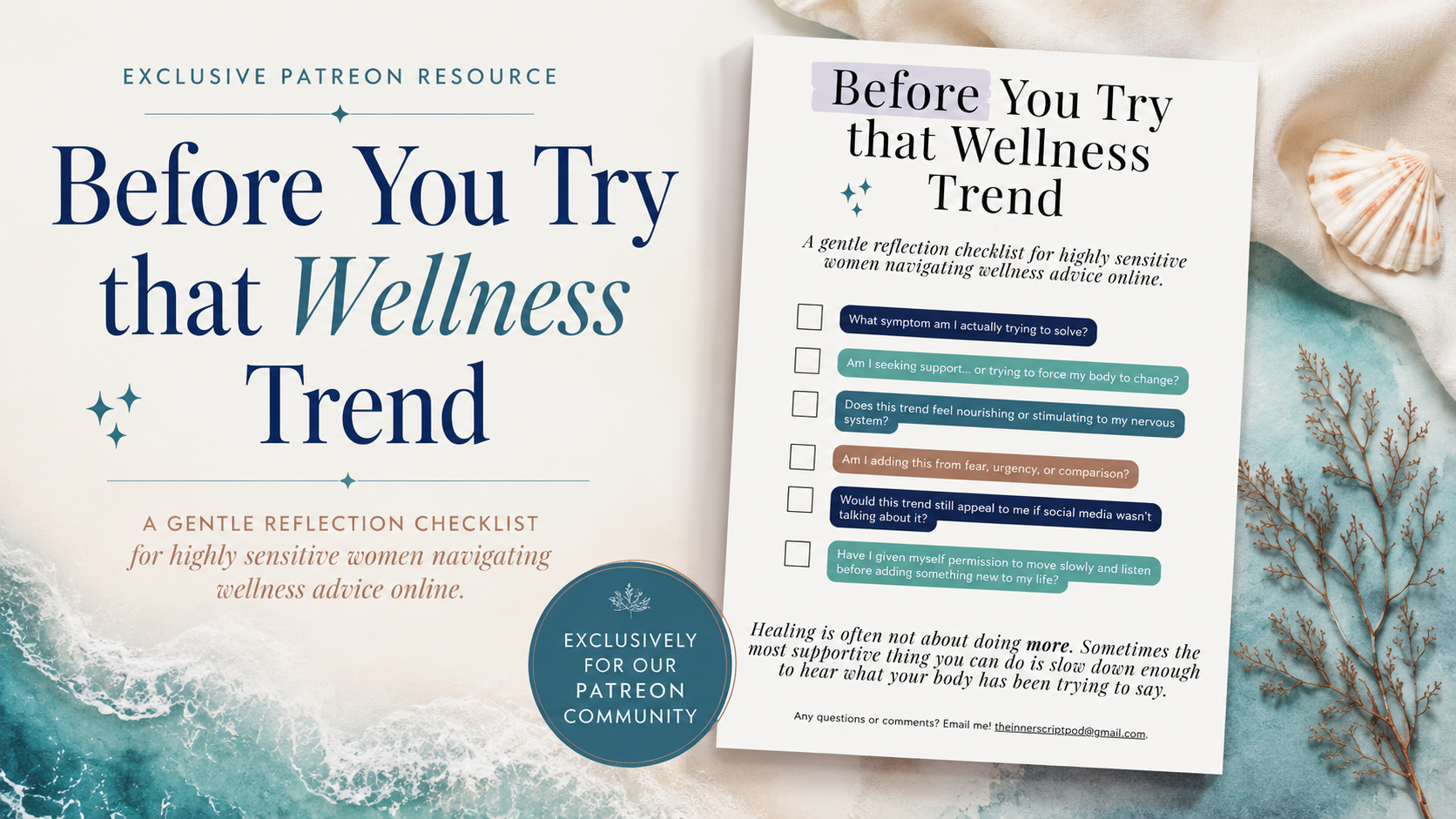
Checklist: Before You Try That Wellness Trend
This gentle reflection checklist walks you through the exact questions to ask yourself before adding any new wellness trend to your routine, so you can tell the difference between real support and one more thing to override your body with. Download it here: Patreon companion resource
You can also join Steph's free Patreon community here: The Inner Script Patreon

Meet Your Host: Stephanie Baubie, NP
Stephanie Baubie is an integrative nurse practitioner and the host of The Inner Script Podcast, where she explores the deeper stories behind health, healing, identity, and transformation. Through a blend of functional medicine, nervous system awareness, emotional insight, and honest conversation, Stephanie helps women better understand their bodies while questioning the narratives they’ve inherited about wellness, worth, and what it means to truly feel well.
On The Inner Script, Stephanie sits down with physicians, founders, thought leaders, and experts in women’s health, while also sharing solo reflections on the transitions and inner shifts that shape our lives.
Follow Steph on Instagram.
FAQs
Why do I feel worse after starting a detox or cleanse?
In this episode of The Inner Script, Stephanie Baubie explains that detoxification happens in three phases: activation, conjugation, and elimination. If phase one is upregulated too quickly without phase two and phase three keeping up, the body creates more reactive toxic intermediates without clearing them, leading to headaches, fatigue, skin flares, brain fog, and anxiety. Feeling worse during a detox does not necessarily mean it's working; it often means the body is overwhelmed rather than healing.
Can eating too much protein cause digestive issues?
Yes. Stephanie Baubie explains that protein digestion requires adequate stomach acid, digestive enzymes, bile flow, and a regulated nervous system. Without these in place, increasing protein intake can worsen bloating, constipation, reflux, and heaviness rather than improving energy or body composition. She emphasizes that digestion has to be addressed before protein intake is increased, not after.
Are liver flushes safe?
No, not without medical supervision. In this episode, Stephanie Baubie breaks down why the popular olive oil and lemon juice liver flush does not actually remove gallstones. The "stones" people see are a byproduct of oil and bile reacting, not pathological material being cleared. She warns that mobilizing real gallstones without guidance can cause a dangerous obstruction, cholecystitis, or a surgical emergency.
What is supplement stacking, and why is it a problem?
Supplement stacking is taking many supplements at once in hopes of quickly resolving symptoms. Stephanie Baubie explains that supplements cannot override chronic stress, poor sleep, nervous system dysregulation, poor digestion, or a sedentary lifestyle. She recommends building foundational health first through her six pillars framework before adding supplements to target specific symptoms.
How do I know which wellness advice is actually right for me?
Stephanie Baubie recommends discernment over blind trend-following. Because everyone's biology, medical history, and nervous system are different, what worked for someone else online may not be appropriate for your body. She encourages listeners to ask what symptom they are actually trying to solve and to slow down enough to listen to their own body before adopting a new protocol.
-
Everything shared here is for educational purposes and personal reflection only. Not medical advice. Always work with your own healthcare provider for individual care.
Hi everyone. Welcome back to the Inner Script. Have a good episode here today, and I am fired up. I am feeling a little feisty right now based on some of the things I'm seeing on social media. You know, this episode I'm gonna be a little bit more direct, definitely a little bit more fiery. It's because I wanna talk about the current trends in the wellness space that.
I'm really just not about, we're going to get into all of the things, but I wanna also preface this by saying, you know, I'm not doing this as a way to tear people down, or, you know, tear wellness influencers down in any, any way. But it's more in a way where I think we just need more discernment on social media when it comes to wellness trends, wellness fads, and just.
Understanding health and wellness on a deeper level, because what I'm seeing right now is a lot of health and wellness advice is being shared without context, without nuance, and really without an understanding of how complex the body is. And the result is that I think more people are more confused than ever, and they're also in this mindset that they need to do more, try harder, be more disciplined, do more protocols, and they're just still feeling off.
And I want to ground this. Into something personal for a second, because I've been on both sides of this. You know, there was a period in my life where I was doing everything, quote unquote, right, when I was going through a lot of my health issues and I was eating clean, working out regularly, and consistently taking tons and tons of supplements, and I had the discipline, I had the knowledge.
But I still felt completely off. My sleep was off, my hormones were outta whack, my skin was flaring. I was exhausted, but also wired. I felt so disconnected from myself and I kept thinking, you know, what am I missing? And the truth was, I really wasn't missing anything. I was doing too much. I was, again, completely disconnected from my body and my own needs and in my own even awareness, self-awareness of what would work for me in this moment.
That's what I think a lot of this health and wellness. Trends and fads on social media is because we're seeing somebody successful in doing a specific protocol or supplement or whatever it is, and then we have this expectation that it's gonna work for us. Then we do the thing and it doesn't work, and we feel really bad.
About it, and it's kind of we internalize this belief that, okay, well there just must be something wrong with me when in reality all of our biology is different. Something that is gonna work for somebody won't work for you based on so many factors, anywhere from your family history, your own medical history, your age, your gender.
Anything. So we're not taking that into account. And it honestly frustrates me because I'm seeing this over and over again in my patients and they feel very frustrated. Okay, so before I get into this specific trends, I wanna start with something really important. This is where I think the line gets blurred if you've gone through a chronic health condition.
You absolutely become an expert of that condition in your own body. I wanna preface that so much. 'cause I truly believe you become an expert of your own body and how that condition is affecting you. Nobody knows that more than you, even if you don't have medical background, whatever. Like I've seen that time and time again, and I want to offer that respect.
Just acknowledging that. Like a thousand percent because of that. Whatever symptom or condition you have dealt with, you've experimented, you've paid attention, you've had to advocate for yourself. You've done research, you know this inside and out, and that really matters. But for me, this is where it gets a little nuanced and where.
There is a difference. So there is a difference between understanding your body and knowing how to safely guide somebody else's. And that's the piece I think that's getting lost in all of this, because what I'm seeing is someone finds something that works for them with good intention, they wanna turn it into advice, which makes complete sense, but then this turns into a protocol or a framework and this is what works.
But health does not. Work like that, and your body is not someone else's body. Your root cause is not someone else's root cause, and what helped you could actually harm somebody else. There's also a massive difference between information, researching, having knowledge about a specific condition or multiple conditions, and then applying it clinically, applying it to people.
With different biologies. You know, you can read studies, listen to podcasts, research for hours, but applying that information to a real human being with a unique physiology, a unique nervous system, a unique lifestyle, a unique medical history, that is a completely different skillset. And I will die on that hill because think of it like me.
If I said I went to nurse practitioner school but never treated a single patient, would you trust me? I hope not because it's a completely different ballgame going into a room with a patient having knowledge about a specific condition, symptom, anything. And then applying it, diagnosing it, the treatment protocol, it's never going to be the same.
I'm gonna give you an example, which I was honestly wary about sharing Something that happened to me when I went on a retreat and there was an option to do a BOD pod. Where it's basically like you get into this contraption, it measures your body fat percentage, and at the time I was dealing with a lot of water retention due to some hormonal imbalances.
Definitely would not have gotten that thing I'll say. But afterwards it showed my body fat percentage being so much higher than I anticipated, even at my least active. My heaviest, my body fat percentage was never that high, so I was like, this doesn't seem right. I realized, I was like, oh, okay. It's probably the water retention could be falsely showing up as body fat on there.
Anyways, I told the person going over the results with me that, you know, I've been retaining a ton of water because I was very confused about the result. She told me that if I was retaining water, it would show up in the muscle mass and not in the subcutaneous fat or like the lymphatic system. I get what she is saying, where after exercise or if you take creatine, that naturally pulls water into your muscle tissue and you get that swollen.
Feeling like your muscles swell, but this is not what was going on with me and what she was telling me about what was going on with my body was false. And I confirmed this after researching because I was like, this doesn't make sense. Okay, so I confirmed this after researching with the BOD Pod, that water retention from any source, including lymphatic fluid accumulation that can go into your subcutaneous or your fat tissue.
Would be misclassified by the BOD POD as increased fat mass rather than lean mass leading to an artificially elevated body fat percentage. And again, my point in sharing this is not to shame this woman at all. She was acting in a way of trying to help being well intentioned, and she is extremely knowledgeable about health nutrition.
Wellness, all of it. But my problem is that people are giving health advice and interpreting data without the clinical background or knowledge. And this can be dangerous because of the high reading. She was telling me I needed to get more steps in on a daily basis. And what she didn't realize is I walked to and from work, I was walking 10,000 steps a day at least, and then she was trying to tell me that I needed to increase my protein consumption.
In that moment, the last thing I needed to hear was that I should be doing more. Telling me to increase my protein intake without asking about my digestion first is a big, big no-no. Basically, let's take away some things. We need better discernment when going over health information and data. You need to understand how the body works, physiologically, hormones, all of it.
Yes. So we need to have more clinical background. In order to apply this information and to just better understand everyone's physiology 'cause we are all coming from a different place in terms of medical history and our demographics. Biggest lesson here, if you are retaining water, do not get into a BOD pod or anything that measures your body fat percentage.
Lesson learned. One other thing I want to mention. About just people getting health information. And this goes to my patients. So I've had so many women come to me struggling with how to lose weight, and almost all of them are in a significant calorie deficit while also doing really intense workouts.
Often they're eating around like 1300 to 1500 calories per day. Based on recommendations from a health coach, and if you're exercising regularly, especially strength training, this is just simply not enough food. It's not enough calories. I wanna emphasize, yes, a calorie deficit is necessary when you want to lose fat, but it has to be appropriate for your activity level or else it can backfire.
And I wanna be clear. There are amazing health coaches out there, but it really concerns me when women are being guided into such aggressive calorie deficits. It's not sustainable. It's going to wreck your metabolism. It'll wreck your hormones at some point, and it will make it impossible to see results.
To lose weight. I could honestly do a whole separate episode on. Undereating calorie deficits, all of the things. And if you grew up in the early two thousands, we really went through it when it comes to food. And there is a lot of unlearning we need to do when it comes to fueling our bodies and nutrition in general.
Now going into the trends, so we're gonna start with the high protein trend. I mentioned this a little bit with my own personal experience, but let's start with the high protein trend. So I wanna be very clear, I am not anti protein. We need protein. Protein is so important for neurotransmitters, building muscle, lean mass, keeping us full.
Great for hormones like yes, a thousand percent. But what I am seeing right now is that this push to increase our protein is more, is always better. And clinically that is just not true. It is possible to eat too much protein, and I've had multiple female patients recently. Who are intentionally trying to increase their protein intake, doing everything right based on what they're seeing online, and they're coming in with really bad digestive issues, whether it's bloating, heartburn, reflux, constipation, just overall like heaviness in discomfort in their abdominal region.
They're confused or like I'm doing the protein thing, but I feel worse because they're thinking, you know, I thought this was supposed to make me feel better. But protein digestion is complex. Like you don't just eat something and there you go. You have to be able to digest it so that you can absorb it, and that is what's getting missed.
So. When you are increasing your protein consumption, you need adequate stomach acid, proper enzyme function, healthy gut lining, and a regulated nervous system. And this is where people are missing the bigger picture. I hear this from women all the time where they're meeting with somebody and they're told to increase their protein consumption, but they're not asking how their digestion is.
And that is just like such misinformation. Anytime you make a dietary change or nutrition change. The clinician or whoever you're seeing, they have to ask you about digestion. If you're constipated, it's not gonna work. You're not going to absorb whatever nutrition or diet change you were doing. So if you are already constipated or bloated, or dealing with heartburn or reflux, protein is not the solve.
We have to focus on the digestion aspect first. Get, you'd have daily bowel movements, reduce the bloating, reduce the reflux, or else increasing the protein will make it worse. Let's talk about the nervous system layer. You cannot separate digestion from nervous system. Hello, been there. So if you are in chronic fight or flight, cortisol is haywire.
Your body is not prioritizing digestion. So blood flow shifts. Enzyme production decreases, motility changes. So now you have someone who is eating quickly, stressed, overscheduled, multitasking, and trying to hit 120 grams of protein every day, and their body is overwhelmed. It's not a protein problem. It's a system problem.
I can't emphasize this enough. It's not just about what you eat, it's about what your body can actually process. Now, let's talk about detox, because this is probably the trend that concerns me the most. And detox is not something you do for seven days. Your body is detoxing every single day. So with detox.
There are three phases of it, which I think is extremely important to understand because if you don't detox appropriately, you're going to feel worse, and it can be really, really dangerous. Your liver is the main organ for detoxification, and there's three phases. Phase one is activation. This is where toxins are broken down, but here's the catch.
This phase actually makes toxins more reactive and more harmful. Temporarily. So if you're doing phase one too fast, you're going to get a detox reaction and feel like crap. Phase two is conjugation, where this is where those toxins are neutralized, where they are made into less kind of harmful or less.
Unpredictable solvents and they're made safer and they're made water soluble so you can excrete them. And phase three is elimination. This is where toxins are removed through bile, stool, or urine. So this is why this matters if phase one is upregulated, but phase two in phase three are not supported. You are creating more toxic.
Intermediates without clearing them. So say you're working on the phase one detox pathway, you're going to feel worse because it's working way too fast for your liver to keep up with phase two to conjugate the intermediates so that you can excrete them. So this is where a lot of people can have detox reactions if they're upregulating phase one, before phase two and phase three have been addressed.
So you have to treat detox. Backwards starting with phase three. Otherwise, as I have mentioned, you'll have detox reactions. So this is why a lot of people can have headaches, fatigue, skin flares, brain fog, anxiety, which those are, can be common detox reactions and sometimes. Yes, when we're kind of opening up our detox pathways, sometimes like mild forms of these can happen and can be normal, but it's more of these like severe things where people are like breaking out in hives or you know, acne flares or feeling terrible.
Like I don't really think that's normal or really should be happening. And I will say, I've had patients come to me after aggressive detox protocols and they feel. Crap. They feel terrible and they think this must mean it's working. And that is one of the most dangerous narratives out in the wellness space right now.
Because sometimes feeling worse does not mean you're healing. It means your body is overwhelmed and we are upregulating certain parts of our detox pathways that we're not ready. So. Detox is not about mobilizing toxins, it's about safely processing and eliminating them.
Hey friend. If there's someone in your life who you think would also love this conversation, please send them this episode. Sharing it with a friend makes you look like the exceptional friend that you are. Oh, and it helps the podcast grow too. Thank you.
So this brings me to the liver flush trend, which I can feel myself getting frustrated right now.
It's basically where people are drinking like a half a cup of olive oil, lemon juice, thinking that they're passing stones. From their biliary system, like their gallbladder. First thing I wanna preface is you never want to mobilize gallstones without medical supervision. Second, those aren't even gallstones coming out with this concoction, and this is where misinformation becomes dangerous and.
When you are drinking that concoction, what happens is there's a chemical reaction between oil and bile, and it creates these globules almost that look like stones, but it's just the byproduct of the bile, emulsifying, the fat. This is where it can be become dangerous because people think they're removing something pathological.
When they're not, and again, if someone were to actually have gallstones, this can be extremely risky because if you mobilize gallstones too fast, say you have multiple, any shift of the gallstone in the biliary system can cause an obstruction. Cause cholecystitis or a gallbladder attack, which can lead to a surgical emergency.
This is not like a one size fits all approach. So yeah, like I can't believe this is out there. So that's all I'm gonna say about that. So just be careful. Discernment is everything. Next trend. Let's talk about supplement stacking another trend I'm not about and I've been there. Myself with the supplement stacking, if you spot it, you got it.
Been there. This is when people are taking 10, 15, 20 supplements a day and still not feeling better because supplements do not override chronic stress. Poor sleep, nervous system dysregulation, poor digestion, a poor diet, sedentary lifestyle. And sometimes the more someone takes, the harder it is to understand what's happening.
And you know, we talk about people taking multiple medications, you know, polypharmacy. In my mind, I'm like, what's the difference between taking multiple supplements? We're not addressing the underlying issue by taking the supplements we have to address our foundations. Of what I call are the six pillars, diet, digestion, movement, sleep, stress management, and detoxification.
We have to build our foundation and then maybe we can add some supplements in to address some of the chronic symptoms we're dealing with. One other thing. I want to mention with specific supplements is the probiotic fad, which believe me, probiotics can be absolutely amazing, but I think they get over recommended for digestion issues without managing the true upstream driver of digestion issues.
Again, it can be way more upstream than just the microbiome We're we're talking about. People need enough stomach acid, digestive enzymes, and bile to break down their food in a probiotic. Won't do that. So taking a probiotic can make people feel worse because we are not addressing the upstream issue.
This is why I emphasize bile flow and digestive enzymes so much. We have to get these things on board and flowing before taking a probiotic. So sometimes we need to strip things back and kind of go even more back to the basics and not add more. Because your body doesn't do well with overwhelm. It just needs clarity and simple.
And then there's optimization culture, which I get it. People wanna, you know, optimize their health, optimize their labs. I'm all about that. But you know, we're seeing people doing cold plunges for five minutes a day. Fasting for 18 hours, high intensity routines five days a week, and all of these things have the potential to tax your adrenal glands, which can lead to cortisol dysfunction.
So especially if you are already in a stressed state or a depleted state, this is gonna make you feel worse. Not everyone can handle cold plunges hit. Or fasting, and this is why it's so important to be getting a careful medical history and understanding symptoms and physiology and understanding how adrenals play into our health when we are going to these extremes.
Then we layer all of this on top of bodies that are already overwhelmed and we're continuing to do too much. And I see this a lot in women and women fasting aggressively, training intensely undereating, overriding their bodies while dealing with stress and hormonal fluctuations and the body. Pushes back, it will inevitably, it's going to make people feel worse.
Then we start to see menstrual cycle changes, sleep issues, fluid retention, and the response is, well, I'm not doing enough, so I gotta do more, push harder, when really the body is asking for less. This is where I wanna talk about. Discipline. Getting into discipline because growing up, this is something I heard in the health and wellness space all the time, is like with workouts.
Well, you know, you need to be disciplined. You gotta get the workout in and discipline is praised. Look, I get it. Some form of discipline is necessary. We need consistency. But what I see happening is discipline being used to override the body. That's never okay. And when you're exhausted, you force the workout, you're craving something, you ignored it.
You're just like, oh, gotta quiet the food noise. When cravings are clues, not problems, like it's telling you that you maybe need to eat something in your diet that you're not currently getting, you're depleted. You push through and we call that discipline. Which is sad, and sometimes I would say most times that's disconnection because we are not tuning in with what our body actually needs in that moment, which is probably rest.
So your body is always communicating cravings are information fatigue. Information. The question is, are you listening? And I think we need to reframe all of this where rest is productive. With all of these health and wellness fads, we really need to be doing so much unlearning out there. I know people are extremely frustrated with the health and wellness space and traditional primary care western medicine.
Believe me, I get it. I worked in it. I've been a patient in it and I understand people are looking elsewhere for health information, which again, like I completely understand, but we need better discernment and regulation of what is being shared on social media because I know there's a lot of. Very well intentioned people out there trying to share what worked for them, but we need to have more medical knowledge to be able to apply this information to people with different biologies, different physiologies, and that is my biggest takeaway with this, because otherwise it can and will get dangerous.
To sum this all up, we are constantly looking outside of ourselves for the next protocol. The next trend, the next solution, instead of asking what does my body actually need? Healing is never about doing more. It's about doing what is right for your body at the right time. And that really requires presence and stillness.
And I know that sounds corny, but it's true. It requires slowing down enough. To actually hear yourself because your body is always giving you information. The question is, are you listening? So to close this, you are your own healer, but not without discernment. Not everything that's popular is right for you.
Not everything that works for someone else will work for your body. That takes awareness, honesty, and self accountability, and most importantly, the willingness to trust yourself over the noise. That's the work, not trends, not fads tuning back into yourself because your body will never lead you. Into the wrong direction.
It will always lead you to the truth and what you actually need. Alright guys, that's all I gotta say about the wellness fads out there, who I'm feeling feisty. I'm clearly getting frustrated with those fads out there because. You know, I've seen it in myself. I've seen it in my patients where they're kind of getting information that is making them feel worse, and there's just continues to be a lot of unlearning that we have to do.
There's a lot of mistrust in the healthcare system right now, which I understand, but I think we all need. To be doing better when it comes to sharing information and really understanding that our biologies are all different and protocols are not going to necessarily work for you if it worked for somebody else.
So I know I'm sounding like a broken record, but. Thank you guys for listening. Always a pleasure. So fun to chat with you guys. Let me know what you think of this episode. Feel free to send me a DM on Instagram at the inter script pod rate review, subscribe. Love you guys. I'll see you next week.
If you wanna connect with like-minded women and dive deeper into these conversations, join my Patreon community. There's a free option and it's where we can talk about each episode together. The link is in the show notes and I can't wait to see you there.
Disclaimer
Everything shared in this episode is for educational purposes and personal reflection only. It is not medical advice. Always work with your own healthcare provider for individual care.
We sometimes include links to products and services we find interesting. These may or may not be affiliate links. Thanks for your support.
Podcast production by Jamie Brooke.
