Why Healthcare Feels Broken | The Truth About Provider Burnout, Patient Frustration, and the System No One Talks About
Listen now by clicking your favorite podcast app below:
What if patients and providers aren't actually on opposite sides, but both stuck inside the same broken system?
In this honest solo episode of The Inner Script, Stephanie Baubie shares a side of healthcare that rarely gets talked about openly. Drawing from her experience as both an integrative nurse practitioner and a patient, she unpacks the growing tension between patients and providers, and why so much of it isn't personal at all. Patients feel dismissed. Providers feel burnt out. And both sides end up blaming each other for something neither of them created.
Stephanie walks through what's actually happening behind the scenes of a rushed appointment, from back-to-back scheduling with no built-in breaks to the invisible mountain of charting, messages, and prior authorizations that pile up after hours. She shares her own breaking point as a clinician, including a moment she snapped at a patient and what that taught her about triggers, nervous system overload, and the difference between a bad provider and a depleted one. It's a rare, behind-the-curtain look at what burnout and compassion fatigue actually feel like from the inside.
This episode also makes space for the patient experience, validating what it feels like to walk away from an appointment feeling unheard, while offering a different lens on why that appointment may have been rushed in the first place. Stephanie's message isn't to excuse poor care, it's to show that patients and providers are often navigating the exact same broken system from opposite sides, and that healing happens more easily when both sides extend a little more grace.
This episode is for you if…
You have ever felt dismissed, unheard, or frustrated by healthcare experiences
You work in healthcare and feel emotionally exhausted or burnt out
You want a more honest conversation about what is really happening inside the healthcare system
Episode Timestamps
00:00 Introduction
02:10 Patients vs. providers narrative
06:05 Why appointments feel rushed
10:30 How healthcare dysregulates providers
15:12 Cost of back-to-back care
20:28 Stephanie's breaking point as clinician
27:50 Triggers as overload, not weakness
34:18 A perspective-changing patient story
48:15 What patients and providers share
53:46 Healing vs. efficiency conflict
Resources & Mentions
The Body Keeps the Score - referenced when Stephanie discusses how unaddressed stress shows up physically in patients
Curious about a supplement Steph has mentioned in the episode?
If you’re looking for products Steph personally recommends in practice, you can browse her dispensary here: Stephanie’s Fullscript dispensary
Please consult your healthcare provider before starting any new supplement. Food, lifestyle, and nervous system support always come first.
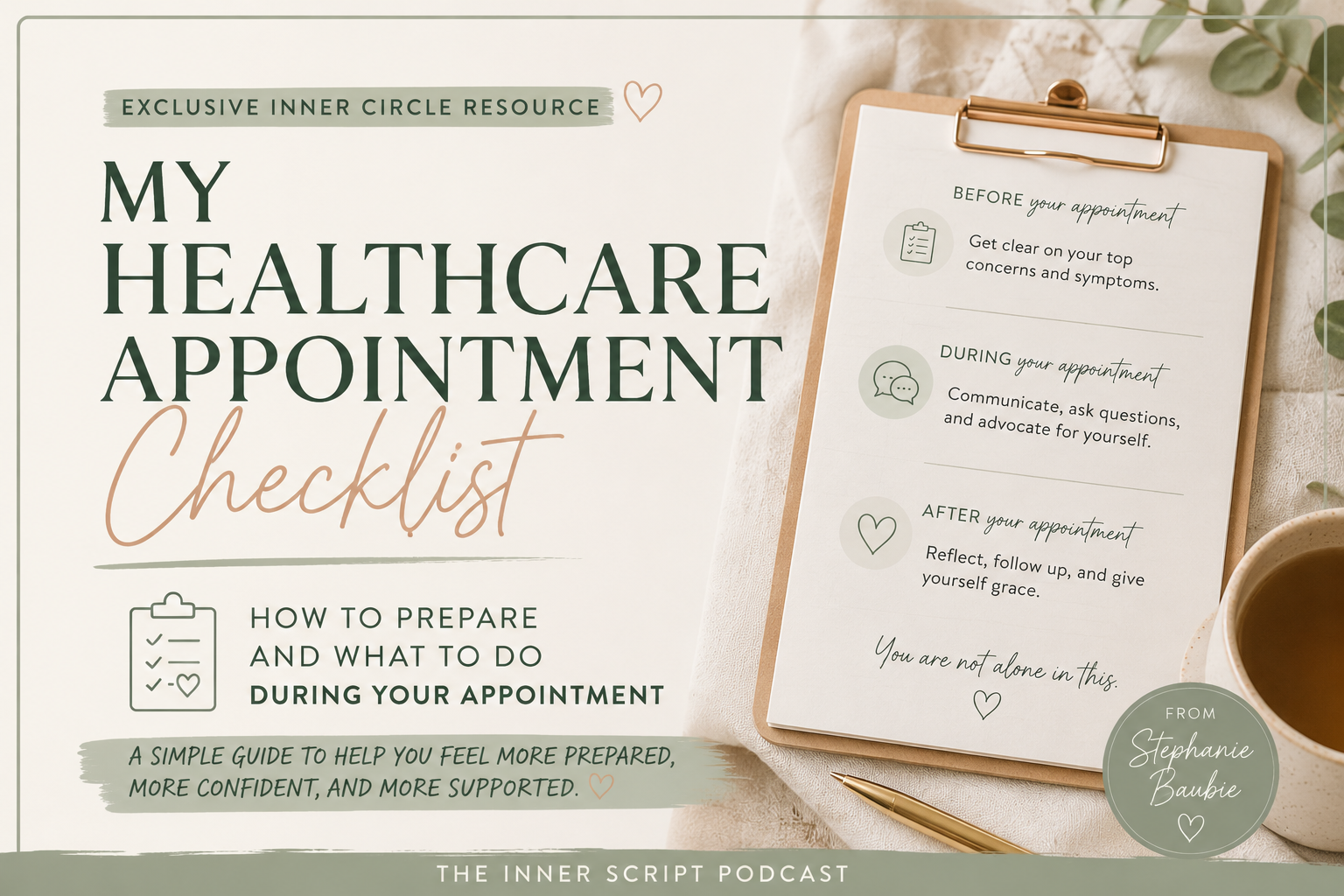
Free Guide: My Healthcare Appointment Checklist
This free checklist walks you through exactly what to do before, during, and after your next appointment, so you can walk in prepared, speak up with confidence, and leave feeling heard. Download it here: Patreon companion resource
You can also join Steph's free Patreon community here: The Inner Script Patreon

Meet Your Host: Stephanie Baubie, NP
Stephanie Baubie is an integrative nurse practitioner and the host of The Inner Script Podcast, where she explores the deeper stories behind health, healing, identity, and transformation. Through a blend of functional medicine, nervous system awareness, emotional insight, and honest conversation, Stephanie helps women better understand their bodies while questioning the narratives they’ve inherited about wellness, worth, and what it means to truly feel well.
On The Inner Script, Stephanie sits down with physicians, founders, thought leaders, and experts in women’s health, while also sharing solo reflections on the transitions and inner shifts that shape our lives.
Follow Steph on Instagram.
FAQs
Why do doctor appointments feel rushed even when providers care?
In this episode of The Inner Script, Stephanie Baubie explains that rushed appointments are usually a system issue, not a sign the provider doesn't care. Providers are typically scheduled back-to-back with no built-in breaks, while also managing charting, labs, messages, insurance tasks, and administrative work behind the scenes that patients never see.
Why are so many healthcare providers experiencing burnout right now?
Stephanie shares that provider burnout is often more than everyday stress. She discusses emotional overload, nervous system dysregulation, compassion fatigue, and the structural pressures of traditional healthcare systems, including constant patient volume and little to no time to decompress between visits.
Can working in healthcare dysregulate your nervous system?
Yes. Stephanie explains that healthcare environments can create chronic nervous system overload through constant co-regulation, time pressure, and the expectation to continuously hold space for others without recovery time. She describes this as one of the most under-discussed causes of burnout among clinicians.
Why do patients and healthcare providers sometimes feel disconnected from each other?
Stephanie explains that patients and providers are often experiencing the same root problem from opposite sides: a healthcare system that leaves both sides overwhelmed, unsupported, and frustrated. Rather than being at odds, she argues both groups have far more in common than the current dynamic suggests.
What should I do if I feel dismissed by my doctor?
While validating that feeling dismissed is a real and painful experience, Stephanie encourages patients to keep advocating for themselves clearly and directly, while recognizing that a rushed or short interaction is often a symptom of system-wide time pressure rather than a lack of care. She emphasizes that self-advocacy and understanding the system aren't mutually exclusive.
Why do providers sometimes get blamed for things outside their control?
Stephanie shares personal examples of being blamed for billing errors, insurance coverage decisions, and appointment delays that were entirely outside her control as a clinician. She explains how patient satisfaction scores and public frustration often land on the provider, even when the root cause is administrative or systemic.
How can patients and providers create better healthcare experiences together?
Stephanie suggests that better healthcare experiences start with mutual grace: patients continuing to advocate for themselves without assuming the worst, and providers being honest about their own capacity and triggers. She reframes the patient-provider relationship as a two-way dynamic where both people are navigating the same imperfect system.
-
Everything shared here is for educational purposes and personal reflection only. Not medical advice. Always work with your own healthcare provider for individual care.
Hi, everyone. Welcome back to The Inner Script. So have a good episode today. We got another bold one because I'm feeling it. I'm feeling feisty, and it's really something I wanna talk about because I don't think it gets said out loud enough. It's really about the healthcare system, but more specifically, this underlying tension I've been noticing over, definitely over the last few years between patients and providers.
You know, what I've been noticing more is that it's this- kind of almost unspoken battle between the two. Patients feel dismissed, providers feel burnt out, and both sides are frustrated with each other. And I know this is a huge generalization, but it's more so just kind of as a clinician, I would say over a majority of the interactions I've had with patients have been absolutely wonderful and I've built amazing relationships with my patients.
But I just think it's kind of this unspoken aspect of it when clinicians or patients have a bad experience or a poor experience. It's kind of those handful of times where it just kind of becomes this unspoken battle between the two. It kind of goes back to patients are feeling dismissed Providers feel burnt out, and both sides are frustrated, and sometimes it's at each other.
You know, here's the truth. We are not the problem. Providers are not the problem. Yes, there are bad apples out there, 100%, when it comes to clinicians or providers, but generally speaking, I will say that we're not the problem, but it's the system. The system is the underlying issue. And what's happening right now is that patients and providers are almost being pitted against each other when, in reality, we are both getting screwed by the same system.
The reason why I'm talking about this is because I want to speak on this from both sides as someone who worked in a traditional healthcare system, got completely burnt out and left, and also as someone who has been a patient and has had negative experiences, have walked away in tears, has felt dismissed.
And I can clearly see the flaws from both perspectives, and there's just a massive disconnect right now, and I want to bring more clarity to it. I just want to be clear, the experiences I'm going to be talking about in, like, my own experiences, this has nothing to do with kind of my job right now. As I've mentioned, I love my job right now.
These are past experiences that I've had, and I just want to make that clear because I love where I work right now. And again, it's not in a traditional healthcare system, so... and I don't really think that's a coincidence, or I know that's not a coincidence. Let's bring up the patient experience first because what I hear over and over again from patients is, "I don't feel seen.
I don't feel heard. My appointment felt rushed." And that is real. That experience is valid. Your appointment was probably rushed, but sometimes we stop the questions too soon and don't ask why. Naturally, that frustration gets directed at the clinician. They don't care. They're cold. They're rude. They're incompetent.
They suck, which, yeah, all of that has been said to me about other clinicians. And, you know, it's also all, all over social media, this fear-mongering about how awful clinicians are. The lab test your doctor won't order from you, what your doctor is hiding from you. The clinician in me is like This needs to stop.
Like, this is outrageous. Like, no, we are not hiding anything. But the patient in me gets it. I'm getting t- like, kind of dual vibes to it almost. Like, I am annoyed on one token, and I get it on the other. So I can only imagine how you guys feel. Because when you're not feeling well and you're looking for answers, that kind of interaction or lack of interaction feels really personal, and I get it, especially I've been there.
I've had family members, and it, it feel just a lot of anger, frustration, and I'm here to say I totally get it. But here's what most people aren't seeing It's not that clinicians don't care, it's that they are operating in an environment that it makes it almost impossible to show up the way they want to.
Because what actually sucks is not the clinician, it's the system they're working in. And to kind of take this a step further, many of us went into healthcare because we love people. We're compassionate, we're caring, we love that kind of caretaking aspect of, in us. Then we get into medicine, and I hate to say it, a lot of us question if we made the right decision.
I've had colleagues, we've talked about it, and it's really the environment that we're in. It's not necessarily what we're doing. It's all about the environment. Let's kind of further paint the picture. Clinicians are expected to see patients back-to-back. We don't have breaks in our day. It's like 8:00 to 8:30, 8:30 to 9:00.
It's not like I get a five-minute break in between patients. This is when I was in a traditional healthcare system, I'm just clarifying. Never, ever did I have a break unless a patient canceled on me. On top of that, patients are getting more complex. They're sicker than they were decades ago, but appointments are not getting longer.
How does that make sense? Now, with AI, there's a pressure to see even more patients. At my last job, they were adding how many patients we were going to see per day before I left. I can't believe that. And then now with AI, there's pressure to see even more patients because there is this assumption that, well, now that documentation is faster- You can handle more.
But here's the problem. Number one, you're still reading the note. You have to fact check it because sometimes it says things that doesn't even make sense. But on top of that, admin work and patient care are not the same thing. It's like comparing apples to oranges, and I said this until I was blue in the face at my last job where, like, reading notes is not the same as holding space for a human being.
Charting is not the same thing as making decisions. Charting can kind of be mindless sometimes. When you're interacting with somebody, that takes everything out of you. That's a whole other ballgame when it comes to working in healthcare. So it's just beyond frustrating.
As I mentioned, seeing patients, it's exponentially more draining, and then now people are getting expected to see more patients, and it's like, "No, you guys are missing the point here."
And then this is where I want to take this deeper because it's not just a broken system. It's also a dysregulating system. And I actually have a theory. It's kind of bold. It's that people working in traditional healthcare systems may be some of the most dysregulated people in society, which sounds kind of crazy.
I also know that's a big statement, but hear me out, and I'm saying this in terms of clinicians, but I think this can actually apply to, like, medical assistants and even administrative staff. But we are expected to give health advice all day long, interact with people all day long, interact with people who don't feel well, who are not at their best, which is completely understandable.
But we are operating in a system that actively makes it hard to be regulated ourselves, and the system doesn't really care how we are doing. They just want us to get the job done, and that's kind of how it felt for me. You know, that's my experience. I can't say wholeheartedly that they don't care, but that's how I felt.
Let me give an example. We're unable to block our schedules as a clinician, and I get that to some degree where people might take advantage of that. But there have been times I needed to block my schedule for 30 minutes to meet with my doctor virtually, and I was told I needed to make that 30 minutes up or take PTO.
And you might be sitting there thinking, "Well, that makes sense." But does it? Does it make sense that I need to make up 30 minutes or take PTO for a doctor's appointment? On top of it, it's a doctor's appointment, it's for my own wellbeing, and I'm getting penalized for it. And I understand if it's like- Taking the morning off, different story, but 30 minutes?
I just felt like there was just so much of this, like, push-pull dynamic where I had to just advocate for myself all of the time when I was at work if I really needed something or to do something for me. It was just this... I don't know. I just, I never felt like my wellbeing was taken into consideration.
And maybe I'm being sensitive about it, but here we are. Kind of going into this dysregulation and the nervous system because I definitely dealt with that. I lived it for many years. You know, we are expected to be calm when someone is spiraling, be compassionate when we haven't eaten, be precise when we're running behind.
We're expected to be the emotional container for patient after patient. And that doesn't even include the invisible work, you know, getting hundreds of messages each week, labs, imaging, refills, prior authorizations for medications and imaging, charting, inbox overflow. And there is no space built in to decompress.
No reset, no pause. So the question becomes, how are we supposed to stay regulated? Like, truthfully, how? I hear all the time how people are in meetings back to- you know, people who don't work in a traditional healthcare system are in meetings back to back all day long and are completely drained. Well, that's a clinician in a traditional healthcare system every day to add some perspective.
Healthcare is uniquely dysregulating because there's, number one, constant co-regulation. You're holding fear, grief, panic, anger all day for other people, and no one teaches you how to release that. You're supposed to hold your shit together no matter what. But if you aren't actively regulating yourself, that tension is gonna store somewhere, and it's gonna stay trapped in your body.
There's no completion. There's no closure. Your nervous system never gets the signal, "Okay, we're done. You're safe. Let's go home." And it's just this constant time pressure. You know? There's urgency to get to the next patient so you, that you don't become behind, and then that leads to adrenaline, and then that leads to burnout, and eventually you get moral injury.
I would be at work knowing what patients needed, and I just felt like the system didn't allow me to give it. And there were times where my 100% effort was 10% because that's literally all I had in the tank. And I know that sounds icky But it's honest. There's this professional mask where you walk into the room and you suppress everything.
If you had a really difficult conversation minutes before, you're just putting this mask on, numbing out, going on with your day and pretending like you're fine. And that suppression shows up somewhere. So what's the result of all of this? What happens? Burnout, compassion fatigue, disconnection from ourselves, even from our social lives.
Like, I've been there. There were times I would be walking home from work, and I couldn't speak to a single individual because I was so tired. Like, I- Couldn't answer a phone call from a friend because I was so tired. Like, that's not normal. I thought that was normal at the time, but that's not normal. You know, on top of it, providers are leaving traditional healthcare or medicine altogether.
You know, I really don't blame them because I did the same thing. I wanna say most of my worst reactions used to happen at the end of the day, usually after I'd given everything to someone right before, somebody who really needed it, and that's completely fair. That's why I was there. I remember one patient in particular.
She was in a really negative head space. She was anxious, and we've all been there. All she needed was some compassion and some TLC. She had a lot going on in her life that she wa- just wasn't happy about and completely relatable. I've been there 1,000%. And she was experiencing these chest sensations that we had fully worked up, full cardiac workup.
Everything was normal. I explained it sounded like stress. She said she didn't feel stressed, and I offered therapy, which she declined. Supplements, declined. Medication, didn't want it. And every recommendation I offered she declined, and she has every right to do that. She is the owner of her body. What she says goes, and I completely understand that.
You know, she just told me, she's like, "I just want to know exactly what it is." And I remember thinking, "I am telling you what it is. Your body is expressing and experiencing stress." Body holds the score, and no matter what I said, it just... You know, she wasn't in agreement with me. At the end of the visit, she asked for a pap smear that was not going to be covered by insurance because it hadn't been a full year.
And I explained that insurance wouldn't cover it, and she said, "Well, that's really annoying." And I snapped, and I'm not proud of it But I snapped. It wasn't because she was wrong. It wasn't because she was difficult. It wasn't because she declined every recommendation I gave. It wasn't that at all. I consider myself to be a very patient person, and once I get to that point, I know there's something wrong.
It was because I had nothing left in the tank. I was done for the day. But sometimes You don't have the choice. You have to keep going. My body was screaming at me, and that moment really taught me my nervous system wasn't reacting to her. It was reacting to being at capacity for months on end, and that's what triggers are in healthcare, and that's what I think many clinicians have dealt with, where it's not about the person in front of you.
It's the cumulative load of what you are doing, and at some point, your body will say, "I've had enough," and that is never a signal to ignore. Every time I have a negative interaction with a patient, I always ask myself, "What could I have done better? What could I have done to avoid my reaction?" And I remember walking home that day 'cause I felt really bad about it.
I felt really, really bad because I didn't like that I snapped. I really liked that patient. I truthfully did. But it was almost like my reaction was automatic. Like, I felt like I lost control, and it was because I was so dysregulated, and I needed to be done for the day, but I couldn't. My body was just screaming at me that I was done for the day, but I had no choice.
And I get it. Many of us do not have a choice when we feel done. But again, the-- I'm just saying the cumulative load of being a clinician in a traditional healthcare system. So overall, there's this misunderstanding that patients think the provider doesn't care, and providers feel, "I have nothing left to give.
Like, how am I gonna get through this visit?" I can't tell you how many times I thought that. Now both sides are frustrated when they're actually experiencing the same root problem. I wanna give you another real example from my own experience, because I think this is where things can get misunderstood, where clinicians are really blamed for things they have no control over.
Zero control, and we're the one that gets blamed because we're the patient-facing person. So every negative experience that kind of happens, it's go- going to get blamed on the provider, which I get it, but it also can suck at the same time if that happens. I had a patient who was struggling with substance abuse disorder.
He was non-compliant. He didn't know his medical history. He would be hospitalized for an extended period of time and come back with no information, not knowing what happened, just assuming I knew everything. And I was essentially trying to manage very complex chronic conditions with almost no context.
He couldn't tell me, like, a single thing. On top of that, he no-showed 16 times, somewhere around that. Like, I'm not exaggerating. It was, like, over 10 times. At a certain point, I had to have a really difficult conversation with him, not from a place of judgment, but from a place of, "This isn't safe anymore."
And I told him, I was like, "You have to participate in your care if this is going to work." You know, a patient-provider relationship is like all other relationships You know, you have to show up, and I think sometimes that doesn't get thought about. We each have to bring things to the table. We both have to show up and take accountability for our health.
He would also come into appointments under the influence, and it was really hard to navigate, and it felt incredibly frustrating because I felt really bad for him and I didn't know how to help him at times. It was a very emotionally heavy conversation that I had to have for him, and honestly, like, very high stakes and we had a really great outcome from it.
But that conversation ended up being this breakthrough moment for him, but it also meant that the appointment ran over 20 minutes and because of that, I was late to my next patient, a brand new patient. And they rated me a 3 out of 10 because I was late, and that score follows me. That score impacts me.
So anytime you're rating a provider, like, I get it, there's times where a bad score is needed, but those scores impact us. We get a score at the end of the year or it's just like this, kind of this running score And it follows us. So anyways, and I just remember sitting there thinking after I got that negative score, I showed up in the most human, present, responsible way I possibly could for another patient, and I got penalized for it.
There are so many other experiences that I've had similar to that where I have been rated poorly for something that wasn't in my control. I'm gonna leave you with a question. Would you want to continue showing up to work if that was your situation, where you would always try to come in and act with integrity and you would get rated poorly?
So I wanna reframe something for you because I know how frustrating it is to wait To be dismissed, we've all been there, and your time matters, 1,000%. But when a clinician is running late, I will say for me, 99% of the time if I was running late, it's not because I didn't respect your time. And I will say this for most clinicians probably as well.
It's because something happened in the room before you which impacted their ability to show up on time for you. And here are just a few reasons I've been late to an appointment: delivering a life-altering or terminal diagnosis, a patient having suicidal thoughts or a mental breakdown, a complex issue that simply cannot be rushed, a deeply emotional conversation like the one I just shared, an emergency, or even a patient arriving late which throws everything off.
There are some days that every single one of those things I just mentioned, those list of six things, those happen in the same day. So the next time your provider is running late, just consider that someone before you might have needed more than 15 minutes to hold their life together. And I'm just sharing that 'cause sometimes I think we don't always give health personnel grace, you know, providers, administrative staff, what have you, anyone that works in a healthcare system.
We don't give them grace when situations like this happen, and I know people have been horrible and rude, and I get it, and just know it's not about you, and I know that doesn't make it right. But I'm just trying to get people to see kind of the different sides of this because I think it'll be helpful, hopefully.
And another thing that people don't realize as well is clinicians have almost zero control over billing, over the bill that you get, and we document the visit based on complexity, and it gets sent to a billing department. It can be recoded without our knowledge. I've had patients threaten to report me to the medical board over bills that I had absolutely no control over.
And I get it. Healthcare is expensive, confusing, frustrated. People often don't understand the insurance plan that they sign up for. I completely get it. I knew nothing about insurance until I became a nurse practitioner. But the unfortunate piece of this is that the frustration is being directed at the wrong person, the clinician.
And I also want to speak to the patient side because I've been on both sides of this. If you've ever felt dismissed, that feeling is real. It sucks. It absolutely sucks, and it taints your view of the healthcare system, 1,000%. If there's anybody who gets it, it's me. I've felt that, 1,000%. Your feeling is real.
But one thing I want to share, and this is something I've had to tell myself as a patient as well- How you show up in that moment matters more than you think. Because I can tell you from experience, when a patient isn't guarded, rude, or trying to fight me, I meet them exactly where they are every single time.
And there are some days where, you know, if they are guarded or rude or trying to fight me, I have more capacity to deal with that and ask more questions. But there have been times where when I'm in the thick of it and feeling extremely burnt out, I don't have that same capacity. I just think it could be helpful for you guys just to kind of remember that piece, like just as much as possible trying to be open, and that's not gonna work all the time.
I totally get it, but just wanted to share that. I also wanna add something here because I can already hear the thought of me meeting people exactly where they are every single time. Well, isn't that your job to hold space for me? And you're right, it is. But here's the part some people don't talk about and don't understand.
Every clinician has been impacted, and I will even go as far as saying traumatized by patient experiences, not once, but many times. And that's not me being dramatic. That's just the reality of working in healthcare. I just think to kind of summarize that up, it's we're all just trying to figure it out at the end of the day.
You know, interacting with people is difficult, can be difficult, especially in high-stake situations. So I think we're all just trying to figure it out, and we're all just human. And yeah, we're both getting screwed by the same system. It's a bold statement, but It's the truth. So when someone comes in defensive, combative, or already assuming the worst, thinks that I'm, like, the most terrible person, rolling their eyes at me, saying really nasty things to me, our nervous system registers that, and it's really painful, and it hurts my feelings, to be honest, because I'm a human.
And you can say don't take it personally, but we're human. How do we not take that personally when we're trying to show up and be there for somebody, but they snap back, swear at me, roll their eyes, ask for the doctor, say I'm just a nurse? I mean, how is that not personal? We go on high alert, and in that moment we're just not just thinking clinically.
We're also trying to regulate ourselves to stay present, professional, and grounded. I've had situations where I've been in a room with somebody and they're saying such terrible things to me. My body is in fight or flight. I feel my heart is pounding in my chest because I feel completely dysregulated, and it's really impacting me.
So we're doing two things at once in these situations, holding space for you and trying to keep our own nervous system regulated, which isn't easy. And again, I wanna be very clear, there are bad experiences in healthcare. There are providers who miss the mark. It is always okay to advocate for yourself, especially if you feel like you're not being heard.
Speak up. I'm not saying not to. Speak up, but it's always the delivery that matters. I think advocating for yourself is crucial. It is so important, and I want you to keep doing that. But it's kind of coming into the room open, not assuming the worst, not coming in ready to fight, and creating the opportunity for a completely different interaction because the best care doesn't come from tension.
It comes from open dialogue, in my experience. So continue advocating for yourself 1,000%. And honestly, this isn't a battle between patients and providers. It's two people, two nervous systems trying to function inside a system that doesn't support either of them. So if you work in healthcare and have reacted to a patient in a way you aren't proud of, believe me, I hear you.
And I wanna emphasize triggers in healthcare are not just wounds, they're overload. They show up when you're exhausted, overstimulated, overextended, and in healthcare, that's the baseline. So if you have a reaction, you're not a bad provider. Your body is at capacity. So this is the truth most people aren't saying.
The system rewards efficiency, but healing requires presence, and those two things cannot coexist the way the system is currently structured. And for the patient, if you are a patient listening to this, your frustration is valid, but the person sitting across from you is likely doing the best they can inside a system that is failing them too.
So instead of asking, "Why are patients so difficult?" Or, "Why are providers so bad?" We should be asking, "Why is the system creating this dynamic in the first place?" Because until we address that, nothing will change. Patients and providers will continue blaming each other while the system stays exactly the same.
The problem was never the people. It was the environment they were forced to operate in. All right, guys. Woo. Taking a deep breath there. It's a hard thing to talk about because it's frustrating, and I think working and being a patient, you have to advocate for yourselves. So my point in sharing this is just showing that the people working in healthcare and the patients, we have way more in common than we think or that we realize, and I just wanna stop this dynamic from happening where people stop having such poor experiences, 'cause it really is unfortunate.
And I honestly think it takes kinda leaving a traditional healthcare system where you're given longer appointment times. You have, you know, less patients you're seeing per day. Your ability to show up for your patients completely changes, and your capacity changes. I am so grateful for where I work right now, and I can't emphasize that enough, and it's unfortunate that our healthcare system is this way.
But anyways, I know bold and direct and a little scary to share, but here we are. We're doing the thing. So yeah, let me know how you guys like this episode. Send me a DM on Instagram at the Innerscript Pod. Rate, review, subscribe, all the things. Would appreciate it. Can't wait to chat with you guys next week
If you wanna connect with like-minded women and dive deeper into these conversations, join my Patreon community. There's a free option and it's where we can talk about each episode together. The link is in the show notes and I can't wait to see you there.
Disclaimer
Everything shared in this episode is for educational purposes and personal reflection only. It is not medical advice. Always work with your own healthcare provider for individual care.
We sometimes include links to products and services we find interesting. These may or may not be affiliate links. Thanks for your support.
Podcast production by Jamie Brooke.
